 |
 |
AN
INTRODUCTION TO 21ST-CENTURY COSMOLOGY
FOREWORD
Here
is the world’s best-kept secret. During the 3,500 years that have passed
from Moses to Christ Raúl, no human being was permitted to break the Seal
with which YAHWEH God decreed that the History of the Creation of the Heavens and
the Earth should remain beyond the reach of the intellect for millennia;
until the Day fixed in His Foreknowledge, that is.
Once
this Seal is opened, and the hieroglyph written by Moses is laid bare for all
nations to read, the Wisdom of YAHWEH God, its Creator, is magnified to
infinity—all the more so because the sages and geniuses of every century
attempted to open this Seal, to read its contents, and failed.
Greetings
There
are three realities that are invisible and are one and the same. These three things are the
Infinite, Eternity, and God. We are three witnesses to this Reality, and the
three of us are one and the same. These three realities are the Universe, the Bible, and
the children of God. Each in our own way, all three of us bear witness with our very Being
to the existence of this Reality, which is Creation.
Statement
of Principles
This
study on the Memoirs of the Creation of the Universe stems from the
need to open Faith to the scientific principles of Nature. I do not
intend to base Faith on such principles, for Faith was founded upon the
supernatural principles of which the Gospels are the Eternal Treatise.
The Incarnation and the Resurrection are the two pillars of the Temple of Faith; when it comes to
questions about the Origin of all things, the only explanation that our
parents could give us—and that we ourselves have been able to give, until
now, to our children—is the Account of the Creation of the Universe according to
Genesis. That is to say, God created the heavens and the earth. As for the rest—the “how” and the
“when”—these are aspects of the Creative Activity that we may or may not know,
but which neither add to nor detract from the Faith. The task I have set for myself in
this book is to resolve the first of these two unknowns: the “how.” For although
Faith is invincible, no one can deny that Faith without Knowledge is
corruptible, as has been amply demonstrated over the centuries. We must therefore
attribute all the errors of Christianity to ignorance. Consequently,
in this book I will go straight to the Truth: the Universe, this
astrophysical engineering structure within whose walls our
Solar System orbits within its walls—has been created by the God of Genesis. The opposite—the
supposed circumstantial fact that this final ensemble of
breathtaking beauty we call the Universe arose from a chaotic series of
elements—posed no conflict whatsoever for scientific materialism,
insofar as science denied the existence of a Natural Aesthetic.
In the
beginning, God created the heavens and the earth
The
necessity of starting somewhere has led us to the
relevant passage from the Bible: “In the beginning, God created the heavens and the earth. The earth was formless and empty, and darkness covered the face of the
abyss, but the Spirit of God was hovering over the surface of the waters.
God said, ‘Let there be light,’ and there was light.”
The
biblical account places us on a specific geological platform. More
specifically, Revelation lays out a geohistorical period before us. If
based on this account—the Earth was empty—we look around and erase from
the surface of the globe all the classic elements of nature
—atmosphere, continents, oceans, and polar ice caps—what are we left with?
An empty planet the day before its biospheric birth! The image closest
to its primordial state is the view of the Moon’s surface.
Starting from this primordial state, the question is: What series of
physical processes would we have to set in motion, control, and direct in order to create a
biosphere from such a geological platform?
This
is the scenario; this is the platform from which we will begin to climb the
ladder of natural elements.
God
opened His mouth and spoke His Word: “LET THERE BE LIGHT.”
Immediately,
the Earth begins to rotate on its axis at an ever-increasing speed. Under the
energy released by the Creator, the Earth begins to rotate on its
axis at an ever-increasing speed.
This
was the first stage of the geohistorical sequence in the origin of the biosphere.
As a consequence of the Earth’s accelerating rotation, and in tandem with the
seismic pulse of the geophysical engine, the Earth’s crust begins to heat up
and crackle amid a symphony of earthquakes and volcanoes. In a few geological hours,
that “empty” Earth became an ocean of molten lava, beneath whose
currents an army of volcanoes seemed to move, battling the magmatic waves
of a mantle that had broken through the crustal barriers and now roamed freely across the surface of the lithosphere.
Tidal waves
and gigantic lava tsunamis shake the planet’s surface; from their crests,
missiles of magma are hurled into the stratosphere, where they cool, turn
into rock, and fall back into the ocean of fire with the roar of a meteorite
or a comet.
The
mechanical answer to the biblical enigma: it sets in motion a geophysical sequence
whose main stages are: the melting of the Primary Crust
and the sublimation of the resulting proto-atmosphere.
The
driving force behind this geohistorical response was the Core. The energy required to
bring about this change of state was provided by God, through which change God produced
an acceleration in the Core’s rate of activity by increasing the Density per
Astrophysical Cubic Unit of the Earth’s Gravitational Field. In practical
terms, comparing the Geophysical Body to a Machine, let us say that
God filled the tank (Earth’s Field) with energy (Gravity), thereby
causing the automatic elevation of the Geonuclear Engine’s parameters to
the Critical Point of Astrophysical Implosion.
The fact that this Critical Point was not
exceeded is evident from the effects caused by the sublimation of the
proto-atmosphere, which in turn gave rise to the polar ice caps; without which the
biospheric system would not have come into being, and whose disappearance would entail its
irreversible collapse.
Thus,
once the Primary Crust had transformed into a sea of molten lava,
stretching from one pole to the other of the Globe, and the
(Primordial) Proto-Atmosphere rose to the very ceiling of the Planet, the
geonuclear body began to slow its rotational speed per
geological unit of time.
It was
already noon when the gases produced by the fusion of the geophysical body accumulatedaround the globe and gave rise to
a planetary atmosphere—primitive, yet containing within its volume all the
elements necessary to give rise to the biosphere. That atmosphere continued to
grow throughout the morning, and as the hours passed, it began to conceal
beneath its rarefied volume the sea of magma that had given rise to it.
Physical of Creation
Taking
into account the mechanics of solid fusion, and understanding that this
elementary mechanics was what God applied to the Primary Crust of the
Earth, we can affirm that the dynamic stabilization of the external geophysical
structure of that Primary Earth resulted from the decrease in
the seismic activity of its internal geonuclear body. Following the law of
inertia, once the energy causing the fusion of the
Primary Crust had fulfilled its purpose, the Earth returned to the state of equilibrium that existed prior to the moment
when God opened His mouth and made His will known: “Let there be light.”
And
thus, as it entered the evening of the First Day of Genesis, the Earth
began to return to its natural state of equilibrium among the different
parts that make up its geophysical body.
The
final stage of this process—the creation of the Primordial Atmosphere
—was the sublimation of this proto-atmosphere, whose primary chemical
composition can be compared to that of the planets in our solar system.
With
the Earth isolated from an external energy source, its Core attained a new thermodynamic
state of equilibrium. During the transition from the “state of massive fusion” to the “state of
geophysical equilibrium,” the Earth’s Crust solidified, and the
Proto-Atmosphere, as a result, entered a phase of Sudden Sublimation.
By the
time night fell on the First Day, the proto-atmosphere had already
transformed into a mantle of ice. This mantle of ice covered the Earth from the
North Pole to the South Pole and was the “light” spoken of in Genesis. Roughly speaking:
from fire to ice.
The
fusion of the Primary Crust and the sublimation of the Primordial Atmosphere—these were
the two main processes that God brought about on the First Day.
Complete
Geohistorical Sequence
The
surprise at discovering this sequence of geohistorical events —a sequence that is perfectly scientific in its
approach and development—should not cause us to lose sight of the complete series
of facts that I have, to facilitate an overview of the whole, glossed over.
Let us recap:
One:
Controlled Multiplication of the astrophysical density per cubic unit of the
Earth’s gravitational field. The origin of this Controlled Multiplication,
I said, is the Nature of the Divine Being.
Two:
Vertical acceleration of the working revolutions of the Earth’s
transformer. From this derived the rotational acceleration of the Globe around its axis, and
the astrophysical implosion of the Core, which is the source of the Planet’s heat.
Three:
Global thermodynamic elevation of the geophysical body, which extended from the Mantle
to the surface and produced the Fusion of the Primary Crust.
Four:
Liquefaction of the Primary Crust under the effects of the fusion of the
outer Globe and the formation of the Primordial Atmosphere.
Five:
Once the transformation of gravitational fuel into heat was complete, the
Earth returned to the hands of Nature, with its new changes conforming to the
law of inertia. Deceleration of the working revolutions of the
geonuclear transformer, a decrease in the Planet’s rotational speed, and
a drop in the Globe’s temperature were the first three visible effects.
Six:
These three effects triggered a new sequence of events. The first
of these new effects was the cooling of the Globe’s outer surface,
which ipso facto laid the foundation for the creation of the outer
geophysical ring, the lithosphere.
Seven:
We can also speak of the solidification of the Secondary Crust. In short, this
is a matter of personal preference. Once we delve deeper into the subject, we will have time
to differentiate between them. Moving the topic forward a bit, let’s say that the lithosphere is to the
Globe what the Secondary Crust is to the lithosphere. In short, the Secondary
Crust is the outer layer of the lithosphere. It was, therefore, the Secondary Crust
that was the first lithospheric layer to solidify.
Eight:
The continuous drop in geophysical temperature from its original
starting point—a point it would never again reach—caused the solidification of the
Secondary Crust, as I have said, and the formation of the lithospheric ring. The
Geophysical Architecture continued to complete its structure with the formation of the
second ring, the Mantle, whose cooling would shut off the heat source from
which, until then, the Primordial Atmosphere had been drawing energy to
maintain its natural state.
Nine:
The cooling from the outside toward the interior of the Globe logically had to
turn the lithospheric ring into a barrier preventing the transfer of heat
from the Core to the Atmosphere.
Ten:
Thermally isolated from the Core, the Atmosphere’s temperature plummeted at
the dizzying speed imposed by the insulation. Its volume froze. The
result was the transformation of the Atmosphere into the Ice Mantle that covered
the entire sphere of the Planet from the North Pole to the South Pole on the Evening of the First Day.
As I said before, this Ice Mantle is the Light in the Word of the First
Day.
This
is the sequence we have joyfully explored. Along the way, I have highlighted
specific facts that demonstrate the stature of the Creative Intelligence and its mastery of
the sciences of space, time, matter, and energy. This cognitive
mastery is like a field in which the Tree of the
Science of Creation takes root. We will pause for a moment to consider these facts in the
next section.
And
so it was, and so it came to pass
Having
said that, here is the sequential summary of the historical events in which
God played the leading role during that First Day:
A:
Increase in the density of the Earth’s gravitational field.
B:
Vertical increase in the operating rate of the Central
Geophysical Transformer.
C:
Fusion of the mantle and volcanic liquefaction of the primary crust.
D:
Formation of the classic primordial atmosphere.
E:
Cooling of the Core and solidification of the Secondary, or
Lithospheric, Crust.
F:
Sublimation of the Primordial Atmosphere. This Mantle of Ice that surrounded the
planet on the afternoon of that day was the Light that came from the lips of our
Creator, when He said,“Let there be light.”
The
Firmament of the heavens
Thus,
bearing in mind the state of the Earth at the end of the First Day, with the
geophysical globe enveloped beneath that mantle of ice that its Creator called “Light,” from
a distance our planet appeared as an immense ball of ice
floating in the Abyss, like the vision of a massive cosmic egg born in the
Darkness. The next geohistorical sequence that God had in mind was the
following:
I:
The Earth’s journey from its region of origin to its final place in the
Heavens
II:
Launch of the Earth into the Solar System and entry into its third
orbit.
III:
Sublimation of the ice sheet.
IV:
The Ice Sheet splits into two blocks and retreats toward the
geographic poles.
V:
Birth of the Ocean and Formation of the Biospheric Atmosphere.
On
Darkness
The
biblical text states that “God created the two great lights—the greater light to
rule the day, and the lesser light to rule the night—and the stars; and He set them
in the firmament of the heavens to give light upon the earth and to rule the day and the
night, and to separate the Light from the Darkness.” The author of Genesis first tells us
that God created Light and then immediately declares that once Light was created, He
separated it from Darkness.
We take
a pencil and paper and draw lines.
We draw
a circle in one corner of the paper and call it “Earth.” On the opposite
side, we draw another circle and call it “Darkness.”
Conclusion:
If
God created Light and separated it from Darkness, then the Earth was at
that moment in the region from which the stars currently separate it. Or,
in other words, before creating Light: the Earth was in the midst of
Darkness.
The
Creation of the Ladder of Natural Elements.
The
Sun’s incorporation of a new planet meant that its system had to
integrate into its field a new gravitational energy transformer, with
its unique properties. How this structural change altered the relationship
among the planetary family is not easy to determine, but this was a factor
that God knew from experience, and based on that experience, He resolved
all the unknowns on paper before taking action. The success of the
application of His mathematics to reality need not be sought far afield;
the results are plain to see. We will focus on Earth and what
its integration into a shared gravitational field
meant for its physical body.
I’ll begin
by saying that any astrophysical body, as long as it is
isolated from any other body, is limited to consuming its own energy.
While the Earth was isolated in its region of origin during Day Zero, the
low rate of transformation at which its core was operating kept
its pulse at a stable minimum of revolutions.
And
God says, “The Earth was in a state of confusion,” to make us understand that any astrophysical body
isolated from an energy network tends to collapse and turn to dust. When God returns and
doubles the energy of its field, accelerating the rotation of its outer body and causing
the fusion of the primary crust and the creation of the Ice Mantle that covered the
Globe at the end of the First Day.
Upon
introducing the Earth into the Solar System, at the dawn of the Second Day, the Earth
suddenly found itself in the same situation as a transformer connected to
an energy grid. The first reaction of its Core was to shift from a
slow operating state to a more advanced one.
The
gravitational pull. Creation and Formation of Mountain Ranges
Regardless
of the equations governing the mass of astrophysical bodies subject to an
astrophysical relationship, and the distance a planetary body travels during
its orbit, the sequence of effects that the Earth experienced during its
trajectory as it approached the Sun resulted in the overheating of its
core,
It
is understandable that the temperature inside that pressure cooker into
which God came to transform the geophysical body could not continue to rise
indefinitely.
The
gravitational pull produced by the interaction between the respective magnetic fields
when the Earth crossed its designated electrical band within the
System served as the brake that brought it to a halt in its orbit. This pull affected
the Lower Lithosphere, tearing the bases of the great
mountain ranges from the Upper Mantle. Through this action of lifting the roots of the great
mountain ranges, God opened up the lithosphere, allowing the heat accumulated in the
inner geophysical body to find an outlet through which to be released: in the form of gases and
lava, whereby God brought about the transformation of ice into water. This
is the sequence of events in the origin of Water and Air.
Sublimation
of the Ice Mantle
The
immediate effect of the Earth-Sun encounter under the conditions described
led to the accelerated sublimation of the Outer Ice Mantle. Solar energy
acted like red-hot iron applied directly to the surface of the Ice.
This sublimation caused the Mantle to split into two large blocks and led to the
birth of the Biospheric Atmosphere.
The
Waters Beneath the Firmament of the Heavens
The
balance betweenthe upper layer of the
Mantle and the lower layer of the Crust, thus disrupted, caused the thermal pressure
to begin lifting the bases of the mountain ranges, around whose bodies
the geonuclear heat found lines of buoyancy leading outward. So while in the
outer zone solar energy did its work, below, geophysical energy did
the same, cracking the Ice Mantle; through these cracks, gases
began to escape and contribute to the ongoing creation of the Atmosphere.
Process
that gave rise to an ocean that covered the Equator and the tropical regions, and
continued to push the two great blocks of ice—
into which the original block had split—toward the geographic poles. The waters of this Mother Ocean were the
waters that were beneath the firmament of the heavens. And the firmament of the
heavens, which was between the waters that were beneath and above its body, is the
atmosphere.
Transitional
Geohistorical Summary
In summary:
The
Light was the Mantle of Ice beneath which the rest of the
geophysical structure was enclosed at the end of the First Day.
Its
creation came about through the fusion of the Primary Crust; and God initiated the fusion of this
Primary Crust by accelerating the geonuclear pulse of the Globe.
This
increase in the working rate of the Earth’s astrophysical heart was the
consequence of the multiplication of the density of the Earth’s gravitational
field per astrophysical cubic unit
At
the beginning of the Second Day, the Earth and the Sun meet again. God creates a
series of effects, of which the sublimation of the Ice Mantle will be the
first. The Mantle breaks apart and the Atmosphere is born; its growth, combined with the
gravitational pull at the origin of the stationary orbit, will result in an
impressive physical acceleration.
The
two resulting blocks of ice begin their journey toward the geographic
poles, leaving between them the waters of the Mother Ocean, from whose volume
the body of the Atmosphere will continue to be nourished through evaporation. This Atmosphere
is the Firmament in the Word of the Second Day.
Once
the Firmament is identified, the movement of the Spirit of God over the Waters
is understood as its movement through Space. And we delve into the behavior of
Gravity, which we can understand based on our knowledge of the nature of
liquids. This opens our minds to understanding the
universal gravitational field as an ocean in which the celestial systems
appear as continents and islands, allowing for celestial navigation thanks to
their positions in local galactic space.
Fire,
Ice, Water, and Air. These are the first rungs of the ladder of
natural elements we are climbing. The next one needs no
introduction. In short, and to conclude:
A.—
Fusion of the Primary Crust.
B.—
Sublimation of the Primordial Atmosphere.
C.—Thawing
and retreat of the ice.
D.—Formation
of the Biospheric Atmosphere.
Formation
of the Biospheric Interrelation Plane
We conclude
our ascent up the ladder of the natural elements and open a new
path. Ice, water, air—all the elements are in their proper place and ready for
the great event: the leap from inorganic to organic matter.
Returning
to the topic of the evolution of the Tree of Life, the roots come first. This is where
the tree begins to sprout. But for there to be a tree, there must be a seed.
Assuming that the Mother Cell, the Seed of Life, had its
origin in God, it follows from the historical sequences we are tracing that
God planted the seed of the tree of species beneath the waters of the Great
Ocean. And consequently, the Plant Kingdom came first. From this
underwater plant kingdom, through the adaptation of the first branches to life on land—
as the water level of the Great Ocean gradually receded—the tree of
terrestrial plant species emerged.
The
evolution of this new kingdom was completed when photosynthesis transformed the
chemical composition of the atmosphere.
This
biohistorical milestone took place during the Evening of the Third Day. We have already seen
how, once the Ice Sheet broke apart, the two resulting blocks began their
retreat toward the poles, and how the ongoing evaporation of the Ocean, combined with the
uplift of the mountain ranges due to gravitational pull, led to the
multiplication of the Ocean into oceans and the division of the oceans into seas.
Thus,
as the water level gradually dropped, marine plants
adapted to life on land, eventually
transforming the prehistoric atmosphere into the historical atmosphere, with
oxygen as its primary component.
In
turn, and as part of the necessary adaptation to the revolution that the plant kingdom
itself was bringing about, the prehistoric plant fiber of the underwater substrate
acquired the properties of historical terrestrial trees.
With
the creation of the kingdom of trees, God completed the structure of the
Biospheric Interrelation Plane. I will pause for a moment to reflect on this plane before
taking off from the ground and launching this narrative into space.
The
autonomy of the Biospheric Interrelation Plane can be summarized by saying that
the polar ice caps were stabilized to serve as the two main
of the ecosphere. God made
the temperature balance of the Biosphere dependent on these centers, and to
stabilize the thawing of both thermoregulating centers, God made
this dependent on the Earth’s axis of rotation.
Over the course of
these millions and millions of years, the ecospheric thermo-refrigeration sources have remained constant, maintaining a
stable biospheric temperature—always bearing in mind that as their mass decreased, the
overall temperature was bound to rise. But by making
the biospheric temperature dependent on the polar thermorefrigerating foci, our
Creator was compelled to provide them with a geophysical platform. A platform that
I will call the Autonomous Ecospheric Substrate, which relates to the equations
underlying the immutability of the Earth’s angle of rotation.
The
Autonomous Ecospheric Substrate
We have
the Earth rotating around the Sun. We have seen that God made the thermodynamic
stability of the biosphere dependent on the polar masses. Now
it is time to study the mechanics that maintain the polar ice caps, since
everything leads us to believe that temperature and the angle of rotation are
directly related; yet the Earth orbits within a
subject to alterations emanating from the central star that transform
interplanetary space due to its interrelation with the sidereal world to
which it belongs. This causes an unstable rotational dynamic in the planets,
a reflection of the Sun’s wobble.
Our
planet’s subjection to the law of solar wobble—the cause of which
we would have to address in another chapter—would alter the area of incidence of
solar energy on the continental landscape, with the consequent effect of
irregular melting of the polar ice caps. But this does not happen, and hence
the question: Why does the Earth always present the same angle of
rotation to the Sun?
This
peculiarity has an explanation. The law governing the tilt of the axis of
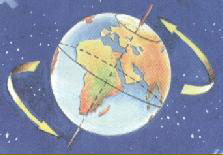
rotation toward one hemisphere or the other of a body rotating on its
own axis holds the answer.
Everyday
life offers us various examples of the nature and
practical effects of this law. Its description is not complicated. Let’s think about it:
What would happen if we started spinning around with our arms outstretched
while holding an encyclopedia in one hand? Wouldn’t the arm holding the weight fall in
the direction dictated by the weight it’s holding? I mean, just take a globe,
place it on the table, and stop to observe this example of the
encyclopedia in one hand alongside the phenomenon of the concentration of the continents in
one hemisphere. Isn’t the entire continental mass clustered in one hemisphere? The
other hemisphere is occupied by the waters of the Pacific. We already have the
encyclopedia in one arm of the Earth—what effect will we see if we now
take the globe and start spinning it on its axis?
This
effect of the rotation angle tilting toward the overloaded hemisphere is
precisely what God intended when He concentrated the pentacontinental mass in one hemisphere. The resulting effect was a fixed rotation
angle.
The need to stabilize the Biospheric
Interrelation Plane was a necessity of the highest order.
The
creation of a stable thermodynamic platform is a necessity of
evolution.
Thanks
to the pentacontinental concentration within a
hemisphere of the planet, God ensured that the area of incidence that the globe
presents to solar energy would always remain the same.
Thanks
to this optical constancy, the growth curve of biospheric temperature—and
therefore of the melting of the polar ice caps—would remain at a
stable rate throughout all geological eras.
Theory
of Geophysical Rings
I
have stated that by stabilizing the Globe’s angle of rotation through the
displacement of continental mass across a hemisphere, God achieved a
constant angle of incidence of sunlight on the geographic poles. From this
effect, He hoped to achieve the gradual thawing that would grant the
evolution of the tree of species the time necessary to be carried out
to completion. And I have emphasized that, of course, this architectural version clashes
with the famous hypothesis of continental drift. Continental drift cannot
explain the constancy of the angle of rotation; and what is worse,
it contradicts its very existence.
Moving
beyond convoluted discussions, and based on the materialization of the mathematics
of the Autonomous Ecospheric Substrate, let us say that the geophysical architecture to
which God gave His approval configures a structure in which the lithosphere
functions as a solid ring rotating on a liquid, magmatic ring.
The
magmatic ring, or Mantle, in turn floats atop a chromospheric ring. And at the
center, the microstar—the Core— sways within the gravitational currents that
serve as its orbit.
Within
this configuration, the fact that the temperature of the
Core’s surface is equal to that of the Sun is no coincidence. Nor is it a coincidence that, by
maintaining a constant lithospheric temperature, the oceans behave like the
river water that a nuclear reactor needs to keep its temperature in
equilibrium.
Theory
of the Volcanological Floating System
On
the first Day, our Creator doubled the energy density per cubic
astrophysical unit of the Earth’s gravitational field. The Core’s response, at that
moment in a cold state, was to activate and proceed to transform that
supply into heat.
Immediately,
the Mantle liquefies and the Primary Crust melts. Once these processes are complete, the
Core cools again, causing the Crust to solidify and transform
into the geophysical ring we call the Lithosphere.
Once
within the Sun’s sphere of influence, the geonuclear transformer reactivates
and reaches a constant temperature, equal to the external temperature of the star
around which it orbits. I believe it is about six thousand degrees Celsius. This
integration into the Solar System halted the solidification of the mantle and at the same
time maintained the solidity of the lithospheric ring, which has since rotated with
its own motion over the magmatic ring. Roughly speaking.
Constant
heat production by the Core compels physics to postulate, between the Mantle and
the Core, a sort of chromospheric zone, within which the
Core itself oscillates, causing this oscillation—subject
to the gravitational variations I mentioned earlier—to result in the flattening of the
poles that the Globe exhibits.
It is this
geophysical structure that leads us to ask the following question: How
does the Earth release the internal heat stored within the lithospheric
ring? The answer calls for facts rather than theories, and well, although we are
talking about a lithosphere with a fixed angle of rotation over a magmatic
surface, its body is equipped with a complex system of flotation tubes
through which geonuclear heat is continuously released. To speak of
volcanoes is to speak of the entire seismological dynamic that accompanies the creation
of this geophysical architecture, impressive in its manifestation and perfect in
its execution.
Law
of Systemological Motion
This
autonomous geophysical system, the source of so many headaches, is
complemented by a planetary structure that is sui generis, unique, and overwhelmingly
marvelous. But I want to start with a law: Every astrophysical system is a
transformer of universal energy into light and heat , andits operating speed will depend on the
gravitational density of its field. That’s one point.
On the
other hand, it is fair to say that the sidereal velocity of a system—be it
a constellation or a galaxy—is a constant derived from the forces of the
astrophysical region to which that system belongs. In other words, if the Solar
System did not interact with the universe of constellations, its
cruising speed would depend exclusively on the amount of energy in its
gravitational field. Subjecting the Solar System to the law of gravitational attraction
between celestial bodies, the law itself tells us that as the
distance between the constellations, the cruising speed of
the stellar systems that compose them must logically increase. From this universal effect,
we can infer that if the speed of the central star—
upon whose speed the smaller bodies of a system depend—accelerates, all bodies
dependent on its physical
Dynamic
Structure of the Solar System
The
answer to the puzzle presented in the previous section—namely, what kind of
automatic brake keeps the Solar System’s cruising speed constant
in defiance of the law of gravity, which dictates the need for constant acceleration
due to the decreasing distances between the Sun and any
point it approaches? I mean, we are—or have been—accustomed to
working with a “photo finish” of the Solar System. Here it is:
When
it comes to matching reality, this snapshot of a Solar System
frozen in time is the exact opposite of the physics of a Solar System that
moves among stars just a few light-years away and with which it clearly forms anopen star cluster. Here is the Solar
System open to the members of its cluster:
The
answer to why the Solar System’s velocity escapes the realm of the law
of gravity—by whose force the entire universe is governed—must be an
unequivocal, simple, and logical answer. And it must be placed in its true
context. We must pinpoint the nature of the problem it embodies. Define which law
it invokes. Make room and sketch on the screen of our minds the
nature of the question to which we seek an answer.
There comes
a point when the experts must step in, for they are the ones
who possess the database whose analysis can demonstrate or
refute, if applicable, the Sun’s integration into a star cluster—more or
less open and more or less populous—based on the gravitational architecture
that this data reveals.
My
own reasoning leads me to define the transformation of planetary mass
into a Solar Orbit Correction Mechanism, through which the centrifugal force
to which the Sun is subjected by the regional cluster gravitational field iscanceled out, leaving it subject to a specific
constant.
“We need only transform the total mass
of the planetary family into drag mass, and we already have the stabilizing brake
for the Sun’s cruising speed.” This transformation focuses
its weight on the Solar Orbit Correction Equation, whereby the centrifugal force
to which the Sun is subjected is overcome through the transformation of the
planetary mass into Directional Control via Remote Mechanism.
We have
the System in which we are going to cultivate the Tree of Life.
We know
for certain that from the time we plant it until it bears fruit,
millions of natural years must pass. We also know that the development of Life
requires that Nature maintain its Structure under conditions that are
inherent to it. This means that we must prevent external cosmological factors from interfering
with the evolutionary process. This compels us to protect the
Biospheric System in such a way that, while remaining within a Universe, the
existence of that Universe does not create a
lethal interference for it.
How
can we do this?
The Sun’s own cruising speed, and its
subjection to the law of Gravity, dictate that as time passes, that speed
must increase—which is precisely what we do not want. And
consequently, this compels us to equip the Solar System with a safety brake that
activates automatically in response to an increase in its speed.
That is the goal. Let’s see what practical solutions our Creator found.
The
first practical solution was logical: to load the solar spacecraft in such a way that the
gravitational acceleration is counteracted by the work of orbital motion, forcing
the spacecraft to transform that exogenous acceleration into the force necessary to
perform the work of orbital motion.
In
this practical way, the solar spacecraft maintains its constant cruising speed,
while overcoming the inertial tendency to increase its speed as it approaches
its stellar neighbors.
But
let’s apply this concept to the road. Imagine we have a car loaded with
fuel. The amount of time the car will spend on the road
will depend not only on its speed but also on the weight of the
load. If we fill the trunk to capacity, we reduce the operating time that
the fuel tank can provide. We’ll call this type of brake “exogenous.”
But
now let’s imagine an even more sophisticated type of exogenous brake. Let’s imagine that as
the vehicle travels a greater distance, the load in the trunk
multiplies in weight. Wouldn’t there come a point when the vehicle would be
slowed to a stop, crushed under the weight acquired by this exogenous brake? The question
is: Is the Sun equipped with this type of exogenous brake, such that the weight
of the planets is multiplied by the potential energy acquired over the
elapsed time? And conversely, isn’t it by this law of the increase in
potential energy and its transformation into weight that the Sun’s tendency
to disregard the Law of Gravity is curbed?
The
Planetary Alignment—whether total or partial, multiple or simple—acts as an
arm, and its effect on the Sun is that of an arm against a lever. The systemological equation states that the Sun’s acceleration is slowed by
the regulatory program into which God transformed the planetary alignment. The
planets transform the weight of the single body into which the Alignment
turns them into force; and, since every force, by its very nature, performs
work, the work they perform is to bring about the angle of rotation we
were discussing and to keep it constant. This, in effect, is the flywheel we
were looking for.
As
for the physical-mathematical description of this starship guided by
remote control in autonomous flight within the constellations of the Heavens,
I leave that to someone more expert in numbers, unknowns, and other
complex equations. Always highlighting both partial and total planetary alignments
within the framework of Applied Astrophysical Systemology,
, the former acting as a counterbalance to speed, and the latter
as the shift of the System’s nose toward the hemisphere from which
the loading takes place. In short, before sowing beneath the waters of the great
ocean the seed of the tree of species, there were many equations that
God had to solve.
In conclusion:
Everything remains to be resolved at the level of final
data. Ideas are the prelude to research. And in this context,
I have sought to refine my initial idea regarding the relationship between the planets and the
Sun within a shared gravitational field, the influence of which the Sun
overcomes through the overall planetary mass corresponding to its system.
This
leads us, ultimately, to a structure of astrophysical engineering so
perfect that to leave it to chaos is, plain and simple, absurd.
The
objective and goal of the creation of the Heavens and the Earth—Man at the end
of the tunnel of time—God mapped out the general architecture of the Heavens and the
specific architecture of the Earth with the millions of years in mind that the Birth and
Growth of the Tree of Life required to bear fruit. Because He could and knew
do so, God created a blueprint for the relationship between the elements of the Biosphere, with
two main heating and cooling centers at the extremes of the Ecosphere, and
specific centers distributed across the continents—the mountain ranges of
perpetual snow. How atmospheric and
oceanic currents are recycled from the polar foci and keep the biospheric thermometer stable is a feat of geophysical engineering as marvelous as it is surprising, one that
involved the morphology of the lithosphere itself.
Because
it had to keep the ecospheric thermometer stable, it had to endow the Ecosphere
with a constant angle of rotation. And, because it could and knew how, it created the
Autonomous Ecospheric Substrate, thanks to which, as I have already said, the angle of incidence
of solar energy would remain constant during the millions of years that the
Tree of Life would need to bear fruit.
But
there was even more, because the Solar System is not isolated from the rest of
Creation, and since it is in motion and subject to the general laws of the Universe,
this interrelation was bound to cause interference that could ruin the
work of so many millions of years. Because He could and knew how, God did not hesitate to
deploy His intelligence and endow the Solar System with a mechanism for
remotely controlling its sidereal velocity, which I have called Applied Astrophysical Systemology. And yet all this was not enough.
In
fact, the celestial structure we observe in our immediate surroundings
exhibits very characteristic features. Ultimately, the whole resolves itself
into a constellational architecture defending the
astrophysical heart, from whose center its special
optical configuration is determined. For just as we can observe with our telescopic eyes, the
universe is traversed by powerful gravitational currents displacing
large masses of clouds back and forth—the origin of nebulae. Thus,
when God reveals to us that “He created the stars of the firmament to separate
light from darkness,” He tells us a great deal about how the Solar System would be affected
by the Earth’s passage through one of those nebular currents. At the same time, He
reveals to us the nature of the constellational shields.
The
Biblical text is crystal clear. “God created the stars to separate
light from darkness.”
On
the First Day, we are told that God created the Light and separated it from the Darkness.
On
this Fourth Day of the First Week of Human History, having separated
the Light from the Darkness, God created the Stars to separate the Light from the
Darkness.
The
text could not be more direct. That the conclusions drawn from it are
fascinating and—though marvelous—completely at odds with the mindset of the
20th century means nothing. Modern man’s opinion on the nature of the
universe does not matter. It was not with modern man in mind that God composed His
Revelation to Moses. Whoever did not matter to God cannot matter to His
children either. The conclusions they reached are of no interest to this book, nor are their
opinions to the author. So let us move forward.
The
structure of the Universe of Revelation and its resolution in the mirror of
Reality gives us, by definition, the following. Namely:
The
Universe of Genesis is the Milky Way. And it is regarding the Creation of this
Milky Way: “God created the Heavens to separate the Earth from the realm of the
Galaxies.”
A
physical necessity inferred from the study of the heavens, whose phenomena reveal that
beyond the heavens lie the powerful currents and winds that sweep through the
cosmos. There, the astronomical images speak with the power of a thousand
words per photograph. Their beauty, however, must not cloud the clarity of
our understanding when interpreting the events that are their
cause. The physical function fulfilled by the star clusters that surround us is that
of a net that traps everything the current carries along and blocks the
from entering the constellation system around which they are distributed. Let us now ground in scientific principles
the divine declaration that the Heavens were created to erect a protective wall between
Earth and the world of the galaxies.
The
description of General Cosmological Space that we have inherited paints a picture of a
Universe-Galaxy that moves and interacts with other bodies through
general laws. This fits perfectly with the expansion to
infinity of Matter suggested by the Idea of Creation.
The
need to understand why God created the Heavens to protect the Earth
from the General Cosmic Movement implies the answer to the relationship between God and
that multiplication of Matter to infinity. And the answer to this
question leads us directly to that other question which the genius of the 20th century
sought to answer with his cosmological theory, namely: Before the beginning,
what?
A question
that in turn leads us directly to ask what part God played in that
Beginning of beginnings and what became of Him before this General Cosmic
Beginning. This matter compels us to enter the realm of theology while always maintaining the
scientific attitude that I have upheld thus far as the language of
understanding between the Creator and His Creation, Man.
In
Before Creation there was Non-Creation, and before the Creator there was God. Between Non-Creation
and Creation, a cosmological revolution took place.
When
and how this cosmological revolution took place, I have touched upon it in THE DIVINE HISTORY
OF JESUS CHRIST. There I delved into the subject of the History of the Uncreation and
elaborated on its major moments. I seem to recall saying that the Creator came
into being because Intelligence was in God. More or less what I meant to say is
that if Intelligence without Power is not sufficient to transform Reality,
neither does Power without Intelligence possess that faculty. I recall having mentioned that
uncreated relationship when speaking of the Childhood of the Divine Being. And this Childhood, from
the perspective of the revolution that led God to become the Origin of all
things. In relation to this process, He spoke of Himself, saying that He was
formed. A process of formation that can only be understood as having taken place within
the Nature of His Intelligence. And
once the Creator was formed within God, the revolution was consummated that would
make God, the Infinite, and Eternity one and the same.
From
this ontological revolution that integrated God, Space, Time, and Matter arises
the concept of the General Cosmological Principle—that is, the event that
marked a “Before” and an “After.” With this in mind, God transformed Reality
starting from the very structure of Reality itself. That is to say, there was the destruction of
a previous cosmos and the transformation of that cosmos into a new one, which, like everything
that begins, originated from an event or General Cosmological Principle.
General
Cosmological Principle that irreversibly marked the “Before” and the “After.” The
question is how God brought this Principle into being, of which the beginning of our
Universe in particular is a fragment of the historical sequence set in
motion by that Event.
The
answer to this question requires discussing the fundamental laws of the
Movement of Multiplication of Cosmic Matter that have been at work since
Eternity. However, unlike the Uncreated Cosmos, which involved the Infinite
in that Multiplication, since the Movement had its Origin in God, this Movement
was revolutionized and carried out by fields that transform matter into
cosmic energy and this cosmic energy into astrophysical matter.
God
revolutionized this process by creating a space-time accelerator in which the
flight of the fundamental matter of the cosmos maintains its acceleration
regardless of mass; when this river of cosmic energy reaches the
center—that is, the mouth of the hourglass—the beam leaps to the other side
through the explosion at the origin of the stars. This is the phenomenon I
call Astrophysical Implosion, a phenomenon that marks the birth of galaxies and
stars.
Since
a single celestial body can give rise to an unlimited number of beams of
cosmic energy, the reproduction of matter to infinity is a reality
that stems from Eternity. What distinguishes this multiplication to
infinity is that previously it required Infinity as a pathway for transformation, and now
that same process is reproduced across fields of spacetime unfolded by
God at the frontiers of the Cosmos.
This
makes the Cosmos a more massive entity and provides General Space with a higher
density of matter, which is why the Cosmos has amazed us with new
galactic creatures ever since the day the Hubble opened its eyes.
Creation is continuous, and its expansion
is constant.
This
process of the multiplication of cosmic matter from a General
Cosmological Principle can be compared to a never-ending chain reaction that
amplifies its radius of action and extent as time progresses, expanding from the center
toward the frontiers. Our telescopic eyes allow us to admire the
movement of galaxies within this General Cosmic Space in constant
expansion. And it also allows us to apply the laws of gravity to galactic
bodies, whose interaction we observe as they attract and accumulate; a classical law
to which we must add the law of electrodynamic forces, thanks to
which the concentration of total mass at a single point is a physical impossibility to
achieve. This is the extraordinary reason why the motion of the atoms of a
inside a container corresponds to the General
Cosmological Motion.
The
General Cosmological Space
The
creation of galaxies as an autonomous phenomenon, set in motion by God through the
constant feeding of the field that transforms cosmic energy into
astrophysical matter, leads us directly to discover the Cosmos as a field of
raw material from which God extracts the matter necessary to build His Works.
Our Universe is one of them. It was not the first, nor will it be
the last. God’s word on this matter is firm: “Truly, truly, I
tell you that the Son can do nothing on His own, but only what He sees the
Father doing; for whatever the Father does, the Son does likewise. For the Father loves
the Son and shows Him everything He does, and He will show Him even greater works than
these, so that you may be amazed.” The theological
implications could not be clearer.
But
why doesn’t a beam of cosmic energy expand to infinity once it has surpassed the
speed-of-light limit?
The
answer lies in experience. The leap toward infinity collides with the critical
point of growth—or the Astrophysical Implosion Point—beyond which the
stellar body transforms the energy it absorbs into astrophysical forces. By
this Uncreated Cosmological Law, even ifthe
matter-energy system had free rein, the very dynamic weight of the
creative process leads it to a point where the transformation into mass gives way to
the transformation into light.
The
General Cosmological Movement
Here
it is worth noting that the Idea of the Universe preceded the Universe itself. This is not
a matter of dogmatizing or philosophizing. That is not my intention. It is simply a matter of
bringing to light a reality as natural as the fact that a site survey is
necessary before constructing any engineering project. And since God
knows the laws of His Creation, its dimensions, its phenomenology, and its
nature, it is logical and natural that when He plans to build a Structure, He draws lines
and make calculations, taking into account the influence of the terrain on the future of the
structure—in this case, an astrophysical one. Better than I can describe this
process of study and reflection preceding the Act of Creation is God Himself, who
inspired Solomon with these words about His Wisdom:
“Yahweh
possessed me at the beginning of His ways, before His works, from of old. From
eternity I was established; from the beginning, before the earth came into being.
Before the abysses, I was brought forth; before the springs of
abundant waters came into being; before the mountains were set in place, before the
hills, I was conceived. Before He made the earth, or the fields, or the
very dust of the earth. When He established the heavens; when He drew a circle
upon the face of the Abyss. When He condensed the clouds on high, when He gave
strength to the springs of the Abyss. When He set the sea’s boundaries so that the
waters would not overstep their limits. When He laid the foundations of the earth,
I was with Him as an architect, always being His
delight; taking pleasure before Him at all times.”
With the
Idea in Mind, all calculations resolved, God sets His hand to the Work. In the
case of the Heavens, the first thing He did—according to Solomon—was “to draw a circle
upon the face of the Abyss.” That is, to mark out the territory, to delineate the perimeter
within whose diameters He would create a New Universe.
The
galaxies generate powerful currents and
winds in General Cosmic Space. These move and follow the directions set by the
galaxies themselves. But we are not speaking only of nebular matter.
Let us transform
the galaxies into cannons that generate cosmic energy. As they generate it, they
fire it into General Cosmic Space
Our
Universe-Galaxy, the Milky Way, relates to the rest of Creation
according to the parameters of this General Cosmological Movement. Viewed from the
outside, our universe behaves like the mountain upon which the
cosmos unloads its clouds. The origin of nebulae lies in this interplay of forces,
in light of which—and considering its dimensions—God endowed our Universe
with its own.
Astrophysical
Engineering of Creation
The
Creative Intelligence involved itself in the interplay of
actions and reactions by creating a universe designed to withstand the weight of
cosmological currents. In other words, God erected the universal edifice
equipped with all the physical mechanisms necessary to overcome the
consequences of the seismic upheaval caused by His own creation. God also knows
that, like soldiers who fall on the front lines of battle, many celestial bodies
outside our Universe succumb to the force of
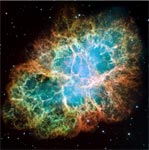
intergalactic currents. What we call novas and supernovae are those warriors
who have fallen in battle and disintegrate in spectacular explosions, which in turn
give rise to the comets and meteorites that traverse the heavens.
In conclusion:
God structured the distribution of constellations around the Solar System, simulating a crystalline gravitational network against
whose solidity the danger of interrupting the Evolution of the Tree
of Life on Earth is shattered.
The
marvelous positive results visible in reality must not cloud the
eyes of our intellect when it comes to seeing that, in accordance with astronomical dimensions,
God traced that Circle upon the Face of the Abyss of which Solomon spoke to us
in his Wisdom. What the wise and peaceful king par excellence saw
with the eyes of his Wisdom, we, thank God, see with the eyes of
our own faces. Clusters and superclusters in the outer belt, and open clusters
and multiple systems in the inner belt, combine to form this crystalline gravitational constellational network about which there is still so much to say.
Let us begin by unraveling the mystery of the Origin of the Heavens.
Origin
and Constitution of the Universe
We now turn
to one of the great questions: the origin of the stars in the firmament. I
believe the answer has already been outlined in the preceding sections. The
formation of stars—as the very purpose of the existence of
galaxies—all leads to the transformation of the Cosmos into a field of raw
material from which God extracts the matter with which to create His Works.
Given the
constant creation of galaxies, the total mass of raw material that the cosmic field
places at God’s disposal to carry out any Work is limitless.
How God extracts that stellar matter and transports it from its
regions of origin to the Universe is another matter. Knowing that the way of doing
things always depends on the Power of the One who makes them, and that the imagination to
create things is directly related to the Intelligence of the One who sets out
to make them, we can speak of great rivers flowing across the
intergalactic plains—and, in short, as the Lord of the Galaxies deems best and in accordance with His
working needs.
The
beginning and end of human intelligence is admiration; it arises from
admiration for Creation and culminates in admiration for its Creator. Everything
else that is said stems from that seed which was not within Man and was
sown into his being by a force foreign to God’s Creation, which is
a matter for theology. In any case, the great question of Origin leads us
directly to the other great question: the Constitution of the Universe.
From
what we have read so far, it follows that the Universe and the Cosmos are two
different things. Together, these two things form God’s Creation, and within it,
the Cosmos is one thing and the Universe is another. The Cosmos is the field of
raw material that God uses, and with the freedom befitting the Lord, He takes
all the materials necessary to carry out His Works. As for the
Universe, the Universe is the stellar field where God carries out these
Works. When Moses speaks to us of the Creation of the Universe, he was
referring to this stellar field. Its Origin, as we have seen, lies in that
cosmological field from which God draws rivers of stars that traverse the
intergalactic plains and flow into this universal ocean, in whose
waters the Tree of Life took root. There is
much to say about the Tree of Life, especially at this stage of its History. However, not everything has been said
about the Constitution of the Universe.
Epilogue
Obviously,
Moses speaks in his Account of the Creation of our Heavens. And in doing so, he
sets before us a Reality: God is the Creator. A Reality that leads us to
another reality: Eternity—that Eternity which implies Infinity.
Realities
of which the human race is the fruit—but not the only one—of that Tree of
Life to which the God of Infinity and Eternity gave the Universe as
a field of Origin and Growth. This final conclusion brings us back to
the revelation of the Son of this Creator and Lord of the Cosmos and the Universe:
“The
Father shows the Son everything He does, and He will show Him works greater than these,
so that you may be amazed.”
By using
the plural when speaking of the Past as a reflection of the Future, the Son of
God reveals to us that our Heavens and our Earth—in short, that the Human Race
is not the first Harvest that the Tree of Life has yielded.
This
statement resolves the dilemma regarding life in the Universe. Man is not the first
nor will he be the last Fruit of this Tree. Before Man, other
worlds were already created, and after Man, new worlds will spring from the branches of the Tree of
Life.
“The
children of God” of whom the Bible speaks are the fruit of those Works. As for the
regions of origin in the Universe of such “children of God,” there is no need to
speculate. The fact is that knowledge of their existence leads us to a new
way of conceiving the Constitution of the Heavens and of the Universe in general.
Having
created the Cosmos as a region that produces Galaxies—and since these are factories of
stars—God turns His thoughts to Life and conceives a stellar ocean that will grow
continuously, and beneath whose Waters Life will take root, spread its
Tree, and bear its Fruit.
Thus,
God initiates the Beginning of the origins of the Worlds by directing rivers of
stars from all parts of the cosmic expanse, which flow from their sources
in the galactic mountain ranges across the cosmological plains and empty into a
specific space, where they create an Ocean of stars, the foundation of a New
Universe.
A Universe
that is initially amorphous and somewhat wild, in which clusters and
superclusters come together and drift apart, and stellar currents move
subject to the forces at work within this Ocean of stars
that have surged onto the shores of the Universe.
But
the purpose of this movement is to sow Life and reap its Fruit. Thus,
during each Act, the Creator extends His Hand over a Zone of His Universe and
shapes it, sculpts it, identifies it, endows it with properties, giving form to
the amorphous, making identifiable that which had no identity of its own.
Within this continuous Process of Creation and
as a result of this movement, our Heavens were born. The fundamental question—
whether the Heavens of our Firmament were created to remain or to be
swept away from space like a sandcastle when the tide rises—has a
definitive, final answer.
I believe
that in His Book, God casually planted the expression: “the
heavens of the heavens,” where He identifies His Universe with heavens that are the dwelling place of
many worlds, each of these in the image and likeness of ours, the cradle and
origin of other worlds that were and others that will be, each with its own
unique region.
This
aspect leads us to another question: navigation through the Universe.
The
tendency toward infinite growth that God has given the Universe
presupposes and implies the need for a universal cosmography that allows for
internal navigation through the remote identification of the regions that
compose it. God is free and powerful to do as the tide does to a
sandcastle, but He did not conceive the Universe that way. He could have compiled in
a book the History and Celestial Constitution of each World, but in His Mind
what He conceived was that this History and Constitution would remain eternally,
with the Heavens becoming the letters of that universal Book where each Chapter
deals with the Creation of a World and its contents. Are not the lines along
which the stars are arranged to write this message to the human creature
beautiful: Infinity + Eternity = God? ..
|
|
 |
 |
 |