 |
 |
 |
 |
 |
 |
 |
 |
THE PORTUGUESE IN SOUTH AFRICA FROM 1505 TO 1700.CHAPTER XV.KNOWLEDGE DERIVED FROM SHIPWRECKS.
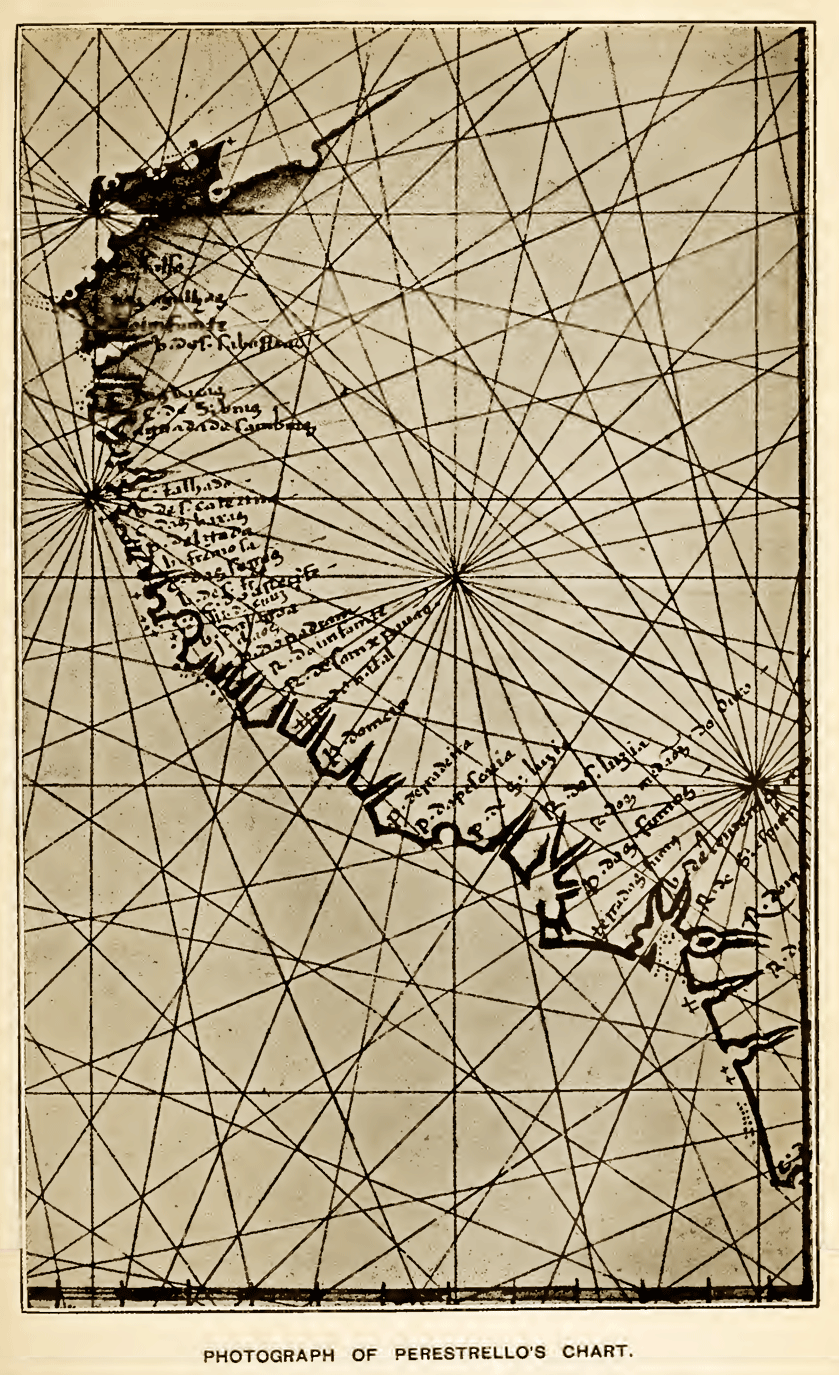
On the Bantu tribes along the seaboard north of the Umzimvubu a good deal of knowledge was obtained during the sixteenth century by the crews of wrecked ships, some of whom underwent almost incredible suffering before their restoration to the society of civilised men. By order of King Sebastiao a flying survey of the coast between the Cape of Good Hope and Cape Correntes was also made during the years 1575 and 1576, by which much information was supposed to have been gained. Occasionally vessels disappeared after leaving Portugal or India, and were never heard of again. Some of these were probably lost on the African shore, though of this there is no certainty except in one instance, when part of a stranded ship was found at the mouth of the river now known as the Saint Lucia, but without a trace of any one that had sailed in her. Particulars, however, have been preserved of the loss successively of the Sao Joao, the Sao Bento, the Santiago, the Sao Thomé, and the Santo Alberto, from each of which some of the crew escaped, and after much intercourse with Bantu succeeded in reaching Mozambique. The Sao Joao was a great galleon laden with a very valuable cargo, which left Cochin on the 3rd of February 1552 to return to Portugal. She had about two hundred and twenty Portuguese and nearly four hundred slaves on oard, and, as was usual at that time, an officer of high rank who was going home was captain in command. The master of the ship directed the working, and the pilot pointed out the course, but the captain gave instructions in such matters as what ports they were to put into and when they were to sail ; he also preserved discipline and exercised general control. The captain of the Sao Joao — Manuel de Sousa Sepulveda by name — was accompanied by his wife, Dona Leonor, a young and amiable lady of noble blood, his two little sons, and a large train of attendants and slaves, male and female. On the 12th of May, when only a hundred and twenty kilometres from the Cape of Good Hope, the galleon encountered a violent gale from the west-north-west, and soon a very heavy sea was running, as is usually the case when the wind and the Agulhas current oppose each other. Some sails had been lost in a storm on the equator, and there were no others on board than those in use, which were old and worn. On this account it was not considered prudent to attempt to lie to, and so the ship was put before the wind under her fore and main courses. After some days the gale veered to another quarter, shifting at last to the west-south- west, when the tremendous seas caused the ship to labour so heavily that she lost her masts and rudder. Those on board feared every moment that she would go down. An attempt was made, however, to set up jury masts, to fix a new rudder, and with some cloth that was on board converted into a substitute for sails to endeavour to reach Mozambique. But the new rudder, being too small, proved useless, and the galleon like a helpless log was driven towards the coast, from which there were no means of keeping her. On the 8th of June she was close to the land a little to the eastward of the mouth of the Umzimvubu, very near if not exactly off the spot where the English ship Grosvenor was lost two hundred and thirty years later. There, as the weather had moderated, the bower anchors were dropped, between which the galleon lay at a distance of two crossbow shots from the shore, almost waterlogged. The captain now resolved to land the people and as much provisions and other necessaries as possible, to construct a temporary fort, and with materials taken from the ship to build a small caravel that could be sent to Sofala for aid. There was no hope of saving the cargo, but he thought of getting out some calico with which to obtain food in barter from the inhabitants of the country, if that should be needed. Only two boats were left, of which one was little larger than a skiff. In these the captain, his family, and about seventy others were conveyed to the shore. But on the third day the wind freshened and caused a heavy swell, both the boats were dashed to pieces on the rocks, and the seaward cable of the galleon parting, she was driven on shore and within a few hours broke into fragments. Over a hundred men and women were lost in the surf, and many of those who reached the land alive were badly bruised. All hope of getting timber to build a caravel was now lost, and only a small quantity of food was secured. As soon therefore as the bruised people were sufficiently recovered to travel, the whole party set out to try to walk along the shore to the river of Lourenco Marques. To that place a small vessel was sent nearly every year from Mozambique to barter ivory, and the only faint chance of preserving their lives that remained to the shipwrecked people was to reach the river and find the trading party. They had seen some Kaffirs on the hills close by, and had heard those barbarians shouting to each other, but had not been able to obtain any information or provisions from them. On the 7th of July they left the scene of the wreck. At the end of a month they were only a hundred and forty-four kilometres from it, for they had been obliged to make many detours in order to cross the rivers. Their sufferings from thirst were at times greater than from cold, hunger, and weariness combined. Of all the party Dona Leonor was the most cheerful, bidding the others take heart, and talking of the better days that were to come. They eked out their little supply of food with wild plants, oysters, and mussels, and sometimes they found quite an abundance of fish in pools among the rocks at low tide. And now every day two or three fell behind exhausted, and perished. To add to their troubles, bands of Kaffirs hovered about them, and on several occasions they were attacked, though as they had a few firelocks and some ammunition, they were easily able to drive their assailants back. At the end of three months those who were in advance reached the territory of the old Inyaka, whom Lourenco Marques and Antonio Caldeira had named Garcia de Sá, and whose principal kraal was on the right bank of the Umfusi river, which flows into Delagoa Bay. This chief received them in a friendly manner, supplied them with food and lodging, and sent his men to search for those who were straggling on behind. In return, he asked for assistance against a chief living about thirty-two kilometres to the southward, with whom he was at war. De Sousa sent an officer and twenty men to help him, with whose aid he won a victory and got possession of all his opponent's cattle. Garcia de Sá wished the white people to remain with him, and he warned them against a tribe that lived in front, but as soon as they were well rested and had recovered their strength, they resolved to push on. They crossed the Maputa in canoes furnished by the friendly chief, and five days later reached the Espirito Santo, where they learned from some of the inhabitants, through the interpretation of a female slave from Sofa! a who had picked up a little of the dialect, that a vessel from Mozambique, having men like themselves on board, had been there, but was then a long time gone. Manuel de Sousa now became partly demented, and his brave wife, Dona Leonor, who had borne all the hardships of the journey so cheerfulby, was plunged by this new misfortune into the greatest distress. 1552] Wreck of the Sao Joao. With what object is not stated, but for some reason they still pressed on northward. They were reduced to one hundred and twenty souls, all told, when they crossed the Espirito Santo or river of Lourenço Marques in canoes supplied by the inhabitants at the price of a few nails, and entered the territory of the chief of whom Garcia de Sá had warned them. His kraal was about five kilometres farther on. He professed to receive them with favour, and for a few days supplied them with provisions, but at length informed them that they must entrust him with the care of their arms while they were in his country, as that was one of his laws. Dona Leonor objected to this, but the males of the party complied with the chief's demand, in the belief that by doing so they would secure his friendship. As soon as they were in a defenceless condition he caused them to be separated, under pretence of distributing them among different kraals where they would be provided with food, but kept the captain with his family and about twenty others at his own residence. Those who dispersed were immediately stripped of their clothing and driven away to perish. Then the captain was robbed of a quantity of precious stones — worth several thousand pounds — as well as some gold that he had with him, and he and his family and attendants were ordered to leave the kraal. They wandered about for two days, without meeting any of their late associates in misery, when some of the inhabitants fell upon them and stripped them naked. Dona Leonor, who fought like a tigress while the barbarians were tearing her garments from her, sat down on the ground with her two little boys, her half demented husband, and a few faithful female slaves beside her. The white men of the party, who could do nothing to relieve such anguish as hers, went on in search of wild plants with which to prolong their lives. Shortly afterwards one of the boys died of hunger, when the father scraped a hole in the sand and buried the body. The next day he went to seek some roots or berries for his starving wife, and on his return found her and the other child dead and the slave women wailing loudly. They buried the mother and child in the sand, after which the sorely afflicted nobleman disappeared in a thicket, and was never seen again. Eight Portuguese, fourteen male slaves, and three of the female slaves who were with Dona Leonor when she died, managed to preserve their lives. Some of them wandered to a distance of eighty kilometres from the scene of the last disaster. At length a trading vessel put into the bay in search of ivory, and her captain, hearing of the unfortunate people, rescued them by offering for each a trifling reward in beads. They reached Mozambique on the 25th of May 1553. Diogo de Mesquita, who was then captain of that island and the stations south of the Zambesi, sent a little vessel to search along the coast, but no trace of any of the lost people could be found. It is this tragic occurrence to which Luis de Camoes alludes in the fifth canto of the Lusiads, verses 46 to 48 : 46 Another too shall come of honoured fame, Liberal and generous and with heart enchained, And with him he shall bring a lovely dame, Whom through Love's favouring grace he shall have gained ; Sad fate, dark fortune nought can e'er reclaim, Call them to this my realm, where rage unreined Shall leave them after cruel wreck alive, With labours insupportable to strive. 47. Their children shall die starving in their sight, Who were in such affection bred and born ; They shall behold by Caffres' grasping might Her clothing from the lovely lady torn ; Shall see her form, so beautiful and white, To heat, cold, wind, exposed, and all forlorn, When she has trod o'er leagues and leagues of land With tender feet upon the burning sand. 48. And more those eyes shall witness, which survive, Of so much evil and so much mischance ; Shall see the two sad lovers, just alive, Into the dense unpitying woods advance ; There, where the hearts of very stones they rive With tears of grief and anguished sufferance, In fond embrace their souls they shall set free From the fair prison of such misery.. 1554] Wreck of the Sao Bento The Sao Bento was one of a fleet of five ships sent by King Joao the third to India in March 1553. Among those who sailed in her on her outward passage was Luis de Cam5es, whose name still lives as that of the prince of Portuguese poets. She was one of the largest vessels of her time, and was commanded by Fernao Alvares Cabral, who was commodore of the squadron. Having reached her destination in safety, she took in a return cargo, and sailed from Cochin on the 1st of February 1554. On the passage stormy weather with a very heavy sea was encountered, in which the ship sustained great damage, and when she reached the African coast it was feared every moment that she would go to the bottom. On the 21st of April she struck upon a rocky ledge on the western side of the mouth of the Umtata and in a few minutes broke into fragments. Forty-four Portuguese and over a hundred slaves lost their lives in trying to reach the shore, and two hundred and twenty-four slaves and ninety-nine Portuguese, many of them severely bruised, managed to get to land. Among the latter was Manuel de Castro, one of the few survivors of the crew of the Sao Joao, who died, however, a few hours later from injuries received during the breaking up of the ship. A small quantity of provisions was washed ashore with the debris of the cargo, but it was so much damaged with salt water that it could not long remain fit for use. After this was collected and a temporary shelter was made of carpets and silks, a general consultation took place as to what was best to be clone. Some thought it advisable to try to march overland to the watering place of Saldanha, but this was overruled by the majority, because of the fierce- ness of the people living in that direction, as had been proved by the slaughter of the viceroy D'Almeida and so man}r of his companions, and further because vessels very seldom called there and consequently, even if they should arrive with life, most probably all would perish before relief appeared. Others were of opinion that they should remain where they were and endeavour to construct some kind of craft that could be sent to Sofala for aid, but this too was overruled, as the supply of food would soon be exhausted and they had no proper materials for building a boat. There was then but one other plan. Before they left India Lourenço Marques was preparing for a voyage to the river which bore his name, in order to trade for ivory, and their only hope of life was to make their way northward and reach him before his departure, which would be some time in June, or, if that should fail, to push on to Sofala. Accordingly, on the 27th of April they set out, each one heavily laden with food, pieces of calico, and nails or other iron for barter. A ship's boy and a female slave, who were too severely hurt to live long, were of necessity left behind. They had seen a few naked savages at the place of the wreck, but there were no huts or any indications of kraals in the neighbourhood, so after crossing the river they directed their course inland, towards the north-east, in hope of finding people from whom they could obtain guides and provisions in exchange for iron. But for four days they were disappointed, and when on the fifth day of their march they came to a kraal of about twenty huts, its inhabitants were found to be living on wild roots and plants, so that no food was to be had from them. Finding the country almost uninhabited, a little later they resolved to turn towards the shore, where they could at least obtain shellfish, and where they believed the rivers could be more easily crossed than inland/ as all had bars of sand at their mouths. Before they reached the Umzimvubu several of the weakest of the party became utterly exhausted, and were abandoned on the way. The passage of this river was accomplished with the greatest difficulty, and on the following day, the thirteenth of the journey, the sea was reached at the place where the Sao Joao was lost. Some of her timbers were still to be seen, and in a deserted kraal in the neighbourhood pieces of chinaware and other articles used by Europeans were found. After this, keeping along the shore, they found a good supply of mussels and oysters, and considered the beach much better for travelling over than the rough mountains and valleys inland. The country was inhabited, but its people were hostile, bands of them constantly hovering about, ready to attack loiterers. Five days after leaving the Umzimvubu they reached the Umtamvuna, which they crossed on rafts, after a skirmish with the inhabitants. Four days later they were on the right bank of the Umzimkulu. Here the people were very friendly, singing and clapping their hands as they came forward to see the strangers, and bringing food to sell for little pieces of iron. It was the first they had been able to purchase since they set out on their journey twenty-two days before. Here was found a young man from Bengal who had been left behind by Manuel de Sousa's party, but as he could not speak Portu- guese he was of little or no service. He declined to leave the connections he had formed, and when Cabral went on two Portuguese and about thirty slaves remained with him and the friendly inhabitants. Three days march farther brought them to the Umkomanzi, which they crossed at a ford pointed out by some Kaffirs, whose friendship they requited by endeavouring to make prize of a large basket of millet. This brought on a skirmish, which ended, however, in their opponents being compelled to retire. At the Umkomanzi they were joined by a young man named Gaspar, a Moor by birth, who was left behind by Manuel de Sousa. He had acquired the language of the people among whom he had been living, but was glad of an opportunity to get away from the country, and so went on with them and made himself useful as an interpreter. At the end of another three days they were at a place which they called the mouth of the Pescaria, and which, from the description given, was in all probability the inlet on which the present city of Durban is situated. They were not the first white men, however, that saw it, for Manuel de Sousa had passed round its shores, and of his party a Portuguese named Rodrigo Tristao, a young man from Malabar, and two slaves were then living there. The inhabitants were very friendly, and brought such a quantity of provisions, including goats, to sell for iron, that they easily supplied themselves with as much as they could consume and carry away. Rodrigo Tristao went on with them, but the Indian and the slaves preferred to remain where they were. They were six days marching to the Tugela, which they termed the Saint Lucia, stopping on the journey only to purchase a cow and to take the needful rest, though they suffered greatly from thirst. The river was crossed on rafts, but the captain Fernao Alvares Cabral and another white man were overturned in the current and lost their lives. Francisco Pires, the boatswain, was then chosen to lead the party, and after resting a day they moved on. South of the Tugela they had suffered much from hunger, thirst, and fatigue, but they had managed to move forward about thirteen kilometres a day in a direct line, perhaps actually walking twenty-two or twenty-three. They were now entering a district much more difficult to travel in, owing to the swamps and sheets of shallow water that abounded in it, the want of shellfish on the sandy coast, and the poverty of the inhabitants, most of whom were hostile. Their iron for barter was nearly exhausted, and only on a very few occasions were they able to purchase a little food. One day's hardships resembled those of the next : struggling through marshes, fainting with hunger, skirmishing with Bantu, their number decreased rapidly. To such a condition were they reduced that some of them cooked and ate human flesh. At length, on the 7th of July fifty-six Portuguese and six slaves, reduced almost to skeletons and covered with rags, reached the kraal of the Inyaka, Garcia de Sa, on the south-eastern shore of Delagoa Bay. Here they were at first well received, but from the avidity with which the Portuguese ivory traders the year before had purchased the gold and jewels taken from Manuel de Sousa the chief had' learned how valuable these things were, and presently he required the unfortunate men to give him everything they had in exchange for food. When they had done this they found that there was at the time such a scanty supply of provisions in the country that the chief, with the best intentions, could not furnish sufficient to keep them alive, and thus they were little better off than before. From their faulty chart they believed the river of Lourenco Marques to be still eighteen leagues distant, but they were so destitute and exhausted that they could go no farther. Hunger, sickness, ravenous animals, and vermin had to be contended with, and to add to their distress the interpreter Gaspar, who had ingratiated himself with the chief, treated them with the utmost cruelty and scorn. Then they scattered about in different kraals, and were everywhere treated with such indignity and suffered such misery that the living envied those who died. At last, on the 3rd of November a sail appeared in the bay, to the inexpressible joy of the few who still survived. It was the trading vessel from Mozambique, commanded by Bastiao de Lemos, who received his almost expiring countrymen with every mark of kindness, and did what he could to restore them to health and vigour. From him they learned that the cause of Lourenco Marques not having visited that part of the coast during the preceding season was his having suffered shipwreck on the passage. Four months and a half the little vessel remained in the bay, her crew trading for ivory with the different chiefs in reach of their boats. On the 20th of March 1555 with the first westerly wind of the season she sailed for Mozambique, taking with her Rodrigo Tristao, of the Sao Joao, and twenty Portuguese and four slaves, of the Sao Bento. Of the three hundred and twenty individuals who set out from the mouth of the Umtata, all the others had either perished or were left behind at kraals on the line of march. A few years later Francisco Barreto, shortly after being governor-general of India, narrowly escaped shipwreck on the African coast. Upon the arrival of his successor, the viceroy Dom Constantino de Braganca, on the 20th of January 1559 he left Goa in the ship Aguia to return to Portugal. Very heavy weather was encountered off the southern shore, and the ship was so disabled that it was with difficulty she could be kept afloat. Barreto then resolved to get as far back towards Mozambique as possible, to keep close to the land on the way, and to run the hulk aground in the last extremity. Fortunately, however, he was not obliged to resort to this extreme measure, for the wind was favourable and the island was reached without further disaster. The Aguia was unladen and repaired at Mozambique, and on the 17th of November she set sail once more. She had not proceeded far when she again sprang a leak, and soon afterwards a westerly gale was encountered which lasted three days. The pilot, who was a veteran in the service, declared that such an occurrence at that time of the year had never been known before, and as all on board looked upon it as a warning from God not to persevere in the voyage, the ship's head was again turned towards Mozambique. Barreto now abandoned the Aguia and proceeded to India in a little vessel, in which he nearly perished of thirst on the passage. After some delay at Goa he embarked in the homeward bound ship Sao Giao, and without further mishap reached Lisbon in June 1561, twenty-nine months after he first set out to return to that city. Owing to this occurrence and others of a similar nature, King Sebastiao issued instructions to Manuel de Mesquita Perestrello, one of the surviving officers of the Sao Bento, to survey the African coast from Cape Correntes to the Cape of Good Hope, and ascertain if there were any harbours in which ships could winter if necessary and at all times find shelter during those gales from the westward that caused the heavy sea. For this purpose the experienced seaman left Mozambique in a small vessel on the 22nd of November 1575. No method of determining longitudes was then known, and the instrument used for ascertaining the sun's altitude at noon was so clumsy that observations made with it on 3shipboard were almost always incorrect. Some of the latitudes of points on the coast given by Manuel de Mesquita are more than eighty kilometres from their true position, and in his report, which was intended to be a guide for navigators, he lays down as a rule that the topography of the different places visited must alone be depended upon. His survey therefore was nothing more than an inspection from the deck of his vessel of the shore from about the Kowie river westward, but soundings were taken, the compass bearings of the points of the bays from the anchorages within them were ascertained, and sketches — some of them almost grotesque — of the scenery at each one were made. Distances were laid down merely by guess. As far as the coast between the Bird islands and Delagoa Bay was con- cerned he depended upon his overland journey twenty-one years before, and as he mistook the Umtata for the river now known as the Fish, his observations upon that part of the seaboard were most inaccurate. Thus he estimated the mouth of the Umzimvubu — by him called the Sao Christovao — as only about forty-five kilometres from that of the Fish, and in his chart also he lays it down in that position. Here he actually made an error of fully two hundred and fifty-eight kilometres. The best shelter along the whole coast, according to him, was to be found within the curve of the land at the mouth of the Breede river, to which as a compliment to the king he gave the name Saint Sebastian's Bay. There, he reported, a vessel would be protected from all winds except those from east-north-east to south-east. An east wind was blowing when he was there, to which he attributed the heavy surf on the bar at the mouth of the Breede river, but he thought that during the westerly monsoon the passage would be smooth, and then a whole fleet might enter the inner harbour and be perfectly landlocked. The place abounded with fish, and plenty of fresh water was to be had. 1576] Survey of the African Coast.
Next in importance he regarded the watering place of Saint Bras, now called Mossel Bay. He described it as sheltered from all winds except those from north-east to south-east by east, and as having good holding ground for anchors. The islet in it he found covered with seals and penguins. Of the hermitage built there more than half a century earlier, and dedicated to Saint Bras, nothing now remained but portions of the walls a metre or thereabouts in height. On the highest point of the western cape on the 7th of January 1576 he set up a wooden cross, and attached to it a sealed tube containing a record of the event. Fermosa Bay — now Plettenberg's Bay — and the bay which he named Saint Francis he also regarded as good ports for the purpose needed, both being sheltered from all winds excepting those from the north-east to the south, having good ground for anchoring, and plenty of fresh water within reach. Of the bay Da Lagoa — now Algoa — he thought less highly, though he was of opinion that shelter could be found near the islet of the Cross. His latitudes and distances are so incorrect that it is impossible to state with precision the limits of his land of Natal, but he seems to have regarded the coast from about the Kei to the Umkomanzi as coming under that designation. He described it as being without ports or rivers into which large ships could enter. Of the inlet termed in modern times the bay of Natal he makes no mention whatever, though his Point Pescaria is most probably the present Bluff. The Bay into which the rivers Maputa, Santo Espirito, and Manisa flow he was able to describe more accurately than any other on the south-eastern coast, owing to his residence on its shores in former years. The old Inyaka Garcia de Sá, who had assisted the wrecked people of the Sao Joao and the Sao Bento, was still alive in 1576. Of the remaining part of the survey it is needless to state anything more than that it was in all respects so defective that it could not have been of use to vessels frequenting the coast, if there had been any such. Manuel de Mesquita's report marks the highest point of knowledge of the African shore south of Delagoa Bay acquired by the Portuguese before they were superseded in the eastern traffic by the Dutch, but for any other purpose it is valueless. Saint Sebastian's Bay, Saint Francis Bay, and Point Delgada still retain the names which he gave to them, and it is interesting to remember that the first of these serves to connect South Africa with the young and gallant king who disappeared in battle with the Moors at El-Kasr el-Kebir, but who, in the belief of the lower classes of the Portuguese for generations) was one day to reappear and restore his country to its former glory. The narrative of the wreck of the ship Santiago throws hardly any special light upon the condition of the Bantu, but from it some particulars concerning the trade of the Portuguese along the lower Zambesi are to be obtained. The Santiago sailed from Lisbon for Goa on the first of April 1585, with more than four hundred and fifty souls on board, and in the night of the 18th of August struck upon a shoal in the Mozambique channel, where she went to pieces. Five or six rafts were made, and on these and in two small boats some of the people tried to get to the African coast. One raft and the two boats succeeded in reaching the shore between the Luabo and the Kilimane mouths, the people on the other rafts were either drowned, or perished from starvation. The commerce of the delta of the Zambesi and of the territory bordering upon it to the south was at this time to a small extent in the hands of Arab mixed breeds, who professed to be vassals of the Portuguese. The principal man among them was one Muinha Sedaca, who was wealthy and had a large establishment. He showed much kindness to those of the wrecked people who landed near his residence, and assisted them to reach a place of safety. The chief commerce, however, was in the hands of a Portuguese named Francisco Brochado, who had acquired great influence and power in the country. He was a man of good family, and had settled on the Zambesi thirty years before. He had two great establishments, consisting entirely of slaves, one at Kilimane, the other on the Luabo, and at each he resided during a portion of the year. His generosity to his wrecked countrymen was unbounded, and by him they were clothed and otherwise cared for until they could embark at Kilimane for Mozambique. Francisco Brochado held the title of an office from the Portuguese government, but his power was not due to that : it was owing solely to the influence which a resolute, active, and able man had acquired over a community of barbarians. It was entirely personal. Portuguese rule existed at Kilimane, and, above the delta, at Sena, but except at those stations Bantu chiefs governed their followers, and knew nothing of foreign supremacy beyond the influence which Brochado had gained among them. He had leased from the captain at Sofala and Mozambique a monopoly of the commerce of the delta, and all the boats on the rivers — ex- cepting a few small ones owned by the Arab mixed breeds — were in his service. The profits were commonly enormous, but the trade was fluctuating and subject to many reverses. 1589] Wreck of the Sao Thomé. In January 1589 the ship Sao Thomé sailed from Cochin for Portugal. No vessel so richly laden had left the Indian seas for many years, but so widespread was corruption among the officials of all classes that she was very insufficiently furnished for the passage. Her captain was a man of little ability, named Estevao da Veiga. There were many passengers on board, among whom were Dom Paul de Lima and his lady Dona Beatrice, Bernardim de Carvalho, Gregorio Botelho and his daughter Dona Mariana, who was proceeding to Portugal to rejoin her husband Guterre de Monroy, Dona Joanna de Mendonca, widow of Gon9alo Gomes d'Azevedo, who had her only child, a little girl not two years of age, with her, and Diogo de Couto, who had been wrecked before in the Santiago. The officers were desirous of reaching the island of St. Helena before any of the other vessels which left Cochin at the same time, so they crowded on sail until the ship sprang a leak off the southern point of Madagascar. The leak was partly stopped, and the ship continued on her course until the 12th of March, when a south-westerly wind was encountered, and the water began anew to gain rapidly on the pumps. An effort was then made to reach Mozambique, pumping and baling were carried on incessantly, and the ship was lightened as much as possible, but a few days later it was seen that she could not float many hours longer. There was a very large boat on the deck, which was now got into the water. A scramble took place, each man striving to fight his way into it, so that by the time it got clear of the ship it contained no fewer than one hundred and nine individuals. The three ladies were among the number, but the agony of the widow De Mendonça was intense, for her child was in the sinking ship, and its nurse would not give it up unless she too were rescued. This was not possible, for already the boat was so overcrowded that to lighten her twelve men were thrown out and drowned. There was a Dominican friar, Nicolau of the Rosary by name, on board the Sao Thomé, and those in the boat shouted to him to jump overboard and swim to them, when they would pick him up, but he would not leave the ship until he had attended to the spiritual needs of those who were about to die. When that was done, he sprang into the sea, swam to the boat, and was taken in. At ten in the morning the ship was seen to go down. Early next day, the 22nd of March, the boat reached the coast of the territory now called Tongaland, which was then occupied by the Makomata tribe. Some sailors landed, and found a kraal not far off, where they were treated in a friendly manner. The officers now resolved to proceed along the coast to the river of Lourenço Marques, but as the wind freshened they were unable to carry out that design in the boat, which would certainly have foundered. They therefore ran her ashore, and burned her to get nails to trade with, after which they set out to march overland. They were in all ninety-eight souls, and they had five guns with ammunition, as many swords, and a little food. On their journey they encountered many Bantu, a few hostile, but the greater number friendly, and they were able to exchange their nails for hens, goats, fish, and bruised millet, so that they did not suffer much from hunger before their arrival at the kraal of the Inyaka chief, who was son and successor of Garcia de Sá. This chief treated them as well as he could, but his resources were insufficient for the maintenance of so many persons thrown thus suddenly upon him. He therefore proposed that they should take up their abode on Elephant Island, then called Setimuro, where he would send them as much food as he could collect until the arrival of the trading vessel from Mozambique in the following year. The one of this season had sailed only a few days before. The wrecked people fell in with this proposal, and were conducted to Elephant Island, which was uninhabited. It was on that account used as their principal station by the Portuguese ivory traders when they visited the bay. The huts which they had put up provided accommodation for the castaways, and they had left there two large boats that could be turned to account. The want of food, which the Inyaka could not supply in sufficient quantity, here after a short time became so pressing that the party resolved to attempt to push on to Sofala as their only hope of life. On the 18th of April sixty of them set out in the two boats for the northern shore of the bay, after arranging that a few sailors should return for the others, thirty-six in number, who were left behind. One of the boats safely reached the mouth of the Manisa, where its crew were informed that at the kraal of the chief, twelve leagues up the stream, there were some Portuguese. They therefore went up the river, and found Jeronymo Leitao, the master of the trading vessel that had left Elephant Island about a month before, with his companions. He informed them that he had put into the Limpopo, where he had been robbed of his vessel and cargo, and had then travelled overland to the kraal of Manisa, who had treated him kindly. The chief received the people of the boat in a friendly manner, and provided for their wants. The other boat got into the surf, and was run ashore near the mouth of the Limpopo, where she was of necessity abandoned. Her crew then set out to march northward. Most of the inhabitants on the way gave them assistance, but their sufferings were so great from hunger, thirst, fatigue, and fever, that nearly half of them perished. The survivors passed through Gamba's country and Inhambane, and a little farther on found a Portuguese trader with a boat. He took them across to the island of Bazaruta, which was then occupied by Arabs of mixed blood, who treated them very well. There was also a native of Sofala living on the island, and this man procured a small vessel, in which they completed their journey to the Portuguese station, where their troubles ended. Meantime fever attacked the Europeans at Manisa's kraal and those left on Elephant Island, so that it was some time before the latter could be taken across to their friends. Manisa was able to provide them all with food, so they did not attempt to go farther. Jeronymo Leitao, who was accustomed to deal with Bantu, had sent messengers overland to Sofala, to inform the captain there of what had occurred. That officer, on receiving the intelligence, at once sent a small pangayo laden with necessary articles, and as at that season of the year she could not sail to the river Manisa, her cargo was landed at Inhambane and then forwarded overland by Bantu carriers. Before this assistance arrived, Dom Paul de Lima, Bernardim de Carvalho, and many other males of the party had died, but the three ladies were still living. They remained at Manisa's kraal until the change of the monsoon permitted a pangayo to be sent for them, in which they went to Mozambique, and there embarked in a ship bound to Goa. 1593] Wreck of the Santo Alberto. On the 21st of January 1593 the ship Santo Alberto sailed from Cochin for Lisbon. She was commanded by the captain Juliao, de Faria Cerveira, and had as pilot a man of experience named Rodrigo Miguels. Among those on board were Dona Isabella Pereira, daughter of Francisco Pereira, an officer at Goa, and widow of Diogo de Mello Coutinho, who had been captain of Ceylon, Dona Luiza, daughter of that lady, a girl sixteen years of age, Nuno Velho Pereira, recently captain of Mozambique, and two friars. There were many other passengers, some of them gentlemen of position. In latitude 10° S. the ship sprang a leak, and could not afterwards be freed of water. On the 21st of March the African coast was in sight, in latitude 31J° according to observations with the astrolabe, and here the leak increased greatly. The ship was lightened as much as possible, the pumps were kept constantly at work, and baling was resorted to, but the water in the hold continued to rise. In order therefore to save the lives of those on board, as there was no hope of being able s to keep afloat much longer, the Santo Alberto was run ashore. Between nine and ten o'clock in the morning of the 24th of March she struck about three or four hundred metres from the beach. One hundred and twenty-five Portuguese, including the two ladies, and one hundred and sixty slaves got safely to land, and twenty-eight Portuguese and thirty-four slaves were drowned. Fortunately a quantity of stores of different kinds, arms, ammunition, bales of calico, pieces of metal, beads, an astrolabe, some writing paper, and other articles were saved from the wreck. The pilot believed the latitude of the place to be 32'1/2 S., but that was certainly an error, because there was only one large river between it and the Umzimvubu, and if it had been correct the Bashee and the Umtata must have been crossed. The Portuguese maps were still so defective that the position of all but very prominent places upon them was uncertain. The wrecked crew of the Santo Alberto believed the remarkable rock now known as the Hole in the Wall, close to which they were, to be the Penedo das Fontes of Dias, and the first river beyond, which was the Umtata of our day, to be the Rio do Infante of that explorer. From this' time onward until their arrival at Delagoa Bay, to which place they resolved to proceed, the pilot kept a journal, in which he noted the distances travelled, the direction, occasionally the latitude, particulars concerning barter, observations upon the inhabitants, and other matters of interest. Many Bantu words given in this journal are easily made out, and from the observations recorded the route of the party from the scene of the wreck to the shore of Delagoa Bay can be laid down nearly — if not quite — accurately on a modern map. The wrecked people commenced their journey from the streamlet Mpako, about sixteen kilometres west of the mouth of the Umtata. The great rock, which then, according to the journal, bore the name Tizombe, is now called Zikali. Nuno Velho Pereira, being a man of rank and experience, was elected leader, and Antonio Godinho, who had for a long time traded at stations in the Zambesi valley, took charge of the barter, on which the very lives of the travellers depended. Arrangements were made for the journey similar to those of a trading caravan. Calico, beads, and pieces of metal were done up in packs to be carried by the slaves, and the arms and provisions were borne by the Portuguese. While these preparations were in progress, on the 27th of March a chief with sixty followers made his appearance. His name, as recorded, was Luspance. Calling out Nanhata ! Nanhata ! in a friendly tone, the band came forward, when the chief presented two large sheep with heavy tails like those of Ormus. Among the slaves was one who could make himself understood by Luspance, and who spoke also the language of the Bantu of Mozambique. Another slave spoke the last-named language and also Portuguese, so that through two intermediary interpreters the Europeans could make their wants known. And throughout one of the most remarkable journeys ever made in South Africa slaves of the party could always converse with the inhabitants, a circumstance which tended greatly towards the safety of them all. Luspance is described as a man of good stature, light in colour, of a cheerful countenance, and about forty-five years of age. He and his people wore karosses of ox hide made soft by rubbing and greasing, and they had sandals on their feet. They could run with great speed. In their hands they carried sticks with jackals' tails attached to them, and the chief had as an ornament a piece of copper suspended from his left ear. They were husbandmen and graziers. Their grain was millet of the size of pepper- corns, which was ground between two stones, and of which they also made beer. Their wealth consisted of cattle, whose milk was one of their ordinary articles of diet. Their huts were round and low, were covered with reed mats, and were not proof against rain. They had pots made of clay, used assagais in war and the chase, and kept dogs. They were without any form of worship, but were circumcised, as were nearly all the males south of the twenty-ninth parallel of latitude. They were very sensual, each man having as many wives as he chose. Gold and silver were esteemed by them as of little value, but for very small pieces of iron or copper they were willing to sell oxen or sheep. Their language was a dialect of that in use by all the people of Kaffraria, and their chief, like the petty rulers in the country to the north, was termed an inkosi. From this description it is evident that Luspance's clan was of mixed Bantu and Hottentot blood, the former, however, being greater in quantity than the latter, and that in 1593 the condition of things along the Umtata was similar to that along the Fish river two centuries later, when the incorporation of the Gonaquas in the Xosa tribe had recently taken place. On the 3rd of April the travellers commenced their march. Luspance sold them two cows and two sheep, and went with them himself as a guide as far as the Umtata. A negro boy, one of whose legs had been broken in getting to land, was left behind with the friendly people. On the afternoon of the next day they crossed the Umtata, which they believed to be the Infante, and then Luspance bade them farewell, after directing a guide whose name is given as Inhancosa — (evidently Nyana wenkosi, i.e. son of the chief) — to conduct them onward. On the 5th they obtained eight cows in barter, on the 7th they passed a field of millet, of which they purchased some, and on the 9th they reached a little kraal that was in possession of a hundred head of homed cattle and a hundred and twenty sheep of the large -tailed breed. The chief presented calabashes of milk, and sold them four cows for pieces of copper worth as many pence. A little farther on they reached a kraal under a chief named Ubabu, who was a brother of their guide. He was a man of middling stature, not very black in colour, with an open cheerful countenance. He entertained the strangers with a dance, in which about sixty men took part, the women clapping their hands and singing in time. Though Ubabu had about two hundred head of large cattle and as many sheep, he would not part with any except at prices which the Portuguese regarded as extortionate, but he was very pleased to accept of the presents they made him. Soon after leaving his kraal some people were seen with beads of Indian manufacture hanging from their ears, which the journalist conjectured must have been brought down from the trading station at Delagoa Bay, though it is much more likely that they were obtained from the wreck of the Sao Joao or the Sao Bento. Progress was slow, often little more than four or five kilometres in a day being covered, but on the 14th the caravan reached the Umzimvubu at the ford now known as the Etyeni, where the passage of the stream was safely made. After crossing this river, the largest in Kaffraria, the tone of the journal changes. The travellers found themselves now in a more thickly populated country, and the inhabitants were blacker in colour. They had not proceeded far when a chief named Vibo, who was much more powerful than any they had seen before, and who is described as being very black and about eighty years of age, came to meet them. After that chiefs in possession of kraals of considerable size were found at intervals along their whole line of march, except when they were on the high plateau from which rises the Drakensberg. They had no difficulty in purchasing as many horned cattle, sheep, hens, gourds, and millet cakes, and as much millet and milk as they needed. For the millet cakes, probably on account of their being so different from European bread, they used the Bantu name isinkwa, which the journalist wrote sincoa. The gleeful exclamation Halala ! Halala ! they mistook for a form of greeting, but they were correct in believing that the word manga (properly isimanga) referred to the sea, though literally it means a wonder. They passed over the high ground behind the present mission station Palmerton, along by the Ingele mountain, which they called Moxangala, and on the 3rd of May saw the Drakensberg to the northward and north-eastward covered with snow. This part of the country, being too cold in the winter season to be pleasant for Bantu, they found uninhabited. Turning now towards the lowlands, on the 13th of May they crossed a beautiful river which they called the Mutangalo, the Umzimkulu of our day. The present colony of Natal they found thickly peopled. By this time they were inured to travel, the weather was in all respects favourable, and they could usually obtain competent guides, so they made much longer stages than at first. It took them only sixteen days to go over the ground from the Umzimkulu to the Tugela — the Uchugel they termed it, — which stream they crossed on the 29th of May. Continuing at this rapid rate, they reached Delagoa Bay on the 30 th of June, having marched as they computed three hundred leagues in eighty-eight days. From the Mpako to the Espirito Santo a straight line measures only one hundred and fifty leagues, but they thought the various turns in the footpaths had doubled that distance. They had nineteen head of cattle when they reached the bay. On the journey they had been compelled to abandon nine Europeans who were worn out with sickness and fatigue, and they lost ninety-five slaves, mostly by desertion. This wonderful success was due to its being the best time of the year for travelling, to their being so strong and so well armed that no one dared to attack them, to their being provided with means to purchase food, and to their having slaves who could make themselves understood by the Bantu along the route. 1593] Bantu tribes south of Delagoa Bay. At Delagoa Bay they found the trading vessel Nossa Senhora da Salvaçao nearly ready to return to Mozambique. She was not large enough to contain them all, but her mixed breed Moslem sailors, who had their wives with them, consented for liberal payment to remain behind, and thus she was lightened of forty-five individuals. It was the custom of these people, instead of receiving wages, to be allowed to trade in millet, honey, and anything else except ivory or ambergris on their own account, and therefore they would have little difficulty in providing for themselves on shore. From them the chief captain purchased an ample supply of millet for food on the passage. Twenty-eight Portuguese soldiers and sailors resolved to travel overland to Sofala, but only two of this party reached their destination; the others perished on the way in conflicts brought on by their own misconduct. Eighty-eight Portuguese, including the two ladies, and sixty-four slaves embarked in the trading vessel, which sailed on the 22nd of July, and reached Mozambique in safety on the 6th of August. In all the region traversed by the crews of these wrecked ships not a single tribe is mentioned of the same name as any now existing. The people were all of the Bantu race as far south as the Umzimvubu, spoke dialects of the same language, had the same customs, but were not grouped as at present. South of the Umzimvubu there was a mixture of Bantu and Hottentot blood, but how far the former extended in this diluted form cannot be ascertained. Probably not far, as the country was very sparsely populated. It is noticeable also that the whole of the high plateau from which the Drakensberg rises was without inhabitants at least as far north as the present colony of Natal. It would serve no useful purpose to give the names of the tribes about Delagoa Bay and farther northward, as placed on record by the Portuguese writers, for even if those names were accurate at the time, the communities that bore them have long since ceased to exist, and never did anything to merit a place in history. Along the coast south of Delagoa Bay only four tribes of importance are mentioned. The first was that of the Inyaka, occupying the island now known by that name and the territory between the Maputa river and the sea. Joining them on the south were the Makomata, under a chief called Viragune by the Portuguese, whose kraals were scattered over the country from the coast a hundred and forty kilometres inland. Then came the Makalapapa, who lived about the St. Lucia lagoon. South of them was the tribe that had recently come down from the Zambesi, and that still retained a title which points to its far western origin, Vambe as given by the Portuguese. It must have been composed of a small number of conquerors and a large number of individuals incorporated from clans vanquished and destroyed in its southward march, in this respect resembling the Matabele of the nineteenth century. This tribe was the Abambo of Hlubi, Zizi, and other traditions, from whom Natal is still called Embo by the Bantu. All the paramount chiefs of these tribes were termed kings by the Portuguese, and the territories in which they lived were described as kingdoms. In the same way the heads of kraals were designated nobles. Phraseology of this kind, so liable to lead readers into error, ended, however, with the so-called Vambe kingdom, as farther south there were no tribes of any importance, no chiefs with more than three or four kraals under their control, and to these a high-sounding title could not be given. The Pondo, Pondomsi, Tembu, and Xosa tribes of our day were either not yet in existence as separate communities, or were little insignificant clans too feeble to attract notice.
CHAPTER XVI.APPEARANCE OF RIVALS IN THE EASTERN SEAS
|
 |
 |
 |