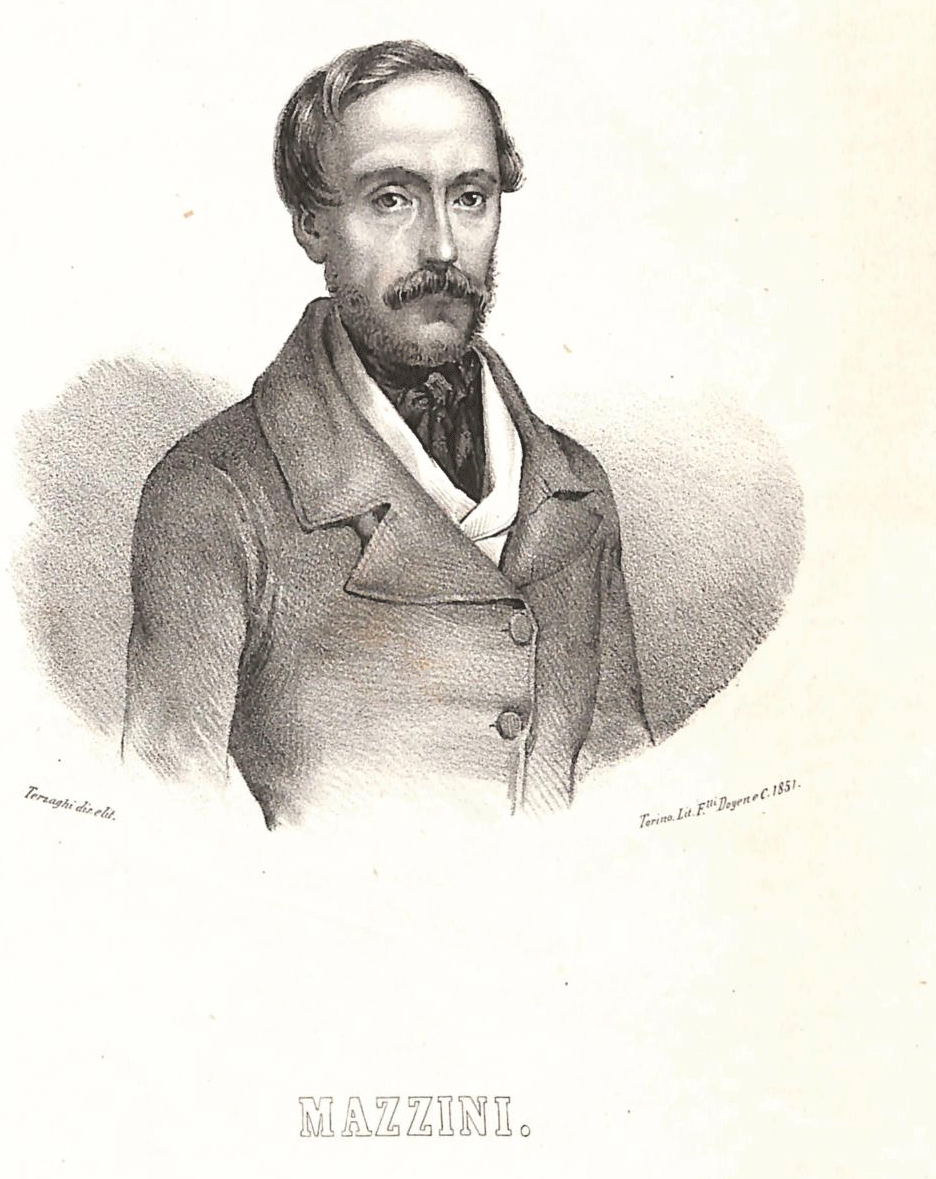
THE LIFE OF MAZZINI .1805-1872
by
BOLTON KING
Preface
This volume contains a life of
Mazzini and a study of his thought. It can hardly be said that any serious
attempt has been made either in England or Italy to deal with either. Hence the
present volume, however unequal to the subject, may have its use. The thirty
years, which have passed since Mazzini's death, make it possible now to place
him in his true perspective; and the author trusts that the supreme admiration,
which he feels for Mazzini as a man, has not prevented him from viewing the
politician with impartiality. There exists abundant matter to allow us to judge
Mazzini's political work, and it is unlikely that anything yet to be published
will seriously affect our estimate of it. For the personal side of Mazzini's
life, the moment is not a very opportune one. Ten years ago it would have been
possible to glean reminiscences from many, who are now silent. It has been the
author's privilege, however, to obtain invaluable information from two of the
very few persons now living, who knew Mazzini intimately. While it is nearly
too late for personal reminiscences, it is too early to avail oneself fully of
Mazzini's correspondence. A good many of his letters have indeed been
published, and I viii have been able to use a good many
unpublished ones, especially his correspondence with Mr and Mrs Peter Taylor, which I have found of the
greatest value. But unfortunately only one volume has as yet appeared of the
collected edition of his correspondence, and there are still probably many of
his letters, which have yet to come to light in Italy.
With regard to the study, which
occupies the second part of this volume, the author is very sensible of his
limitations in dealing with so vast and complex a system as Mazzini's ethical
and political thought. It is his hope that he may do something to stimulate
more competent writers to labour in a very fruitful
field. He believes that the more Mazzini's thought is disentangled, the more
its essential importance will appear.
BOLTON KING.
October 1902.
Chapter I. The
Home at Genoa1805-1831.
Boyhood and Youth—University
Life—Literary Studies—Classicism and Romanticism—Joins the Carbonari—Arrest and
Exile.
Joseph Mazzini was born in the
Via Lomellina at Genoa on June 22, 1805. His father
was a doctor of some repute and Professor of Anatomy at the University, a
democrat in creed and life, who gave much of his time to unpaid service of the
poor; at home affectionate and loved, though sometimes hard and imperious. His
mother, to whom in after life he bore a strong resemblance, was a capable and
devoted woman, who had little of the weakness of an Italian mother, and brought
up her children to bear the brunt of life; with strong interest in the mighty
movements that were remoulding Europe at the time, a
mordant critic of governors and governments inside the four walls of her house.
It was a happy home, and "Pippo" grew up the darling of his parents
and three sisters, a delicate, sensitive, gentle child, quick and insistent to
learn despite his father's fears for his health, and giving precocious proof of
brilliant talents. He was nearly nine years old, when the Napoleonic system was
shattered, and the Emperor went to Elba. Doubtless, Mazzini heard from his
father that Napoleon was Italian born and was going to exile in an Italian
island. The shock of the downfall was felt at Genoa, for the proud city, to
which Lord William Bentinck had promised in the name of England its ancient
independence, learnt that "republics were no longer fashionable," and
saw itself helplessly made over to the alien rule of Piedmont. Bitterly the
Genoese chafed at the traffic of their liberties, and we may be sure that there
was republican talk in Mazzini's home, which sank into the mind of the
thoughtful child. He himself mentions four influences that turned his boyish
mind to democracy: his parents' uniform courtesy to every rank of life; the
reminiscences of the French republican wars in the talk at home; some numbers
of an old Girondist paper, which his father kept half hidden, for fear of the
police, behind his medical books; and—more than all these, probably—the
classics that he read under his Latin tutor. "The history of Greece and
Rome," wrote a fellow-student, "the only thing taught us with any
care at school, was little else than a constant libel upon monarchy, and a
panegyric upon the democratic form of government." Like many another boy
of his time who had for school exercises to declaim the praises of Cato and the Bruti, he came to regard republics as the appointed
homes of virtue. It was the unintended fruit of the classical training, which
the despotic governments of the time fostered to keep their youth innocent of
any itch for innovation.
So he lived his quiet, studious
home-life, till an incident one day, when he was nearly sixteen, suddenly changed
its tenor. The Carbonaro revolutions of 1820 and 1821 had ended in deserved
collapse; and the Piedmontese Liberals, abandoned and defeated, crowded to
Genoa and Sampierdarena, while yet there was time to
escape to Spain. Some had fled penniless, and Mazzini, walking with his mother,
noted their despairing faces, and watched while a collection was made for them
in the streets. Their memory haunted him, and with a boy's enthusiasm for his
heroes, he longed to follow them. He neglected his lessons, and sat moody and
absorbed, interested only in gleaning news of the exiles and learning the
history of their defeat. In his boyish impatience, which came near the truth,
he felt "they might have won, if all had done their duty," and the
thought puzzled and obsessed him. He insisted on dressing in black, and kept
the habit to the end of life. He brooded over Foscolo's Jacopo Ortis,
till the morbid pessimism of the book wrought on him, and his mother,
apparently with good reason, feared suicide.
In time he recovered his balance,
and went back to his books with the old zest. He was now studying medicine,
intending to follow his father's profession; but at his first attendance in the
operation room he fainted, and it was clear that he could never be a surgeon.
To his father it must have been a sore disappointment, but he seems to have at
once recognised the inevitable, and allowed the lad
to read law. Mazzini had little heart in his new studies, for the arid,
perfunctory teaching of law current at the time had small attraction for one
who wanted to know the reason of things; but he persevered, and did well in his
examinations, though it is probable that he always gave a big slice of his time
to reading poetry and history. He was now at the University. Probably he went
to school, though there is some doubt about it; at all events he seems to have
escaped the brutality and bad pedagogy, which generally made school life then
one long misery for a high-principled or sensitive lad. University life began
at an early age in Italy, and Mazzini had matriculated at Genoa, when he was
fourteen. So far as his fellow-students were concerned, he was in happy
surroundings. But he was a troublesome scholar, always ready to rebel against
the formalities that made a big part of University life. To the last he refused
to attend the compulsory religious observances, not because he disliked them,
but because they were compulsory; and the authorities, tolerant for once, shut
their eyes to his insubordination. The University of Genoa did not possess a
high name for scholarship; and at this time it had its special drawbacks, for
the government was scared by the recent revolution, and fearful that a few
hundred lads might shake the pillars of the state. No one could matriculate
without a certificate that he had regularly attended church and confession.
Those whose parents did not possess a certain quantity of landed property, had
to pass a stiffer examination, though at the worst, it is probable, not a very
prohibitive one. Lecturers, beadles, porters, all had the cue from government
to make life unpleasant for the students, and the better professors dared not
be detected in any leniency or considerateness. Moustaches were forbidden, as a
mark of the revolutionary mind, and if any student, greatly daring, grew them,
he was carried off between two carabineers to a barber's shop.
Mazzini soon became a leader
among the clean-living, affectionate, impetuous undergraduates. His appearance
was now, as always, very striking; he had a high and prominent forehead, black,
flashing eyes, fine olive features, set in a mass of thick black hair, a grave,
serious face, that could look hard at times, but readily melted in the
kindliest of smiles. He led a studious, retiring life, fond of gymnastics and
fencing, but with small taste for amusements, his cigars and coffee his only
indulgences; his days spent among his books, his evenings with his mother, or
in long solitary walks that defied the weather, or in rare and stolen visits to
the theatre, which he had to leave after the first act, for the home was
rigorously shut at ten. But, though he was slow to make close friendships, he
was no misanthrope. He played much on the guitar and sang well to it; and his
musical talents and clever reciting made him in demand among his middle-class
and patrician friends. There was none yet of the half-bitter sadness of after
life; he had a shrewd sense of humour, perhaps
inherited from his mother; when warmed by enthusiasm or indignation, he could
speak with a fiery eloquence, that was remarkable even among those declamatory
Italian youths. "My soul," he wrote afterwards, "was then a
smile for all created things, life showed to my virgin fancy as a dream of
love, my warmest thoughts were for nature's loveliness and the ideal woman of
my youth." He revelled in generous actions,
sharing books and money, even clothes, with his poorer friends. But it was
sheer force of character that gave him his ascendancy over them—the loyal,
justice-loving nature that made him champion of every victim of undergraduate
or professorial spite, the purity of thought, that checked each loose or coarse
word from those about him. That clear, high soul, untouched by self, not
knowing fear, passionate for righteousness, gave him even when a lad the power
that belongs only to the saints of God.
His closest friends were three
brothers, Jacopo, Giovanni, and Agostino Ruffini. Jacopo, the eldest of the
three, had perhaps more influence on Mazzini's life than any other man. They
were born on the same day; and Jacopo's fine, sensitive, enthusiastic nature
matched well with Mazzini's own. The tragic fate, that afterwards brought his
life to an early close, only strengthened the influence; and the memory of one
so dear, who gave his life for their common cause, remained a perennial
inspiration to keep his faith alive in years of weariness and failure. The
other brothers had little of Jacopo's temperament. Giovanni at this time was an
even-tempered, humourous, brilliant lad; Agostino was
impressionable, impulsive, shallow, of quick and artistic nature. Mazzini's
closest companions for some years, they proved how little they could rise to
his high level, and they repaid his devotion by a want of sympathy and an
ingratitude, which, in Agostino's case at all events, was gross. In later life
both attained in their small way; both were deputies in the Piedmontese
parliament, and Giovanni was minister at Paris. They long moved in English
society and had some reputation there. Agostino, who was for a time a teacher
at Edinburgh, is the "Signor Sperano" who tells the story of The
Poor Clare, in Mrs Gaskell's Round the Sofa.
Giovanni, who became as proficient in English as in his mother tongue, wrote
two notable but now half-forgotten tales, Lorenzo Benoni and Doctor
Antonio, which stand among the best second-rate novels of his time.
Under Mazzini's lead the group of
friends at Genoa formed a society to study literature and politics and smuggle
in forbidden books. Half the masterpieces of contemporary European literature
came at this time under the censor's ban; no foreign papers were admitted
except two ultra-monarchical French journals; and contraband was a necessity of
literary study. Mazzini's strongest interests took him to literature. He read
omnivorously in Italian and French and English and translations from the
German. His favourite books, he tells us, were the
Bible and Dante, Shakespeare and Byron. His close knowledge of the Gospels
comes out in everything he wrote. He shed his orthodoxy indeed as soon as he
began to think; he went sometimes to mass, when a lad, and read Condorcet's Esquisse disguised as a missal; but he refused to go to confession as soon as he
understood its meaning,—the one thing, apparently, in all his life which pained
his mother. For a short time he went through a phase of scepticism,
but the Ruffinis' mother soon rescued him from this,
and a deep religious faith came to him, to remain the spring of all his life.
The poets he loved best were Dante and Byron, and he always remained true to
them. From Dante he learnt many of the master-ideas of his mind, the conception
of the unity of man and unity of law, the fervid patriotism, the belief in
Italy and Rome predestined to be teachers of the world, the faith in Italian
Unity, the moral strength that makes life one long fight for good. When only
some twenty years old, he wrote an essay on Dante's patriotism, which, however
boyish in style, proves his close knowledge of the master. Byron was then at
the height of his fame, and then, as always afterwards, Mazzini thought him the
greatest of modern English, perhaps of modern European poets. He was
"completely fascinated" by Goethe, and would often say that "to
pass a day with him or a genius like him would be the fairest day of
life." How his admiration for Goethe waned, while that for Byron grew,
will be told in another chapter. He read Shakespeare, but always, apparently,
with more respect than enjoyment, and Shakespeare too came under the same ban
as Goethe. He thought very highly of Schiller, and placed him with Æschylus and Shakespeare, as the third great dramatist of
the world. He read a good deal of English literature; at this time he was a
fervent admirer of Scott, but he seems afterwards to have lost his interest in
him; he knew something at least of Wordsworth and Shelley, Burns and Crabbe.
Modern French literature, except de Vigny's and some of Victor Hugo's writings,
did not now (nor, with the exception of George Sand and Lamennais,
at any time), appeal to him, for he disliked the tendencies of French
Romanticism, and already there were the beginnings of his life-long prejudice
against most things French. Among his modern fellow-countrymen Alfieri and
Foscolo were his favourites; he read Manzoni and
Guerrazzi, but largely to criticise them, though he
was ready to do justice to the strength of both. He thought Mickiewicz, the
Polish national poet, "the most powerful poetic nature of the time."
The classics he no doubt read pretty widely, as every educated lad was then
bound to do, but none seem to have made much impression on him, except Æschylus, for whom his veneration was unbounded, and
Tacitus. Both now and later he gave much time to metaphysical and political
writers. He read something of Hegel, whom he detested for his political
fatalism, of Kant and Fichte; but the German who influenced him most was the
now-forgotten Herder. From him he learned or confirmed his spiritual conception
of life, his belief in immortality, his theory of the progress of humanity and
man's co-operation in the work of Providence. Among Italian philosophers he
studied Giordano Bruno and Vico; he rated the latter at his real worth, and regarded
him as the great luminary of an Italian school of thought whose continuity he
professed to trace from Pythagoras. Among political writers Macchiavelli
certainly impressed him most, as a great Italian patriot, and he excused his
morality as a product of his time. He seems to have known a good deal of
Voltaire and Rousseau. Of recent political writers, he and his circle most read
Guizot and Victor Cousin, whose lectures at this time made them the mentors of
young liberalism; he records how the group at Genoa handed on to one another
manuscript copies of the lectures, and found their inspiration in the men whom
they were soon to regard as traitors.
Now and for long after,
literature was the call that spoke sweetest to Mazzini. Politics and conspiracy
were constraining but unwelcomed duties; he gave his love to literature. To be
a dramatist or write historical novels was at this time his plan of life. Many
a time in later years he was still looking for the day, when Italy would be
united and free, and, his political task accomplished, he could give himself to
the literary schemes he still cherished,—a history of religious ideas, a
popular history of Italy, and the editing of a series of the great dramas of
the world. But the burden of his country's woe lay too heavily on him to be
long forgotten. It was no time now for Dante studies or play-writing. Sadly and
unwillingly he convinced himself that at such a time pure literature was no
patriot's first task, that the writer, who would not shirk his duty, must make
his work political. Not but what the literary critic still appears on every
page; but the whole gist of his teaching is that the value of a book is in proportion
to its power to inform the reader's soul to love of country and mankind, and
impel him to serve his fellows by political action in the sight of God. He held
it wasted effort to do, what Manzoni had tried to do,—to school the individual
to a smug life of cloistered virtue, a life which in a vicious or torpid
society was impossible to the many. No religion, no morality, he taught, is
worth the writer's labours, unless it dedicates men
to be workers in the public cause, to hold comfort, and, if need be, home and
life itself as cheap, while oppression and wrong are stunting other lives, and
men and women round are crying to be freed.
He found his opportunity in the
controversy between Romanticists and Classicists, which then divided the
literary world of Italy into hot factions. Not that he held Romanticism to be
any final or faultless form of literature. But when a theory of literary
servitude, like Classicism, lent itself to political oppression and depressed
the vital and spiritual forces of the country, when a young and vigorous
movement was making literature free and stood for liberty all round, he
necessarily took his stand for the latter. There could be no political or
social regeneration for Italy, till she had a literature that made for freedom
and progress. "These literary disputes," he urged, "are bound up
with all that is important in social and civil life"; "the legislation
and literature of a people always advance on parallel lines," and
"the progress of intellectual culture stands in intimate relationship with
the political life of the country." It was the aim of the Romanticists
"to give Italians an original national literature, not one that is as a
sound of passing music to tickle the ear and die, but one that will interpret
to them their aspirations, their ideas, their needs, their social
movement." And thus, while generously recognising Manzoni's worth, he looked rather to Alfieri and Foscolo, who had scourged
political wrong-doing and preached resistance to tyranny; he praised the
writers of the Conciliatore, the short-lived
Milanese journal of Silvio Pellico and Confalonieri, which, like himself, had
turned Romanticism to political purposes. Here and there in his writings of
this time a more or less direct political allusion manages to escape the
censor's eye. He speaks for the first time of "Young Italy," a name
soon to ring through Europe; he pays his tribute to the political exiles; he
slips in a remark that the spirit of a state cannot be changed without
recasting its institutions. More than this he could not do in a censor-ridden
press; perhaps literature was struggling still with politics to command his
mind.
As it was, he had trouble enough
with the censors. His first published articles appeared in the Indicatore Genovese, a commercial paper
issuing at Genoa, whose editor was persuaded to admit short notices of recent
books, which gradually swelled into literary essays. Among his later
contributions were an article on the historical novel and reviews of Friedrich Schlegel's
History of Literature and Guerrazzi's Battle of Benevento. They do not read
very well. They are juvenile and exaggerated, and it is amusing to find the
twenty-three years' old author telling his coeval Guerrazzi, the young Leghorn
novelist, that he had not drunk enough of the cup of life to be a pessimist.
The Indicatore gradually became a literary
paper, and for a few months the censorship did not see what it was tending to.
At the end of 1828, however, about a year after Mazzini began to write in it,
it was suppressed. Mazzini easily transferred his energies. Guerrazzi had
founded another paper at Leghorn much on the same lines, the Indicatore Livornese,
and asked Mazzini to send contributions. Mazzini readily responded; he wrote,
besides minor papers, an article on Faust, and attacked the defects of the
Romanticist School in an essay on Some Tendencies of European Literature.
His writing is still effusive, and generally dogmatic and sententious, but the
style has improved. The censorship was comparatively lenient in Tuscany, and
though the young writers were barred from direct reference to politics, they
were able to make the political allusions sufficiently transparent. But the
paper grew too daring even for the somnolent Tuscan censors, and, like its
predecessor, it was snuffed out after a year of life. Mazzini and Guerrazzi
parted, to go on very different ways, and meet again nineteen years later when
both were famous.
In the meantime Mazzini had with
some difficulty got a footing on the Antologia,
the one Italian review of the time that ranked among the great European
periodicals. It had been founded some ten years before, in the hope that it
might become an Italian Edinburgh Review, by Gino Capponi, the blind Florentine
noble who traced his race from the Capponi who bearded Charles VIII., and Vieusseux, a Swiss bookseller who had settled at Florence
and opened the one circulating library of any note in Italy. Most of the
leading Italian writers of the day contributed to it; and though its aim was
avowedly nationalist, and in a sense Liberal, it had succeeded so far, thanks
probably to its influential patrons, in eluding the censor's ban. Mazzini wrote
for it three articles On the Historical Drama and another On a
European Literature. His work had rapidly matured, and there is no trace
now of the juvenilities of his earlier efforts. Every page has the mark of the
strong, original thought, which made him one of the greatest critics of the
century.
Meanwhile he was practising at the bar in a desultory fashion. Sometimes he
pleaded in the lower courts as an "advocate of the poor," and was
much in demand for his attention and skill. According to the etiquette of the
profession, he read in the rooms of a barrister, who limited his interest to
seeing that his pupils sat with a book in front of them. The vacations were
generally spent in a little country villa at San Secondo, in the Bisagno valley, within sight of a house which the Ruffinis occupied; and he shared in attentions to the Ruffinis' mother, who was now his spiritual guide and
dearest friend, or went on botanical walks or shooting expeditions in the
lovely hill country. He did not do much of the shooting himself, and when he
was more than fifty, he remembered with remorse a thrush that he had mangled
when sixteen.
His interests became more and
more absorbed by politics. His Genoese home no doubt encouraged this, for the
nobles and the working-classes were still unreconciled to Piedmontese rule,
while the liberals of the middle classes looked on the annexation only as a
step to some wider Italian state. But the local environment was only a minor
influence, and Mazzini would doubtless have become a conspirator, had he lived
in any other town of Italy. About the time that he began to write in the Indicatore Genovese, he was admitted into the
Society of the Carbonari. The Carbonari were at this time suffering from the
decadence, which sooner or later palsies every secret society. They had grown
out of Neapolitan Freemasonry in the days of the French rule, and when, after
Napoleon's fall, reaction came and the old dynasties returned, they swept into
their ranks the mass of discontented men, who, with very varying political
ideals, were at one in resenting the small tyrannies, the bigotry and obscurantism
of the princes, who had come back from exile to misgovern and sometimes to
oppress. The high level of their tenets, their appeals to religion and
morality, the esoteric symbolism of their rites, the vague democratic sentiment
that was often only skin-deep, had made them a vast Liberal organisation.
Since they had made and wrecked the revolutions of Naples and Piedmont seven
years before, they had kept the skeleton of their party together with
considerable skill and persistency. But the conspiracy had changed its
character. It was no longer a purely Italian society, for the exiles had
carried it into France and Spain, and the headquarters were now at Paris, where
Lafayette and the Orleanist conspirators were using it to upset the Legitimist
monarchy and dreamed of a league of Latin countries to balance the Holy
Alliance. In Italy the democratic sentimentalism had left it, it had lost touch
with the masses, and its leaders were mostly middle-aged men of the
professional classes, who discouraged young recruits, and had no wish to step
outside their meaningless small formalisms and barren talk of liberty.
Mazzini had little stomach for
their ritualism and lack of purpose, their love of royal and noble leaders; and
probably the subordinate position, that as a young man he necessarily took, sat
uncomfortably on him. But at all events they were the only revolutionary organisation in the country, and he admired the bravery of
men, who risked prison or exile for however inadequate an end. Though fitfully
in practice, he had a theoretic belief in subordination, which prepared him for
the moment to act under orders. But as soon as he joined the Carbonari and
swore the usual oath of initiation over a bared dagger, he began to see the
futility of it all. He found that he was sworn only to obey his unknown chiefs,
and he was allowed to know the names of two or three only of his
fellow-conspirators. He suspected that their political programme,
if they had any, was but a thin one. All the Italian in him revolted against
men, who talked lightly of their country, and preached that salvation could
only come from France. The subscription to the Society's funds, of which,
needless to say, no account was rendered, was sufficiently heavy to bear hardly
on his slender purse. He was so sickened by a melodramatic announcement,
perhaps in bluff, that a member was to be assassinated for criticising the chiefs, that he threatened to withdraw. His unknown superiors, however,
apparently thought well of him, and he was commissioned to go on propagandist
work to Tuscany, where he made a few recruits. He seems to have returned in
better spirits as to the future of the Society; and if we may believe Giovanni
Ruffini, he began with a few young co-affiliates to organise on his own account, nominally in the name of the Carbonari, but really to
substitute a more vigorous association. His plan was apparently to bring the Carbonari
of Tuscany and Bologna into closer touch with those of Genoa and Piedmont. He
asked for a passport for Bologna on the pretext that he wanted to examine a
Dante manuscript, but was told by the police, that if he had no more important
business, he could wait. Baffled in this, he returned to his semi-independent
conspiracy at home. The July Revolution in France had raised the hopes of
liberals everywhere; and he and his friends enrolled affiliates, discarding the
Carbonaro lumber of oaths and secret signs, and simply pledging them to act, if
an insurrection proved possible. Bullets were cast, and other juvenile
preparations made. How far he succeeded in enlisting followers, we do not know,
for he himself has left hardly any record of the plan.
At all events, it was abruptly
nipped. The government had its secret agents among the Carbonari, and Mazzini
was arrested on the charge of initiating one of them. It is probable that the authorities
had suspected him for some time. He was, as the governor of Genoa told his
father, "gifted with some talent, and too fond of walking by himself at
night absorbed in thought. What on earth," asked the offended officer,
"has he at his age to think about? We don't like young people thinking
without our knowing the subject of their thoughts." Mazzini was taken to
the fortress of Savona, where he consoled himself by watching the sea and sky,
which made all the prospect from his cell windows, and taming a serin finch,
which would fly in through the gratings, and to which he "became
exceedingly attached." His case came before the Senate of Turin, the
highest court in the country. In the eyes of the law he was supremely guilty;
but, with an adroitness that he afterwards recalled with pride, he managed to
destroy all compromising papers, and there was only one witness of the
initiation, whereas the law required two. Mazzini stoutly denied the fact. The
denial was more than a plea of not guilty in an English court; perhaps he
thought that a conspirator is bound to put his government outside the pale of
moral obligation. But whatever we may allow for his position, the plain man
will count his action as one of the disingenuous lapses, that rarely, now and
again, stain the clear honour of his life.
The court had to acquit him, but
the authorities had too much evidence of his activity to leave him unmolested.
They gave him the choice between internment in a small town or exile.
Contemporary events decided him. The revolution had just broken out in Central
Italy; the French government had encouraged the Carbonari to expect direct or
indirect assistance, and Mazzini thought that he would serve the cause best at
Paris, whence, he confidently hoped, he would soon return to a liberated Italy.
In February 1831 he said his good-byes to his family, who had hastened to
Savona, and crossed the Apennines and, for the first time, the Alps, afterwards
so familiar and beloved. He watched the sunrise from Mont Cenis, and has left a
memorable description of it, drawn with all the wealth of his artistic imagery.
At Geneva he made the acquaintance of Sismondi and his Scotch wife. While
there, he was advised to join the Italian exiles at Lyons, and, giving up the
projected journey to Paris, he made his way to them.
Chapter II
Young Italy 1831-1833.
Condition of Italy—The Revolution
of 1831—Young Italy—Its principles: belief in Italy; inspiration of duty;
social reform—Its political system: Republicanism; Italian Unity; war with
Austria—Secret societies.
The governor of the prison at
Savona had allowed him to read the Bible, Byron, and Tacitus, innocently
thinking that they contained no revolutionary material. Out of these and Dante
sprang Young Italy. Italy was ripe for the teaching of the epoch-making society.
The country was "a geographical expression." Conquerors, whose
appetites had been tempted by the Southern land, had carved it into appanages
for themselves. Austria held Lombardy and the lands of the Venetian republic;
the King of Piedmont ruled the North-West, and Sardinia, and Savoy across the
Alps; the Bourbons of Naples had the South; the Pope, the grand-duke of
Tuscany, the petty dukes of Modena, Parma, and Lucca divided up the Centre. Nor
had there been any serious demand for unity. History and character sundered
North and South; the great medieval cities still cherished their independence too
dearly to wish to sink it in a common country. Napoleon, while he ruled, had
gone far to unite the land both in form and substance; and the aspirations he
did so much to create survived him. Weak though they still were, practical
grievances were ever enforcing the argument for unity; and Italians were
chafing more and more against the artificial barriers, which stopped the
circulation of the nation's life. The customs-lines, that met the trader on the
confines of each state, strangled commerce. Literature circulated with
difficulty, and the Genoese could hardly get access to books published at
Florence or Leghorn, a hundred miles away. In the smaller states at all events,
the area was too small to offer any field for enterprise, and every lawyer and
engineer and civil servant was cribbed by the restrictions, that confined his
activities to a handful of towns. Through all the peninsula there was a more or
less intolerable misrule. Political disabilities allowed no voice in
legislation, no control of taxation or the executive, no rights of public
meeting or association, small liberty of speech or writing. There were more
present grievances in the discouragement of education, in the clerical tyranny,
in the obsolete and partial legal system. And the misgovernment had its yet
more evil and intimate aspect in the power of the police, which threatened each
man's home and honour and career. Governments, that
breathed and moved in chronic dread of revolution, sought safety in a system of
covert terrorism. The police had their spies everywhere,—in the streets, in
men's households, in the churches, in the universities,—to scrape up any idle
word or act, that seemed to mark a possible critic of government. There were
mitigations of the misrule in Piedmont, Tuscany, and the Austrian territories.
But in the Pope's states and Naples there was little or nothing to relieve the
crying corruption and incompetency; and everywhere there was more or less a
vexatious intolerance and oppression, that showed the blacker after the
relative liberty and progress of Napoleon's rule.
The Carbonari had voiced somewhat
fitfully the national protest. And just at this time they made their final
attempt at revolution. Early in February 1831,—just before Mazzini was released
from Savona,—the insurrection broke out in Modena, and spread at once to Parma
and the Papal province of Romagna. In three weeks the greater part of the
Pope's dominions were free, and the insurgent army was marching towards Rome.
The leaders knew that, however easy it was to upset the rule of the Pope and
Dukes, they could make no effective resistance to an Austrian attack; but they
counted on the promised backing of France to ward off invasion.
"Non-intervention,"—the European equivalent of the Monroe
Doctrine,—was one of the formulas of the July Monarchy, and by it Austria had
no right to interfere in the domestic concerns of an Italian state. The French
government had assured the Carbonari, that, if she violated the principle, it
would declare war against her. But only a section of the ministry was sincere
in the promise, and Louis Philippe saw that a war in the name of nationality
might easily slide into a revolutionary movement, which would shake his own
unsure throne. His government let Metternich know that non-intervention was a
phrase that stopped at words. By the end of March, despite some fine fighting
by the Italian levies, the Austrians had stamped out the ephemeral
insurrection. Its feebleness courted failure. Not that the programme of the leaders wanted breadth and boldness. Mazzini's after criticism that it
was neither nationalist nor democratic was exaggerated and unjust. During their
few weeks of rule, the chiefs had showered projects of social reform. Some of
them at all events wished to make Romagna the centre of a great national rising, and aimed at an independent federation of all Italy
with Rome for its capital. But they made two irreparable mistakes. They did not
face the facts; they failed to win the people. They were for the most part,
like the rest of the Carbonaro leaders, middle-aged professional men, out of
touch with the masses, possessed by the dread that popular imprudences might scare the diplomatists, on whom they built their hopes. Under an
inspiring chief, the people would have fought perhaps, as they fought seventeen
years later, when they drove the Austrians in confusion from Bologna. But the
leaders were not the men to touch their enthusiasm. They had, in fact,
miscalculated what the movement meant. These comfortable men of peace flinched
from the fact that Austria must be fought and beaten. They had no stuff for a
desperate guerilla fight, that meant the wasting of the country, privation and
disease and death, for an uncertain hope that France might come eventually to
the rescue. Still less were they prepared to launch on a forlorn enterprise,
where friends were none and immediate disaster certain, that they might be
precursors of their children's victories.
Their failure, so consonant with
all the later Carbonaro policy, confirmed Mazzini in his belief that a new organisation was needed and new men to lead it. As usual,
he saw only one set of facts. He exaggerated the mistakes of the revolutionary governments,
and left out of his reckoning the unreadiness of the people. The insurrections
had failed, he convinced himself, simply because they had been badly led. In
the main, indeed, he was right. The revolution had been in the wrong hands. The
Carbonaro chiefs kept at arm's-length younger men, whose energy might have made
up for their own unforwardness. If the next
revolution was to fare better, it must have these younger men to captain it,
men of confidence and enthusiasm and fresh ideas, men with a message that would
nerve "those artisans of insurrection, the people and the young."
Mazzini had at this time a supreme faith in his generation; he had already
written in the Antologia of "this young
Italy of ours," so vigorous and cultured and warm-hearted, that no new
movement, however bold and difficult, was beyond its powers. "Place,"
he said now, "the young at the head of the insurgent masses; you do not know
what strength is latent in those young bands, what magic influence the voice of
the young has on the crowd; you will find in them a host of apostles for the
new religion. But youth lives on movement, grows great in enthusiasm and faith.
Consecrate them with a lofty mission; inflame them with emulation and praise;
spread through their ranks the word of fire, the word of inspiration; speak to
them of country, of glory, of power, of great memories." They had been
muzzled in the past; they must not be again. So rigidly did he insist on this,
that the rules of Young Italy excluded from membership except in special cases,
all who were over forty years. Mazzini had no diffidence to curb the
magnificent egotism of a design, in which he consciously destined for himself
the leading part. As one of his closest friends of those days said, "his
confidence in men was great and in himself unlimited." "All great
national movements," he wrote in later years, "begin with unknown men
of the people, without influence except for the faith and will, that counts not
time or difficulties." It is worth noting that Camillo Cavour, five years
younger still, was at this same time writing to a friend that "he would
one fine morning wake up Prime Minister of Italy."
When we disentangle Mazzini's
ideas from the superfluous verbiage that sometimes wraps them, two leading
principles are found to differentiate them from those of earlier movements,—the
principles, that, with his trick of making watchwords, he summed up in the
phrase, "God and the People." The new movement must have the
inspiration and power of a religion. Italy needed something that would shake
her from the hopelessness of disillusion and defeat, something that would prove
she "had a strength within her, that was arbiter of facts, mightier than
destiny itself." Action must be roused by action, energy by energy, faith
by faith,—the faith that made Rome great and inspired Christianity and sent
forth the armies of the Convention, the faith that makes the weak strong in the
knowledge they are carrying out God's will. Mazzini had two arguments to
persuade his countrymen to this believing and conquering patriotism. He hoped
to fire them with his own superb faith in Italy and her destinies. He called up
"that old name of Italy, hung round with memories and glory and majestic
griefs, that centuries of mute servitude could not destroy." Twice had she
been queen of the world; many times had she, the land of Dante and Vico, of the
Papacy and the Renaissance, inspired European thought. "Italy," he
said, "has been called a graveyard; but a graveyard peopled by our mighty
dead is nearer life than a land that teems with living weaklings and
braggarts." Her task was not yet done; she had still to speak to the
nations "the gospel of the new age, the gospel of humanity." He
pointed Italians to "the vision of their country, radiant, purified by
suffering, moving as an angel of light among the nations that thought her dead."
Rightly he judged that men, who shared his faith, would never despair of their
country. But he had a more sounding note to strike. He had the genius to see
that he who would have men rise to high endeavour,
must appeal to their unselfish motives, that only when some great principle
calls, will they lift themselves to heroism and sacrifice of all that makes
life dear. The effort to make Italy meant the loss of thousands of lives, meant
exile and imprisonment and poverty, the blighting of homes and the misery of
dear ones; and men would only face it at the call of duty. The Carbonari had no
call; they came of a school that appealed to interested motives, and the appeal
inevitably broke down in the day of disappointment and defeat. Mazzini offered
his countrymen "a national religion"; Young Italy was no mere
political party, but "a creed and an apostolate"; it taught that
victory came "by reverence for principles, reverence for the just and
true, by sacrifice and constancy in sacrifice." As individuals and as a
nation, they had a mission given them by God. God's law of duty bade them
follow it; God's law of progress promised them accomplishment.
The other principle of Young
Italy was social reform. Earlier liberal movements had thought or attempted
little for the masses, though at all events the recent rising in Romagna aimed
higher than Mazzini gave it credit for, and had more of a democratic tendency
than contemporary movements in France and England. Mazzini exaggerated the
revolutionary impatience of the masses in 1821 and 1831; but it was true that
such enthusiasm as they had, had been cooled by the disappointment of their
hopes. Revolutions, as he said, had been Dead Sea apples to them. They would be
slow to stir again, till they saw that the liberation of their country had
tangible social results in store. The gospel of duty would rouse the cultured
middle classes, but at this time he seems to have thought that the uneducated, down-trodden,
priest and official-ridden masses could not respond to the higher call, and
must be won by some visible prospect of relief from present evils. Pope Julius'
cry of "Out with the barbarian" would not touch men, who did not see
how every social injustice leant in the last resort on Austria, how dear food,
conscription, all the petty tyranny, were fruits of the foreign domination,
that sheltered the princes who misgoverned them. Till the masses felt this, there
was no hope of a successful war of liberation. "Revolutions," he
said, "must be made for the people and by the people, and so long as
revolutions are, as now, the inheritance and monopoly of a single class, and
lead only to the substitution of one aristocracy for another, we shall never
find salvation." The cry of the poor, unheard by most Italian statesmen
from his time, down to yesterday, was ever with him. "I see the people
pass before my eyes in the livery of wretchedness and political subjection,
ragged and hungry, painfully gathering the crumbs that wealth tosses
insultingly to it, or lost and wandering in riot and the intoxication of a
brutish, angry, savage joy; and I remember that those brutalised faces bear the finger-print of God, the mark of the same mission as our own. I
lift myself to the vision of the future and behold the people rising in its
majesty, brothers in one faith, one bond of equality and love, one ideal of citizen
virtue that ever grows in beauty and might; the people of the future, unspoilt by luxury, ungoaded by
wretchedness, awed by the consciousness of its rights and duties. And in the
presence of that vision my heart beats with anguish for the present and
glorying for the future." That they would rise in insurrection, he had no
doubt. Once make them see whence sprang their wretchedness, where stood its
remedies, once make them feel that "God is on the side of the
down-trodden," the people of Italy would be again what they had been in
the days of the Lombard League and the Sicilian Vespers.
Out of these principles,—social
reform as the immediate end of revolution and duty as its inspiration,—Mazzini
built up an elaborate political programme. He loved
system-making and hardly apologised for it. You
cannot have unity or harmony without it, he urged, and to a certain extent he
had practical justification. It were better, as he said and as subsequent
events proved, that the nationalists should argue out their differences before
the time for action came, and not paralyse themselves
by quarrels in front of the enemy. It was this want of a positive programme, that was, he thought, largely responsible for
the failure of the Carbonari. Their policy had hardly gone beyond the overthrow
of the existing governments; and they had mustered under their flag royalists
and republicans, conservatives and liberals, with the inevitable result that
after their first successes they split their ranks and fell an easy prey. It
were wiser, so Mazzini pleaded, to be few but united. "The strength of an
association depends not on its numbers but on its homogeneity." But the
principle was necessarily an intolerant one. It barred many a true patriot, who
could not swear to the whole Mazzinian doctrine. For such he had no pity. In
his view it was only fear, "the Almighty God of most politicians,"
that prevented the Moderates from accepting his position. "There can be no
moderation," he said at a later date, "between good and evil, truth
and error, progress and reaction." Unluckily truth to him too often meant
adhesion to his own theories; and he could never forgive men, who, starting
from his premisses, could not follow his logic to the
end, though, like most men who pride themselves on being logical, he was often
singularly incapable of accurate reasoning. It was this intolerance that
wrecked so much of his after life, that made him waste his splendid powers in
fighting men, by whose side he ought to have been working.
However, for better or worse,
Mazzini required from his fellow-workers implicit acceptance of his
theories,—theories which embraced every sphere of national life, religion and
politics, literature and art. His chief political doctrines were republicanism
and Italian Unity. How he pieced republicanism on his general theory of things,
is the subject of another chapter. It is sufficient here to note that he was a
republican, chiefly because he thought that democratic legislation was
impossible under any form of monarchy. The belief was natural enough at the
time. Few had been the popular reforms under any European crown, while the one
genuine series of democratic laws had been passed by the French Republic or
while the French monarchy was tottering to its fall. Mazzini may be pardoned,
if at that time he sharply sundered monarchies and republics, and failed to see
how imperfect was the classification. In Italy, Mazzini saw special
circumstances that made for a republic. Her great memories were republican,
though even he must have recognised how little the
republics of medieval Italy had in common with his ideal polity. At Venice and
his own Genoa the republican tradition was still dear. Italian republicanism
was free from any recent memory of outrage and proscription, such as tarnished the
name in France. And above all, he urged, there was no possible king for a
united Italy. Each prince was pledged to Austria, each had proved his sympathy
with reaction. Monarchy in Italy had "no splendid annals, no venerable
traditions," no powerful nobility to buttress it. Two princes only had an
army, which could help in the war of liberation; and neither the King of
Piedmont nor the King of Naples would submit to the other without a bitter
civil struggle. And the antipathies of North and South, though they might bow
to the principle of a common republic, would never allow the Neapolitan to take
a king from Piedmont. History has proved how wrong was his diagnosis, and
temporarily and reluctantly he had glimpses of his error. More than once in
after life, as we shall see, he alternated his republicanism with fits of
half-belief in the Piedmontese monarchy.
His advocacy of Italian Unity
rests on a surer bottom. That the country was fated to stagnate till the
foreigner had gone, was common ground with every school of patriots. But when
the Austrians had been driven out, was Italy to be a federation of states or
one united country? Mazzini pleaded that the point at issue between him and the
federalists was mainly one of practicability. This hardly took sufficient
account of the school, which looked to Switzerland and America for its types,
and preferred a federation on its own merits. But on the whole his contention
was right. Every argument that told for federation, told yet more forcibly for
unity. The strength of the federalist movement lay in the belief that unity was
impossible. As yet, though Napoleon had foretold that unity must come, only a
handful of Italians had dared to speak of it as a possible ideal. The great
majority doubted whether Italy even wished to be united, whether, if she did,
the facts of the European polity made it possible, whether unity could
permanently stand the strain of the old provincial animosities. It was easy for
them to adduce a host of facts,—the differences of race and temperament and
tradition, the various habits formed by dissimilar systems of law and land
tenure and education, the jealousies, still far from dead, that sundered
province from province and city from city. Mazzini himself had felt the force
of their arguments, and there was a moment, when even he had been shaken in his
faith. He had little tangible reasoning to back his confidence. But he had the
prophetic assurance of a great possibility, and his contagious faith made it a
reality. He saw, when hardly another of his contemporaries saw it, that Italian
Unity was a practicable ideal; his teaching informed the national resolve, that
changed the seemingly impossible into a fact. To few
men has it been given to create a great political idea; to fewer still to be
not only the creator, but the chief instrument in realising it. Mazzini was both, and it gives him title to rank among the makers of modern
Europe.
But there could be no unity, no
republic, no political advance of any kind, till the inevitable war with
Austria had been fought and won. She would not surrender her Italian provinces,
unless by force of arms. She could not tolerate free institutions side by side
with her own despotic rule. She had crushed the Neapolitan and Piedmontese
risings ten years before; she had done the same in Modena and Romagna
yesterday. "She robs us," said Mazzini, "of life and country,
name, glory, culture, material well-being." As Giusti said more pointedly
a few years later, the Italians "ate Austria in their bread." Mazzini
and many another patriot knew that any peaceful solution was utopian. "The
destinies of Italy," he preached, "have to be decided on the plains
of Lombardy, and peace must be signed beyond the Alps." Mazzini rather
welcomed war in a just cause. It would redeem the torpid, disillusioned
Italian, who was brave enough, as Napoleon's campaigns had proved, but required
much to nerve him to effort. It would give Italy again her national
self-respect, her claim to the esteem of other peoples. "War," he
said, "is the eternal law, that stands between the master and the slave
who breaks his chains." But Mazzini in his saner moods saw the futility of
any local or ill-prepared rising. In words, that condemn only too eloquently
much of his after action, he declared that only victory could justify a rising
against Austria. It was only when the great mass of the people had been won to
the nationalist cause, that the patriots "might stretch their hand to
Lombardy and say, 'There are the men who perpetuate your servitude,' towards
the Alps and say, 'There stand your confines.'" Mazzini's plan of campaign
was guerilla fighting. It was, as he said, the natural resource of an insurgent
people, that had to win its freedom against disciplined armies,—the method
chosen by the Dutch against Philip II., by the American colonists against
England, by the Spaniards and Greeks in more recent times. Had he lived now, he
might have added another illustrious example. Italy, with her long chain of
mountains that no enemy could hold in force, had special fitness for the
strategy. "Italians," he cried, "look to your mountains, there
stand strength and infallible victory."
In the meantime the work of Young
Italy was to organise and educate; and the only
possible organisation was that of the secret society.
Mazzini did not see its inherent weaknesses. Young Italy soon became as much
the quarry of the spy and police agent as the Carbonari had been; and to the
end of life Mazzini was the victim of informers, who won his easy confidence.
The society developed an uncontrolled and irresponsible leadership, and its
chief, eager as he was and sincerely eager to disclaim any desire to dictate,
was too impatient, too self-confident to allow fair play to other men's
convictions. As a means of preparing for war, it failed disastrously; and it
proved an ill school for the parliamentary politics of later days. But in a
country, where any open expression of liberal sentiment meant prison or exile,
if not the scaffold, there was no alternative; and as an educating influence it
came to be the greatest of the forces that made Italy. Its writings, smuggled into
every corner of the land, moved many a young thinker to a passionate resolve,
that bore its fruit in after times. At this stage, however, Mazzini was hardly
looking to the slow results of political education. The hour of insurrection,
he confidently believed, was near; the European revolution was threatening, and
Italy must not be behind the sister nations. He was certain of success.
Whatever difficulties might come to a nationalist movement without a backing
from the native governments, however much Italians might distrust their own
unaided strength, there was "no real obstacle for twenty-six millions of
men, who wished to rise and fight for their country." Austria, he
calculated, could at the best put two hundred thousand men into the field; he
fondly counted on four million Italian volunteers. A people, that even under
the leading of the Carbonari had made three revolutions in ten years, would
rise again more readily and more victoriously at the inspiration of a nobler
faith.
Chapter III.Marseilles.1831-1834.
At Marseilles—Spread of Young
Italy—Letter to Charles Albert—The Army Plot in Piedmont—At Geneva—The Savoy
Raid.
When Mazzini arrived at Lyons, he
found an unhopeful plan in preparation for raiding Savoy. Some 2000 Italian
refugees, many of them Piedmontese who had fled through Genoa ten years before
and stirred his boyish enthusiasm, were ready to march under the hardly concealed
protection of the French government. It was still in the early days of the July
monarchy, when it had yet not quite forgotten its revolutionary origin. But
before the expedition could start, Louis Philippe's swift lapse into
conservatism, which had already made him break his promises to the Romagnuols, abruptly ended the patronage of the
authorities. The would-be raiders were scattered, and Mazzini joined a small
party of republicans, who were starting for Corsica, on their way to join the
insurgents in Romagna. The Corsicans were still Italian in sentiment as well as
race, and the Carbonaro influence was strong in the island. Two thousand men
offered themselves for service with the insurgents, but no funds were forthcoming
to pay their passage, and before arrangements could be made the news arrived
that the rising had collapsed.
Mazzini returned to Marseilles,
and found himself among the refugees who had escaped from Central Italy. He
recruited a few young patriots among them, and with their help he began to give
body to his schemes. In a small room at Marseilles the young Titans started,
with nothing but their own sincerity and daring, to revolutionise Italy. "We had no office, no helpers," he wrote of them in after
years. "All day, and a great part of the night, we were buried in our
work, writing articles and letters, getting information from travellers, enlisting seamen, folding papers, fastening envelopes,
dividing our time between literary and manual work. La Cecilia was compositor;
Lamberti corrected the proofs; another of us made himself literally porter, to
save the expense of distributing the papers. We lived as equals and brothers;
we had but one thought, one hope, one ideal to reverence. The foreign
republicans loved and admired us for our tenacity and unflagging industry; we
were often in real want, but we were light-hearted in a way, and smiling
because we believed in the future."
In later life Mazzini looked back
longingly to the freshness and enthusiasm of those days, before failure had
disillusioned him or misunderstanding estranged him from his friends. When he
was well and happy, all the charm of his nature—his radiant idealism, his
warm-hearted friendship, his contagious unselfishness—made him the beloved
inspirer of the little band that worked under his orders. "He was,"
said an Italian of him at this time, "about 5 feet 8 inches high and
slightly made; he was dressed in black Genoa velvet, with a large
"republican" hat; his long, curling black hair, which fell upon his
shoulders, the extreme freshness of his clear olive complexion, the chiselled delicacy of his regular and beautiful features,
aided by his very youthful look and sweetness and openness of expression, would
have made his appearance almost too feminine, if it had not been for his noble
forehead, the power of firmness and decision that was mingled with their gaiety
and sweetness in the bright flashes of his dark eyes and in the varying
expression of his mouth, together with his small and beautiful moustachios and
beard. Altogether he was at that time the most beautiful being, male or female,
that I had ever seen, and I have not since seen his equal." But sometimes
even now overwork and impatience told on him, and he felt ill and exhausted. In
such moods he must have been a trying man to be much with—irritable, exacting,
requiring absolute submission from his fellow-workers, angry if they thought
well of men whom he disliked.
For two years the little band
worked on, sowing the seeds of revolution. It was a heroic enterprise. A few
young men, without birth or wealth to help them, and, except for their leader,
of no great ability, were planning to change the future of their country and
preparing for war with a great military empire. To an outsider it must have
seemed a madman's dream. But their masterful chief had taught them his own faith;
and they, and thousands of their countrymen after them, found in it the power,
to which few things are impossible. They worked with remorseless energy, month
after month, corresponding with sympathisers all over
the peninsula, planting lodges of Young Italy wherever a chance opened, drawing
together the threads of conspiracy. They found abundant backing in Italy.
Mazzini appealed to his followers there to work among the people by every road
that the despotism left open, to bring children to school and teach them, to
hold classes for men in the country districts, to circulate pictures and
pamphlets and almanacs, which would insinuate patriotic ideas without exciting
the suspicions of the police, to carry the cross of fire from town to town and
village to village. "Climb the hills," he asked of them, "sit at
the farmer's table, visit the workshops and the artisans, whom you now neglect.
Tell them of their rightful liberties, their ancient traditions and glories,
the old commercial greatness which has gone; talk to them of the thousand forms
of oppression, which they ignore, because no one points them out." His
appeal found a ready response. Hundreds of young Italians, fired by his own
passion, gave themselves to the dangers and toils and the thousand small
annoyances of a conspirator's life. It was no light call. "I know of no
existence," said one of them in later life, "which requires such continual
self-abnegation and endurance. A conspirator has to listen to all sorts of
gossip, to soothe every variety of vanity, discuss nonsense seriously, feel
sick and stifling under the pressure of empty talk, idle boasting, and
vulgarity, and yet maintain an unmoved and complacent countenance. A
conspirator ceases to belong to himself, and becomes the toy of anyone he may
meet; he must go out when he would rather stay at home, and stay at home when
he would rather go out; he has to talk when he would be silent, and to hold
vigils when he would rather be in bed." And behind these petty vexations,
which meant more to the Italians of that day than to a generation trained in
strenuousness, lay the knowledge that discovery meant prison or exile, perhaps
death. But they faced it with the courage of men who believed that the
"wear and tear was smoothing the way, inch by inch, towards a noble and
holy end," who looked to the day when through their labours their country would be lifted from the slough of misgovernment and low ideals.
Life and everything they were ready to give for that. "Here are we,"
said Jacopo Ruffini to his fellow-conspirators at Genoa, "five young, very
young men, with but limited means, and we are called on to do nothing less than
overthrow an established government. I have a presentiment that few of us will
live to see the final results of our labours, but the
seed we have sown will shoot forth after us, and the bread we have cast upon
the waters will be found again."
Mazzini might well be sanguine,
with men like these behind him. He looked to his literature to do the rest. The
journal of Young Italy was, as he described it, "a collection of political
pamphlets," each of the infrequent and irregular numbers consisting of a
hundred to two hundred pages, badly printed on bad paper. Later on, it was set
up by French compositors, who knew no Italian, and whose misprints gave him
infinite concern. He himself did most of the writing. It was terribly diffusive
often and wanting in precision, but his articles redeem their literary defects
by the glow of noble purpose, that made them thrill their readers, and gave
them a potency, that perhaps no other political writings of the century
attained to. Most of the remaining articles came from his fellow-workers.
Mazzini tried to persuade Sismondi to contribute, but the historian, though
sympathetic, was too opposed to some of his teaching to respond. Louis
Napoleon, drawn by a fellow-feeling for conspiracy and scenting a chance to
preach Bonapartism, sent an essay on Military Honour, with the thesis that
soldiers are not bound by their oath to act against a revolution. Mazzini
consented to insert it with many emendations, which apparently left little of
its Bonapartist intention; but for some reason that does not appear, it was not
published. The journal had a small circulation, and only reached a limited
number of young educated men; it was indeed too literary for popular
consumption. There seems to have been a larger demand for rules and
instructions and popular tracts written by Gustavo Modena, afterwards to become
one of the most famous Italian tragedians of his day. At all events there was a
considerable contraband of printed matter, smuggled to Genoa or Leghorn or
across the passes into Piedmont, inside barrels of pitch and pumice stone or
bales of drapery or packages of sausages. So great became the demand, that
secret presses were set up in Italy and the Ticino to supplement the output
from Marseilles.
The results surpassed even
Mazzini's sanguine hopes. The first lodges of Young Italy were planted at Genoa
and Leghorn, and they spread thence to a good many towns of North and Central
Italy. The chief strength of the society lay at Genoa, where the nationalist
and anti-Piedmontese parties made common cause, and men of every class came
in—nobles and commoners, lawyers and civil servants and priests, seamen and
artisans. Outside Genoa the working men seem to have kept aloof as a rule;
years had yet to pass before Mazzini's social teaching reached them. The
recruits came chiefly from the young men of the middle classes, sons of the men
who had had their importance under the French rule and had been cribbed and
kept under since the restoration. Here and there a young noble joined; in
Piedmont and at Genoa at all events there was a sprinkling of older
professional and business men; a few priests welcomed a movement, which bore so
strong a religious imprint. Everywhere the scattered remnants of the Carbonari
enrolled themselves. Buonarrotti, doyen of the conspirators, descendant
of Michelangelo, friend of Robespierre and Babœuf and
Napoleon, attached his society of the Veri Italiani. Early in 1833
Mazzini, it is impossible to say with what accuracy, put the number of
affiliates at fifty or sixty thousand. Many a man, who came to the front in the
later nationalist movement or in the first Italian parliaments, began his
political life as a member of Young Italy. Garibaldi, a young sailor who wrote
verses, just promoted to be captain in the Genoese mercantile marine, whose
fearlessness and charm of manner made him the idol of the men under him, and
who had already learnt from Foscolo a belief in the destinies of Italy as
ardent as Mazzini's own, met the chief at Marseilles and joined the society.
Gioberti, who was teaching a transcendental and literary patriotism to the
novices in the Archbishop's seminary at Vercelli, sent warm words of encouragement
to the cause of God and the People.
All Mazzini's preparations centred round Piedmont and Genoa. He realised,
with the bulk of patriots of whatever school, that though the other provinces
might play a secondary part, Piedmont must take the lead. It was the only state
that possessed the military training and traditions, essential in a war; it was
the natural base for an invasion of Lombardy; Alessandria and Genoa were two
all-important strategic points, and if the Italians were defeated in the plains,
they could fall back on the Alps and Apennines. There were few republicans
among the Piedmontese, but they were nationalists with all their race's
tenacity of purpose. The Genoese were zealots for the cause, all the more if it
were under a republican flag; in Savoy there was a strong strain of liberalism,
and its position made it a connecting link with sympathisers in France. Mazzini's first public act—some three or four months after he left
Italy—was to write an open letter to the king. Charles Albert had just ascended
the throne of Piedmont; and expectation ran high, as it had run ten years
before, that he would lead the nationalists. This time there was small bottom
for the hope. Charles Albert had had his phase of liberalism; in his youth he
had relations with the Carbonari, and encouraged the Piedmontese conspirators
of 1821 to look to him to lead the army to a war for Lombard independence. Had
he had the courage, he would have stood by his word. But as he was then, so was
he now, a moral coward, buffeted by irreconcilable ambitions. He was still a
nationalist, but no liberal. Liberalism had come to loom before him as a spectre of Revolution, to be fought and crushed without
pity. But priest-ridden absolutist as he was, he never quite forgot his
patriotic faith, he always had some vision, faint though it often was, of an
Italy untrodden by the foreign soldier. It is probable that even now, in his
worst years, he was waiting dubiously for the distant day, when he would
measure himself with the enemy. But he knew that as yet this was impossible. He
had a saner view than Mazzini of the possibilities of the time, when France—on
the high road to the juste-milieu—would
give no help, and a single-handed fight with Austria was foredoomed to defeat.
He would have scorned an offer of Mazzini's guerilla bands; but had he been as
ready to welcome the volunteers, as his son was twenty-eight years later, they
had little prospect of existence at this time outside Mazzini's visionary
hopes.
Such was Charles Albert, when
Mazzini appealed to him to lead the nationalist movement. What was the exact
purpose of the letter, will probably never be known. In after life Mazzini
denied that there was any serious intention in it; he pleaded that he expressed
the hopes of others rather than his own, and wrote it in the certainty that its
appeal would not be heard. At the time he disclaimed, though not so
emphatically, any hope of a response, and suggested that its object was to
disillusion the Piedmontese of any belief in their king. There is some reason
for thinking that the disclaimers must not be taken quite literally. When he
wrote twenty years and more afterwards, he was anxious to prove that he had
never lapsed from his republican faith. His earlier commentary was in a letter
to a man, whom he did not know, and to whom he was not likely to express
himself unreservedly. There are indications that he had not quite escaped the
glamour that Charles Albert threw over the liberals, had not entirely abandoned
all hope of winning him. The secret instructions of Young Italy, written a few
months later, accepted the possibility of a monarchy as a "system of
transition"; and in the subsequent army plot Mazzini intended to offer the
King the leadership of the revolution. One would fain believe that his own
interpretations do him injustice, that he did not write his glowing prose in
utter insincerity. Were it otherwise, we must bow the head and sadly own a
stain upon that noble life.
The letter, it must be confessed,
was hardly calculated to make a convert. Threats alternate with overdone praise;
the assumption of political omniscience, the claim of the young exile to speak
for Italy, the magniloquent parade of the obvious, must have, like much else of
his earlier writings, offended Italian common-sense and been extremely
irritating. Much of it reads like a declamatory school essay on the duties of a
constitutional king. But the lesson was true enough on its negative side.
Charles Albert could find no safe foothold outside popular government;
coercion, administrative reform, the support of Austria or France—none would
permanently content or overawe his people. And if Charles Albert had retorted
that to grant a constitution meant war with Austria, Mazzini would have
welcomed the corollary. The King was right and Mazzini was wrong as to the inopportuneness
of a national rising at the moment. But for the policy of another day, the
letter has passages that speak like a trumpet call. "Sire, there is
another road, leading to true power and a glorious immortality; another ally,
safer and more strong than Austria or France. There is a crown more brilliant
and sublime than that of Piedmont, a crown that waits the man, who dares to
think of it, who dedicates his life to winning it, and scorns to dull its splendour with thoughts of petty tyranny. Sire, have you
never cast an eagle glance upon this Italy, so fair with nature's smile,
crowned by twenty centuries of noble memory, the land of genius, strong in the
infinite resources that only want a common purpose, girt round with barriers so
impregnable, that it needs but a firm will and a few brave breasts to shelter
it from foreign insult? Place yourself at the head of the nation, write on your
flag, 'Union, Liberty, Independence.' Free Italy from the barbarian, build up
the future, be the Napoleon of Italian freedom. Do this and we will gather
round you, we will give our lives for you, we will bring the little states of
Italy under your flag. Your safety lies on the sword's point; draw it and throw
away the scabbard. But remember, if you do it not, others will do it without
you and against you."
The letter was published in May
or June 1831, and a few copies found their way into Italy. Mazzini thought he
had evidence that the King read it. At all events his police did, and ordered
the writer whose anonymity did not conceal him, to be seized, if he crossed the
frontier. Whatever Mazzini's hopes may have been, this proved that the letter
had failed in its ostensible object, and he threw himself feverishly into his
preparations for a revolt in Piedmont. His detailed scheme shows that he had
not yet planned or had abandoned for the time the strategy of guerilla
fighting, and intended to rely on the Piedmontese army. Charles Albert was, if
possible, to be persuaded to lead the revolution, and the army was to be mobilised for an immediate advance on Lombardy. Should the
King decline the offer, a provisional directorate at Genoa would assume the
government. Mazzini had better ground for his hopes than often afterwards. The
army had not forgotten that it had led the constitutional and nationalist
movement ten years before. Many a soldier, who had served in the Grande
Armée, cherished the democratic sentiment that clung to it all through, and
was eager to avenge himself on the enemy, whom he had routed in old days. These
feelings were especially strong among the non-commissioned officers. Many of
them were men of the middle classes of good standing and education, for in
many, if not all, of the regiments commissions could be held only by those of
noble birth, and no bourgeois, whatever his capacities, could rise above the
ranks. A few officers joined the society, and a general or two promised to
throw in his lot, if the movement proved successful. At Alessandria and Genoa,
the two chief garrison towns, the society had a considerable strength. The
government, though quietly tracking the civilian conspirators, seems to have
had no suspicion of the army plot; and had the revolt broken out early in 1833,
it would have had its chance of success at home, though the inevitable disaster
must have come, when the little army faced the Austrians.
But the conspirators waited too
long, and late in the spring an accident led to the discovery of the plot. The
government cautiously followed up the clue, till it possessed itself of every
detail of the conspiracy. Then it threw itself on its prey with a savage
vengeance, that outside the Austrian provinces has had no parallel in Italy
since the days of Fra Diavolo. Charles Albert, pitiless with fright,
surrendered himself to the reactionary court party and fed their thirst for
blood. Moral, sometimes physical, torture was inflicted on the victims to
extort confession of their own or their confederates' guilt. Jacopo Ruffini,
given the choice between execution and the betrayal of his friends, committed
suicide in prison. Ten soldiers and two civilians were shot; fourteen more only
escaped by flight; numbers were sent to longer or shorter imprisonment. Italy
still execrates those courts-martial. Not all Charles Albert's later patriotism
has purged his memory from their indelible shame; and while yet he reigned, the
Genoese erased from their city every record of the brutal general who was his
worst instrument. The humble lawyers and sergeants whom he shot, have a
deathless homage from their country. "Ideas ripen quickly," said
Mazzini, "when nourished by the blood of martyrs." It was the memory
of these and other victims of tyranny, that helped to nerve Italian arms and
send Italians to die in the battles that won their country's liberty
Meanwhile, since the
previous August, Mazzini had been driven into hiding at Marseilles. The French
government decreed his banishment and broke up his press. Mazzini eluded both
blows. He started a secret press and got French compositors to work it. He
himself found refuge in the house of a French sympathiser,
Démosthène Ollivier, father of Louis Napoleon's last premier, under whose roof
he remained "a voluntary prisoner." Twice only in the year he passed
its threshold, and then only at night, disguised as a woman or a garde
national. It was at this time that the French government, whether
maliciously or itself deceived, brought against him a false charge of encouraging
assassination, for repeating which in after years Sir James Graham wore
sackcloth. Mazzini was still at Marseilles, when the news of the Genoese
executions came; and so terrible was his anguish, for in Jacopo Ruffini he had
lost his dearest friend, that his health and mind nearly broke down. The
devotion of a noble woman, whom he loved, saved him from insanity or death.
About the beginning of July 1833
he moved to Geneva. He came there to be on the spot for a new plan of
insurrection. The failure of the army plot only impelled him more feverishly
into his fixed idea of a rising in Piedmont. He wished no doubt to punish
Charles Albert, and well may he have been maddened by the savagery, which had
sickened Europe. He wanted to "moralise"
his party by proving that the terrorism had no fears for him and striking back
at the victorious and brutal enemy. He thought that, if he was to keep his
following together, he must make his cast now or never. Once allow the fire to
slack down, and it would be beyond his power to rekindle it. He believed that
half Europe was on the brink of revolution, that a republican movement in Italy
would be the signal for republican risings in France and Spain and Germany. It
was probably a fantastic dream; but he had surer ground for thinking that a
revolt would fire the tinder throughout Italy. Exaggerated as his hopes were
even here, the revolutionary spirit, that Young Italy created, had sunk deep.
In the Genovesate and Savoy, in the Papal States and
parts of Naples there was a good deal of material ready for an insurrection;
and Mazzini had assured himself that on the appointed day guerilla bands would
take to the mountains in several districts. The chances of success, indeed,
were not bright at the best; but the raid was not quite the unpardonable
playing with brave lives, that it seems at first sight. Mazzini, taking up a
plan of the Carbonari at Paris, chose Savoy for the starting-point of the
insurrection. He expected that the troops there would join the insurgents, and
the revolutionary army would cross the Alps into Piedmont, while another band
would land in the Riviera and rouse the Genoese country.[7]
By the autumn of 1833 several
hundred exiles had been enrolled in Switzerland. Many of them were Poles and
Germans, a few were French; and Mazzini welcomed assistance, which he hoped
might cement an international alliance of democrats, and develop into a
"Young Europe," which would do elsewhere what Young Italy was doing
for his own country. He had the help of several officers, Bianco di San Jorioz, author of a clever book on guerilla warfare, which
had much influenced him, and Manfredo Fanti, the future organiser of the Italian army. They saw the importance of giving the command to an
experienced officer, and the Savoyard conspirators insisted that the choice
should fall on a certain General Ramorino, a cosmopolitan adventurer of Savoyard
birth, who had fought under Napoleon, and had an undistinguished command in the
Polish rising of 1831. Mazzini's slender preparations were completed by
October, and about eight hundred men were armed and ready to march. There were
plans of simultaneous risings at Genoa and Naples, in the Marches and the
Abruzzi; and Garibaldi enlisted in the Piedmontese navy in the quixotic hope of
bringing it over to the revolution. But what chance there was of success was
spoilt by Ramorino. He had no real interest in the
expedition; perhaps he was paid by the French government to wreck it. At all
events he lingered at Paris, squandering much of the war-fund, that Mazzini had
collected with infinite labour. Every week added to
the difficulties. The foreign governments put pressure on the Swiss to break up
the volunteers. Buonarrotti, suspicious of the whole design, did his best to
discredit Mazzini among his own men. When Mazzini at last insisted that the volunteers
must wait no longer, the conspirators in Savoy refused to cooperate unless Ramorino came. Mazzini worked desperately to undo the
mischief, and at last, in January, Ramorino arrived.
It was too late. The Swiss authorities harassed the volunteers, and on February
1 only a small body of the raiders could gather on the frontier near St Julien. Ramorino marched them aimlessly about. Probably he
saw from the first how desperate were the chances, and wished to spare a
useless loss of life. On the 4th, before hardly a shot had been exchanged, he
disbanded his men, and the insurrection was still-born.
Chapter IV. Switzerland. 1834-1836.
Life in exile—Mental
crisis—Principles of the revolution—Young Switzerland—Young Europe—Literary
work—Women friends: Giuditta Sidoli—Madeleine de Mandrot.
During the raid Mazzini's health
collapsed. The strain of work and anxiety might have broken down a stronger
man; he had not touched his bed for a week, and fatigue and cold and the
crushing responsibility brought on fever. There was a false alarm one night,
and a patrol fired; and Mazzini, hurrying up excitedly with his musket, lost
consciousness and did not regain it till the volunteers had recrossed the
frontier. The collapse unstrung him for the time, and perhaps it was only the
letters of the woman he loved, that kept him from a worse fate. "I have
moral convulsions," he writes to her; "there are moments when I could
roll on the ground and bite myself. I have fits of rage at every human face and
voice." When he recovered, he found his residence in Switzerland
threatened. The foreign governments rained threats on the Federal Diet to make
it expel the refugees. The Diet was easily frightened, but even had it been
braver, it could not tolerate acts contrary to international law, or allow
Switzerland to be a recruiting ground for raids upon a neighbouring power. The Swiss could not be expected to risk foreign complications for the
sake of men who, from any ordinary standpoint, had abused their hospitality.
After what had happened, it was difficult for the raiders to plead at once even
the traditional right of asylum for political refugees; and though after a
lapse of time a stronger government would have reverted to the more generous
policy, and though some of the cantons were restive at its continued deference
to foreign pressure, it is not easy to blame the Diet, even at a later date,
for its unwillingness to shelter the raiders.
Many of them were sent at once
across the frontier; others succeeded in hiding themselves. Mazzini was
determined not to leave Switzerland. It was essential to his plans that he
should be near Italy, and he dreaded moving further from the beloved land. He
grew fond of Switzerland, and came to "love the Alps almost as one loves a
mother." England and America were the only other countries open to him,
and he feared that if a Tory government came into power in England, he would
find no shelter even there. "Besides," he said, in words to be
recanted later, "there is no sympathy there, no help, no anything."
For nearly three years he led a more or less hunted life—at Lausanne, at Berne,
at Soleure and Bienne and Grenchen,
in the house of a Protestant pastor at Langnau;
sometimes hotly sought by the police, sometimes with the connivance of the
government, but generally a virtual prisoner in the houses where he found a
refuge. For seven months, at one time, he fled from place to place, living in
apparently untenanted houses, with mats at the windows, never setting foot
outside, except in his fugitive removes by night across the mountains.
Exhausted in body and soul, he had to taste an exile's life in all its
bitterness; "the existence mournful and dull as a stormy sky or the ashes
of a dead fire; the suffering that has no name, that finds no vent in tears or
words, that has no poetry save for the distant sentimentalist; the suffering
that makes a man wan and hollow-cheeked but kills not, that bows but does not
break; while the weary eyes follow the driven clouds, that the wind wafts away
to the skies of fatherland, beyond the everlasting Alps, those icy cherubim
that guard the gate of the heart's Eden."
There was little interruption to
his desolate solitude. Save for occasional glimpses, he was parted from his old
comrades, except the Ruffinis; and though he found a
few sympathetic friends in Switzerland and caught greedily at their affections,
it could not make up for the loss. He had few books; "I could well live
all my life shut up in one room," he wrote wearily, "if I had all my
books at hand, but without books, or guitar, or view, it is too much." The
sedentary life told on his health, and he obstinately declined the medicines
his mother sent him. Toothache wore him down, though sometimes he welcomed it
as a diversion from his sickness of heart. Money difficulties came, with their
sordid complications. His mother sent what she could spare; friends helped him
with loans. But he could never refuse an exile in need, and they importuned
him, till even he rebelled against their exigencies. The organisation of Young Italy—such of it as still was left—and expenses of publishing and
postage absorbed most of the rest, for there were few subscribers to the party
funds. He denied himself all but bare necessities and cigars, even the two
small luxuries he valued—scent and good writing paper. He borrowed what few
books he had. He went short of clothes, and sends his mother lean inventories
of his wardrobe, which she and his old nurse did their best to replenish.
Sometimes he found himself in absolute want, and writes "with a blush on
his face" to the mother who never refused him. Aching fits of
home-sickness came on him, "a physical craving for home, for Italian
clouds and winds and sea." "The other day," he writes to a
little girl friend, "I was looking at the Alps in the distance—beyond them
is my country, my poor country that I love so much, where my father and mother
are, and my two sisters, and another sister who has been dead many years, and
the tomb of the best friend of my youth, who died for liberty, and meadows and
hills and beautiful lakes like your own, and flowers and oranges and a
beautiful sky—all that one needs to make one die happy, and I thought sadly on
it all."
He had more pungent thoughts to
trouble him. The disastrous raid demoralised his
party. From Italy came news of discouragement and desertion. The exiles loaded
him with the responsibility of the fiasco; he found himself the centre of a miserable cross-fire of recrimination, and he
repaid the criticism with scorn and suspicion. The want of response in Italy
made him at times very bitter against his countrymen. "Oh, how cold those
Italians are, and how they hunt for excuses for their apathy. They will not see
that they are slaves, without a name, accursed by God, and mocked among the
nations." The human sweetness in him was half dried up, and a misanthropy,
so new and alien to him, made him querulous and captious. Friends were cold, or
at all events seemed so to his sick mind. He wrote peevishly to the best of
them; probably he talked more peevishly still. The society, even of those who
were dearest, worried and distressed him, and he preferred to be left alone
with a favourite cat. "I am inclined to love men
at a distance," he writes; "contact makes me hate them." The
sorest pain, one that obsessed him and dragged him to the abyss, was the
thought of his suffering friends, suffering because of him, though for a cause
for which he too had given all. It was the Gethsemane of every true-hearted
man, who calls his fellows forth to sacrifice and battle. The friends of his
youth were in exile. Men who had loved him and whom he had loved, were laying
their misery to his charge. The Ruffinis' home was
desolate—one son the victim of his own hand, two more in exile, the mother,
whom of all women he reverenced most, sitting in loneliness and mourning.
Another woman, to whom he had given his love, but to whom a fugitive exile
could not give a home, was hunted by the Italian police, worn and desperate.
"What gives me pain and very sad moments," he writes to his mother,
"is the past and present and future of the few beings who love me and whom
I really love, you, and the Ruffinis, their mother,
my sisters, and Her. If I could see you all and my few other friends, I will
not say happy, for that we can never be again, but tranquil, quiet, smiling,
and united, I would die that day with rapture." "I wanted to do
good," he writes to a friend, "but I have always done harm to
everybody, and the thought grows and grows till I think I shall go mad.
Sometimes I fancy I am hated by those I love most." Once, at all events, it
made him doubt of all that he had done. "I think over it from morning to
night, and ask pardon of my God for having been a conspirator; not that I in
the least repent the reasons for it, or recant a single one of my beliefs,
which were, and are, and will be a religion to me, but because I ought to have
seen that there are times, when a believer should only sacrifice himself to his
belief. I have sacrificed everybody."
The black misery settled on him.
"I felt alone in the world, except for my poor mother, and she too was
away and unhappy for my sake, and I stopped in terror at the void. In that
wilderness I met Doubt." The men whom he had sent to a patriot's death,
had they died in vain? Was it all a frightful error, an empty dream born of
ambition and pride of intellect? Was it for some grandiose, impossible chimera,
that he had taken men from quiet useful lives and the simple round of
kindliness? What authority had he still to preach a creed, which meant the
sacrifice of thousands more, the unhappiness of many another mother? In his
nightly terrors, in his little lonely room, while the wind howled round, he
heard Jacopo Ruffini's voice calling to him. He was of course verging on
insanity, and thoughts of suicide passed through his mind. His strong moral
nature and the influence of two women—Madame Ruffini and one unknown—saved him.
Characteristically, mental health returned in the shape of a philosophy of
life. It was his theory of Duty, expanded till it penetrated every cranny of
the individual soul. His old enemy, the utilitarian theory, had taken subtle
root in his affections. "I should have thought of them, as of a blessing
from God, to be accepted with thankfulness, not as of something to be expected
and exacted as a right and a reward. Instead of this, I had made them a
condition of fulfilling my duties. I had not reached the ideal of love, love
that has no hope in this life. I had worshipped not love but the joys of
love." And so he put away that last infirmity of the true man, took to
himself not only toil and danger and opprobrium, but unloved solitude of soul,
the desert life of him who has no friend but God. He, who ached for sympathy
and love, took duty for his hard task-master—duty, "an arid, bare
religion, which does not save my heart a single atom of unhappiness, but still
the only one that can save me from suicide." "There are four lines of
Juvenal," he said, "that sum up all we ought to ask of God, all that
made Rome the mistress and the benefactress of the world:—
'Pray for the soul, that
has no fear of death,
That holds life's end
among kind nature's gifts,
Brave to endure each pain
and labour; nought
Vexes it, nought it
covets.'"
"When a man," he writes
to a friend, "has once said to himself in all seriousness of thought and
feeling, I believe in liberty and country and humanity, he is bound to fight
for liberty and country and humanity, fight long as life lasts, fight always,
fight with every weapon, face all from death to ridicule, face hatred and
contempt, work on because it is his duty and for no other reason."
Long indeed before his mental
crisis, the light and joy had gone out of his work. There were times when he
felt he had neither strength nor time nor capacity for it, when his theories
became cold, emotionless abstractions, far other than the passionate beliefs of
other days. God was "a geometrical solution," his own task "a
fated mission." All life seemed drab and purposeless. "There is so
much agony in life," he writes, "that when I see a baby quiet,
smiling, at peace, I can only wish for death for it." Perhaps though such
moods were the exception. "He is almost always good-tempered and sometimes
gay," wrote Giovanni Ruffini. Certainly during these three years he wrote
some of his warmest and humanest pages. At times he
was even hopeful of his immediate political schemes. He was strong in the sense
of his mission. "I know," he said, "there is the future in this
life of mine, little matter if I see it." "We have made," he
writes, "the cause of the people our own, we have voluntarily taken on
ourselves the sorrows of all a generation. We have snatched a spark from the
Eternal God, and placed ourselves between Him and the people; we have taken on
ourselves the part of the emancipator, and God has accepted us."
Alike in hours of insight and of
gloom he remained ever constant to his work. His friends advised him to retire.
His father threatened, his mother entreated. To the latter he "would have
yielded, if he could." He would gladly have withdrawn, at least he thought
so, if anyone else had come forward to take up the work; but this of course was
impossible. He would have liked to fall back on the Manzonian policy, and
devote himself to quiet moral and literary education. But this seemed an
impossible solution in a country, where there was no freedom of speech or
writing. The only way, he thought, to rouse his countrymen was to give them the
example of a life, that no adversity could turn back, no want of response
dishearten, ever labouring and suffering for their
sake and the ideal's. There must be no folding of the hands, because others
were slow to follow.
He set himself to think why the
revolutions of the last five years had failed, why the people, whether in Italy
or France or elsewhere, had been so deaf to the call to liberty. He was always
asking himself why it was that Christianity had succeeded, and why a movement,
that had so much in common with it, the movement for the social and political
redemption of the people, had failed. He found his answer in the fact that the
Revolution had missed the spiritual power, that made Christianity triumphant.
It was the substance of his Marseilles teaching, but informed with a more
mystical, transcendental spirit, due no doubt to the apocalyptic results of his
depression, and partly too to the influence that Lamennais had over him at this time. The French Revolution had appealed to men's selfish
and personal interests, their rights, their desire for happiness. It had been a
rebellion against evil, not a mission in search of good. It had had its use,
but now it had done its work. The principle of liberty and human dignity was
accepted everywhere in theory, however much realisation lagged. The nineteenth century was plagiarising the
eighteenth, and following precedents whose day was past. A new principle was
needed to carry progress one step further, and that principle must be a spiritual
one. "We fell as a political party, we must rise again as a religious
party." The new revolution must find its strength in "the enthusiasm,
which alone begets great things"; it must appeal to men's sense of duty,
it must bid them work not for themselves but for humanity. Then and not till
then, the pettiness and party feeling and want of earnestness, which had wrecked
the movements of 1831 and his own Italian schemes, would vanish in the light of
a great faith, and that same light would be a beacon, which would draw the
masses after.
He was still, in spite of
disappointment and the scepticism of his friends,
convinced that Europe was ripe for revolution, if only one country showed the
way. He was equally convinced that Italy would be that country. France, he
thought, had disqualified herself by her adherence to the traditions of her Revolution.
The strong dislike of France, which marked him all through life, was now
especially prominent, and he declared that popular progress throughout Europe
depended on emancipation from her political and literary influence. Why he
appropriated for Italy the revolutionary hegemony, he would have found it
difficult to give a convincing reason. At bottom, probably, with the sublime
prophetic confidence that went hand in hand with all his searchings of heart and absence of personal ambition, he claimed the primacy for his
country, because he hoped to inform her with his own principles.
His Italian programme remained almost unaltered. He was indeed prepared, though regretfully, to
support a royalist movement, if it declared for Italian Unity. But he would not
countenance a royalist programme with any lesser
goal. He still believed in the Republic, both for Italy's own sake and for the
example it would give to other democracies. And he still believed in insurrection
as the only possible road to reformation in a country, where there were no
constitutional liberties to make constitutional progress possible. Gioberti urged to him in vain that unsuccessful
insurrections only discouraged the patriots and intensified the oppression.
Mazzini, though he promised that he would not again encourage an
insurrectionary movement, unless it started inside the country and independently
of the exiles, argued that insurrection was the only means to rouse the masses.
It mattered little if the first risings failed; they would keep alive the
spirit, that one day would lead to victory. His hopes of the early triumph of
the revolution grew slowly fainter; he began to see that time, perhaps a
generation, was needed to quicken the inertia, that ages of despotism had
instilled. But every effort brought them nearer to the goal; every slackening
made it more remote. He would not believe that sacrifice and struggle could go
unrewarded, or quiet waiting spring from ought but cowardice. He still, though
fitfully—for want of money and the need of secrecy and his own deepening gloom
hampered him at every turn—went on with his preparations. The sixth number of Young
Italy appeared in July 1834; this was its last issue, but he persevered in
the thankless work of organisation, carrying on a
voluminous correspondence, raking in sympathisers from every quarter, sending agents to Italy, who brought back the same
monotonous tale of discouragement and unreadiness.
He found time meanwhile to
interest himself in Swiss politics, and tried to organise a party to do for Switzerland, what Young Italy had been doing for his own
country. Many of the Swiss naturally resented the intrusion of a stranger.
Mazzini brushed away the objection, though he would perhaps have been the first
to criticise a foreigner, who had preached to the
Italians, as he preached to the Swiss. Switzerland, he urged, played so
important a part in the European polity, that no one could be indifferent to
its destiny. At this time, certainly, Swiss politics offered abundant scope for
a reformer. The Federal Pact of 1815 had undone Napoleon's comparatively liberal
constitution. The cantons were connected by the loosest of ties; many of them
were governed by small oligarchies; class privileges depressed the artisans and
peasants. The return of the Jesuits stirred a bitter religious struggle, which
from time to time threatened to blaze into civil war. A vigorous reform
movement had indeed recently swept away the worst abuses inside some of the
cantons; but, nothing had been done to strengthen the bonds between them, and
the narrow cantonal life threatened to smother the country in a
"mud-death." It was impossible for Switzerland to assert her
independence or maintain her traditions, when she had no central authority
worthy of the name. To Mazzini it meant too the absence of any real national
life, the adhesion to a policy of neutrality, which prevented the one
republican state of Europe from throwing its weight into the European balance.
Mazzini's ideal for Switzerland was to include it with the Tyrol and Savoy in a
federation of republics, and substitute for the settlement of 1815 a true
federal authority, representing and responsible to the whole people and not to
the separate cantons. He founded a "Young Switzerland" society, and
published a paper, La Jeune Suisse, which appeared twice a week in
French and German, till after a year's existence (the usual life of Mazzini's
journalistic ventures) the Diet suppressed it and decreed Mazzini's perpetual
banishment. In some of its articles Mazzini appears at his best,—more tolerant,
less dogmatic and theoretical. The movement does not seem to have found any
great measure of success, though it attracted a certain number of the finer
spirits among the younger men and Protestant clergy. But, whatever may have
been the immediate fruits of Mazzini's work, at all events his ideas triumphed.
The Swiss constitution of 1848 embodied their essentials, and it is worth
noting that Druey, one of its two draughtsmen, was
his personal friend.
Italy and Switzerland together
were not enough to occupy his energies. Two months after the collapse of the
Savoy raid, seventeen of the exiles, Italians, Germans, Poles, signed a
"pact of Young Europe," which was intended to be an alliance on Mazzinian
principles of the republicans of the three countries. When one remembers that
its vast scheme of transformation was the work of a few young exiles, it reads
like pure rhodomontade. Mazzini himself recognised afterwards that the plan was too embracing to lead to practical results. But at
the time he seems to have expected a good deal from it. It was to be a kind of
"college of intellects," which would watch and give information on
the popular and nationalist movements of the Continent, and at the same time be
an organised propagandism with its machinery of
agents "and countless other means." One thing in particular he hoped
from it, that it would assist towards "the emancipation from France,"
and encourage another country, Italy of course by preference, to initiate the
new age of religion and the republic. As a matter of fact, nothing seems to
have been done beyond the despatch of a few agents to
France and Spain, and an attempt to organise meetings
in England. But it loomed large in the public eye, and did something to teach
democracy that its interests are international.
Meanwhile, in addition to his
political correspondence and journalism, he found time for literary writing. It
was partly in the vain hope of earning a little money for himself and his
political work. "I think over schemes day and night, as every man in want
does." It was partly too to encourage "a religious and poetic
sentiment" in Italy, and combat the dominant scepticism and materialism. For literary fame he cared nothing. Friends, who wished him to
retire from political work, advised him to "honour Italy with his pen." "Excuse me," he answered, "but this
has no meaning for me. I don't know what or where Italy is. We must try to
regenerate and create her, and honour her
afterwards." His articles on Byron and Goethe and The Philosophy
of Music date from this period. He collected materials for the edition of
Foscolo's works, which was so near his heart now as at a later time. He wished
to edit a collection of translated dramas, and wrote introductions to Werner's Der vierundzwanzigste Februar and De Vigny's Chatterton. "No other critic," says a recent
Italian writer, "has written at such length or so profoundly on Werner as
did Mazzini." The essay was published later at Brussels with Agostino
Ruffini's translation,—the only instalment of the projected series. He planned
a Foreign Review, to be published at Genoa, but an indiscreet friend betrayed
his editorship, and the censorship promptly withdrew its sanction. Another
scheme for a Review of European Literature, to be issued in the freer
air of Lugano, broke down, apparently for want of funds. Another venture, which
had a brief life, was the Italiano, a literary and scientific magazine,
which appeared at Paris for a few months in 1836, to which he and Tommaseo and some of the best Italian writers of the day
contributed, and where Guerrazzi published the first chapters of his Siege
of Florence. Mazzini, who drafted the prospectus, seems to have been
especially anxious to include novels and poetry. "It must be
remembered," he writes, "that fancy and the affections make up at
least four-fifths of man. Poetry is not the gift and privilege of a few, the
masses are full of a living and speaking poetry." He urged too that
women's questions should have adequate attention.
It is to this period
chiefly that belong the only love-episodes of Mazzini's life. He had a lofty conception
of womanhood. "Love and respect woman," he once wrote. "Look to
her not only for comfort, but for strength and inspiration and the doubling of
your intellectual and moral powers. Blot out from your mind any idea of
superiority; you have none. There is no inequality between man and woman; but
as often is the case between two men, only different tendencies and special
vocations. Woman and man are the two notes, without which the human chord
cannot be struck." "Marriage," he wrote to a young wife many
years afterwards, "is sacred, because it is one of the most potent means
of accomplishing life's mission. It gives the almost superhuman strength that
comes of love, the supreme comfort that makes sacrifice a joy, the dew that
tempers the scorching heat upon the flower." But "now, as a
rule," he says, "we do not love. Love, the most holy thing that God
has given to man, has become a febrile need, a brutish instinct; the family is
perverted into a denial of all vocation and social duty; male and female have
cancelled man and woman." He himself was a man, not likely to be easily in
love. His work absorbed his vital force, and he had no pity for men who forgot
public work in domestic happiness. And though his unsoiled purity and
gentleness, together with the sympathy that allowed him to understand women as
few men can do, won him the devotion and affection of many women, especially
Englishwomen, the sentiment, on his side at least, was, save in two cases, one
of "intense friendship" only.
He had two or three boyish
passions, one for an English girl who lived near his home at Genoa, another for
a Genoese, Adele Zoagli, who afterwards became the mother of the patriot-poet
Mameli. When he went into exile, the only women who had a place in his heart
were his own mother and Madame Ruffini. His affection for his mother was very
serious and deep, more masculine and less sentimental than in the common course
of Italian filial love. Perhaps after his boyhood she did not influence him in
details, and intellectually there was some lack of sympathy between them. But
her strong pride in him, that made her "thank God day and night for having
given her that son," her faith in his political, though not in his
religious beliefs, the love that watched year after year over the son she saw
not, the courage that made her bear long years of parting rather than ask him
to deny his call, made the most lasting human inspiration of his life. In time
of deep trouble a man will turn to his mother and his God, and he looked to
her, as to one whose love would never change, to whom he could pour out, not
indeed his spiritual misery, but all the little material worries which a man
tells only to his mother and his wife, certain that her sympathy would never
fail. His love for Madame Ruffini was of another kind. She was a very noble
woman, with intense and unconcealed sympathies, wise with the experience of age
and motherhood and sorrow; and Mazzini was not the only one in the circle of
friends at Genoa, who loved her with the reverential affection, that an elderly
woman of saintly life and understanding will call forth from young men. It was she,
whose own deep religious faith had saved him in youth from his short episode of scepticism. Another woman would have reproached him
with Jacopo's death; to her the common memory of one so dear only fed the
affection, that many memories and the same intense religious, almost mystical,
beliefs had already made so strong. He calls her "mother, friend, and all
that is more sacred," "the purest, whitest, holiest soul he had ever met
on earth." As far as we can tell, it was from no fault of his that their
friendship closed afterwards in misunderstanding and silence.
His devotion to these two women
had a deeper and more lasting influence on him than any lover's passion. There
was, however, at least one other, whom he loved in another way, one to whom he
gave his troth and whom he would have married, had an exile's life allowed it.
Giuditta Sidoli was the daughter of a noble Lombard
family, where she had been brought up in a school of patriotism. Her brother,
Carlo Bellerio, was a follower of Young Italy, and was banished for his faith.
She had been married, when a mere girl, to Giovanni Sidoli, a wealthy Reggian, a patriot and an exile too; and he swore her on
his death-bed to be true to the cause to which he had given his life. She was
one year older than Mazzini, a quiet-moving, gracious woman, almost beautiful,
with a gentle, blonde Venetian face, warm, golden hair, and dark, thoughtful
eyes; sober and unemotional in her manner, but with deep springs of enthusiasm
and devotion. Mazzini first met her, a five years' widow, at Marseilles and
afterwards in Switzerland; their liking and common interests soon deepened into
love, and he was engaged to her before he left France. A few months before the
Savoy Expedition, her yearning for her children, who were left at Reggio, drove
her to Florence in the hope that with or without the Government's consent she
might see them. Thanks to the Tuscan police, who opened and copied Mazzini's
letters to her, we have some fragments of their correspondence. "There are
words in your letter," he writes, "which make me still thrill with
joy. In these last days I have learnt the strength of my love. I have covered your
lock with kisses. Oh, that I could sleep for once with my head resting on your
knees." To a common friend he writes, probably a little later, "I
love her more than she thinks, much more than she loves me. I dream of her day
and night, and it becomes more and more a fixed idea with me; and yet I know
with absolute certainty I shall never live with her, not even if Italy were
free."
Up to a point they doubtless
loved; but, especially when one remembers Mazzini's emotional epistolary style
of this time, one is tempted to question whether their love had very much
passion in it. It was the tender, strong affection of two absolutely good and
kindred souls, and with neighbourhood it might have
ripened into more. But long separation cooled it, and neither was inconsolable.
To Giuditta probably at bottom her children were dearer than her lover, and
Mazzini felt this. She seems to have made no effort to join him afterwards in
England; she went to Parma to be near her children and importune the ducal
brute, who forbade her access to them, at last going to Reggio in his despite
and apparently seeing them for a moment. Mazzini for his part was wrapped up in
his work and the struggle with exacting poverty. In England he hardly
corresponds with her, partly because his letters might have brought fresh
persecution on her, but partly, one is forced to conclude, because there was no
lover's ardour to find out a way. But he still
considered himself as in honour bound to her, and in
a sense no doubt he loved her still. He writes in the summer of 1838,
"Giuditta loves me, I love her, and have promised to love her," but
he speaks as if he feared a rupture rather for its effects on her than on
himself. Two years later he writes as if his love were dead. But, if love was
dead, friendship, and a very strong and true one, remained to the end. It is
probable that they never ceased entirely to correspond. In the fifties, when
she was living in the Valle dei Salici,
near Turin, a grey-haired woman, with all the gracious gentleness and culture
of her earlier days, Mazzini would come to see her in his secret visits to
Piedmont, and she was still the tolerant but ardent believer in his policy.
When she was on her death-bed, a year before he died himself, he wrote "as
an old friend" to "one of the best spirits he had ever met."
In a sense Giuditta had a rival.
During his Swiss wanderings, the daughter of de Mandrot,
a friendly avocat at Lausanne, whom he had met casually, became strongly
attracted to him. And what was at first a woman's pity and a disciple's
adoration, changed to passionate love. She was a girl of some sixteen years, of
rich, emotional nature and spiritual yearnings, that echoed to his own. When he
went to London, and she saw no more of him and heard of his uncared-for
loneliness, her hopeless love and pity worked on her, till she pined into
melancholy and illness, and her friends begged him to return and save her by
his presence. What response he made to her love, it is not easy to say. If one
may judge from the meagre references in his letters, he felt at first no more
than affectionate gratitude for the rich gift he could not take. But later, as
he learnt more of her constancy and unhappiness, and his love for Giuditta wore
away, and he ached for a woman's loving hand, his affection ripened into
something that was probably nearer passionate love than anything he felt before
or after. Not that his permanent, reasoning self was disloyal to Giuditta.
"Am I free?" he writes to a friend, who would gladly have seen him
and the girl united; "before society and men, who recognise only actual bonds, I am; but before my own heart and God, who watches over
promises, I am not." Sometimes indeed he balanced the results to the two
women, and was tempted for the moment to think that "the imperious
duty" of saving the one from death or life-long misery might justify the
breaking of his promise to Giuditta. But he knew that it would be a cruel blow
to the woman to whom he had pledged himself; he felt he would gladly escape
from an attachment, which stained his loyalty to her; and his common sense told
him that his gloomy companionship and the privations of an exile's life would
never make a young girl permanently happy. And so he never seriously faltered
in crushing down the rising love within him or trying to crush it out in her.
He steadily declines to admit more than a brother-and-sisterly relationship; he
prays she may forget him and begs his friends to do their best to kill her love
by painting him in his defects; he refuses to correspond with her, and though
at last at the earnest prayer of her friends he promises to come, if he can
find the money, it was only to save her from the pining that was bringing her
to her grave. But though he put her aside as a beautiful and impossible dream,
he could not stop the yearning. "Do you think," he writes, "that
I easily give up having near me one like her, a creature of God, young, pure,
religious, enthusiastic, into whose heart I could pour all the world of
feelings and dreams and beliefs and love that is in me?" He finds his
comfort in the thought that theirs is "a mystical, spiritual union,"
that she will meet and make him happy in another world. In this world he never
saw her again, and it seems that her passion soon fretted her frail life away.
Love of wife and love of family were not for him, and bitterly he felt it.
"He, who through fatality of circumstances," he wrote long after,
"cannot live the serene life of family, has a void in his heart, that
nothing fills; and I who write these pages, well I know it."
Chapter V. London. 1837-1843.
Life in London—Spiritual
condition—English friends—The Carlyles—Lamennais and George Sand—Literary work—Decay of Young
Italy—The Italian School at Hatton Garden—Appeal to working men.
Early in 1837 Mazzini and the Ruffinis came to London. The determining cause was the
inability of the latter to bear the privations of a life of hiding. They
travelled by slow diligence stages through France, the French government, which
was only glad to get them out of Switzerland, giving them every facility for
the journey. In London at all events they were free men, able to live under
their own names and move where they liked, untroubled by the police. But the
change from the snows and sunsets and silences of Switzerland to the squalor
and noise of a back street in London added to Mazzini's desolation. In this
"sunless and musicless island," with the
dreary stretches of houses and the wearing din, he pined for the peace of the
Alps, where nature had brought him an occasional respite from his heart-ache.
"We have lost," he writes, "even the sky, which the veriest wretch on the Continent can look at"; and in
time the desolate walls across the street worried him, till he would not go to
the window. The one thing in London that appealed to him was the fog.
"When you look up, the eye loses itself in a reddish, bell-shaped vault,
which always gives me, I don't know why, an idea of the phosphorescent light of
the Inferno. The whole city seems under a kind of spell, and reminds me of the
Witches' Scene in Macbeth or the Brocksberg or the
Witch of Endor. The passers-by look like ghosts,—one feels almost a ghost
oneself." The half-glimpses of the buildings, harmonising with their sombre colouring,
gave him a sense of mystery and indefiniteness, that redeemed London of
"the positive and finite" of a Southern town, and responded to his
growing faith in the poetic and unseen.
For a few weeks he lived at 24
Goodge Street, Tottenham Court Road, with the Ruffinis and two other exiles, who had helped him in the Marseilles days. In March the
quintet moved to 9 George Street, near the Euston Road, where they suffered many
things from the maid-of-all-work, who no doubt did much as she liked with the
five inexperienced males, only two of whom could speak English at all well.
Here they lived for three years, on the whole a very miserable household.
Mazzini himself was "an angel of kindness and good-temper and
enthusiasm," ever ready to sacrifice himself to others' whims and
comforts. But the unhappy mystic was no cheerful companion, he was unpractical
and dogmatic, probably sometimes peevish, half-lost in the empyrean of his
ideals, beyond the ken or sympathy of the others. Agostino Ruffini's petty
selfishness and ungovernable tongue were the source of frequent scenes, which
one day brought Mazzini to tears, "tears which nothing else could have
drawn from him," as he writes plaintively to Agostino's mother. At bottom
young Ruffini recognized Mazzini's worth and devotedness, and swore himself on
paper to keep his temper, with other salutary resolutions, to be read over
three times a week; but he was quite incapable of reaching to Mazzini's mind,
and he longed to enjoy himself in a freer life, where the gospel of duty was
never heard. Giovanni was more equable, and knew Mazzini better, but he too had
small belief in the gospel, and there was little except old associations and
the common love of his mother to bind him to his transcendental friend. The
general irresponsiveness at home bitterly hurt and saddened Mazzini. "I
love no one and want to love no one," he writes of his English
surroundings; and in his letters to his friends in Italy and Switzerland, he
returns again and again to the lack of sympathy around him, as the heaviest
trial of those unhappy days.
There was nothing to distract him
from the sordidness of the bickering household in George Street. He seldom went
out of doors, except to the British Museum. He had no money to buy books and
complains that nobody would lend them. He saw few besides a few exiles, as poor
and perhaps as unhappy as himself. He was "lost in a vast crowd of
strangers, in a country where want, especially in a foreigner, is a reason for
a distrust, which is often unjust and sometimes cruel." In common with his
companions, he was miserably poor, often living on potatoes or rice. His father
advanced him money to speculate in olive oil; naturally he lost it, and after
an angry letter from the hard old man, refused for several years to accept help
from home. He tried to find employment as a proof-reader, but in vain. He had
an offer of work at Edinburgh, but the Ruffinis would
not leave London, and he felt himself tied to them. Literary work came in very
slowly, and for a year or two his articles in the English reviews brought in
little profit, when the translator had been paid. The income of the rest of the
household was not much larger, and the bad house-keepers found that in England
"francs were little better than sous."
Mazzini, as ever, could not shut his purse to the needy exiles, who importuned
him and, as Agostino grumbled, "in the name of this chimera of human
brotherhood thought they had a right to make themselves at home in his
house." His few possessions soon found their way to the pawn-shop. He
pledged his mother's ring, his watch and books and maps; his cloak went to buy
cigars, "the one thing I don't think I can do without." On one black
Saturday he pawned a pair of boots and an old waistcoat to find food for the
Sunday. One winter he risked his health by giving away his only overcoat. His
mother, finding that good clothes got sold at once to buy suits for his
friends, thought it better to send several suits of cheaper garments, so that
he could keep one at least for himself. Sometimes his wardrobe was so depleted,
that he had to stay at home, and could not go to the British Museum to carry on
his literary work. His generosity was well-known to his better-off friends, and
it is not surprising that their patience in lending him money was exhausted. He
tried a few years later to negotiate a loan on the security of yet unwritten
manuscripts; but the ingenuous scheme met with no better success. Once some
friends at Paris lent him £120; another by a ruse persuaded him to accept what
was practically a gift; but when towards the end of his first residence in
England a proposal was made at Turin to raise a subscription for him, he
obstinately declined it, partly because, if it reached his mother's ears, she
"would have died of shame." There were thus only two roads open to
him, suicide or the money-lenders. The thought of suicide came to him again and
again, but he put it away as a coward's act and for his mother's sake. So more
and more he fell into the money-lenders' hands, borrowing at thirty or forty or
sometimes nearly one hundred per cent. from loan societies, that "rob the
poor man of his last drop of blood and sometimes his last rags of
self-respect." Year after year he plunged desperately in the morass, and
though £320 seems to have been the limit of his indebtedness, it was a crushing
sum for one so utterly destitute. It was the common lot of the exiles, and some
of them fared worse. In the midst of wealthy London, with men of means all
round them, who shared their political views and made speeches for their cause,
Karl Stolzmann, the Polish leader, one of Mazzini's nearest friends, went
sometimes literally without food, and Stanislaus Worcell, born a rich Polish
noble, was saved from a pauper's burial by an English acquaintance.
Apart, however, from money
troubles, Mazzini's external life gradually brightened. In 1840, after a short
stay at 26 Clarendon Square, not far from their George Street house, where
happily Agostino left them for work in Edinburgh, he and Giovanni moved to 4
York Buildings, which then stood in the angle between King's Road, Chelsea, and
Riley Street. He came there to be near the Carlyles,
and escape from London gloom and noise and importunate visitors. An Italian
artisan, an exile from Perugia, kept house with his English wife, who proved an
excellent housekeeper and saved them from servant-girl worries. In those days
there was a hay-field on one side of the house and market-gardens on another,
some trees in view "of a very sombre green, but
still trees," and not far off the Thames, "equally sombre with its muddy dirty-yellow water, but beautiful at
night, when its colour is lost in the dark, and the
water shines silver in the moonlight, and the barges go down, black, silent,
mysterious as ghosts." After a year Giovanni left him after a violent
quarrel, and went to Paris. They were never really reconciled again, and
Giovanni repaid his friend's devotion with a coldness and contempt almost as
unworthy as his brother's, though he did something to atone for it by the
sympathetic picture of his old comrade as the Fantasio of his Lorenzo Benoni.
Uncomfortable as his relations
with them had been, Mazzini felt the loss of the Ruffinis.
With them or without them, the early years of his English life were, if
anything, more utterly forlorn and miserable than his worst days in
Switzerland. His intellect, indeed, was safe now, though there are indications
still of a mental weariness and strain, that bordered on hallucination. There
was no longer any fear of a spiritual collapse, like that which had threatened
a year or two ago to wreck his moral faith. But he was more wedded to his
misery, more desolate, alone in "the solitude of a damned soul."
"A man cannot live alone," he writes, "and I have nobody who
cares to know what I am thinking of and what I want." His heart sank, when
he came home from the British Museum to his bare, dark room, where there was no
friend or woman to welcome him, and Agostino's querulous temper to add to the
loneliness of it all. More and more the want of
response around him made him seal up his thoughts and aspirations. His friends'
ingratitude, the desertion of his followers added to the "terrors" of
his spiritual solitude. It seemed to him "an age of moral dissolution and
unbelief, an age like that in which Christ died." The sense of failure
still lay heavy on him, a brooding, unhealthy feeling that his work had been in
vain, that it was his doom to bring ill-fortune to his friends, that he had
sacrificed himself and made no one happier by it. He felt like "one
irrevocably condemned, though without fault." "Pray for me," he
writes to one of his best friends, "that, before I die, I may be good for
something."
Two things saved him from
despair, perhaps from suicide. In the crisis in Switzerland he had put away,
once for all, any thought of personal happiness. Sometimes still the natural
man rebelled. "Do you think," he writes of Madeleine, "that in
my hours of desolation I would not, if I could, seek a breast on which to lay
my brow, a loving hand to place upon my head." But he knew that to look
for happiness led imperceptibly but certainly to selfishness, that
"sacrifice was the one real virtue," that duty "to God, and
humanity, and country, and all men" was the only law of life for the true
man. And what he had worked out once in cold philosophy, now mellowed into
religion, mystical sometimes, but beautiful and saving. Jacopo Ruffini and his
own dead sister were praying for him, watching over him, inspiring him with
strength and love. Life was an expiation, to purify the soul for another stage,
where friends would meet again, and misunderstandings pass, and love reign over
all. And even in this world, though sorrow might be the portion of the
individual man, Humanity, the great collective being, would go ever forward to
new knowledge, and new hopes, and nobler rules of life.
Perhaps, even more than by his
faith, he was saved by his intense affections. True that they centred on ever fewer persons. He had hardly a real friend
left among his old political associates. For the men and women, whom he was
coming to know in England, he felt as yet gratitude but little more. His love
for Giuditta Sidoli was fading into a sincere but
unpassionate esteem. Madeleine was an impossible dream, that he resolutely
shook away. But the dear ones of his boyhood,—Madame Ruffini, his mother, his
unmarried sister, even his dour father,—were loved with an affection that was
pitifully, almost morbidly sad, but ever more intense. It was the only sunshine
in his clouded life. "I feel God's power and law more every day," he
wrote to Madame Ruffini, "but He cannot weep with me or fill my soul's
void for I am a man still and tied to earth. I worship Him more than I love
Him, but you I love." And he pours out, in words that read extravagant but
came in truth from his inmost being, all that reverential love, which he felt
for her, who had been more than mother, but whose affection for her devotee was
cooling all too quickly. Agostino did his best to damage his friend in her
eyes; there seems to have been friction between her and Madame Mazzini; and no doubt
she sided with her own sons, when the estrangement with them came. At the
beginning of 1841 Mazzini's correspondence with her appears to have abruptly
ceased.
To his parents he turned
yearningly in a new sorrow, that was bowing them down. His one surviving
unmarried sister died. She had been his favourite,
the one of the family who had sympathized most with his political schemes, and
encouraged him in his work, and pleaded for him with his father. Her death
obsessed him with an unhealthy depression; but he felt most for his parents,
left in the solitude of old age, bereft of the one who had been a needed link
between them, for the father had grown morose, and there was evidently some
want of harmony between the old people. Then the father himself fell very ill
and recovered with difficulty. His son brooded over the thought that he had not
been enough to his parents while he was with them, that the life he had chosen
for himself had been the cause of all their trouble. Plans for their comfort
worked in his mind "like a never-resting wheel." He would have risked
the death-sentence that still hung over him, and gone to live with them in
hiding, but he knew that the dread of discovery would only have added to their
cares. It seems indeed that in 1844 he paid a visit to them in disguise.
The gloom lifted
somewhat, as he began to make friends in England. He was not yet, it is true,
in sympathy with English life. He found little liking here for his
transcendentalisms, his big indeterminate generalizations; and English love of
facts and suspicion of theories seemed to him "materialism incarnate, pure
critical analysis," fatal to spiritual or philosophic thought.
"Here," he writes, "everybody is a sectarian or a
materialist"; and now, as always, he never understood or valued
Protestantism. He had a poor opinion of English statesmen, especially of the
Whigs, who irritated him by the folly of their attempts to put down Chartism.
Nor did he think much better of the Chartist leaders, who were
"Englishmen, which means materialists, utilitarians, Benthamists par excellence, with no principle except that of the greatest possible
happiness." The severance between the middle and working classes
portended, he thought, an imminent and terrible revolution. But he came by
degrees to recognize the better side of English life. He admired its tolerance,
its insistency and tenacity, the "unity of thought and action, which never
rests till it has carried each new social idea into practice, and when it has
taken a step, never retraces it." He watched the Chartist movement
sympathetically, and contrasted its great following with the scanty disciples
of the French socialists. Though he cared little for its doctrines, he saw in
it something that rose above "the narrow egotism, which characterizes
English politics," and he especially approved, when the Chartists put
aside national prejudices and sent their good wishes to the Canadian rebels.
Gradually he came to feel more at
home in England. "There," he says, "friendships develop slowly
and with difficulty, but nowhere are they so sincere and lasting."
"Never," he wrote in after days, "shall I forget, never without
a throb of gratitude shall I mention the land, which became a kind of second
country to me, where I found friendships that brought an enduring balm to my
weary and unhappy life." After a year or two his circle widened almost too
rapidly, for clothes and bus fares and the drain upon his time made society an
expensive matter to him. One of the first English persons who took an interest
in him, was Mrs Archibald Fletcher of Edinburgh. A
few months after he came to England, she met him, "a young, slim, dark man
of very prepossessing appearance," who could not speak English and wanted
admission to a public library. So profoundly unhappy he seemed, that the kind
old lady feared suicide and wrote to gently warn him. Mazzini replied that no
one but "a man, who wished only to enjoy and has made that his chief
thought, will destroy his life as a child does its play-thing."
His first close English
friendship was with the Carlyles. "They love me
as a brother," he wrote in 1840, "and would like to do me more good
than it is in their power to do." For Carlyle he had for several years a
very sincere liking. "He is good, good, good; and still, I think, in spite
of his great reputation, unhappy." He respected Carlyle's sincerity, his
freedom from insular narrowness, his outspokenness. "He may preach the
merit of 'holding one's tongue';—to those, in truth, who do not agree with him,
are such words addressed,—but 'the talent of silence' is not his." He
welcomed him as one "who served the same God" as himself,
"though with a different worship"; his ally in the attack on
utilitarianism, in the exaltation of the spiritual. "His motive is the
love of his fellow-men, a deep and active feeling of duty, for he believes this
to be the mission of man on earth." Their common love of Dante, no doubt,
too, helped to draw them together. But in his criticisms of his books he
condemned, however gently and respectfully, his individualism, his
hero-worship, his depreciation of the great common march of the race, his
ineffectiveness and timidity, when he came to practical political applications.
And the antagonism grew on him, till in time they seemed to be
"diametrically opposed." "Why," he said long afterwards to
a girl, who had been reading and admiring Carlyle, "you are fast drifting
down the road to materialism. You are lost. Carlyle worships force, I combat it
with all my might. Carlyle is the sceptic of sceptics. He is grand, when he
pulls down, but incapable of reconstructing something [anything] fresh. If
instead of loving and admiring nations and humanity, you only love, admire, and
reverence individuals, you must end by being an advocate of despots."
Carlyle on his side had little sympathy with Mazzini's opinions, which to him
were "incredible and (at once tragically and comically) impossible in this
world." He was impatient with his "Republicanisms, his 'Progress' and
other Rousseau fanaticisms." He valued him none the less for "a most
valiant, faithful, considerably gifted and noble soul." Once the
Piedmontese minister spoke lightly of Mazzini in his presence. "Sir, you
do not know Mazzini at all, not at all, not at all," Carlyle angrily
replied and left the house. At the time of the Bandiera episode, though they
had recently been quarrelling, he wrote to the Times, "Whatever I
may think of his practical insight and skill in worldly affairs, I can with
great freedom testify to all men, that he, if I have ever seen such, is a man
of genius and virtue, a man of sterling veracity, humanity, and nobleness of
mind, one of those rare men, numerable unfortunately but as units in this
world, who are worthy to be called martyr souls; who in silence, piously in
their daily life, understand and practise what is
meant by that." Mazzini, mindful of their late coolness, was much touched
by the defence. "That I call noble," he
said of it to a friend.
For Mrs Carlyle Mazzini had a warmer feeling; and she reciprocated it not only with an
intense personal confidence, but for a time at all events by sharing his
political beliefs. Gradually she came more to her husband's view of these; and
Mazzini and she had "warm dialogues," when he unfolded some wild design
of throwing away his life in Italy. "Are there not things more important
than my head?" he asked her. "Certainly," she replied, "but
the man, who has not sense enough to keep his head on his shoulders till
something is to be gained by parting from it, has not sense enough to manage
any important matter." But "to the last," says Carlyle,
"she had always an affection for him"; in 1846 she came to him for
advice on her troubled married life, and he appeals to her to "send her
ghosts and phantoms back to nothingness" and make it bearable by communion
with her dead parents and work and love. "Get up and work. When the Evil
One wanted to tempt Jesus, he led Him into a solitude."
Mazzini was a frequent caller at
their house; coming in all weathers, "his doe-skin boots oozing out water
in a manner frightful to behold" upon her carpets. Sometimes he would come
with any story that he could think of to amuse her; sometimes he would discuss
Dante with John Carlyle, who was then writing his translation of the Divina
Commedia, till Carlyle grew weary of the talk and reminded both that the
last bus was starting. Margaret Fuller has left a description of an evening
spent with the trio; how Mazzini turned the conversation "to progress and
ideal subjects, and Carlyle was fluent in invectives on all our 'rose-water
imbecilities,'" how his flippancy saddened Mazzini, and Mrs Carlyle said to Margaret, "these are but opinions
to Carlyle, but to Mazzini, who has given his all and helped bring his friends to
the scaffold in pursuit of such subjects, it is a matter of life and
death." On another occasion Carlyle, after monopolizing the talk while he
passed in long review the silent great ones of earth, turned to Mazzini,
saying, "You have not succeeded yet, because you have talked too
much." The contests between them became more frequent and painful. They
would argue, so the tradition has been handed down, the one courteous, deeply
moved, pleading with his whole heart, eloquent in his rather broken English;
the other exaggerative, splenetic, scornful in the wild flow of his language.
All the time Mazzini would sit pale and quiet in his chair, sometimes excited
almost to tears, nervously smoking his small cigar; while Carlyle with his long
clay pipe shifted restlessly, as he stormed out his sentences. None the less
Mazzini's intimacy with them went on unbroken, at all events as far as Mrs Carlyle was concerned, through all his first stay in
England. When he left for Milan in 1848, he told her with a kiss to be
"strong and good until he returned"; and when he came back aged and
worn, she sadly stroked his grey beard. She found lodgings for him; she went to
comfort him, when prostrated by his mother's death. But the severance between
him and her husband gradually widened, till two or three years later they
completely parted, to respect each other's character and detest each other's
opinions to the end. Once more they met, years afterwards, and "talked in
a cordial and sincere way with real emotion on both sides."
"Mazzini," Carlyle noted at the time, "is the most pious living man I now know." Even for his politics he had at last some
tolerance. "The idealist has conquered," he confessed, "and
transformed his utopia into a patent and potent reality."
With the Carlyles,
however, even in the days of his closest acquaintanceship, he was never at home
as he came to be in other English households. His best friends in the forties
were the Ashursts of Muswell Hill. They were, he
says, "a dear, good, holy family, who surrounded me with such loving care
as sometimes to make me forget I was an exile." W. H. Ashurst was a
solicitor, who had been a friend of Robert Owen, and who made Mazzini's
acquaintance at the time of the letter-opening episode. To Mrs Ashurst Mazzini, forgetful of Madame Ruffini's expired title, gave the name of
"second mother." One daughter married James Stansfeld; the other, at
this time "the favourite of his English
sisters," afterwards became Madame Venturi, and has left the best English
memoir of him. Both they and their brother for long years after gave him much
quiet help in his work. Through the Ashursts he came
to know the Stansfelds and Peter Taylors, but his
intimate friendship with them belongs rather to the time of his second
residence in England. Among his other friends were William Shaen, whom the
Italian refugees knew as their angelo salvatore, Joseph Toynbee, the father of Arnold
Toynbee, Joseph Cowen, afterwards member for Newcastle, and George Jacob
Holyoake. J. S. Mill wrote of him as "one of the men he most
respected." Margaret Fuller, who had come to England prepossessed against
him, lost her prejudices when she visited his school for organ-boys, and began
the friendship which was to be renewed in the days of the Roman Republic.
"She is," he writes of her to a friend, "one of the rarest of
women in her love and active sympathy with everything that is great, beautiful,
and holy." He had some intercourse with the two, next to himself, most
notable Italian exiles in London at that time, Gabriel Rossetti and Antonio
Panizzi. Mazzini interested Rossetti in his school, and they had common
acquaintances among the exiles; but they never came into close touch, and
Mazzini tried in vain to persuade him to help in his patriotic work. At a later
date political differences completely sundered them. Panizzi was already Keeper
of Printed Books at the British Museum. He had been a Carbonaro in his Italian
days, and he and Mazzini had common ground in their cult of Dante and Foscolo.
He backed Mazzini warmly in the incident of the letter-opening a few years
later; but they disagreed on Italian politics, and they saw little of one
another, though they seem to have been never entirely estranged. Among other
foreigners that he met were Prince Napoleon ("Plon-Plon"), then
busily conspiring against the Orleanists, and Conneau,
afterwards Louis Napoleon's doctor and a general go-between for the Emperor and
the Italian patriots. But he hated anything that tasted of fashionable society.
The mistress of a famous London salon once persuaded him to come to her house,
but when he found that she wanted him to adorn her society and not from any
interest in his cause, he refused to go again.
He came at this time much under
the influence of Lamennais. They began to correspond
soon after the Words of a Believer were published, and once at least
they met. Mazzini saw a kindred soul in this "priest of the Church
Universal," who "preached God, the people, love, and liberty";
this man "whom I saw but lately," so he writes in 1839, "so full
of sweetness and love, who weeps like a child at a symphony of Beethoven, who
will give his last franc to the poor, who tends flowers like a woman, and steps
out of his path rather than crush an ant." He recognised how much Lamennais' teaching had in common with his own
in its reaction against the sceptical, destructive
school of the Revolution, in its belief in tradition and humanity, in its
appeal to duty as the principle of life. In some degree, perhaps, Lamennais' Words of a Believer inspired his own Duties
of Man. He had his own plans for him. He saw in him "a Luther of the
nineteenth century"; he hoped, though not very confidently, that he would
come frankly forward as a teacher of the religion of humanity, and he urged him
to "do something better than write books," and become the missionary
of the new faith. Lamennais replied, that though
Christ could preach in the highways, four persons could not meet now in a field
to speak of God and humanity without being taken up by a policeman. Mazzini was
grievously disappointed at the refusal, and he felt that Lamennais regarded him with some diffidence, as indeed was natural enough. He "loved
him as a friend and revered him as a saint"; but he felt that Lamennais returned his love "as it were in spite of
himself." "This good Mazzini, one cannot help loving him," Lamennais once said in his hearing; and the phrase left an
unhappy sense in Mazzini's mind.
Lamennais and "George
Sand" were in his judgment "the two first living writers of
France" at this time, and he looked to the latter too as one of his own
faith. At the time of his mental crisis in Switzerland he read her Lettres
d'un Voyageur (he always thought it her best production), and the book was
"sweet to him as is the cradle song to a weeping child." He
corresponded with her, and in 1847 visited her in the Vallée Noire. She
impressed him above all, as she did Matthew Arnold the year before, by her
simplicity. "Madame Sand," he wrote back to England, "is just as
we wanted her to be; good, noble, candid, simple, calmly suffering, even more
than can be seen in her books." He warmly defended her in England; not
that he thought that all her books were to be lightly put into everybody's hand;
but "the evil she has portrayed is not her evil, it is ours,"
and her realism was informed by a passionate moral purpose. Genius, he said,
can in the long-run do nothing but good, and it is bound to make itself heard.
"You may sound your alarm against her in your old Quarterly, and
forbid your youth to read her: you will find some day, without well knowing
how, the best places in your library usurped by her volumes." He saw in
her "an apostle of religious democracy"; he responded to her sense of
the Divine, her belief that the decay of the old creeds restored allegiance to
the true Godhead, her faith in a future which should be built on love. He
delighted to repeat her words, "there is but one virtue, the eternal
sacrifice of self." And he saw in her, too, the voice of down-trodden
womanhood; "thank God," he says, "she is a woman," and her
books were a revelation of the "inward life of woman," a woman's
pleading for justice and equality. At this time few writers appealed to him
more; but her later works and her acceptance of the Empire alienated him, and
afterwards he "sadly and unwillingly" convinced himself that what he
had hailed as the sincere and conscious "utterance of a high priestess,"
was but the artist's passive echo of a faith that was not hers.
Slowly, besides making
friends, Mazzini began to find work. The difficulties were great. He was at
first too worn-out and unhappy to care to write. He could not yet write in
English, and the expenses of translation absorbed a large part of the
remuneration. It was a painful effort to trim his pen to the likings of the
English public. "My ideas and style frighten them," he says.
"What is old to us is new to them. One cannot talk to them of mission or
humanity or progress or socialism." One editor refused an article in
praise of Byron, "because Byron was an immoral poet." Kemble, the
editor of the British and Foreign Review, politely declined his
articles, after some experience of them, on the ground that the English public
were "conceited asses," who could only gradually be broken in to
listen to generalizations. Mazzini sometimes promised to do his best, but the
effort came unwillingly, and it was only the pressing need of money and his
resolve to ask no more from home, that made him write in an alien style on
subjects that often had little interest for him. To an English reader, however,
the discipline appears a salutary one; and his English articles have a
precision of thought that his earlier writings lacked. His literary out-put was
considerable. Some of his articles were more or less pot-boiling; thus he wrote
on Fra Paolo Sarpi in the Westminster Review, on Victor Hugo and
Lamartine—brilliant and suggestive essays—in the British and Foreign Review,
on contemporary French literature in the Monthly Chronicle. He put more heart
into those on English subjects,—his masterly criticisms of Carlyle in the British
and Foreign Review and the Monthly Chronicle, and his papers on
Chartism in Tait's Edinburgh Journal. But what he cared for most was to
bring Italy or his own religious faith before English readers. He wrote for the
love of it, when he discoursed on Dante's Minor Works in the Foreign
Quarterly and on Lamennais in the Monthly
Chronicle, or when he wrote on Italian politics for the same magazine, and
on recent Italian literature, and probably on Italian art, for the Westminster
Review. In the People's Journal under John Saunders' editorship he
began the Thoughts on Democracy in Europe, which were afterwards
expanded into I sistemi e la democrazia,—a
very able criticism of the utilitarian and earlier socialist schools; in his
own Apostolato Popolare he wrote the first six chapters of the noblest of all his writings, The
Duties of Man. He seems to have written a novel, which never saw the light.
He found one literary task very
near his heart. From the days of his early studies at Genoa, he had had a
supreme admiration for Ugo Foscolo, as the one modern Italian writer, besides
Alfieri, who had a virile political teaching for his countrymen. While in
Switzerland, he had planned to write his life, and made researches for his
manuscripts and rare and scattered publications. His interest strengthened, now
that he was living close to where Foscolo's bones lay in Chiswick churchyard.
He knew that Pickering, one of Foscolo's English publishers, possessed the
manuscript of his unfinished notes on the Divina Commedia, already
published, but with many inaccuracies, in 1825; and in a dusty corner of
Pickering's shop he found the proof of part of Foscolo's Lettera apologetica, a kind of political testament, which
apparently had not been published. Mazzini undertook the task of getting both
re-published with more zeal than candour. Pickering
would not sell the Lettera apart from the Dante manuscript, and asked
£420 for the two. Mazzini "cursed his bookseller soul, and would have
stolen them without scruple, if he could." A Tuscan lady, Foscolo's donna
gentile, lent the money for the proofs; and Rolandi, the Italian publisher
in Berners Street, was disposed to buy the Dante notes. Mazzini found that the
notes were very incomplete, and feared that Rolandi would not buy, if aware of
the deficiencies. He concealed the fact, and with immense labour completed the notes and the revision of the text. Rolandi, who, it seems, did
not discover the pious fraud, bought the manuscript, and in 1842 published the
edition in four volumes with an anonymous introduction by Mazzini, who took no
pay for his known and unknown labours. The edition
had its value at the time, though its interest now is historical only.
Meanwhile he discovered the remaining manuscript of the Lettera apologetica in an old trunkful of Foscolo's papers; and
thanks mainly to his friend, Enrico Mayer, the educationalist, this and others
of Foscolo's political writings were published at Lugano in 1844. Mazzini gave
much assistance to Le Monnier, the Florentine publisher, in the complete
edition of Foscolo, which he brought out a few years later. But the life
remained undone. For years with the true student's fever he hunted up every
letter and record of Foscolo, to which he could find a clue. But as time went
on, politics and social work commanded him again, and the biography, on which
so many cares had been spent, was never written.
Gradually he returned to
political work. At first the moral prostration produced intense lassitude; and
he found it as difficult to settle down to politics as to literature. There
were moments indeed of nervous reaction, when his brain teemed with
"daring projects, titanic presentiments, limitless conceptions." But
generally the struggle with depression used up his strength, and he felt too
weary and discouraged to revive Young Italy. He seems, a few months before he
left Switzerland, to have taken some sort of formal step to abdicate
leadership. But where no actual organization survived, and there was no one to
step into his place, the retirement meant nothing. Young Italy was so
completely himself, that the society was non-existent, till he took up the
reins again. There had been something of a stampede among its members. In Italy
many had made their peace with the governments; others were nourishing their
faith in silence; few carried on the work, at least in the old spirit.
Conspiracy, it is true, was not quite dead; but the few secret societies, that
still lived on, mostly harked back to Carbonaro traditions, or turned to an
agrarian and free-thinking agitation, which was as hateful to Mazzini as
apostacy itself. It was no better among the exiles. "There are not two of
us," he complained, "who think the same on any single subject."
"You cannot find one Young Italian among us." Many took advantage of
the Lombard and Piedmontese amnesties to return home. Gioberti was attacking the society. Even those nearest to Mazzini had little faith in
its methods or hopes, and Mazzini would compromise on no tittle of his creed to
win them. In his high singleness of purpose he could not understand or tolerate
the faintness of men, who had sworn to fight for an idea, but deserted at the
first defeat. If his countrymen had not responded, that was only an argument
for renewed and yet more strenuous effort. It was all so pitiful to him,—this
want of faithfulness unto death. "When I write in favour of Italy," he says, "I feel myself blush, as if I were lying."
For a time, though, he himself felt powerless to act. He was tempted to go to
Italy, and throw away his life in some desperate act of protest. But he had too
fine a nature to be long content with inaction or despair. "If you only
knew," he writes early in 1839, "how this absolute uselessness of
existence weighs on me." He dreaded dying with his work undone. Jacopo
Ruffini's memory was ever present with him, and he felt that he was dedicated
to the cause for which his protomartyr had died. He had taken on himself a task
"in the face of God and Italy and himself"; he thought of himself as
blasphemer and hypocrite, if he slackened in it; and though he knew that his
enthusiasm had gone, sometimes too his confidence in Italy and himself, yet
duty still remained, and he could trust in God and the righteousness of his
cause. "I know," he wrote, "that Jacopo is not dead, that he and
we are forerunners, not of a new policy, but of a new faith, which we perhaps
shall see not, but whose advent no human force can stop."
It was not however till the
summer or autumn of 1839, that he decided to return to active political work
"with an almost fierce resolve." At first he had no definite plan,
except to accentuate the popular side of his programme and appeal more than he had yet done to the working classes. He had at present
little means of reaching those at home, but he could do something among the
Italian population in London, the shopkeepers and organ-grinders and hawkers of
terra-cotta casts. Hitherto he had been little in contact with his
working-class compatriots; now in the whirl of a foreign city he came to know
them. It began with his intense feeling for suffering, that for the remainder
of his life made him happiest when relieving individual cases of misery. About
this time, going out one winter morning, he found a young girl on the doorstep
worn out with cold and hunger. With the sympathy for forlorn womanhood, which
he had in common with the greatest of English statesmen, he took her in and put
her in his landlady's charge. When the girl afterwards married, and was
deserted by her husband, he undertook the education of her children, and for
many years devoted to it a large share of his scanty income. The same charity
now drew him to the waifs of his own land. Talking to the Italian organ-boys,
who went about the streets of London with a barrel-organ and its squirrel or
white rat, speaking a patois half Comasque half
English, he learnt the details of the "white-slave traffic," how a
few Italians living in London brought over poor peasant-boys under contracts,
which promised high pay and good living, but which had no validity in England;
how when the boys got there, they were beaten and half-starved and cowed. He
brought the worst offenders to justice, and did something to frighten the
masters into better treatment of their victims. But he cared more to influence
the boys themselves. In 1841 he opened a school at 5 Hatton Garden (afterwards
removed to 5 Greville Street, Leather Lane), where the boys came in the late
evenings to learn the three Rs and some elementary science, and on Sundays had
lessons in drawing and Italian history. The school was very dear to Mazzini,
and the boys, says an English observer, "revered him as a god and loved
him as a father." One of them, returning to Italy, travelled to Genoa
expressly to tell Madame Mazzini what her son had done for him. Italian and
English friends (Joseph Toynbee among them) taught gratuitously, and the annual
supper was a great event for him and his circle. Mario and Grisi sang at
concerts to help the school's finances. The school flourished in spite of the
noisy opposition of a neighbouring Italian priest,—an
opposition, which Mazzini repaid by his first angry attack on the Papacy.
Already, before the school was
opened, he had started a political society for the Italian workmen in London,
and was publishing a paper, the Apostolato Popolare, which came out at intervals till 1843. In it
he makes his appeal to the working-men of Italy. He felt more strongly even
than in his Marseilles days that a revolutionary movement must depend for its
main support on the working classes and have their good for its ultimate goal.
English life had brought him into touch with the social thought of the time,
and he felt that political movements were dwarfing beside the question of the
condition of the masses. He began to speak of the Italy to-be as the
"Italy of the People." It was the people, he wrote, who suffered most
from her dismemberment and misrule. While other classes had their compensations,
there were no distractions for the unknown poor, no true home life, no
intellectual interest. He tried to rouse them from their provincialism, their
self-absorbed indifference to politics. He appealed to them to be patriots and
republicans, proud of their country's glorious past, working for its future and
their children, and remember that God would judge them not by what wages they
earned but by what they had done for their fellows. But however much he laid
stress on the democratic side of his agitation, on working-class organization
and social reform, he was careful to safeguard Young Italy from becoming a
class movement. It was at this time and in his papers for working men, that he
first began the crusade against socialism, which he continued, sometimes with
less discernment, to the end of life.
Chapter VI. The
Revolution. 1843-1848.
Politics in Italy—The
Bandieras—The Post-Office scandal—The People's International League—Life in
1845-47—Letter to Pio Nono—Attitude towards the royalists—The Revolution of
1848—At Milan.
While Mazzini was watching from
England in discouragement, and the waves seemed to gain no painful inch, in
Italy the main came flooding in. How far exactly the sudden tide of national
impulse owed itself to his teaching, is perhaps an insoluble problem. But when
one remembers how wide had been the influence of Young Italy, how many of the
men who were now coming to the front had been its members, it seems unlikely
that the impetus could have come without him. Young University men who
treasured secretly at home his pamphlets or numbers of the Apostolato Popolare, artisans who had fingermarked his or Gustavo Modena's tracts, were pondering his teaching and waiting for the
times to ripen. But Mazzini's influence, even if the most powerful, was not the
only one. Traditions still lived on, handed down from the Carbonaro
revolutions; the old belief in Charles Albert was flickering into life again;
the mild Catholic nationalism, that came from Manzoni and his school, flowed
strong; and all the time the daily witness of oppression and misrule was there
to preach against the Austrians and the native tyrants. And though there were
many currents in the swelling crowd of nationalists, at two points all moved
together. Austria must go, and there must be some guarantee for good
government.
In spite of censors and police,
the rising spirit showed itself in literature. "The shade of Dante, the
poet of the regenerated nation, began to brood above the speech and silence of
the land." Students, in the footsteps of Foscolo and Gabriel Rossetti,
drew all the reading world of Italy to the great national seer, who more than
five centuries before had pleaded for unity. Dramatists and historians and
novel-writers spoke of the ancient glories of their country. Social reformers
came in to swell the liberal movement, founders of schools and savings banks,
agricultural pioneers, builders of railways that would "stitch the
boot." Their interest in politics was a secondary one, and such political
sympathies as they had, were generally with the Moderate politicians, just
rising to a prominence, which was soon to eclipse Mazzini's waning light. Gioberti had already published his Moral and Civil
Primacy of the Italians, which, while it echoed Mazzini's faith in Italy
and Rome, banned democracy and unity, preached federalism and half-hearted
liberalism, and looked for salvation to Charles Albert and a reforming Pope.
Cesare Balbo in Piedmont was pleading for the same mild policy, without its
faith in the Papacy. Theirs was an easy creed beside Mazzini's. They had little
of his religious faith, none of his passionate democracy, his demand for
sacrifice and martyrdom. It was a creed for the doubting and half-hearted, for
the royalist and Catholic, for the courtier and the rich man and the priest;
and also for the level-headed man of the world, who turned from Mazzini's
fancies and idealism, who laughed at Italy's mission to humanity but cherished
a more modest hope for her own regeneration. But at all events the teaching had
two notes in common with his own. It strove to lift the nation to healthy
ambition and strenuous effort; it cried as earnestly as he did for the
expulsion of the Austrian. And so it made the complement of his work. Less
noble in its spirit, more halting in its patriotism and uninspiring of great
deeds, yet it marshalled for the cause a host, that would never have swelled
the thin ranks of Young Italy. It supplied the common movement with qualities
that Mazzini conspicuously lacked,—a political sense of the possible, and,
among its better exponents, a patience and tolerance, a comprehensiveness that
prejudged no class and welcomed all, who, gladly or reluctantly, offered
themselves for the great task.
One of the sources of the
Moderate movement was the impatience at the little insurrections, that only led
to useless loss of life and an embittering of the tyranny. One of its
postulates laid down that there should be no revolt against the better native princes,
and that the fight with Austria should be waged by regular armies. But the
traditions of revolt could not die out at once, indeed were all the stronger
for the new spirit of hope that was abroad. All Central Italy was alive with
plots. Mazzini, though he was coming partially to recognize the futility of
these petty risings, still had a standard of preparation that was pitifully
inadequate. He was elaborating a scheme for a rising in the Papal States, to be
followed by movements in the North and South and supported by the exiles. He
was still persuaded that a few small guerilla bands would draw the people after
them, that daring and a clear programme were the only
necessary conditions of victory. He found few men and less money for his plot.
Among the handful, who put themselves at his disposal, were two young Venetian
nobles, Attilio and Emilio Bandiera, officers in the Austrian navy, which was
chiefly manned by Italians and Dalmatians. They were high-minded lads, and, one
is bound to add, sentimentalists and prigs, naively self-conscious and
immature; but with the supreme virtue that they were ready to take their lives
in their hands. Mazzini wished to use them for his designs in Central Italy;
but there were police agents of the governments around them, who had their ear
and sent them with a handful of followers, including a man in the pay of the
police, to help an imaginary rising in Calabria. The English government, too,
had opened their correspondence with Mazzini, and put the government at Naples
on its guard. Thus they went, as they foreboded, to their death. The trap was
ready for them; and when they landed near Cosenza, they were captured easily
and shot.
The ignoble action of the English
government brought Mazzini into English political life. He suspected that his
correspondence had been tampered with in the post, and careful experiments
proved to him that his letters had been opened, sealed with new wafers, and the
postmark altered. He put the matter into the hands of Thomas Duncombe, the
member for Finsbury; and the storm of indignation, that followed Duncombe's
disclosures in the House of Commons, showed how angrily the better English
opinion felt it, that the government had violated elementary ethics and
"played the spy" in the interests of continental tyranny. Shiel and
Macaulay denounced it in parliament. Carlyle wrote to the Times that
"it is a question vital to us that sealed letters in an English
post-office be, as we all fancied they were, respected as things sacred; that
opening of men's letters, a practice near of kin to picking men's pockets, and
to other still viler and far fataler forms of
scoundrelism, be not resorted to except in cases of very last extremity."
The government tried to ride out the storm with quibbles and constructive
falsehoods, which proved, as Mazzini said, that they adopted different
standards of honour for their public and their
private lives. Sir James Graham repeated the stale charge that Mazzini had
promoted assassination in France, and honourably withdrew it, when he knew the facts. But public feeling was too heated to let
the matter rest there; and secret Committees of enquiry were appointed by both
Houses. They reported that letters had been constantly opened at the
Post-Office, at all events since 1806; that even letters of members of
parliament had been tampered with; that in this case the government had issued
a warrant to open Mazzini's letters (his letters had in fact been opened
several months before the date of the warrant), and had sent information
extracted from them to "a Foreign Power." It is true that this
information seems to have been of a general character, but that did not affect
the ignominy of the whole business or the fact that an English government had
sent a warning to the Bourbons, that helped them to entrap the hapless
patriots.
The incident gave Mazzini a
welcome opportunity to appeal more directly to English opinion on behalf of
Italy. He had a supreme contempt for English foreign policy, which
"opposes everything that introduces a new fact in the European polity, and
is the first to recognize it when it shows its strength." It was an unfair
criticism, at least of Canning and Palmerston, tied though the latter's hands
were by court and colleagues. England was still on the whole the champion of
the cause of men. But it was true that the Foreign Office gave small attention
to the great nationalist movements that were maturing in Europe. The wise
policy for England, as he urged, was to encourage these movements, and win the
gratitude of the rising nationalities, not necessarily by armed intervention
(he expressly disclaimed asking for that), but by her moral backing. Perhaps it
was partly owing to the seeds he sowed at this time, that Palmerston afterwards
did for Italy so much of what he asked for. We may regret that he never gave a
generous recognition to the great Foreign Secretary's policy.
On individual Englishmen and
Americans he knew that he could count for practical sympathy. He exploited well
both the anti-Papal feeling in the country and the old love of Italian liberty,
which had descended from the days of Byron and Hobhouse. English and American travellers carried his secret letters and literature into
Italy. He had plans for utilizing the Christian Alliance, an American society for
Protestant propagandism. A year or two later he induced his English
women-friends to organize an Italian bazaar, which was held at Mrs Milner-Gibson's, nominally for the expenses of his
Italian school, but with the secret intention of devoting any surplus from the
Italian contributions to a National Fund, which he was trying to raise for
political work. In the same year, 1847, he founded a People's International
League to resume the interrupted work of Young Europe, but mainly with the
object of enlisting sympathy for Italy. Stansfeld, the Ashursts,
Peter Taylor, W. Shaen, Thomas Cooper, Henry Vincent the Chartist, W. J. Fox
(the Unitarian orator, afterwards M.P. for Oldham), served on the Committee.
They used to meet once a week at Mr W. J. Linton's
house in Hatton Garden, and Mazzini "with those wondrous eyes of his lit
up with a power that was almost overwhelming," infected them with his own
enthusiasm and faith. Men among them, like Thomas Cooper and Peter Taylor, who
had denounced physical force remedies in England, demurred at his gospel of
revolution. "You are right about your own country," he passionately
answered. "You have had your grand decisive struggle against tyrannous power.
You need no physical force. But what are my countrymen to do, who are trodden
down under the iron heel of a foreign tyranny? They have no representation,
they have no charters, they have no written rights. They must fight."
The business of the League
brought one of the very few occasions, on which, so far as is known, he
expressed his views on Ireland. Some Repealers complained to the League that it had omitted Ireland in its report from the
list of the nationalities of the future; and Mazzini was asked to draft an
answer to them. His argument was addressed to Separatists, but it would apply
almost equally to Home Rulers; it proves how radically he misunderstood the
Irish movement, and he seems to have felt himself on unsafe ground. He regarded
the Irish demand as at bottom one for better government only; and he had every
sympathy with their "just consciousness of human dignity, claiming its
long violated rights," their "wish to have rulers, educators, not
masters," their protests against "legislation grounded on distrust
and hostility." But he believed that the nationalist movement was not
likely to be permanent, and he refused to see any elements of true nationality
in it, on the grounds that the Irish did not "plead for any distinct
principle of life or system of legislation, derived from native peculiarities,
and contrasting radically with English wants and wishes," nor claimed for
their country any "high special function" to discharge in the
interests of humanity. On which it may be noted that the first objection shows
Mazzini's ill-acquaintance with Irish life and feeling, and that the second
involves a condition, which, save in his own theories, has not been asked of
any nation.
In place of the enforced
idleness of a few years before, he was now only too busy. Political
correspondence, literary work, the school, the bazaar, visiting and being
visited crowded on his time. He hardly left London, except for two visits to
France and one perhaps to Italy, and once for a pilgrimage to Newstead Abbey
and other places of Byronic memory. He had left Chelsea, and moved first to
Devonshire Street, near the British Museum, and afterwards to Cropley Street,
near the New North Road. He was somewhat happier and more hopeful. His active
life left little time for the old broodings. The Post-Office scandal had
brought him new friends, and the desolation of his solitude had gone. He joined
the Whittington Club, largely for the sake of playing chess, at which he was an
adept and did not like being beaten. He was much perturbed by a proposal to
allow no chess on Sundays, and jokingly threatens a rider that smoking too
shall be forbidden, except to those who undertake to sit silent for an hour in
religious contemplation, and that, as further penance for the members, one of
them shall "read twelve minutes every hour alta voce e con declamazione a parliamentary speech
from Mr Plumpton or Sir Robert Inglis or a chapter
from the second volume of Tancred by D'Israeli."
But when back in his lodgings, he was often depressed and miserable again. He
was "giddy" with writing, worn down with work and want of proper food
and clothes; and for the first time he writes in bad spirits about his physical
condition. The burden of poverty and debt still "dominated his life."
He was now in receipt of a small allowance from his mother, to find which she
stinted herself of every luxury and more. But he was generous as ever, and
probably as bad a housekeeper; and he found himself powerless to reduce the
mountain of debt. His literary earnings were again very small. The life of
Foscolo was still waiting to be begun, for he thought it better now "to supply new materials for Italian
history than make an inventory of the old." The better-paying reviews no
longer took his articles, and he was "writing on Switzerland and heaven
knows what for a petty Edinburgh magazine." He fretted because the need of
hack-work and his multifarious occupations left little time for writings that
would help the cause, as they had helped it fifteen years ago. "For the
wretched sum of some 8000 francs," he writes, "I am a slave; I am
growing old in body, in soul, in power, and I am not allowed to help my country
and fulfil my mission." And from causes that we can only guess at,—perhaps
the worry and publicity, perhaps the partial lifting of his unhappiness,
perhaps the loss of physical health,—there is a perceptible, though slight
decline from the moral height of a few years before. He is less the apostle,
more the politician, too fond of coming forward as the practical man—a part
that ill became him,—not always straightforward in his utterances and methods,
more reasonable, it is true, and tolerant, but at the same time sliding into
occasional reticences and equivocation.
The result of the Bandiera
episode was to leave Young Italy yet more friendless than before. Its miserable
mismanagement was set down to Mazzini, unfairly on the whole; and cruel
slanders charged him with egging others to a desperate task, while he stayed
safe behind. In reality, he was more impatient than ever to lead a fight in
Italy "before he grew quite old." But he seems again to have
recognized that any fruitful action was impossible. All his efforts for the
National Fund brought in a poor £100. And he knew that he was losing his hold on
the middle classes, and must wait till he had formed a party among the working
men of the towns. The Rimini revolt of 1845, its poor programme of local reform and silence on the bigger issues, proved what influence the
Moderate movement in its worst and weakest form had even in those parts of
Italy, from which he had hoped most. A year later the Moderates leaped into
overwhelming prominence with the accession of Pio Nono to the Papacy. Here was
a Pope, the Italians fondly thought, eager to bless Liberals and Nationalists,
while Charles Albert in the North was threatening to bare his sword for war.
The mass of Italian Liberalism caught at their protection, and was ready to pay
the price. Some no doubt hoped to push on the King, till he was
"moral," if not actual "lord of Italy"; others dreamed that
circumstances might make Pius president of an Italian Republic. But the
majority willingly accepted the limitations of the policy, were ready to
safeguard the Temporal Power, to make Italian union no better than a loose
federation, to stop short at administrative reform or at the most at
middle-class constitutions.
Mazzini was very suspicious of
the new development; jealous that the nationalist movement had passed into
other hands, that the credit of it went to men like Gioberti, who had halted in
their faith, while he alone had held the banner high; sceptical of Charles Albert's and the Pope's intentions; angry at the tentative,
compromising ambitions of the Moderates, at their repudiation of democracy,
their trust in diplomacy and its pretences and
deceptions. He knew Charles Albert's "rabbit-nature"; he judged Pio
Nono much at his own estimate. "They want," said the Pope, "to
make a Napoleon of me, who am only a poor country parson." "An honest
parson but a bad prince," was Mazzini's verdict. The triumph of the
Moderates meant that Unity would be put indefinitely back, and federalism
inflict "perpetual impotence" on Italy. But he saw the impossibility
of standing out against the new spirit. And he was prepared, as he had been in
1833 and again in 1844, to waive his republican agitation, if the Moderates for
their part would abandon federalism and declare for unity. "If I
thought," he said, "that Charles Albert would rise to rare ambition
and unite Italy for his own behoof, I would say Amen." "Let the
Moderates," he wrote, "give us, if they like, a Pope, a single king,
a dictator; we can compromise on everything but federalism." And on these
lines he was working through 1847 to bring the exiles at Paris together on a
common programme of Unity, to which both monarchists
and republicans could rally.
It was in this spirit that in
September of the same year he wrote his famous letter to the Pope. As with the
parallel letter to Charles Albert, he was anxious afterwards to explain away in
part its implied belief in the Pope's patriotism and its anxiety to see him
leader of the Italian movement. But his private letters of the time would seem
to show that this was an afterthought, and that he was sincerer than he gave
himself credit for. In one of them, written apparently just before the letter
to Pius, he says in somewhat Carlylean style, "I consider this as the last
agony of popedom authority. And in my own way of feeling I would not be sorry
to see a great institution dying, for once, in a noble manner; transmitting the
watchword of the future before vanishing, rather than sinking into the
Crockford or Tuileries mud of the English aristocracy and French monarchy. A
moral power, like a great man, ought always to die so; uttering the words of
dying Goethe, 'let more light in.'" In another letter, written in the same
month, he says that he wrote to the Pope "in a moment of expansiveness and
juvenile illusion," as he would have written to his friend himself. He was
excited and sanguine at the great European drama, that was developing so fast.
He still probably had moments, when the old faith in men broke through his
later suspicion and exclusiveness. He was ever looking for a new religion to
issue forth from Rome, and for the moment dreamed that a nationalist Pope might
be its herald. His appeal, however, was ludicrous in its miscalculation of the
facts. "Be a believer," he said to Pius, "and unite Italy."
He told him that he, the foremost man of the moment in Europe, had duties of
corresponding magnitude. He could guide Italy to her appointed future, make of
her one great state, based on the people and justice and religion, with "a
government unique in Europe, which would end the absurd divorce between the
spiritual and temporal powers." If Catholicism were capable of revival, he
under God might be the instrument; if it were destined to give place to a new
creed, based on the same Christian principles, he could be the leader, who
would guide the Church securely through its passage. One can imagine the horror
with which Pius read the part so tactlessly suggested to him; and we know that the
only result of the letter was to thoroughly alarm him.
In fact Mazzini's fits of belief
in Pope or King were very transitory. Only five months before he had written in
an open letter, that he "did not believe that from prince or king or pope
Italy would now or ever find salvation." His mind was in a state of flux,
wavering between his old simple, but for the time impracticable, creed and some
compromise with the new order. It would read him wrongly, if we charged him
with downright insincerity; but his whole conduct through this period is a
disingenuous one, too subordinate to unavowed intentions, too much akin to that "substitution of Macchiavelli for
Dante," which he condemned so unsparingly in the Moderates. While
professedly ready to work with the monarchical nationalists, while abstaining
from any active republican agitation, he was encouraging republican beliefs,
anxious even to keep something together of a republican organization, that when
"the Moderate farce was hissed off the stage," the republicans would
be again in a position to captain the nationalist cause and lead it to their
own goal. He wants to spread the literature of Young Italy broadcast. He urges
that his followers, while nominally joining the Moderate ranks and
"shouting for Pio Nono louder than the rest," should quietly prepare
to seize the movement for themselves. At the same time, outside Italy they were
to depreciate the Pope with equal vehemency, that when the inevitable
disillusioning in Pius came, they could put in a claim to foresight. Apart from
this underhand diplomacy, his hesitation was largely justified. He had no
security that the Moderates would accept the offered compromise or declare for
Unity. And he feared that the enthusiasm
of the masses might evaporate in noisy demonstrations, that reform would prove
an opiate to lull the nationalist impulses to sleep again. Towards the end of
1847 his chief anxiety, as Cavour's was for different reasons twelve years
later, was to irritate Austria into taking the offensive, and force the
Italians to fight for independence. He was confident that she would intervene.
Sometimes he hoped that the popular pressure behind would force Charles Albert
to head the national defence; at other moments he
welcomed the thought that the native governments would decline the challenge,
and Young Italy be left alone to lead the war.
For once he underrated the
strength of the nationalist feeling. The new year opened with revolutions in
dramatic sequence. Its first day saw the Tobacco Riots at Milan,—the overture
to the maturing Lombard rising. Two days later the social revolution mildly
reared its head at Leghorn, and Mazzini's old collaborator, Guerrazzi, was
master for a few days of the insurgent city. In another fortnight Sicily, with
one great effort, threw off the Bourbon yoke; and before the month was out, the
Neapolitans had forced a constitution on King Ferdinand. In the first half of
February Tuscany and Piedmont had their constitutions too; in a few days more
the Second Republic was proclaimed in France, and the face of European politics
was changed. Pio Nono, ever more fearful of liberalism, but carried helplessly
along, gave the Romans a constitution; and, save in the Austrian provinces and dependant Duchies, all Italy had won its liberties. War
with Austria was now only a question of weeks, and the nation waited breathlessly
till the signal came from Milan or Turin. Charles Albert was still the
"Wobbling King," drifting towards war, thirsting for national
applause and revenge on Austria, but timorous of the democratic forces that
pushed on behind, dreading republican France as much as the real enemy across
the Ticino.
While he paused, the great
uprising came. The news of revolution at Vienna passed the signal through the
North. The heroic Milanese after five days of memorable struggle drove the
great garrison out in flight. Venice, Bergamo, Brescia, Como, well-nigh every
city in the Lombard and Venetian lands, fought for and won their liberty. The
Austrian power crumbled in a week, and save at Ferrara and the fortresses of
the Quadrilateral,—themselves too all but lost,—no foot of Italian ground
remained to Austria. From all Italy the forces of the nation were hurrying to
complete the work. Piedmont and Tuscany declared war. The Pope and King of
Naples let perforce their troops march to the front. From town and village,
from plain and mountain valley the volunteers poured up. Princes and statesmen,
clergy and nobles, students and artisans,—all were swept along by the great
flood of patriotism, some lightly or with purpose to betray, but the mass with
the enthusiasm of crusaders, glad, for the day at all events, to give up
comfort and home and life. It seemed as if Mazzini's vision were fulfilled, and
Italy, transfigured by a holy call, had risen in unconquerable might.
Mazzini hurried to Italy at the
glad tidings. He was already in Paris, where he had gone again directly after
the Revolution, and had just founded a National Association to carry out his
policy of bringing royalist and republican exiles together in the cause of
independence and unity. He crossed the St Gotthard with some danger. "The
scene," he wrote back to England, "was sublime, Godlike. No one knows
what poetry is, who has not found himself there, at the highest point of the
route, on the plateau, surrounded by the peaks of the Alps in the everlasting
silence that speaks of God. There is no atheism possible on the Alps." He
stopped to pick the first pansy he saw, when he left the snows, to send it to
an English friend. He reached Milan on April 7. He could not go to Piedmont or
Genoa, for the sentence of 1833 still hung over him, and, besides, Milan was
the centre of everything at the moment. But the scene
of the Five Days did not bring the sense of exultation he had expected.
"As for Italy," he writes, "I have grown old, and seem only too
much to bear the chains of exile with me." But he "cried like a
child" with enthusiasm, when he saw two thousand Italians, who had
deserted from an Austrian regiment, march through the shouting crowd; and the
reception he found must soon have cheered him. The very customs-officers on the
frontier had known him from his portraits, and repeated his phrases to him. A
procession met him at the gates of Milan, and took him in triumph to his hotel.
His position was in fact a very strong one. He stood before his countrymen as
the prophet once cast out and stoned, who had preached in the wilderness, what
was now a commonplace on every tongue. His beliefs of yesterday—utopias to
other men—were potent facts to-day. Italy was free or nearly so. Throughout the
land democracy seemed on the eve of triumph. Even the republicans and
unitarians had shown an unexpected strength. And he, who through long years had
preached and suffered, while others fell away or doubted, had the grateful
homage of his countrymen. At this time, probably, his word was law at Milan.
It remained to be seen if he had
the talent for actual political life, whether he could put away accumulated
prejudices, see clear to the supreme and indispensable end, and waive all
secondary things for that. His professed position was a sound one. While the
war lasted, so he laid down, there must—apart from the postulate of Unity—be a
truce to party struggles. Monarchy or republic must await the decision of the
liberated and united nation; and meanwhile the whole strength of the country
must be given to the war. His earlier actions were true to this programme. He supported the Provisional Government, and
discouraged the extremer republicans. Probably, as he hinted later, he was half
inclined at first to believe that Charles Albert was the fittest instrument for
the deliverance of Italy. And though he soon abandoned any hope in the King, he
repeated to the end that, while the war lasted, there should be no republican
agitation.
So far as the war itself was
concerned, he did his best in the one way open to him, the encouragement of the
volunteers. He exaggerated their military value, just as he had always
exaggerated the possibilities of guerilla fighting in Italy. But his advice
that every available man should be thrown on the enemy's communications in
Venetia was better strategy and patriotism than the poor jealousies, that made
the regular army and the politicians depreciate the volunteers from fear lest
their influence should be cast for a republic. In a fight, where the Italians
had no single commander of genius, the Moderates had the folly to reject the
services of men, like Garibaldi and Fanti, who twelve years later were the
first generals in Italy. But, sincerely as Mazzini tried to help the war, he
was not equally loyal to his professions of political neutrality. His refusal
to let unity remain an open question deprived them at once of any seriousness.
Even his ostensible attitude towards the monarchy was no doubt in part a matter
more of necessity than principle. He seems to have gone to Milan undecided what
exact policy to adopt; and as soon as he arrived there, he wrote that he was
occupied in organizing the republicans, and that, should Charles Albert fail to
gain a speedy and brilliant victory, he had hopes of success for them. But he
soon realized that a republican agitation meant, if not civil war, at all
events a fierce dissension in the face of the enemy, a dissension on no point
of vital principle or honour,—which would have shamed
its author. And, though the republicans were strong at Milan, they were perhaps
a minority even there, and in the rest of Lombardy a handful, while Piedmont
and its army stood solid in their loyalty to the King. And so, whether from
choice or from necessity, he stood in the letter by his promise to abstain from
republican agitation. But the policy of neutrality sat uneasily on him, and he
soon broke from the spirit of his undertaking by loud professions of republican
faith and suggestions quite inconsistent with the silence he was pledged to.
To some extent the policy of the
Provisional Government excused his change of attitude. At the beginning of the
war everybody had accepted the position, that there should be a truce to
politics till the fighting was over. But as the war dragged on, the position
became a hardly possible one. The government of Lombardy was hopelessly
incapable, and everybody wished to see it superseded. The conservatives both at
Milan and Turin feared to leave an opening for a possible Lombard republic
after the war. Many of the democrats wished for annexation as a step to Unity.
The agitation for "fusion" with Piedmont grew so strong, that the
government, not unwillingly, capitulated, and ordered a plebiscite to be taken
on the question whether fusion should take place at once. When the voting came,
there was no doubt abundance of intimidation by the fusionists; but the
overwhelming majority that declared for them proved that the desire for a North
Italian Kingdom was predominant in the politics of the moment.
Almost irresistible as the forces
were that made for fusion, Mazzini was strictly accurate in branding it as a
breach of faith. The fusionists had tried to win him over. The King had sent a
message, that, if he would use his influence with the republicans in favour of fusion, he should have an interview with himself,
and exercise as much influence as he wished in drafting the constitution on democratic lines. The offer was a generous and
patriotic one, but Mazzini consented only on condition that the King would
publicly declare for Unity, and sign a bombastic promise to be "the
priest-king of the new age." Naturally no answer came to this, and Mazzini
broke into polemics, that the bad faith of the other side did something to
excuse, but which were none the less opposed to the spirit of his pledge.
Italy, he said, would never be united, till the flag of the republic flew at
Rome. He pleaded that France should adopt a frankly "republican and
revolutionary" diplomacy. Royalty was "a hereditary lie," and
the republic the only government which would put the best citizens in power.
Now and again he shot stinging phrases at his opponents, that only added to the
bitterness of faction; for, as often, even when Mazzini tried to be tolerant,
his pen ran away with him. He attacked the Turin nobles, forgetting that they
and their sons were at the war, giving their lives for the cause he loved. No
doubt he had provocation, and the baser Moderates were even more intolerant,
but none the less he was playing a hurtful and ungenerous part.
He made, in fact, a grave blunder
in staying at Milan. His presence there did little to help the war; it was,
whether he wished it or not, a standing encouragement to the factiousness, that
was not a little responsible for the ill-fortune of the army. His place was at
Rome. At bottom the Italians were defeated through the feebleness of Charles
Albert's generalship and policy and the defection of the Pope and King of
Naples. Mazzini could do nothing to make a capable commander of the King; but
he might have influenced his policy. Charles Albert, timid and conventional as
he was, had had his hand forced already and was prepared to have it forced
again, as his son's was a few years later. Mazzini judged the King accurately
and not unkindly; but his attitude towards him was lacking in all tact. Bad-tempered
attacks on the monarchy, melodramatic appeals for a "priest-king,"
suggestions that the united nation would proclaim the republic from the
Capitol, could only alarm. But had the popular pressure been sufficient and
well-directed, Charles Albert would, half fearfully but half gladly, have felt
his way to the crown of Italy. He had a deep belief in nationality; he dearly
loved popular applause. Romagna was only waiting for his signal to come over to
him. Piedmontese agents were at work in Tuscany, and it is hard to believe that
he had not approved their mission. He hesitated long before he declined for his
son the crown that Sicily laid at his feet. Had Mazzini gone to Rome, he would
have given a great impulse to the radicals and unitarians there. It would
almost certainly have decided the Romagnuols; it
would not impossibly have created such a force of opinion in all Central Italy,
as would have overborne the autonomist parties and the King's own hesitations,
and put all the Papal States and Tuscany under his suzerainty. Nay more, though the counter-revolution had triumphed at
Naples, the nationalist elements were strong throughout the South; and had
Mazzini organized them from Rome, and Garibaldi marched South in the name of
Unity and Charles Albert, the work of 1860 might have been done twelve years
earlier. Even had the bigger consummation failed, Mazzini could have forced the
Pope to choose between a nationalist policy and deposition from his temporal
throne; he would have thrown all the energies of the Roman government into the
war, and given Charles Albert another ten or twenty thousand men, enough to
shift the scales of victory.
Chapter VII. The
Roman Republic. 1848-1849.
The collapse of the war—The
People's War—At Florence—The mission of Rome—The Roman Republic—The
Triumvirate—Attitude to the Church—The French attack.
Had he done this, he might have
averted the catastrophe, which quenched the nation's hopes in swift disaster.
In one pitched fight after another the Italians had won. But courage could not
repair bad generalship and growing inferiority of numbers, and Mazzini foretold
disaster only too accurately. At the end of July the collapse came, and the
army, still fighting doggedly, but starved and outmanœuvred,
retreated on Milan. For some weeks past Mazzini had urged that a small
committee of defence should be appointed; and when
disaster threatened, he was allowed to nominate his men. He chose Fanti and two
others, who did their best in the short time to organize the defence of the city. The Milanese rose again to something
of the spirit of the Five Days; but it was too late to turn the tide of
victory. The army made a gallant fight outside the city walls, but were driven
back within the gates. The unhappy king would fain have fought on still, but he
knew there was no hope of victory, and after long hesitation he surrendered the
city. The people, maddened by the desertion, attacked the palace where he
lodged, and it was with difficulty that his life was saved. Sullenly he and his
army withdrew, followed by thousands of the citizens, intolerant of Austrian
rule.
Mazzini left Milan, as soon as
the army arrived, shouldering a rifle that Mrs Ashurst had given him when he left England. He had persuaded himself that a
popular rising might have saved the city, but that the army could not. He
started to join Garibaldi, who was in command of the volunteers at Bergamo, and
met a detachment of them at Monza. Their flag had "God and the
People" for its legend, and the volunteers chose Mazzini to carry it.
Garibaldi's small force of three thousand men made a difficult retreat, in
terrible weather and ever harassed by the Austrian cavalry. Mazzini, frail and
exhausted, won their admiration by his endurance and intrepidity. He was happy
doubtless to have a simple task, which only asked for physical courage, after
the tangled politics of the last four months.
The volunteers disbanded when
they had passed the frontier, for the national cause seemed desperate. The army
had retreated into Piedmont, and the King had signed an armistice. The Roman
and Tuscan forces hardly existed; Naples was at the mercy of King Ferdinand.
The Austrians had triumphed swiftly and conclusively. They dared not indeed
cross the Ticino for fear of French intervention, they were not strong enough
as yet to advance into Central Italy, and Venice defied them in her lagunes;
but Lombardy and the Venetian mainland seemed lost past hope. Mazzini refused
to own defeat. But he based his hopes more on partisan illusions than on cool
possibilities. The royal war had ended; the people's war would begin. The
Italians, betrayed by their princes, would rise in their own strength, and
crush the Austrians by force of numbers and enthusiasm. He was working
feverishly at Lugano to create a national organization to this end, and prepare
for a popular rising in Lombardy. Again he wavered whether or not to raise the
republican flag. Providence, he thought, had by the recent disasters pointed
the Italians to a republic. But, at all events after the fiasco of a mad rising
near Como, he recognized the hopelessness of an unsupported insurrection in the
Austrian provinces. He saw, as cooler heads saw all along, that the Piedmontese
army was indispensable; and, while urging the Romans to declare for a republic
there, he was willing to postpone the political question elsewhere, and work
with any, who would relegate it to the decision of a Constituent Assembly after
the war and throw their strength into a new fight. He recognized at last that
his own best field was in Central Italy. Various motives drew him there. He
could use his influence at Florence and Rome to push on the military
preparations; he could perhaps secure a union of the two states, which would be
a step towards unity; he might, if circumstances favoured,
help to plant the republican flag. Both in Tuscany and at Rome democracy was
triumphant. The Pope had fled to Ferdinand's fortress at Gaeta, and the Romans,
finding every overture for compromise rejected, and left without a stable
government, were heading irresistibly for a republic. At Florence the Grand
Duke was at the mercy of the democrats, with no alternative before him but
flight or unconditional surrender. Mazzini left Lugano, and sailing from
Marseilles, arrived at Leghorn on February 8, just when the news had come that
the Grand Duke had fled from Florence. He used his influence to prevent any
attack on the ducalists and dissuade the Livornese from secession. A week later he was at Florence.
Here he saw Giuditta Sidoli, at whose house he met Gino Capponi, and paid a
visit to Giusti. But he had little time for the society of friends. Guerrazzi
was now virtually dictator of Tuscany. More practical in small things than
Mazzini, but with none of his inspiring confidence or simple loyalty to an
idea, he was trying to steer a middle course and keep clear of a republic. He
and Mazzini had hot words, and Mazzini, backed by a great republican meeting by Orcagna's Loggia, forced him to a nominal and
insincere acceptance of its programme. After
fruitless efforts to promote union with the Roman states, and make the slow
Tuscans prepare for war, Mazzini left for Rome.
Ever since the Pope's flight in
November, he had been appealing to his friends there to agitate for a republic.
The road, he urged, was plain. The Pope had virtually abdicated, and, without a
blow, the republic was in their grasp,—a republic, which might grow into a
republican Italy. "You have," he wrote, "in your hands the
destinies of Italy, and the destinies of Italy are the destinies of the
world." It was one of the master-ideas of his life, cherished through
years of meditation from the first days of Young Italy. The thought was a
fantastic one; a student's conceit, fed on his early classical studies, on his
later readings in medieval history, above all on Dante's faith in Rome, the
destined seat of Empire; a strange historical survival, born of what Cesare
Balbo called "the importunate memory of Rome's past greatness," which
translated into modern terms the theories of the Holy Roman Empire. Many an
Italian in those days shared that faith,—a faith that fed their
inextinguishable resolve that Rome should be the capital of Italy. Mazzini and Gioberti went beyond, and looked to Rome for some new word
of truth for all humanity. But while Gioberti's destined instrument was a
reformed Papacy, Mazzini watched for a Pope-less, republican, Italian Rome to
bring the dawn of that "religious transformation," Christian in
spirit and in origin but with another dogma, which would again unite mankind in
a living, universal faith. Indefinite as his conception was, the thought of an
all-embracing unity, the "word of universal brotherhood"—the
necessary mark of any great religion—runs through it all. As Imperial Rome had
united Europe by force of arms and majesty of law, as Papal Rome had united it
by thought and spiritual authority, so "Rome of the People" would
unite it once again in some new gospel of social duty and progress, would
harmonize the temporal and the spiritual, the Roman law of justice and the
Christian law of sacrifice. When nationality had remodelled Europe, then would eternal Rome, destined alone of cities to rise more mighty
from each fall, be hailed its moral centre, seat of a
diet of the nations, to teach to them their common duties to humanity. Who will
say that this last more modest vision may not some day and in some sense be
fulfilled?
Partly in consequence of
Mazzini's incentives, more from force of circumstances, the republic was
proclaimed at Rome on the day after he landed at Leghorn. The Assembly, a
fairly level-headed body, elected on manhood suffrage and drawing its members
from the larger landed proprietors and upper middle classes, had voted for it
by a great majority; and the republican Triumvirs had discoursed in true
Mazzinian phrases, and headed their acts with the rubric "God and the
People." On the fourth day of the republic the Assembly unanimously made
Mazzini citizen of Rome, and invited him to come. He started as soon as he
could leave Tuscany, and arrived on the evening of March 5, slipping into the
city unobserved, "awed and like a worshipper," feeling, as he passed
under the Porta del Popolo, "a spurt of new life," that for the
moment swept away doubtings and disappointments. His
first thought was to organize for the impending war. Piedmont, unreconciled to
defeat and stung by Austrian brutalities in Lombardy, was about to denounce the
armistice; there were formidable preparations for insurrection in the Lombard
cities; Venice was undaunted and threatening from her lagunes. Republican Rome
must not be behindhand. Mazzini made her anticipate the belated appeal from
Piedmont by offering ten thousand men, and they had started for the North when
the news of Novara came.
Piedmont lay crushed by one
staggering blow, and the hope of freeing Lombardy had gone. The moment's task
was to save Central Italy, and in the imminent danger the Romans turned to the
man who had won their reverence and lifted them to something of his own moral
greatness. Mazzini was made a Triumvir, and henceforth became little less than
dictator. He had probably at heart small hope of saving the Republic, and to
foreigners like Clough and Margaret Fuller did not conceal his fears. But the
cause was not yet desperate. He knew he could contemptuously disregard the
Neapolitans, who were hovering on the Southern frontier; and at this time he
could not foresee how base a part France was soon to play. The Austrians were
the only serious enemy in sight; and with Hungary still untamed, with the
chance that Piedmont might brace itself to a third effort, a desperate defence might yet keep them at bay. He intended to treble
the Roman forces, and concentrating them at Terni, swoop down on the long line
of Austrian communications, as they advanced along the Eastern coast.
Meanwhile, among the cares of
war, he began to build a government that should be worthy of his ideal.
"Here in Rome," he told the bickering politicians in the Assembly,
"we may not be moral mediocrities." He hoped to inspire government
and people with one great purpose, that would leave no place for party-spirit
or suspicion. He would have no exclusiveness, no intolerance, no war of classes
or attacks on property or person. "Stiffness in principles, tolerance to
individuals" was the motto of his rule, and to this, through all the
troubled times that followed, he was nobly true. At a time when national danger
might have excused severe precautions, the press was hardly interfered with;
there were few arrests, fewer penalties, for political offences; conspirators,
with barely an exception, were left in contemptuous tolerance, or merely warned
not to let the people know of their intrigues. It was this very leniency to the
men who were plotting the Republic's downfall, that led to the few outrages
that stained its name. The civil service and police, left full of enemies and
lukewarm friends, lacked vigour to repress the
disorderly elements; and here and there a fanatic or criminal took advantage of
the murmurings at Mazzini's tolerance to assassinate a Papalist. But save in a
few provincial towns, where political murder was endemic, and for a few isolated
outrages at Rome, there was absolute security alike for friend and foe.
Mazzini's mild authority stands out in luminous contrast with the Papal
terrorism, that scourged the unhappy land before and after.
The Triumvir's attitude to the
Catholic Church is a strange commentary on the myth, that writes him down an
anti-clerical fanatic. The man, who believed Catholicism a spent force, whose
whole soul yearned for a new religion to issue forth from Rome, was yet
superlatively careful not to shake the people's one religious creed. It would
have been easy to do otherwise. There was fierce exasperation at the Pope's
obduracy, at the ferocious fanaticism of men, who would see Rome bombarded
rather than yield one tittle of their temporal power. Churches were half empty,
and, but for the government's precautions, many another priest would have died
the victim of the people's anger. But Mazzini made it one of his first cares to
protect the clergy in their spiritual work. His deep religious instinct, old
memories and friendships, his respect for men who in their way were witnesses
to the spiritual, made him always tolerant towards them. "In Italy,"
he once said, "the priest is powerless for harm but powerful to do
good"; and before this time and after he made impassioned appeals to them
to take their part in the national work. He tried to win them now. It was from
no ill-will towards the Church that he did something to repair the
ecclesiastical misrule. Such reforms as he effected were bound to go to the
strengthening of a church, made hateful by clerical domination; and many were
the priests and monks who defied the threatening cardinals at Gaeta, and gladly
rallied to the republic. The nationalization of church lands, which Mazzini
took over from his predecessors, aimed at improving the stipends of the poorer
clergy. Religious services and processions went on uninterrupted, and his one
act of severity towards the priests was to fine the canons of St Peter's for
refusing to celebrate the usual Easter services. "It is the duty of the
government," the Triumvirs said, "to preserve religion
uncontaminated." "Do not be afraid," he wrote to a nun, who
feared the suppression of her convent; "pray God for our country and for
men of good intentions." Once in the fear of imminent attack upon the
city, the crowd fetched a few confessional boxes from the churches to make
barricades. Mazzini reminded them that from those confessionals had come at all
events words of comfort to their mothers. It is perhaps the most convincing
proof of his grip on the people's hearts, that the confessionals were taken
back. With the Pope himself he was ever ready to compromise. True, he had
postulated his expulsion and the downfall of his authority as the condition of
the new faith, for which he yearned. But whether it was that the statesman saw
that the idealist must wait, or from his deep respect for the institution round
which hung so much of Christian history, or that he wished to remove the last
pretext for the intervention of foreign Catholics, his attitude went to the
extreme of conciliatoriness. At its first outset the Republic, while decreeing
the fall of the Temporal Power, had promised all necessary guarantees for the
Pope's spiritual authority; and Mazzini, anticipating Cavour, tried to persuade
the Assembly to define the guarantees, and offer to consider any suggestions
for them that the Catholic Powers chose to make. We must distinguish, he said, the
Pope from the Prince, and claim our rights without doing violence to religious
faith.
Thus noble and thus gentle was
the Triumvir's rule, and finely the people responded to it. At first there had
been small enthusiasm for the Republic. The Romans had accepted it calmly, as
the one alternative to the intolerable rule of priests. But Mazzini touched
them with his own great faith. He appealed to no selfish interests. He promised
social legislation, but it went into the background behind the national
question; and except for a land scheme to create a peasant proprietary on the
church lands, there was no time to project much for their material well-being.
His was a pure spiritual ascendancy, that made a populace, demoralized by bad
government and charity, rise to something of his own moral height and dare to
bear and die. There were some at all events, to whom Rome, hallowed by a great
ideal and noble rule, had become as the city of God. Greatly their leader
merited their love. The equivocations of the past few months had gone, and in a
clear position of command, untrammelled by the need
to compromise with alien forces, he stood in all the majesty of his translucent
soul. It shone in his face; worn and emaciated, he seemed to Margaret Fuller
"more divine than ever." His personal life, of which we have
grievously few records, was one of democratic simplicity. Lodged in the
Quirinal, he hunted for a room "small enough to feel at home in."
Here he sat unguarded and serene, "sadly ἀδορύφορος for a τύραννος," wrote Clough (for it was a country
where political assassination was a tradition on both sides), as accessible to
working men and women as to his own officials, with the same smile and warm
hand-shake for all; dining for two francs at a cheap restaurant, afterwards,
during the siege, living on bread and raisins, his only luxury the flowers that
an unknown hand sent every day, his one relaxation to sing to his guitar when
left alone at night. The Triumvir's slender stipend of £32 a month he spent
entirely on others. As an administrator, he was too gentle to be sufficiently
prompt and stern. He even refused to sign the death-warrant of a soldier
condemned by court-martial. But he made amends by his unbending energy and the
quick and fertile intellect, that helped in every military detail of the defence and made his diplomatic notes, so Palmerston is
said to have called them, "models of reasoning and argument." Through
all the tangled cares of government he kept his calmness and serenity, the
statesman's right to lift his people to new visions and new powers.
His hope was to leave a great
republican example. Probably he dared expect no more. Sanguine no doubt he was,
but in his cooler moments he seems to have realized from the first that the
powers of evil were too strong for the noble little republic. The blow came
from an unexpected quarter. This is not the place to dissect the causes, that
led France to the meanest of modern political crimes, that impelled a state,
pledged by its own constitution "never to employ its forces against the
liberties of another people," to destroy an unoffending sister-republic.
France paid at Sedan for the carelessness of honour,
that allowed the Catholics and Louis Napoleon to do a great crime in her name.
When Oudinot's expedition started, and, in spite of
falsity on falsity, it was plain that the French government intended to crush
the Romans, Mazzini's policy was clear. He would not yield to brute,
unrighteous force; Rome, he told the Assembly, must "do its duty and give
a high example to every people and every part of Italy." But to him the
enemy was not France but the French government. The true republicans at Paris
were striving courageously to save the Romans and their own national honour; and on their efforts depended the one hope of
safety. He would do nothing that would weaken their hands or unnecessarily hurt
French pride. When the Assembly resolved without a dissentient voice to resist
at all cost, and Oudinot's troops were ingloriously
driven back, defeated by the raw Italian levies, he refused to let Garibaldi
make the rout complete. The French prisoners were released after generous and
diplomatic hospitality. A monster gift of cigars was sent to the enemy's quarters,
wrapped in handbills that appealed to republican fraternity. Perhaps someone
remembered that eighty years before the American Congress had sent the same
ingenuous present to the Hessian mercenaries.
Fraud and force alike had failed
to open the gates of Rome, and the long chapter of deceit went on,—deceit hard
to parallel even in the diplomacy of great nations. Ferdinand de Lesseps, then
a budding attaché, was sent to parley with the Romans, till Oudinot's reinforcements arrived, and the new elections in France gave a Catholic
majority in the Chamber. It was a mere ruse, but de Lesseps was Napoleon's dupe
and negotiated in all good faith, giving ample credit to Mazzini's
"moderation and loyalty and courage." Had they been left alone, they
would have concluded peace on terms honourable to
both sides, and Mazzini seems to have hoped that the danger from France was
passing. Garibaldi was sent to meet the Neapolitans, who had advanced as far as
Albano, and drove them back in rout across the frontier. King Ferdinand
brevetted Ignatius Loyola field-marshal of his army, but the very posthumous honour could not exorcise the superstitious terror, with
which the great guerilla-chieftain's name inspired his men. Had the Triumvirs
been free to let Garibaldi advance, the Bourbon power would perhaps have
crumbled, as it crumbled eleven years later.
But at the moment when Mazzini
and de Lesseps had agreed on terms, the French government threw off the mask,
and Oudinot made a treacherous attack. Then came the memorable siege, when for
nearly a month the badly-armed and badly-generalled Romans kept at bay an army twice their number and a powerful siege artillery.
Heroically they struggled on against the overwhelming odds. The great majority
of the soldiers were natives of the state; but some had gathered from all
Italy, drawn by the spell of Rome to fight once more for country. It was a band
of heroes, such as never came again together in the Italian struggle; generals
of the future like Medici and Bixio; Manara, the Lombard leader in the Five
Days; Mameli, the war-poet of Italy, son of the woman who had been Mazzini's
boyish love; Ugo Bassi, the priest-patriot, greatest Italian preacher of his
day, nearest of spiritual kin to Mazzini's self; Bertani, the future organizer
of the Sicilian Thousand and Pisacane their precursor; and the great
protagonists themselves, Mazzini and Garibaldi;—a diverse band, patricians and
plebeians, saints and sinners, royalists and republicans, all moved by one
supreme redeeming love of Italy and Rome. Within, the city showed a passive
heroism as fine. Calmly and patiently the people bore the destruction of their
homes, the growing scarcity, the hopelessness of victory as the toils drew ever
closer round the fated city. Six thousand women came forward to offer their
service in the hospitals. When the women of the poor Trastevere were driven
from their homes by the French shells, the government lodged them in the
palaces of the fugitive nobles, on their simple promise that there should be
neither theft nor injury, and the promise given in the name of "God and
the People" was scrupulously kept.
To their leader those weeks must
have been a time of fearful strain. Garibaldi's bad generalship and bad temper
shortened a resistance, that was hopeless from the first. The losses were
heavy, and Mameli and Manara fell with many another of Mazzini's friends. After
the ill-fated revolt of the Mountain on June 13, there was no hope of diversion
from the republicans at Paris. At home, though the Assembly loyally supported
him, he had to meet the petulant criticism of Garibaldi and the intriguers who
made him their tool. To him it was a matter of clear duty that the Republic
should fight on to the end. "Monarchies may capitulate, republics die and
bear their testimony even to martyrdom." When the last defences broke down, he wished to make a desperate fight from street to street, or
retire with the Assembly and the army to the Apennines, throw themselves on the
Austrian lines, and keep the republican flag flying in Romagna. The army was
prepared for either course; but the Assembly had no stomach for the sacrifice,
and Mazzini, bitterly reproaching them, resigned his office on the eve of the
city's fall. Sullenly Rome surrendered, and the victors, as they entered the
city, hung back before the threatening populace. Garibaldi, with three thousand
who disdained surrender, began his great retreat. "Hunger and thirst and
vigil," he promised them, "but never terms with the enemy."
Mazzini would have been more consistent, had he gone out with them. Perhaps he
had no liking for a desperate fragment of his rejected scheme; perhaps the
personal tension with Garibaldi was too great. For some days he stayed on in
Rome. He was worn out and overstrung; he had not slept on a bed since the siege
began, he had fed on coarse and insufficient food. In two short months he had
grown old; his beard was grey, his face cadaverous, his manner, so Margaret Fuller
noted, "sweet and calm, but full of a more fiery purpose than ever."
He wandered defiantly about the streets. It was partly that he wanted, by
offering himself to any assassin's knife, to kill the lie of the Catholic press
that he had forced a hated tyranny upon the Romans. Besides, he had a desperate
hope that he might rouse the people and the remaining troops to one more
struggle. His whole soul was possessed by the passion to protest on to the end
against the triumph of brute force. It is strange that the French did not
arrest him; perhaps they knew too well the temper of the people. At last
Gustavo Modena's wife and Margaret Fuller persuaded him to withdraw. He had no
passport, but he found the means of sailing to Marseilles; there he succeeded
in eluding the French police and travelled on to Geneva.
Chapter VIII. London
Again. 1849-1859.
In Switzerland—Life in
London—English friends—English politics and literature—The Friends of Italy.
Mazzini stayed for a few weeks in
a quiet hotel near his old quarters at Geneva, then moved to Lausanne, where he
and a few more refugees, Saffi, his co-Triumvir, and
Pisacane among them, took a small house (the Villa Montallegro)
near the town on the hills that overlook the lake. Here he and his friends
plunged at once into the old eager work of correspondence and journalism, as if
the struggle at Rome had been a holiday. Another ephemeral paper, L'Italia del Popolo, was launched on its
short career. His head was full of literary schemes,—an Italian translation of
the Gospels with an introduction, a new Encyclopædia,
which should do for religious democracy what the old Encyclopædia had done for the thought of the eighteenth century. It was a quiet, not unhappy
time, that must have recalled something of the old days at Marseilles. At times
indeed he was miserable and pessimistic as of old, brooding over lost
friendships, chafing at the triumph of brute force in Italy. But except in
these hours of taciturn gloom, when he avoided all companionship, he was serene
and genial, sometimes brightening into anecdote and humour,
when the party settled down to the evening's talk and chess.
In the spring of 1850 the
agitation in France at the proposed revision of the constitution excited vague
hopes of a revolution there; and with some fatuous idea that he could help to
stop Louis Napoleon's progress to empire, Mazzini went to Paris, only to
discover how empty was the expectation. On the journey he lost a note-book, in
which for many years he had entered his thoughts on religion. The world would
gain more from its discovery than from that of any lost Greek tragedy. He
crossed to England for a few months, then returned to Switzerland. But the
persecution of 1834 repeated itself. The governments put pressure on the Swiss
to expel the refugees, and Mazzini after a month or two of hiding found it
necessary to leave. One night in November he and two friends left Geneva,
walking along the lake to Nyon, while they discussed Byron and Mickiewicz, and
were taken on in a friend's carriage to Lausanne, whence he found the means to
escape to England.
Here he made his home with few
interruptions till the last years of his life, taking no small part in English
society and politics, finding his best friends in English men and women.
"Italy is my country, but England is my real home, if I have any," he
said. He had come to love England and English ways, and in his brief political
journeys to Italy his home thoughts went to England, and he was glad to be back
again. His old horror of London changed to a real liking; and its conveniences for his work
made it difficult to get him out of town, save for a rare visit to his friends,
or for a day or two to recruit his health at St Leonard's or Eastbourne, which
he liked, or at Brighton, which he hated. He longed sometimes, indeed, for
"some secret nook in the country, to breathe fresh air and gaze on the sky
or at the sea"; but when he was urged to take rest in the country, he
railed affectionately at his "misled and dreamy friends" for
supposing he could attend to his work anywhere out of London. The fogs still
had their fascination for him; he wrote once from Italy, "I think very
often under these radiant skies of the London fogs and always regretfully.
Individually speaking, I was evidently intended for an Englishman."
At first he lived at Cromwell
Lodge, Old Brompton, a little house in the middle of orchards and gardens at
what was then the extreme western end of London. Building operations drove him
thence, and Mrs Carlyle found him lodgings over a
post-office at 15 Radnor Street, near his old rooms in York Buildings. Here, at
first with Saffi and three other exiles, afterwards
alone, he lived the frugallest of lives. His income
indeed was somewhat larger than it had been. At his mother's death he came into
an annuity of £160 a year, which she, knowing how readily his money flowed to
public work and charity, had wisely invested with obdurate trustees. His friends
would gladly have helped him, but though he frankly asked money of them for his
cause (always scrupulously repaying it, if borrowed on his personal
responsibility), he never, so far as I know, would take from this time forward
money for strictly personal needs. Once only he accepted some to pay for a
private secretary, and once again for cabs, when his friends suspected that
there were plots to assassinate him, and feared for his walking in London
streets, unprotected save by a sword-cane. Thus, even with casual literary
earnings, his income seldom reached £200, and of this for some years £80 went
to the education of the Tencioni children, and often
every other available penny to finance his plots of insurrection. While his
enemies in Italy painted him living in patrician luxury, he denied himself
every comfort (cigars always excepted), save the modest ones that his friends
forced on him. Money he only wanted for his political schemes. "I have
never felt so bitterly the curse of not being rich," he wrote once, when wanting
rifles for one of his revolutionary plots. For himself, he was content with his
humble fare and modest lodgings. Here in his small room, every piece of
furniture littered with books and papers, the air thick with smoke of cheap
Swiss cigars (except when friends sent Havannahs), brightened only by his tame
canaries and carefully-tended plants, he was generally writing at his desk till
evening, always with more work in hand than he could cope with, carrying on the
usual mass of correspondence, writing articles for his Italian papers, raising
public funds with infinite labour, stirring his
English friends to help the cause, finding money and work for the poor
refugees, or organizing concerts in their interest. The school in Greville
Street went on for three years longer, when, except for the Sunday lectures, it
was closed. And amid all the exacting cares of public work he spared himself no
trouble for his English friends, advising in their family affairs, writing long
letters of tenderness and spiritual wisdom to comfort a bereaved son or lead a
young girl from a life of selfishness to higher things.
He had aged greatly since he left
London less than three years ago. He was worn and thin, his beard was white,
and the once dark features wore "a sort of grey, ashy halo." But it
was the same high "cliff-like" forehead, the regular features, the
strong, straight nose, "the exquisite curve of lips like a woman's in their
expression of spotless purity," the piercing black eyes, whose like none
ever knew who saw them, "of luminous depth, full of sadness, tenderness,
and courage, of purity and fire, readily flashing into indignation or humour, always with the latent expression of exhaustless
resolution"; "the only eyes," says another observer, "I
ever saw that looked like flames." "His face in repose was grave,
even sad, but it lit up with a smile of wonderful sweetness, as he greeted a
friend with a pressure, rather than a shake, from the thin hand." He
carried his head a little forward, and he had a habit of sitting on the edge of
a chair, perhaps, it has been suggested, because in his own room his books left
but narrow margin for sedentary uses. He dressed, as ever, with perfect
neatness, in a worn black frock-coat, a double-breasted velvet waistcoat
buttoned high, despising collars and substituting a silk handkerchief wound
round his neck, wearing a long thin gold watch chain, which had probably been
his father's, and two rings, one at least no doubt his mother's, now rescued
from the pawn-shop.
His personal life was centred almost wholly in his English friends. It is true,
he felt his exile bitterly. "Wish for me," he writes to friends one
Christmas, "that I may die in the country and for the country, in which I
have been forbidden to live." But he had no home ties in Italy now. His
father had died in the winter of 1848, leaving him to brood over the thought
that he had been but a source of pain to the grim old man, who under all his
moroseness and want of sympathy had never lost his pride and affection for his
son. His mother, whom he had seen once again when at Milan, with whom he had
never relaxed the close, affectionate correspondence, died in the summer of
1852. It was a very heavy blow. There was no one to replace her; he had lost
"the dream of his individual life,—to see her in the joy of triumph,"
when Italy was free. But he nerved himself, and took her loss as an incentive
to fresh effort. "My mother," he writes, "seems to me to be
present, perhaps nearer than she was in her terrestrial life. I feel more and
more the sacredness of duties, which she recognized, and of a mission which she
approved. I have now no mother on earth except my country, and I shall be true
to her, as my mother has been to me." So intensely actual was she still to
him, that once afterwards, when in hiding and deep dejection, he thought she
came to him in veritable presence to strengthen and console him. His lonely
heart, athirst as ever for affection, went out to his English friends, the men
and still more the women, who believed in him and in his politics, and tried to
bring some warmth and brightness into his sad life. After a year or two he saw
little more of the Carlyles, but their place was more
than taken by the Ashursts, the Stansfelds,
the Peter Taylors, the Shaens, the Mallesons, the
Nathans, the Milner-Gibsons. When the day's work was over, he would generally
spend the evening at one or other of their houses, most often with the Stansfelds, whose home at Bellevue Lodge was within an easy
walk from his lodgings. Gradually he came to have a large outside circle of
acquaintances. He corresponded with Grote and Mrs Gaskell; the Brownings, J. S. Mill, Jowett, Swinburne,
Cairnes, Miss Martineau, probably Dickens were among the people he met.
With these friendships a new
light and happiness came to his life. Probably, too, the consciousness of
having played a great part nobly added a new touch of dignity and gentleness.
"The indescribable look of suffering for others," noted one who met
him now after a ten years' interval, "has disappeared, and he is now a man
full of experience, patience, and hope." "The Roman revolution,"
wrote Carlyle to Emerson, "has made a man of him,—quite brightened up ever
since." All the human sweetness in him blossomed out. His friends provided
the home care, which he had lost, since he left his mother and sisters at Genoa
twenty years ago; and he loved to repay them by many little marks of affection,
never forgetting birthdays, buying presents of books and jewelry out of his
slender purse, taking them to the Opera, where his acquaintance with the great Italian
singers sometimes put boxes at his disposal. In his evenings at the Stansfelds he was often full of merry fun; he could tell a
story well, all the more piquantly for his Italicisms.
One favourite anecdote (he had told it to Mrs Carlyle) was how he baffled an undertaker, who brought
a coffin by mistake to his landlady's, and refused to take it away. "My
dear," he said, no doubt with his sweet gravity, "we have not here a
dead." Or he would, when quite alone with the family, sing to his guitar,
or finger out on it the score of some favourite opera. His native gentleness came out in his kindness to children and animals.
He does not seem to have been naturally very fond of children, but, when among
them, he made himself easily at home. Some French children at a house which he
visited, who got into disgrace when Louis Blanc came to see them, were always
good with Mazzini, "because he was so kind and never failed to enquire
after the dolls." They loved to sit and listen to his talk, not that they understood
him, but because the beautiful voice fascinated them. With dogs and cats and
birds he was always happy. He would make one of his hostesses angry, because he
insisted on feeding her dog at dinner. "But, my dear," he would say,
"I make Bruno happy." Ledru Rollin and he, once talking, probably, of
the European revolution, put out their cigars, because the smoke made a dog
uncomfortable. His most constant companions were his tame linnets and canaries.
He had netting over the windows, so that they could fly about his room at
liberty; and visitors would generally find a bird or two perched on his head or
shoulders, or hopping among his papers, inured to the thick tobacco smoke, in
which they and he lived.
He was a brilliant talker,
because he was in earnest and his thoughts were clear, at all events to
himself. There was no trace of effort or affectation; he was always just
himself and never played a part. He would speak with a prophet's simplicity and
conviction of his religious faith and the destinies of man, talking
vivaciously, tenaciously, passionately sometimes, with the authority of one who
had no thought of self and had lived and suffered for his creed. Some of his
hosts were the champions of every struggling cause, and the conversation turned
naturally to American slavery or women's rights or nationality or cooperation.
Music and poetry were favourite subjects with him,
and he would contend pugnaciously in mock-earnestness for the superiority of
Meyerbeer over Rossini, or inveigh to his heart's content against the
abominated doctrine of "art for the sake of art." He once, when
dining with Mr and Mrs William Shaen, forgot his dinner in his eagerness to convert his hostess from
the heresy; and when pressed to eat, pleaded that he had something else to do,
for "here is Mrs Shaen travelling to perdition
as fast as she can, and I must save her soul." He spoke English now well
and fluently, but,—unlike his English writing, which was rarely unidiomatic,—with
many little Italicisms. Among those he seldom met, he
was sometimes nervous and silent; at other times, perhaps from the same
nervousness, he would monopolize the conversation, and was remorseful
afterwards. Once, many years after this time, he met Jowett, and talked
uninterruptedly for two hours, Jowett listening silently. When Jowett went, he
observed, "he made me talk all the time, and I have no notion what he
thought of it." Jowett, made careful notes of what he said, and years
afterwards remarked, in allusion to their meeting, "Mazzini was a man of
genius, but too much under the influence of two abstract ideas, God and the
principle of nationality." He thought, though, very highly of him.
"He was an enthusiast, a visionary," he said, "but he was a very
noble character, and had a genius far beyond that of ordinary statesmen. Though
not a statesman, I think that his reputation will increase as time goes on,
when that of most statesmen disappears."
With those, who knew him well,
constraining was the influence of this man, who spoke with authority of life
and God and duty. Young people at all events, who came under the spell of those
eyes, and heard the vibrating voice speak with passionate earnestness of the
deep things of God, felt for him an awe and veneration, such as few, if any, of
his generation inspired. Here was one who had given all for his ideal, who had
taken poverty for his bride, yet without self-righteousness, too sad at the
world's sin and struggle to be aught but humble; one too, who had lived on a
great stage, who was helping to remodel Europe, a great thinker, a great moral
teacher, yet with infinite concern for the trials and temptations of some
puzzled soul. "Thou noble Mazzini," said Clough after brief knowledge
of his life at Rome. Much deeper was the feeling of those, who had the
privilege of close companionship. And, though, perhaps, it would be difficult
to prove it, it is probable that he has left no inconsiderable impress on
English thought. Here and there one finds strong traces of his influence on
men, who have helped to mould the best thought among
us in the last forty years. "Mazzini is the true teacher of our age,"
said Arnold Toynbee. Never, certainly, did age more need his high idealism to
teach a nobler rule in national and private life.
His literary work at this
time was not remarkable. He was "still praying God to grant him, when
Italy had become a nation, two years of hermit life," when he could write
his long-cherished book on religion and a popular history of Italian
nationality. But the hope of ever writing them was gradually fading. He was too
absorbed through all this period by political propagandism, and in his
controversial writings of these years he is generally far from being at his
best. The latter chapters of his Duties of Man, however, date from this
decade. He seems, despite his busy life, to have found a good deal of time for
reading. His writings on the Slav question are evidently the result of careful
study. Apart from political reading, English literature seems to have claimed
his interests. Byron was still to him the greatest of English poets, and he
read Byroniana with the zest of a devotee. He could
not forgive England for her neglect of her "only poet who will live in
times to come." "I wish," he once wrote, "I had time to write
before dying a book on Byron, and abuse all England, a few women excepted, for
the way she treats one of her greatest souls and minds." He was keenly
interested in the controversy on Byron's treatment of his wife, refusing to
believe that the husband was the more in fault, but owning himself too
indiscriminating an admirer to be a fair judge. He would contrast him with
Wordsworth and Coleridge, criticizing the latter as contemplative poets, living
remote from action among their lakes and mountains,—which proves that he had
not read Wordsworth's patriotic sonnets. He liked Chatterton in a way, drawn
doubtless to him by his sad end and de Vigny's drama; "I have
always," he writes, "had a sort of fondness for him, as I have for
crushed flowers." Among contemporary poets Mrs Browning was probably his favourite. He reads Aurora
Leigh, "admiring it very much, only wishing from time to time that she
had written it in beautiful prose than—passages excepted—in neglected
poetry." Browning himself he is said to have read and admired. But perhaps
he alludes to him when he writes, "the form in England begins to be
systematically wrong, I think."
Meanwhile he had resumed his
strong interest in English life and politics, stimulated no doubt by the keen
thinkers he moved among, but always preserving his own original outlook. On the
whole, his was not a very appreciative criticism. Sincerely and increasingly as
he admired the freedom and seriousness of English ways, he keenly felt the
decay of our religious life, and, what he regarded as its consequence, the
selfishness and want of principle in our foreign policy. His knowledge of
Protestantism was never very deep or sympathetic; but he knew enough of it to
apply his own tests of religious vitality. He condemned it for its soul-killing
formalism; he showed how it sinned against itself, when it ceased to be
concerned with men as citizens; he poured scorn on the Bible Societies, that
tried to proselytize his countrymen, and made no sign, when he and other
Italians had fought at Rome for liberty of conscience. It was to this want of
true religion, that he charged our insular selfishness. He detested the Cobdenites. "The 'peace-men' have no principle."
"Your Peace Societies," he wrote in an open letter to "the
people of England," "allowing God's law and Godlike human life to be systematically
crushed on the two-thirds of Europe,—your believers in liberty as the
only pledge for man's responsibility, allying themselves with despots,—your
Christians fighting for the maintenance of Mahommedan law on European
populations,—seem to me to be the reverse of religious." If England gave
no helping hand to the young nationalities to which belonged the future, she
would find herself in twenty years shut out from the sympathies and alliances
and markets of the Continent. He vigorously condemned the Crimean War, and took
his stand with the few, who tried to save England from that colossal blunder.
Not that he objected to war with the oppressor of the Poles. But a war, which
might have been a crusade for the downtrodden peoples of the East, had ranged
England, once the champion of liberty, on the side of Turkey and Austria. The
alliance with the tyrant of Italy and Hungary "took from the war whatever
made it sacred in the eyes of God and man." It pledged English backing for
the evilest of Continental despotisms. It robbed the war of any principle, and
"war is the greatest of crimes, when it is not waged for the benefit of
mankind, for the sake of a great truth to enthrone or of a great lie to entomb."
He "bowed before" the heroism of the army, "the quiet, silent
devotedness, with which the nation accepts all the sacrifices inseparable from
a war"; but "the policy of your war," he said, "is
absolutely immoral, how can you hope for victory?" How different had it
been, had England avoided the dishonouring touch of
Austria, and sought her ally in a Polish revolution.
Mazzini's interest in English
society and politics was, like everything else except his friendships, turned
to the use of his own country. He expected three results from his English
propagandism,—to secure for Italy the moral support of English opinion and the
English press, to influence the foreign policy of the country in her favour, and to obtain money for his insurrectionary
schemes. He worked on the traditional sympathy for Italy, and tried to turn it
from its belief in Piedmont to his own revolutionary and democratic programme. He appealed to the anti-Papal feeling of the
country, and played on the theme that a free Italy would allow fair play for
Protestant missions. With men of the Manchester School he argued that free
trade would follow free government; with the working classes he spoke of the
common interests of working men the world over. His own friends he constantly
enlisted in his schemes, and made large levies on their private purses.
"It makes my hair stand on end," said one of them—a well-known
politician—afterwards, "to think of what I did at the suggestion of that
man." Public opinion he hoped to influence through the Society of the
Friends of Italy, founded in the autumn of 1851 by the men, who had promoted
the People's International League four years before,—James Stansfeld, Peter
Taylor, William Ashurst, William Shaen. Some of the best English Liberals of
the day were on the committee,—William Byles of Bradford, Joseph Cowen, George
Dawson, John Forster, W. E. Forster, J. A. Froude, G. J. Holyoake, William
Howitt, Douglas Jerrold, Walter Savage Landor, G. H. Lewes, W. J. Linton, David
Masson, Edward Miall, Professor Newman. Mazzini generally, if not always, spoke
at their annual meetings,—with intense nervousness, for he was not yet sufficient
master of English to speak it fluently, and he "could not think without a
pen in his hand." "I cannot understand people," he writes,
"who can prepare a speech or article walking up and down their room or
garden. I could walk about a day without an idea entering my head." His
speeches, none the less, seem to have been eloquent and successful, his manner
being, as the newspapers reported, "most exciting." The Society
suspended work, when the Crimean War broke out, and was re-constituted again at
the end of 1856. As far as money went, Mazzini got less than he hoped from his
English agitation. A few friends gave generously, but there was little of the
response that came to Garibaldi's appeal a few years later. But the Society did
much to win English opinion, if not for Mazzini's own special schemes, at all
events for the bigger question of Italian liberty. The Leader, the Daily
News, the Morning Advertiser opened their columns, and did something
to counteract the anti-Italian bias of the Times. In 1857 a fairly
vigorous agitation, especially in the North and Scotland, carried on the work
that Kossuth's meetings had begun, and roused a vehement popular feeling
against Austria.
Chapter IX. Mazzini
and Cavour. 1850-1857.
The Piedmontese School—Mazzini
and Cavour—The French alliance—Mazzini and Manin—The theory of the
dagger—Conspiracies—The Genoese plot of 1857.
It is painful to turn from
Mazzini in England, the great-hearted friend, the prophetic thinker, the
generous worker in the cause of man, to his political action in Italy. Had he
yielded to the advice of some of his friends and left politics at this time for
literature, his fame were brighter and his life more fruitful in pure good. His
work for Italy was done; he had conquered it for more than half his creed. Half
its best men had been nurtured on his writings, had learned from him to believe
in independence and unity, though still they spoke of unity in whispers, and he
himself knew not how far opinion had advanced. The day of conspiracy had
passed; free Piedmont was slowly marshalling the forces of the nation for
another and decisive war. The republic became impossible on the day, when
Victor Emmanuel swore loyalty to the constitution, and thereby proclaimed
himself champion of Italian aspirations. The one thing needful was to rally
every section of patriots to the one possible flag. To attack the monarchy now only
hurt the bigger issue, lost sight of the great goal in mists of schism, brought
bitterness and dissension where discipline was all important for the day of
trial. No one was more insistent than Mazzini on the need of discipline, but in
practice he conditioned it in these years by being himself leader. One who
found it so difficult to compromise, could hardly follow.
Had Mazzini thought the republic
the more important issue, his action would at least have been consistent. But
he had deliberately set unity above it, and independence from Austria above
either. A saner politician would have been silent on the minor question. But
Mazzini could never long repress his republican teaching. It was partly that,
save in moments of comparative lucidity, he convinced himself that Piedmont
would never make a cast for unity, that the Austrians could not be expelled but
by a great rising of the people. Had he gauged Italian sentiment more
accurately, he would have spared himself the error, would have lost his deep
distrust in Piedmont and its king, his bitter animosity to Cavour, his pitiable
exaggeration of the strength of his own party. But an exile lives in necessary
half-knowledge. The government of Piedmont, as exclusive and intolerant as
himself, barred from wholesome activity in his own land the man, who, had he
been at Turin in daily contact with men of other parties, would have been a
mighty force for good; and to them, more than to Mazzini himself, belongs the
pity of his wasted patriotism. Not but what in any circumstances Mazzini found
it hard to recognize new facts. The prophet is by nature inflexible; and
Mazzini's whole creed was a thing of such passionate intensity, each part had
twisted itself so inextricably round the rest, that it cost a wrench to part
with any detail. "I may, of course, be mistaken," he wrote of his
political creed, "but mine is a matter of deep conviction, and it is
impossible for me to modify or alter it." He was incapable of taking
advice; if men differed from him, he assailed them bitterly instead of
examining the reasons for their dissent. And the partisan, that was always
latent in him, grew till it obscured the statesman. He who was so insistent
that no one had a right to set his own opinions above the people's common
sense, was the last to bow to the popular verdict, when it declared against
himself. Henceforth Mazzini was more foe than friend to his own ideals. Much he
still did to stir his countrymen to strenuous and high-thinking patriotism.
Though he aimed beyond their ken, he shot more high than all the politicians.
But in the great march he broke the ranks, and made the task more difficult for
men, who, with a patriotism as true and with a saner strategy, had set their
faces for the same high goal.
Retirement was however impossible
for a man of Mazzini's temperament. He was too feverishly impatient for his
country's salvation to only stand and wait. Inaction seemed treachery to the
cause of righteousness. Both in public and private life he insisted that
"thought and action" must go hand in hand, that a man had no right to
confine his energies to literature and decline his part in practical political
work. He criticized intolerantly the men in Italy, who wrote patriotic
literature instead of plotting insurrection. "Actions," he said,
"are the books of the masses," especially in a country where the
majority were illiterate. He in fact, like every other patriot, was maddened by
the savage tyranny, with which the Austrians and the Pope and the King of
Naples were scourging his unhappy country,—"the insolent triumph of brute
force, the exile and death of our brothers in two-thirds of Europe, the long
weeping of their sisters and mothers, the lying, the espionage, the corruption,
the cry of the oppressed masses, the teaching of those who fight and die in
silence, the shame that makes us blush for those who submit and sell themselves
in despair." "Such a state of things," he wrote to an English
friend after the Mantuan executions, "cannot last, must not last. It is
far better to die in a supreme glorious battle, fought under the eye of God
with our national banner unfurled, than to see the best of our land falling one
by one under the axe of the executioner." It were sin to wait, and he saw
no need for waiting. He was right of course in his belief that a nation, which
had once so nearly won its freedom, would try for it again. "The dreams of
violence," he said, "are brief, and infallible the triumph of a
people, that hopes and fights and suffers for justice and holy liberty."
He had persuaded himself that the masses were only waiting for a signal to rise
and throw themselves on Austria. As so often in his logic, the thing ought to
be and therefore must be. He knew indeed that he could not count on the middle
classes for insurrection. The men, who had been the strength of Young Italy,
had gone over almost in mass to the Piedmontese School, and he did not spare
them his reproaches. But he hoped in the working men. While the Moderates
hardly noticed them, he saw what stuff lay in the despised and misunderstood
Italian artisans. But he exaggerated his influence with them. "They are
mine, devotedly mine, to blindness." Individuals, indeed, among them he
won, as he won men of every class, by his simple, noble earnestness. But except
in and round Genoa their numbers at this time were few.
It was an impossible policy. It
had nearly succeeded in 1848, when Europe was in flames, but Mazzini would not
see how radically circumstances had changed. There was no serious hope now that
a general movement of European democracy would divide the forces of Austria;
and his efforts to bring together again the democrats of different countries,
especially of Italy and Hungary, had no results, at all events till in after
years. The resuscitation of Austria, the evidence of her military strength, the
Second Empire in France, the resignation of Palmerston, the collapse of the
German democrats had killed any early hope of a successful war, even though all
the armed strength of the nation, regular armies and volunteers alike, were put
into it. It was true that the nation could win its freedom even now, if it
sought it at all cost, if it were willing to face the awful sacrifice,—the
mowing down of the undisciplined levies, the wasting of the country,—and fight
through defeat to victory. But Mazzini's hopes shipwrecked on the fact,—and
bitterly he came to recognize it,—that the Italians, like most other peoples,
were not a nation of martyr-heroes, that the peasants had little active
patriotism, that thousands in other classes cared more for church than country,
that even among the rest there was little of the grim tenacity of Americans or
Dutch or of the fierce unconquerableness of Greeks
and Spaniards.
It was this that gave the
Piedmontese party its justification. Timid and conservative as it often was, it
at all events recognized facts. It saw that this undisciplined enthusiasm was
not business, that in the present condition of Europe another national rising
meant another and more terrible disaster, that each little revolt with its
miserable ending only tightened the tyranny and damped the patriots, that
Piedmont's first duty was to preserve its own liberty,—no light task in
itself,—that its next was to gather round it all the aspirations of the
country, discipline them and husband them, till the chance came again to fight
with a probability of victory. The Piedmontese had learnt the lessons of
1848-49 very differently from their critic. To them discipline was the one
essential. Never again must dissension about means paralyze the country in
front of the enemy. And in the interests of union they had small mercy for
democratic theories, they were prepared to be unfair to opponents and crush
minorities. Victor Emmanuel must be the figure-head of the movement and the
Piedmontese statesmen its leaders. Theoretically, of course, their policy was a
smaller one than Mazzini's. It had little of the poetry and idealism of the
movement, which he had helped to inspire. There was no majestic vision of a
people rising in its own spontaneous might and deciding its destinies in a
great national pact. It postulated encroachments on democratic freedom. It was
willing to buy alliances by concessions, that abated the country's dignity. It
veiled the great ideal of Unity, and sought attainment by slow stages and
crooked paths. But, assuming that independence and unity were the great
essentials,—and on this the best men of the party were at one with Mazzini,—it
was on its main lines the only possible policy. And it was a sense of this,
that rallied the great mass of patriots to the flag of Piedmont, and left
Mazzini to protest almost alone, a leader without followers.
The antagonism of the two schools
was typified in Cavour and Mazzini. They were very different in
temperament:—the one an aristocrat by training, a genial hater of theories, an
opportunist content to feel his way by little steps, to wait patiently year after
year rather than risk failure, making success his object, with small scruple as
to means or personal honour, so his country stood to
gain; the other a man of greater nature and culture but less capacity, democrat
of democrats, distrusting king and nobles and middle classes, passionate and
outspoken in his friendships and his enmities, the uncompromising, inflexible,
restless apostle, who would conquer armies by a principle of abstract
righteousness, too dazzled by the future to see the mundane obstacles and hard
facts about his feet. Cavour had a supercilious contempt for Mazzini and his
doctrines; he probably regarded him as a nuisance, and would have gladly seen
him shot. His business was to win Italy, if he could do so without risking
overmuch; but he was minister of a crown and would do nothing to endanger it.
He had convinced himself, save at moments of impatient optimism, that only
through a French alliance could Austria be driven out. For this he was willing
to humour Louis Napoleon, to stoop to trickery, to be
brutal to the republicans. He would use the revolutionaries if he could, but it
must be at their own risk and for the greater glory of the monarchy. Cavour,
hiding his ideals and working in mists of diplomacy, chose to be misunderstood;
and it is no wonder that Mazzini generally read him on the surface, and refused
to see how much their programmes had in common. To
him Cavour's slow patient policy came of mere weakness and inconstancy of
purpose. He thought of him as a timid diplomatist, half-leagued with the
despotisms, more careful of convention than of right, incapable of aspiring to
Italy and Rome. It was only late in life, that he recognised his statesmanship. He hated him as a truckler to Napoleon; he thought that he favoured Napoleon's cousin, Lucien Murat, for the throne of
Naples, that he held the Emperor's friendship of more account than Italy. He
never realised that under the careful statesman lay a
bold and eager spirit, that at the fitting moment might be as revolutionary as
himself.
Two men of such diverse character
could probably have never worked cordially together. But under other
circumstances they might have helped and supplemented one another. It was a
cruel fate that, owing to Mazzini's exile and the consequent impossibility of
mutual understanding, they should have wasted so much in a bitter and
unnecessary antagonism. Mazzini no doubt had much provocation for his fixed
hostility. He, who had given all for country, was an exile from the land he
loved, seeing it only in rare and secret visits, stealing to his mother's grave
by night "like a man bent on a crime," his followers persecuted, his
apologies suppressed. But he painfully exaggerated the deficiencies of the
rival school. When he asked the Piedmontese government, "Are you with
Austria or against her?" when he branded the royalists as being,
"next to Austria, the great obstacle to Italian freedom," he showed a
partisan's unwillingness or incapacity to grasp the facts. His watch, in
Giusti's phrase, had stopped at 1848; and he could not see how radically Cavour
and the new King had changed the spirit of Piedmontese policy. Victor Emmanuel,
he confidently asserted, though "better than his ministers,"
"neither wishes to be nor can be King of Italy"; it was "an
absolute impossibility" that he would try, unless compelled, to win
Italian freedom. Mazzini was on sounder ground, when he fulminated against the
French alliance. Others besides him foresaw the difficulty of reconciling Louis
Napoleon's timidity with Italian aspirations, the recurring temptation to
duplicity, if Italian statesmen had to quiet his suspicions and fears. He well
said that it stained the name of Italy to seek salvation from the man who had
crushed the Roman Republic and made the coup d'état. But Mazzini never
faced the hard fact, that no otherwise could Austria be driven out. And his
blindness grew partly out of the sheer personal hatred of the Emperor, which he
did not attempt to conceal. Only in later years he came to see at all, and
never fully, that Louis Napoleon, however timidly, wished to remodel Europe on
his own principle of nationality. He never understood how real was the
Emperor's good-will to Italy, how far his foreign policy outstripped his
people's. He thought he had first-hand information as to Napoleon's schemes,
and the first-hand information was always incomplete and misleading. Nor were
his antipathies limited to the Emperor. "My antagonism to the
French," he writes in 1850, "grows stronger every day." He had a
bitter controversy with Louis Blanc and the French socialists. But, strangely,
he had no word of condemnation for the French Catholics, who had prompted the
expedition to Rome and were ever pulling back Napoleon in his more generous designs.
At a later time, at all events, he quite underrated their strength.
Was compromise with Piedmont
impossible? Daniel Manin, the republican Triumvir at Venice in 1849, whose rule
there stands out with Mazzini's own at Rome as one of the most brilliant pages
in the history of the century, founded in these years a National Society, with
a unitarian but royalist programme. He recognised with the Piedmontese politicians the need of
discipline, and that discipline could only come by accepting Victor Emmanuel as
nominal leader. But he conditioned his conversion to royalism by the King's
acceptance of Unity. "Make Italy," he wrote to him, "and we are
with you; if not, not." Manin hoped to win Mazzini to his programme. He, like him, had been a republican; he was a
man of noblest private life, of sincerest patriotism; he was striving earnestly
for Unity; he fretted almost as much as did Mazzini himself at Cavour's slow manœuvring. Why should not Mazzini abandon his impossible
dream of the republic, and work together for the bigger end with a man as democratic
as himself? Mazzini refused. All that he would offer was "the neutral
flag" of 1848,—a promise to leave the settlement of the question between
monarchy and republic to a future Constituent of the freed nation. The position
was plausible enough, but there were fatal objections to it. It encouraged the
federalists to agitate; it must necessarily alienate the King; it would make
discipline more difficult than ever. And, when the country, as Mazzini himself
began to recognise, was declaring unmistakably for
the monarchy, to keep the question nominally open was a homage more to the
letter than to the spirit of popular sovereignty.
As a kind of appendix to
the controversy, Mazzini had his famous argument with Manin on "the theory
of the dagger." In 1856 Manin wrote an open letter, attacking the theory
as "the great enemy of Italy." He sent his letter to the Times,
provoking Mazzini's retort that his "sense of personal dignity and respect
for his country should have prevented him from writing to such a paper."
Manin did not specifically mention Mazzini, but the reference was understood, and
Mazzini indignantly replied. It is hardly necessary to-day to answer the charge
that Mazzini encouraged political assassination. He held indeed that there were
rare occasions when it was right,—"exceptional moments in the life and
history of nations, not to be judged by normal rules of human justice, and in
which the actors can take their inspiration only from their conscience and
God." Tyrannicide was justifiable, when it was the only means, and the successful
means, of staying an intolerable oppression. It was a commonplace to glorify
Judith and Brutus and Charlotte Corday; it was hypocrisy, he said, begging his
own postulates, to condemn for the same actions the men who tried to kill Louis
Napoleon or Ferdinand of Naples. In every other case he "abominated"
political assassination. It is, he says, "a crime, if attempted with the
idea of revenge or punishment; a crime when there are other roads to freedom
open; culpable and mistaken, when directed against a man, whose tyranny does
not descend into the grave with him." When, for instance, Cavour charged
him with plotting to kill Victor Emmanuel, he indignantly replied that the
King's life was "protected, first by the existence of a constitution, next
by the uselessness of the crime." With one exception only, he was loyal to
his profession. Young Italy explicitly abandoned the Carbonaro tradition of
assassinating traitors, and so far as its founder could control the society, it
never sinned against the precept. The forged charge of the French government in
1833 that he ordered the murder of some spies at Rodez was amply exposed, when
Sir James Graham repeated it in 1845, though the Paris correspondent of the Times was not ashamed to drag the libel up again nineteen years afterwards. When
Triumvir at Rome, Mazzini vigorously repressed the assassinations there and at
Ancona. He was absolutely ignorant of Orsini's attempt to assassinate Louis
Napoleon, though he disdained to defend himself from the suspicion of
complicity, partly because he scorned the puny libellers of the press, partly because "Europe needed a bugbear to frighten it and
his name would do as well as any other." The charges that he was privy to
Tibaldi's and Greco's plots against the Emperor were certainly in the latter
case, and almost as certainly in the former, inventions of the French police.
Late in life, he vigorously discouraged plots to assassinate the Pope and
Victor Emmanuel, and stopped another to explode six bombs at a ball given at
Venice by the Austrian Viceroy. In one case only—in early life—Mazzini was in
some sense an accomplice in an assassination plot. In the midst of the
preparations for the Savoy raid, a young Corsican, Antonio Gallenga, who
afterwards settled in England and was for some time special correspondent of
the Times in Italy, came to him with a plan to assassinate Charles
Albert in revenge for the Genoese executions. Mazzini tried to dissuade him,
but at last persuaded himself that Gallenga was an
appointed agent of Providence "to teach despots that their life may depend
on the will of a single man." He gave Gallenga the means of travelling to Turin and sent him a dagger; but he seems to have
given little more thought to the matter, perhaps concluding on reflection that,
as proved to be the case, Gallenga had no stuff in
him for the business.
Manin's indictment aimed equally
at the use of the knife in popular insurrections. Mazzini's answer here was
easier but less ingenuous in its applications. It was cant, he properly
replied, to call it no murder, if a soldier shot an enemy with his rifle, and
murder, if an artisan conspirator stabbed an Austrian soldier with the only
weapon he possessed. Unfortunately he weakened his argument by extending this
theory of "irregular warfare" to cases, like those of Rossi or
Marinovich, where men had been killed treacherously in revolutionary times for
political or private vengeance. Perhaps he was defiantly exaggerating, for
before this he had strongly reprobated Rossi's murder; probably he did not know
the facts of Marinovich's case. It would at all events be very hard to justify
him, when he commissioned Orsini to find men to surprise and kill the Austrian
officers at Milan as the first step in an insurrection. It was no lower in its
ethics than some established rules of war, but it came sadly below his own more
noble estimate of the sacredness of human life.
While Mazzini's theories
kicked against the pricks, his political work of these years is a pitiable tale
of noble effort all in vain, of high purpose spoilt by obstinacy and
incapacity. In the autumn of 1850 he founded a National Italian Committee,
which claimed to be a kind of legal successor to the Assembly of the Roman
Republic. Practically, though not ostensibly, it was a republican organisation. "The manifesto is moderate,"
Mazzini wrote privately to Italy, "but behind the manifesto am I, which
means, I think, the republic." The ambiguity doomed it from the start. The straiter republicans attacked it as departing from
the faith. The much vaster host of democrats, who were learning to believe in
the Piedmontese monarchy, held carefully aloof. Others revolted at Mazzini's
"intolerable dictatorship"; and the charge was half a true one. He
proudly and sincerely replied to the taunt of personal ambition, but now, as
always, he exacted an impossible obedience from his fellow-workers. In Italy
the society found a certain following; and Mazzini boasted half-seriously to
his friends that the republican flag would be flying on the Quirinal next year.
But outside some of the Lombard towns the movement had little real strength;
its organisation was too loose to be effective; and
one by one the exiles on the Committee drifted away, till in 1853 it died a
natural death. The same fate befell a "National Loan," which he had
started with the ambitious hope of raising an adequate fund for insurrection.
He issued bonds, which were to be honoured by the
future Italian state. It was to be "the first act of a financial war,
which would prove that the few monarchical or aristocratic possessors of big
capitals can be matched by the collective power of the small capitals of
democracy." Apparently a good many of the bonds were taken up in Italy,
but the money they brought in seems to have been soon exhausted in the expenses
of agitation and conspiracy.
Up to this time Mazzini had been
inclined to postpone insurrection, till, at all events in his own judgment, it
had a fair prospect of success. Unluckily at this moment he was approached by a
revolutionary society among the artisans at Milan. He was hesitating whether to
encourage them to action, when the ruthless execution by the Austrians of some
conspirators at Mantua maddened the men, and they decided on revolt whether he
supported them or not. He was very anxious about the scheme and far from
hopeful, but he was too generous and impatient to refuse help now. He did what
he could to find them money and sympathisers, and
late in 1852 he went in disguise to Locarno to complete the preparations. The
rising was fixed for the Carnival on February 6, and on the eve of it Mazzini
was on the frontier at Chiasso, ready to go on to
Milan, as soon as the call came. Had the rising been better organized, it had
some small chance of success. As it was, Mazzini learnt at Chiasso that it had smoked itself out in a confused and bloody scuffle. The business
was disastrous to him, and he came out with reputation badly damaged. The
responsibility was fixed on him, and he accepted it, though he had only been
drawn into a plan that others made. His friends in Italy had published a
two-years-old appeal from Kossuth urging the Hungarian regiments in the
garrison to revolt, and whether or not Kossuth authorized its publication now,
had made unjustifiable alterations in the wording. Mazzini was responsible, if
at all, only in not taking precautions to prevent the issue, but he did not
make matters better, when he pleaded that men, who were risking their lives for
their country, were "not amenable by strictly punctilious rules of normal times."
The fatuousness and mismanagement of the whole business, the pity of the wasted
lives, a feeling that these ill-judged risings hindered the cause and damaged
it in the eyes of Europe, hastened the stampede from his own party. He still
kept a considerable though reduced hold on the artisans in a few towns of the
North, but among the middle classes his following shrank to nearly nothing.
Even he almost despaired. He felt
himself "accursed by all," the "scapegoat on whom all the faults
of Israel will be heaped with a curse." The Piedmontese press loaded him
with shameful scurrility; and there seems to have been an attempt to
assassinate him. He fretted with the sense of failure, with something like
remorse at the sufferings of the conspirators under the Austrians' brutal
vengeance. But instead of taking the moral of the failure home, he broke into
invective against the Piedmontese, and only plunged more desperately into
schemes of insurrection. He had been misled into suspecting an understanding
between France and Piedmont to create French protectorates in the South and
Centre; and he was eager to checkmate it by forcing on the movement for unity
and a revolutionary war with Austria. He had two main plans of operation. For
one, the revolutionising of South Italy, he could,
though anxious for immediate action, at present only sow the seed. The other
was to organise guerilla fighting in the Alps and
Northern Apennines and encourage the Lombard cities to revolt. He had persuaded
himself that the fast-maturing Eastern question gave a favourable chance of attacking Austria. Her policy of see-saw between the Western Powers
and Russia had won her the ill-will of both sides, and she had been obliged to
denude her Italian garrisons to concentrate troops on the Russian frontier.
Mazzini had vague hopes, too, of help from America. Kossuth's lecturing tour in
the States in 1852 had excited an angry feeling against Austria. The American
government was irritated by the unfriendly attitude of France and England, and
perhaps had its designs on Cuba; and Mazzini hoped that it would encourage the
revolutionary forces in Europe, in order to keep the Powers occupied at home.
George N. Sanders, the American Consul in London, gave a dinner to him and
Kossuth and Ledru Rollin, and healths were drunk to a
future alliance of America with a federation of the free peoples of Europe. Mazzini's
hopes were high. He studied military maps with Kossuth and Ledru Rollin at St
John's Wood. He went to Paris and Italy in 1854 in disguise, probably spending
most of his time at Genoa, and perhaps on his way paying a visit to Giuditta
Sidoli, now silver-haired, and sweet and gracious as ever. His movements
worried all the police of Italy and France and Switzerland, and his secret
journeys had their romance of clever disguises and audacious escapes. A popular
rhyme of the time, attributed to Dall'Ongaro, said:—
Where is Mazzini? Ask the
pines
Upon the Alps and
Apennines.
He is, wherever traitors
cower
In terror for their fatal
hour;
Where'er men wait impatiently
To give their blood for
Italy.
Mazzini wrote home to England
that the people were fretting for action, and would have risen already,
"had he not been exceptionally prudent and calm"; in two months more
he hoped to have sapped the influence of the royalists, and then "the
field will be mine." In August he was in the Engadin, arranging for
insurrection in the Valtellin and the Como hill
country. But the Swiss police broke up the conspirators, and Mazzini narrowly
escaped capture as he came by the Julier diligence to Chur.
His hopes of Austrian isolation
were soon dashed. Austria nominally joined the Western alliance, and Piedmont
followed her into it and sent a contingent to the Crimea. He was bitterly
disappointed, and relieved himself in angry criticisms on English and
Piedmontese policy. Against Piedmont he turned with sheer passionate
bitterness. Cavour's adhesion to the alliance puzzled his own followers; and
even now it is not easy to be sure as to its wisdom, still less as to its
morality. But at all events everyone else recognised that the Crimea was intended to be "the road to Lombardy." Mazzini,
blinded by his partisanship, saw only proof that Cavour's sympathies were more
with the oppressors than the oppressed.
For the moment all seemed to him
a hopeless blank. His soul was "wasting in a decline," and he longed
to find mechanical work to drug the pain, or break into some desperate action.
"I am dreaming of, raving, raging about action, physical action," he
wrote. "I am sick of the world and all its concerns, and want to protest."
"Literally," he wrote to another friend, "life weighs on me. My
feeling towards my country, right or wrong, is intolerable. If I were younger,
I would be on a mountain to protest, with twenty or thirty more. As I am, I can
only eat myself away, and pretend to smile, to avoid torturing others."
Next year (1856) his hopes suddenly revived. There seemed a chance that Cavour
would secretly assist an insurrection against the Duke of Modena in the Carrara
country. Through this and the two following years the premier had intermittent
plans to foment a rising there, which would lead to annexation of the
borderland, or be twisted into a casus belli with Austria and force
Louis Napoleon to send his army across the Alps. He allowed Mazzini to visit
Genoa, and carried on communications with him there. What were the details of
the plot, we have no means of knowing; but at all events it was impossible to
come to terms. "The Piedmontese government," Mazzini wrote to
England, "are a plague. I am indirectly in contact with them and trying
all sorts of concessions, but it is of no use. My own position is extremely
delicate and difficult between their party and the extreme men of our own. I
have now sent a sort of ultimatum to them, which will compromise them, if
accepted, or leaves me free, if not." When the rupture came, he turned to
his plans for revolutionising the South. For two
years past he had been industriously connecting the threads of conspiracy, that
Crispi and others had laid in Sicily and Naples. He had met Garibaldi in
London, and discussed plans with him for an expedition to the island; and
Garibaldi had promised to go, if the Sicilians revolted and Cavour was willing
to cooperate. Again there seemed a hope that the premier would secretly assist.
Every patriot saw the danger of Napoleon's fitful scheme to put his cousin,
Lucien Murat, on the throne of Naples; and Cavour, though he dared not openly
oppose, would gladly see the scheme checkmated, and he had his own plans for
adding Sicily to Victor Emmanuel's kingdom. He seems to have promised funds for
Mazzini's design, but again from some unexplained cause he drew back. Mazzini
refused to give up his scheme, and indeed the Genoese conspirators were too
impatient for action to desist, whether he wished it or not. He went to England
to raise money for the project, and returned to Genoa to mature it. Carlo
Pisacane, his friend and fellow-exile, a Neapolitan duke with socialist
theories that little accorded with his own, was to seize a steamer plying
between Genoa and Sardinia, and make for Calabria, there to join hands with the
insurgents in the South and raise the country in the name of Unity. The plot
was linked to a more questionable plan. It was proposed that the conspirators,
who stayed behind, should seize the forts at Genoa and Leghorn and obtain
munitions to send on to Pisacane. Mazzini realised the peril of the business, the risk of civil war, the certainty that the
movement would be understood as one for the republic rather than for unity. But
he easily allowed himself to be persuaded into it. It would, he thought, at all
events prove the solidarity of North and South, force on a war with Austria,
and prevent the French alliance; and he had a hardly avowed hope that the
movement might after all make for a republic. So, taking careful precautions to
avoid reprisals on the Genoese conservatives, and prevent if possible a
conflict with the troops, he threw himself into the mad plot. Pisacane seized
the Cagliari, and went to his doom. Mazzini, finding that the government
had scent of the design on the forts, tried to stop it at the last moment; but
it was too late, and the fatuous attempt ended in some street fighting and a
little loss of life. The government struck at its fellow-conspirators of a few
months back with a severity, that did little credit to its honesty. It
deliberately misrepresented the movement as anarchist. Mazzini and five more,
who escaped, were sentenced in contumacy to death; others were sent to long terms
of imprisonment. Mazzini took refuge in the house of the Marquis Ernesto
Pareto, a relative of the minister of 1848, who concealed him successfully,
though the police searched his house and probed the mattresses and the
Marchioness' wardrobes with their swords. The story went that Mazzini,
disguised as a footman, opened the door to the police-officer who proved to be
an old school-fellow and probably recognised him.
Some days after he walked out of the house without disguise, arm-in-arm with a Genoese
lady, asked the sentry for a light for his cigar, and drove away unsuspected to
Quarto, where he remained in safe hiding, till the news of Pisacane's disaster
reached him.
Chapter X. Unity
Half Won. 1858-1860
The war of 1859—At Florence—Plans
for the South—Garibaldi's Expedition—Projected raid into Umbria—At Naples.
Mazzini returned to England,
weary and sad, but not discouraged, and convinced that success was only a
question of opportunity and management. He recognised how strongly the tide was setting towards the royalists, but he still thought
he had the working classes with him. Cavour's double play and the cruel
repression of the Genoese plot left him bitterer than ever against the monarchy
and its men. "I have never loved you," he wrote in an open letter to
the premier; "now I despise you." He attacked more angrily still the
fast-cementing alliance with France. The Emperor was maturing his plans to
drive the Austrians out of Italy. It was not, as Mazzini thought, mere policy
alone that moved him. No doubt, his waning prestige at home, and the fear that
another Orsini might arise, both had their influence; but he was still true in
a way to his nationalist ideals, and since he had sacrificed Poland to the Russian
alliance, he was the more eager to free Italy and Hungary. Mazzini, through his
private channels of information, was among the first to have an inkling of the
compact between Cavour and the Emperor at Plombières, but, as usual, his
information was inaccurate. He believed, quite wrongly, as we know now, that
they had agreed to leave Venetia to Austria and give Central Italy to Prince
Napoleon, and that Cavour had offered to surrender the parliamentary liberties
of Piedmont as the price of Lombardy; he had no knowledge that Napoleon had
promised that half the Pope's territory should pass to Victor Emmanuel's crown.
Events moved fast. In the spring
of 1859, thanks to Cavour's unscrupulous but supremely skilful diplomacy, war was imminent, and all Italy was fretting for it. Cavour was
hardy and shrewd enough to use the revolutionary elements, on whose value
Mazzini had laid insistent stress. The volunteers flocked to Piedmont with
Garibaldi for their general, and, except for Mazzini and Crispi and a stranded
handful, the republicans declared definitely for Victor Emmanuel's leadership.
Even Mazzini was sometimes carried by the tide. He told his English friends
that royalists and republicans were aiming equally at Unity; he appealed to the
Piedmontese statesmen to pronounce for the greater policy, and if the French
alliance broke down, he was prepared to support them. But he could not
reconcile himself to the hated Emperor's help. Shutting his eyes to the hard
facts, he thought that Piedmont could defeat Austria with no other allies than
the hesitating revolutionaries of Hungary. To ask assistance from a despot
blighted the country's self-respect; to win its freedom, save by its own
unaided strength, dishonoured it at the birth; and it
were small gain to change the tyranny of Austria for the domineering patronage
of France. "I am equally hostile to Austria and to Napoleon," he
wrote; "and my double aim is to get rid, if possible, of both." When
war was declared, Cavour and he both said, "the die is cast"; Cavour
added, "we have made history," Mazzini "we are beaten." But
when the fighting began, when, in spite of his previsions, the enthusiasm swept
through the land, and for a moment Louis Napoleon was, next to the king and
Garibaldi, the hero of his countrymen, he could not hold back. Be it right or
wrong, the best must be made of the war; it might yet, in the end, make Italy.
Modena and Parma, Romagna and Tuscany had driven out their princes and declared
for Victor Emmanuel's rule. While the armies were winning Lombardy and Venetia,
he wished to see the popular forces overrun all the Centre and make an end of
the Temporal Power. He appealed to his friends at Naples to revolutionise the South, though he urged that they should not annex themselves to Piedmont,
while the war lasted. After Solferino he was very hopeful. "The Austrian
domination in Italy," he said, "is at an end."
Suddenly came the great betrayal
of Villafranca. Louis Napoleon, afraid of defeat in Venetia, afraid of an
attack from Prussia, repentant of his promises to Cavour, made peace with
Austria, and abandoned Venetia to the enemy and Central Italy to the fugitive
princes. Mazzini took credit for prophesying it; and what came of the Emperor's
timidity and the real difficulties of the situation, he regarded as the
pre-determined treachery of Plombières. Relying again on his imperfect private
information, he thought he had discovered an understanding between France and
Russia to partition Europe into spheres of influence, and that Villafranca was
a prelude to a triple alliance of the three Empires. He fulminated against
"the European coup d'état"; he appealed to English fears, and
preached a league of England, Prussia, and the smaller states in defence of Italian freedom. At home he urged a truce to
party feeling and the completing of the work in despite of France and Austria.
He voiced the feeling of the country. Cavour had resigned in hot anger at the
Emperor's desertion; but his influence was still very powerful, and he and the
King and the men, who were at the head of affairs at Florence and Modena, were no
less determined than the democrats that at least Central Italy should be saved.
All through the autumn their obstinate stand baffled the Emperor's half-hearted
veto, and pushed on the feeble men, who now held office at Turin. The key of
the position was at Florence, and Ricasoli, the stark Tuscan baron, who was
practically dictator there, believed with a faith as fearless as Mazzini's own
that Italian Unity, pregnant with mighty issues for the world, was written in
the decrees of God. He too detested Napoleon, and was determined not to flinch
for all his threats.
Mazzini hurried to Florence, and
arrived there early in August. The Piedmontese government, to its shame, had
excluded the greatest of living Italians from the amnesty, which it granted at
the beginning of the war; but Ricasoli allowed Mazzini to remain unmolested, on
his parole that his presence at Florence should not be publicly known. There
was not a little in common between the two men,—both stainless in their private
lives, brave, honest, single-minded patriots. They were, indeed, too
uncompromising to work together; but they sincerely respected each other, and
Ricasoli had none of the narrowness, that made the Turin statesmen shrink from
contact with a democrat. Mazzini's policy was the same as it had been during
the war. The people must make the movement as far as possible their own. He
addressed to them a rhapsodical appeal to nerve themselves for the great work.
"You are called," he said, "to a task like the tasks of God, the
creation of a people." The free provinces of the Centre must hold fast to
their freedom. Louis Napoleon, he knew, could not enforce his veto; the Powers
would accept accomplished facts; the danger of an Austrian attack he said
little of. At heart, though, he knew that the perils were thicker than he
publicly owned, and he confessed in private letters that "the position was
more than difficult," that, if the suggested Congress of the Powers met
and declared in favour of the exiled princes, Italy
could only make an ineffectual "protest in action." He almost hoped
that Napoleon would use force after all, and that a war with France would come
to simplify the situation.
With a good deal of hesitation,
he was prepared to support annexation to Piedmont. He promised to foment no
republican agitation, so long as the royalists marched towards Unity; and he
wrote the King an irritating but dignified appeal to have done with the
subserviency to France and bid openly for the crown of Italy. "The day you
speak this language," he said, "parties will disappear; there will be
only two living forces in Italy,—the People and yourself." He does not
seem however to have really expected to win him. "The King," he wrote
privately in reference to the letter, "is wavering and weak, but on him I
did not reckon." Victor Emmanuel appears, though, to have read the appeal
and taken it to heart, and perhaps it had its influence on the events that
followed. Mazzini's supreme aim was to spread the movement for Unity. If the
government would not act, the people must do the work themselves. He wanted to
make Tuscany and Romagna the base for an invasion of the Pope's remaining
territory; and then—onward to Naples and the South. The hope was shared by all
the democrats and many of the moderates; but with Mazzini it meant something
even more than Unity. It meant the triumph of religious liberty at Rome, the
downfall of "the Vicar of the Genius of Evil," the chance that on the
wreck of the Papacy Rome would send forth the gospel of the new religion.
"The liberty of Rome," he wrote, "is the liberty of the world.
If Rome revolts, she must proclaim the victory of God over Idols, of eternal
Truth over Falsehood, the inviolability of the human conscience." He urged
his English and German friends to stir public opinion against the French
occupation of Rome, and put pressure on Napoleon in the name of the principle
of non-intervention.
Meanwhile he sent his agents to
prepare a Sicilian rising, and agitated feverishly for an advance of Garibaldi
and the troops of the Central States into Umbria, which the Papal volunteers
had recovered from the nationalists. He had thoughts of leading the invasion
himself, but he feared that his name "would frighten the mass of the
people," and he humoured Garibaldi by promising
to make him the hero of the movement and "abdicating my own individuality,
which is the easiest part." He won Farini, the dictator of Modena, once a
member of Young Italy, to countenance the raid. He tried to win Ricasoli, but
Ricasoli, though he had threatened to join hands with Mazzini rather than let
Tuscany lose its freedom, knew that the dangers of a forward movement were too
great at present, that if the Pope were attacked, the outcry of Catholic Europe
would compel Napoleon to withdraw his indispensable, however irritating,
patronage, and that Italy would find herself caught in a hopeless single-handed
fight with Austria. His own strong will and the King's common-sense stopped
Garibaldi's projects. Mazzini, ignorant of the real position, underrated the
difficulties in the way; he never realised the
strength of Catholic opinion, he thought that Austria was not in a position to
fight, or that, if she did, it meant an uprising of all Italy and her eventual
defeat. He charged the King's veto to mere truckling to Napoleon. But he felt
his own powerlessness. He was incensed by the harshness, with which the
government had treated some of his friends, by the intolerance that drove
himself to live in hiding. "To be a prisoner among our own people is too
much to bear." "I have never," he wrote, "felt so wretched
and worn out in mind and soul as at certain moments now." Ricasoli
intimated that he must leave Tuscany, and hopeless of doing any good there, he
left for Lugano and returned to England at the end of the year.
His ideas had passed to men more
competent to execute them. In January Cavour was again prime minister, resolute
to have Unity with Rome for the capital, prepared, if the Emperor deserted him,
to attack Austria, rouse Hungary in her rear, and, so he hoped in sanguine
moments, "go to Vienna." But he knew how heavy was the stake, and he
would keep the Emperor's protection if he could. When he found that Napoleon
would guarantee the annexation of the free provinces at the price of Nice and
Savoy, he sadly and reluctantly consented to the humiliating bargain. Mazzini
read him by his despatches, and knew nothing of his
real ambitions. He thought that the premier was opposed to Unity, even to the
annexation of Tuscany, that he clung to the French alliance to safeguard
himself from democracy at home. He was indignant at the cession of Savoy, bartered
without reference to the wishes of its people, still more at the desertion of
Italian Nice. He was eager to drive from office the man, on whom depended the
attainment of his hopes. He was right, however, in thinking that Cavour could
not initiate the revolution in the South, that the government would only follow
up what the free lances began; and he was willing to make the road easier for
it, by promising, when revolution broke out in the South, to support annexation
to Piedmont and leave Rome alone for the present. He was persuaded that Austria
would not attack, and that the Bourbon army would dissolve or join the
insurgents.
The programme seemed so simple, that he hoped to unite all the democrats upon it. But the
saner men among them saw that, as usual, Mazzini had underrated the danger.
They knew that it meant harder fighting than he supposed, and they dreaded a
repetition of his earlier ill-starred risings. They insisted that, if the
volunteers went to Sicily, Garibaldi must lead them and Cavour's moral support
must be secured. Mazzini was ready to welcome Garibaldi's leadership, though
there was no very cordial feeling between them; but he knew how reluctant
Garibaldi was to go, and he refused to let the movement hang on any one man's
action. Early in March, while Garibaldi was still hesitating, he sent Rosalino
Pilo, a young Sicilian noble, to lead the insurgents in the island, spending
every available shilling of his own in the preparations. He was terribly
overwrought and excited, for he must have realised something of the tremendous danger and responsibility; and he travelled to
Lugano to be nearer the scene of action. There he learnt that his long efforts
had had their fruit, that the impatience he had done so much to rouse had borne
down Garibaldi's doubts, and that he and his Thousand had started for Sicily.
"God be praised," he wrote, "Italy is not dead." When the
news came of Garibaldi's victory at Calatafimi,
"Sicily saves us," he said, "Italy will be."
On May 7, two days after
Garibaldi started, he arrived at Genoa, still compelled to live in hiding, and
able to see his friends only by night. Characteristically, he amused himself in
leisure moments by taming sparrows, which came to him at meal-times, followed
by two hens ("I have always been fond of hens," he writes),
"whom I feed after dinner, sometimes with bread and wine to strengthen
their constitutions against shocks and adversities." He was not welcomed
by the men who had organised the expedition, and he
found himself regarded as "a self-intruding man," he who was ever
ready to take the risk and give others the honour,
who was bracing his frail body only by sheer sense of duty. "God
knows," he wrote, "that morally and physically exhausted as I am,
everything I do is a real effort." But the suspicion of his motives was
inevitable. Absolutely disinterested as he was, ever ready to spend and be spent,
he was again playing an ill-informed and equivocal part, thrusting in his
unwise projects among the well-laid schemes of shrewder men; and those who had organised Garibaldi's movement with consummate
skill—Bertani and Medici and Bixio—felt that his independent action might spoil
the game. He clung to his insensate prejudice against Cavour, at a time when
Cavour,—with whatever lapse of political morality,—was straining every nerve to
back Garibaldi and win all Italy. In his persistent distrust of the government
and its connections with the Emperor, he wanted to act independently of though
not in hostility to the monarchy, and while he urged annexation in Sicily to
checkmate the separatists in the island, he was eager to prevent it on the
mainland, and reserved his freedom to preach his own doctrines there. While
Garibaldi snatched victory after victory against tremendous odds in Sicily, he
was planning a raid into Papal territory, more or less under his own direction;
his volunteers, he hoped, would not only free the rest of Central Italy and
attack the Bourbons from the North, but would create an influence, independent
alike of Cavour and Garibaldi, which might perhaps in the chapter of accidents
upset the monarchy, or at least compel it to break with France. He did not
suspect how perilous the situation was, that it was still only Louis Napoleon's
protection, that stood between Italy and a terrible conflict with Austria in
the North and Bourbons in the South, with utter disaster as its almost certain
sequel. Ricasoli and, it seems, the King gave some countenance to the raid, for
which Mazzini and Bertani were, with Garibaldi's approval, completing the
preparations. But Cavour knew that it meant the forfeiture of the Emperor's
friendship, and arranged with Bertani, who was throughout lukewarm for the
scheme, terms which would at all events save his own credit with the Emperor.
The force, which had been destined for the Papal coast, sailed to join
Garibaldi in Sicily. Mazzini either did not know of the agreement or refused to
be bound by it; he went to Florence, where another body of volunteers was
waiting in the neighbourhood ready to cross the
frontier, and intended to lead them to a desperate attack on Perugia. Cavour
insisted that the men should be disbanded, and Ricasoli, tempering the
premier's orders, persuaded them to go to Garibaldi.
Less than a month after, the
Piedmontese declared war against the Pope, and Fanti,—Mazzini's follower once
in the days of the Savoy raid,—overran such of the Pope's remaining territory
as was not occupied by the French. Garibaldi, victoriously advancing from the
South, had entered Naples, and save for Rome and its neighbourhood and a small district held by the remnants of the Bourbon army, all the Centre
and the South were free. Austria, frightened by Napoleon's threats, had been a
passive spectator, while her allies were crushed. Italian Unity was nearly won,
but the splendid consummation was dashed by the dread of civil strife.
Garibaldi, careless of obstacles, was impatient to march on to Rome; Cavour
knew that that meant war with France and would have it at no cost. Crispi and
Bertani were trying to organise the South in an
opposition to Cavour and his party, that might easily take a republican colour. Mazzini went to Naples, and warmly backed them. He
urged Garibaldi to go on, though by preference to Venice rather than to Rome,
for he saw now almost as acutely as Cavour did the danger of a conflict with
France. If Garibaldi advances, he wrote to England, "we shall have Unity
within five months; if he does not, we shall have slumber, then anarchy, then—a
little later—Unity." He appealed to the Neapolitans to save the principle
of popular sovereignty by conditioning their annexation to Victor Emmanuel's
crown with the stipulation that an Italian National Assembly should meet to
draw up a new constitution. The cry was a futile and dangerous one, for the
mass of the people were impatient for annexation on any terms; and with trouble
threatening the young country on every side, it were madness to throw its
future into the melting-pot of the constitution-mongers. It was easy to paint
Mazzini as an enemy of Unity; and a Neapolitan mob shouted 'death' under the
windows of the man, who had given everything for them. Pallavicino,
the pro-dictator, Manin's old co-worker and Garibaldi's friend, courteously
appealed to him to leave. "Even against your wish," he said,
"you divide us." Mazzini refused to waive an Italian's right to live
on Italian soil; and he was molested no more. Garibaldi indignantly intervened
on his behalf; the King probably protected him. "Leave Mazzini
alone," he had said, "if we make Italy, he is powerless; if we
cannot, let him do it, and I will be Monsù Savoia and clap my hands for him." But Mazzini was bitterly pained and
weary of it all. "I am worn out morally and physically," he wrote;
"for myself the only really good thing would be to have unity achieved
quickly through Garibaldi, and one year before dying of Walham Green or Eastbourne, long silences, a few affectionate words to smooth the
ways, plenty of sea-gulls, and sad dozing." Early in November, after a
friendly interview with Garibaldi, at which they laid their schemes for winning
Rome and Venice, he left Naples.
Chapter XI. For
Venice. 1861-1866.
Policy after 1860—Disappointment
in Italy—Rome and Venice—Attitude towards the monarchy—Life in England—the
Greco plot—American and Irish politics—Mazzini and Garibaldi—Overtures from
Victor Emmanuel—The war of 1866.
Mazzini's remaining life is one
of melancholy pathos. He could not rest, till Unity was accomplished. Aged and
often very ill and suffering, longing for quiet and literature, he braced his
frail body and unhappy soul to the fret and weariness and disillusioning of
politics. Could one be sure that it profited country or mankind, one would rest
content, knowing that he had chosen the hard path and never flinched. But it
was—at all events in the near results—a grievous waste. Those splendid
faculties were worn, as he would sometimes own himself, in rolling the stone of
Sisyphus. Had he given these years to the book on religion, that he ever kept
in mind, to building up "the church of the precursors," he might
perhaps have done a thing yet greater than the making of Italy. His political
work henceforth was mostly thrown away; for, as he said, his star was the Dog,
and his business "to bark, generally without being heard." Gloriously
right in his ideals, he marred it all by ignorance of facts. His nearer vision
failed in blinding partisanship, in his obdurate hatred of Louis Napoleon and
suspicion of the Italian statesmen. He could not see that the royalists were
aiming at Unity almost as seriously and more wisely than himself, that Louis
Napoleon wished to be his country's friend, and that the Emperor's hesitations
and backslidings were concessions to the relentless pressure of Catholic
opinion. He could not escape from his own past, he had a feverish, unreasoned
craving for a single form of action, he could not see that conspiracy and
insurrection, which had their justification and chance of success twenty years
ago, had neither now. It is perhaps never easy for one man to be both idealist
and statesman,—for Mazzini, with his passion and inflexibility, least of all.
He could not leave it to other men to achieve his ideals in their own way. He
had a dangerous belief that he had "the instinct of the situation,"
and would never own in politics that others might have their fragment of the
truth. This obstinate rebellion—covert or open—against the verdict of his
countrymen,—was it the heroism of the one righteous man, or was it, as one of
his old friends called it, "a huge egotistical presumption?" Or was
it rather the noble error of one, who, with his mind fixed on the highest,
scorns the high? Who shall say, who does best service for humanity, he who
seeks the small attainable, or he who 'heaven's success finds or earth's
failure?'
Mazzini knew that he had failed
in the near results. He was a disappointed man. He had indeed the pride that
his utopia had come so near accomplishment. But it had come by another way than
that which he had marked for it, it had fallen very short of what he looked
for. He had idealised his country in his mighty love,
till disillusion was inevitable. "I saw," he wrote, "a great
void in Europe, a void of any community of belief or of faith, and therefore of
initiative and worship of duty and solemn moral principles, of great ideas and
potent action for the classes which produce most and yet which are most
wretched; and I thought that Italy would rise and save Europe, and, soon as it
breathed its own new life, would say to itself and others, 'I will fill that
void.'" "Little it matters to me," he wrote to "Daniel
Stern," "that Italy, a territory of so many square leagues, eats its
corn and cabbages cheaper; little I care for Rome, if a great European
initiative is not to issue from it. What I do care for is that Italy shall be
great and good, moral and virtuous, that she comes to fulfil a mission in the
world." So he had dreamed, and woke to find it but a dream. In bitter
exaggeration he reproached his countrymen for being "less than their
fathers and their destinies." In his favourite phrase, new Italy had found its inspiration not in Dante but in Macchiavelli.
There was no high principle, no true religion, no sense of freedom's dignity.
His criticism was partly a true one. The feeble statesmen, who succeeded Cavour
and Ricasoli, opportunists almost all, some of them mere tricksters, may well
have roused his anger and contempt. The country had become the hunting-ground
of office-hunters and speculators, who, as Giuditta Sidoli said, "have made Italy and now are eating it." The antagonism of
North and South, the jealousy of Piedmont, the brigandage, the financial chaos
were symptoms of a dangerous discontent. Few cared for the great moral hopes,
the "living apostolate" of Italy. But Mazzini did not understand the
value of the sane, wholesome patriotism, that had made Italy in its own way, or
see how great the step had been, that had brought the country political and
social freedom. In his absorption in the political question, he paid at this
time small attention to the social changes that were going on; he never alludes
to the great cooperative movement, that was beginning in Italy in these years.
But beyond all this, Unity was
not complete, and its completion was the one thing necessary. The triumph of
nationality, the cause of morality and religion, alike in Italy and Europe,
depended, he believed, on the winning of Rome and Venice. "I have to kill
myself with work," he wrote, "for Venice, for Rome, for the republic,
in order to make the instrument." The winning of Rome meant the downfall
of the Papacy, the triumph of liberty of conscience, the dawn of a new
religion. The winning of Venetia meant the break-up of the Austrian Empire, and
a great reconstruction of Central and Eastern Europe, in which Italy would
prove her mission as the "guide of oppressed nationalities."
"Providence," he said, "has written that the function of
initiative is a necessary condition of the life of Italy. We cannot live
without a European life; if we free ourselves, we must free others. We must be
great or perish." For Rome he was willing to wait. Wiser than Garibaldi,
he saw that any attempt to win it by force meant war at once with France and
Austria, and he knew that that meant ruin. His Roman policy was at bottom that
of the Piedmontese statesmen,—to secure the withdrawal of the French by the
force of public opinion. He urged that there should be "a temperate but
weighty remonstrance" from parliament, backed by half a million Italian
signatures. He prompted petitions in England to ask the government to use its
influence in the same direction,—a spur that Lord John Russell hardly needed.
But he rightly saw that Venice must take precedence. Italy, he thought, was
strong enough to fight Austria alone, and he made extravagant calculations as
to their relative military strength. Only there must be no French alliance, no
more paltering with the false prophet of nationality. Cavour and his
successors, except for brief backslidings, were at one with him in the resolve
never to call in again the dangerous help of France. But he would not believe
this, and he hoped both to make the French alliance impossible and force the
government into war with Austria, by fomenting a rising in Venetia or
encouraging volunteers under Garibaldi to attack it. Italy's allies must be the
nationalities of the East, which had a common interest with her in breaking up
the Austrian Empire,—an idea which he shared with the King and Cavour and
others of the Italian statesmen. If Venetia and the Balkan countries rose,
Hungary would follow, and "war with Austria would dissolve the Empire in
twenty days." With Austria, Turkey would go too, for the two despotisms,
he held, must stand or fall together. The Polish rising of 1863 made him still
more impatient. His love of "poor, sacred Poland" was strong as in
the days of Young Europe. Forgetting that a resuscitated Poland was bound to
add its weight to the Catholic and anti-Italian coalition, he reproached his
countrymen for their indifference to the people, which had sent its sons to
fight for Italy; and he tried to charter a steamer to take a cargo of arms to a
Lithuanian port. He industriously encouraged the pro-Polish movement in
England, and talked of organising a Hyde Park
meeting.
At home, he was still for some
years yet willing to suspend any open republican agitation. He indeed attacked
the government with increasing acerbity; he fretted at its delays, he was
irritated by the libels of the royalist press. But though he held the monarchy to
be the source of all the trouble, he would not openly declare against it. He
kept up a secret republican propagandism in view of future possibilities, but
so long as there was any hope that the monarchy would go to Venice and Rome, he
would not harass it by a barren agitation. He knew in fact, that, so long as
that hope remained, the "ice-wall" of popular timidity made the
republic impossible, and he was angrily attacked by the intransigents for his
saner view. He was anxious for the present even to postpone any agitation for
reform, though he pleaded insistently that, when the work of unity was done, a
Constituent Parliament should meet to draw up a "national pact,"
which was apparently to be an ill-defined constitution, temporarily admitting a
democratic monarchy, and defining the social duties of the country and the
respective functions of state and local bodies. He had a bold domestic programme, whose chief articles were a universal volunteer
system, the nationalisation of railways, mines,
church lands, and "some great industrial undertakings," state
encouragement for productive cooperative societies, and a reorganisation of local government on a basis of some twelve large "regions" and
big, amalgamated communes.
Meanwhile, save for an occasional
visit to Switzerland, he was living in England, where he returned after leaving
Naples at the end of 1860. Here in new lodgings at 2 Onslow Terrace, Brompton,
he returned to the old life of the fifties. The days were spent in the weary
round of letter-writing, but it was often a physical torture now, and failing
eyesight made it impossible to go on after dark. In the evening he had two
hours' reading, then went to the Stansfelds' neighbouring house in Thurlow Square, to return home at
eleven and read his letters and the Italian papers. His personal life was more
and more a struggle with failing health. Earlier attacks he had conquered by
force of will. "Make an effort of will and be well; I have often
successfully done so," he wrote once to a friend; and again, "I hear
that you are rather unwell. Don't. It is absurd to be ill, while nations are
struggling for liberty." He had always scorned medicine and doctors, and
had an especial detestation for "that infernal irony of homæopathy, for which Hahnemann must atone somehow,
somewhere." But now he had often to succumb to an internal trouble, which
brought acute pain and sometimes prostrated him. He no doubt smoked too much,
and a few years after this Lloyd Garrison tried in vain to break him off the
habit. Rheumatism made him "stiff like an English statesman." He
could not eat his landlady's ill-cooked dinners, and hid the untouched food
rather than hurt her feelings. Now and again he would feel he had "more
than ever the ardour of a young man with all the
obstinacy of an old one"; more often he knew that work was killing him,
and he had a recurring presentiment that he would not live through each new
year. He had financial troubles again to worry him. His small annuity was not
enough to meet his heavy doctor's bills, and a royalty, which he had been
receiving for the collected edition of his writings, failed through the
unwillingness or inability to pay of his Milanese publisher. A subscription was
raised for him in Italy, but it was passed on to his Venetian fund, and
probably most of the £500, that were collected for him in England in 1866, went
to public purposes. Serene and cheerful as ever on the outside, he had moods of
great depression. "I am sick of men and things," he wrote, "and
long for a desperate peace." "Morally," he writes to "Daniel
Stern," with whom he began a steady correspondence at this time, "I
am always the same, given up to work without enthusiasm, from a sense of duty;
expecting nothing, hoping for nothing in the scrap of individual life left me;
loving and recognising those I love, not for the joy
but for the sorrow they can give me; believing, as in early youth, in the
future I have dreamed of for Italy and the world; sick at the present, but
resigned and calm, if people don't talk too much of materialist pantheism or
tactics or happiness or French music." When Lincoln was assassinated, he
contrasted sadly with himself the man who died in the knowledge that his cause
had triumphed.
His literary work at this time
was unimportant, for politics and sickness used up his strength; but his
longings went, as ever, to a life of study. "I should like," he
wrote, "to drag myself from library to library, from one monastic archives
to another, to unearth some lines of a great forgotten thinker, Joachim for
instance." Mystical writers, like Joachim and Eckhart, attracted him more
strongly than ever; and he seems to have joined an esoteric society in Italy,
which had Dante for its spiritual chief. Modern spiritualism, however, only
irritated him; "when men have ceased to believe in God," he said,
"God pays them out by making them believe in Cagliostro or
table-turning."
His admiration of English life
was stronger than ever. He held up for Italian imitation its freedom of life
and thought, notwithstanding his suspicions that his letters still ran the risk
of being tampered with in the English Post-Office. He had words of praise even
for the monarchy and aristocracy, but predicted that the growing power of
financial magnates would prove the death of both. It was about this time that
he became again a prominent figure in English politics. A Calabrian, named
Greco, attempted to assassinate Louis Napoleon. Mazzini had had no part in or
knowledge of the plot; but he had known Greco in the past, and letters from him
were found on the assassin. The French police caught at the opportunity to
bring odium on him and inculpate Stansfeld, whose name and address were found
in one of his letters. Without any particle of evidence to connect the letters
with the plot, the French court condemned Mazzini; and the Tories and Irish in
the House of Commons gleefully used the handle given them to discredit his
English friend. Stansfeld, who was a member of the government, resigned office
rather than embarrass his colleagues, but the insincerity of the attack was as
clear as its audacious shamelessness. The incident had its sequel of comedy,
when Disraeli, who had been foremost in denouncing the imagined sympathy with
assassination, was confronted with a Revolutionary Epick of his own youthful days, in which he had blessed "the regicidal
steel."
Mazzini keenly watched the
American Civil War. He had for many years felt intensely about slavery, and he
now gave his sympathy and subscription to the London Emancipation Society,
which was enlisting English sympathy for the North. "I believe," he
wrote to his friend, Mr W. Malleson, who was its Secretary,
"that in these times of ours there are three things, against which a man
ought to protest before dying, if he wants to die in peace with his own
conscience: slavery—capital punishment—and the actual either narrow or
hypocritical condition of the religious question." "Abolition,"
he wrote to Mr Moncure Conway, "is the religious
consecration of your battles." But he was not equally enthusiastic for the
Union. In curious inconsistency with his usual preference for big nations, he
thought that America was "wide enough for two or three eventual sisterly
confederations." When the war was over, he implored the Americans not to
impair their victory by refusing the vote to the negroes, though they should
see that education went hand in hand with it. Again, as in 1854, he was eager
that America should come into world politics, and help to build up the future
Europe of nationality and the republic. "You," he said, "have
become a leading nation. You may act as such. In the great battle which is
fought throughout the world between right and wrong, justice and arbitrary
rule, equality and privilege, duty and egotism, republic and monarchy, truth
and lies, God and idols, your part is marked; you must accept it." He
hoped that they would upset Napoleon's Mexican scheme, which meant
"Imperialism at their own door"; at the time of the suggested
Anglo-French intervention, when American feeling was bitter against England, he
wrote, "war with England would be a crime and a fault; war for Mexico a
holy thing." Shortly before Lincoln's assassination, he and Ledru Rollin
and Karl Blind wrote to the President, urging the danger to the Union that
threatened from Mexico, and suggesting a cooperation with the democrats of
Europe, that would weaken or upset Napoleon. Apparently the plan was that the
Americans should invade Mexico, while their unofficial allies stirred a
republican movement in France or organised an attack
on Rome. Lincoln seems to have listened to the suggestion not unfavourably. When the Northern army disbanded after the
war, Mazzini would have liked to see the men go as volunteers to aid the
Mexicans, and the government "whisper" that it would follow. "It
would have done more than anything towards the fraternisation of North and South, and the negroes would have won then, undisputed, the right
to the suffrage."
A few years later, he was much
concerned in the fate of the Fenian prisoners. "I am feeling," he writes,
"between the unhappy and the furious about the Fenians condemned. To-day,
I think, is the Queen's birthday. Does she read a newspaper? Cannot she find a
womanly feeling in her heart and ask the Cabinet to commute the punishment? In
point of fact, the killing of these men will prove an absolute fault [mistake].
Burke will be the Robert Emmet of 1867. A feeling of revenge will rekindle the
energy of the discouraged Fenians. The dream will become, through martyrdom, a
sort of religion. But that is not my ground. It is the legal murder reenacted
against a thought, a thought which ought to be refuted, destroyed by thought only. Burke and others are genuine believers in
Irish nationality. I think they are philosophically and politically wrong; but
are we to refute a philosophical error with hanging?" After their reprieve
he wrote, "You have been spared the infamy of Burke's execution. I am glad
of it; I have a weakness for England, and did not like the shame for her."
Mazzini's active
political work in these years was given almost wholly to the winning of
Venetia. Before he left Naples in 1860, he and Garibaldi had agreed to agitate
for an attack on either Venetia or Rome in the following year. But the
jealousy, that was always latent between the two, prevented any cordial
cooperation. The fault was very little on Mazzini's side. He must have felt it,
that Garibaldi, whose work for the country was so small beside his own, had
eclipsed himself in the nation's imagination; but he was ever ready to let him
take the honour and keep himself in the background.
Once get Garibaldi with the volunteers, he said, "and he may send me to
the devil the day after." But Garibaldi had always some grievance to
nurse, and he had not forgotten the friction at Rome in 1849. Mazzini's
theories irritated him, and he dubbed him "the great doctrinaire."
The most easily led of men, "weak beyond expression," as Mazzini
truly said of him, he hated it to be thought that he was under anybody's influence;
and Mazzini complained with cause that "if Garibaldi has to choose between
two proposals, he is sure to accept the one that isn't mine." The
mischief-makers, who always clustered round the hermit of Caprera, did their
best to feed his prejudices. And though the two men were both burning to free
Venice and Rome, they had radical differences as to the means. Garibaldi
believed in the King; Mazzini's faith in him was very limited. Garibaldi wanted
to have an understanding with the government; Mazzini generally wished to act
independently. He saw that the patriots must concentrate on the freeing of
Venice; Garibaldi was ever running back to his cherished design of marching to
Rome, or, if he temporarily abandoned it, he leaned to some knight-errant
enterprise in Eastern Europe, where he could attack Austria from the rear.
Meanwhile Minghetti and the less statesmanlike section of the Moderates,—a tepid, craven,
weak-principled crew,—wanted to stamp out the democratic agitation; and it was
left comparatively unmolested, thanks only to the bigger outlook of Ricasoli,
who had become premier after Cavour's death. Had Ricasoli remained in office,
he would have amnestied Mazzini from the sentence of 1857; and the greatest of
living Italians would have been no longer a felon in his own country. But
Ricasoli was driven from office by a cabal; and Rattazzi, who succeeded him,
was too much under bond to Louis Napoleon to pardon the Emperor's enemy.
Rattazzi began a double game with Garibaldi, which ended, as Mazzini had
predicted, in "a solemn mystification" and the catastrophe of
Aspromonte. Mazzini was opposed to the whole foolhardy business, and among his
English friends condemned it in strong language; but apparently he helped to
collect funds for Garibaldi, and when once Garibaldi took up the cry of
"Rome or Death," he thought it his duty to help. The day after the
volunteers crossed from Sicily on the tragi-comic march for Rome, he left
London to join them. He had got as far as Lugano, when he heard that Italian
soldiers had fired on them, and that Garibaldi lay stricken by an Italian
bullet. His anguish at the pity of it all brought on delirium. The ghosts of martyr-patriots
reproached him, as they had done in 1836; he cried that Garibaldi was dead, and
his friends could not quiet his ravings. He recovered quickly, but broke into
passionate denunciation of the government, scourging the monarchy as impotent
and unwilling to make Italy, and threatening to raise the republican flag
again.
The threat was forgotten, as he
regained his calmness, and he returned to his old plan of a volunteer movement
on Venetia, which the government would be compelled to follow. He was
"silently raging at poor, brave Poland being left alone in the field,"
and hoped that an attack on Austria would save her. It was at this juncture,—in
the spring of 1863,—that he received strange overtures for alliance from the
King. The two men had always had a certain fascination for each other. Victor
Emmanuel shared Mazzini's impatience to win Venetia, his hatred of Austria; he
had something of the great agitator's wish to see the nationalities of Eastern
Europe free. Both were irritated by the feeble Minghetti ministry, which had come into office after Aspromonte, half-hearted in its
nationalist aspirations, dreading the democratic forces, which Cavour would
have taken in hand and guided. The fellow-conspirators bargained hard, but,
after months of tedious negotiation, they seem to have agreed that Mazzini
should foment a rising in Venetia and waive meanwhile any republican movement,
that the King should make his government supply arms to the insurgents and
eventually declare war, while both would encourage a rising in Hungary or
Galicia. It was impossible, however, to give effect to the alliance. The fact
of the negotiations leaked out more or less. The Greco plot, though probably
few believed that Mazzini was an accomplice, made it difficult for the King to
treat with him. The ministers, morbidly afraid of any contact with the
revolutionaries, and possibly aware that Mazzini had made their dismissal a
condition of his cooperation, remonstrated; and indeed it shows the King's and
Mazzini's small respect for parliamentary government that the personal treaty was
attempted at all. The King was irritated at Mazzini's exigencies, and began to
transfer his attentions to Garibaldi. Garibaldi at this moment (April 1864) was
paying a long promised visit to England, where he had a mythical prestige
almost as great as in his own country. As usual he was buffeted by the various
influences that sought to capture him. The English Radicals wanted to use him
for a series of popular demonstrations; Palmerston laid his schemes to keep him
quiet in the hands of hosts, like the Duke of Sutherland and Charles Seely, the
member for Lincoln, who would be responsible for his discreet behaviour. Victor Emmanuel, while still negotiating
fitfully with Mazzini, sent his agents to persuade him to head a rising in
Galicia; Mazzini wanted him for the Venetian movement. The worthy, puzzled man
tried to please everybody, provided that he appeared to be managed by nobody.
Mazzini wrote to him to begin his tour in the provinces at once, before he went
to London; and met him, soon after he arrived, at Mr Seely's house in the Isle of Wight. There was a cordial reconciliation, and
Mazzini thought he had won Garibaldi to his own scheme. At a breakfast given by
Alexander Herzen, the one rich man among the exiles, at his house at
Teddington, Garibaldi spoke of Mazzini as the counsellor of his youth and
constant friend. The incident alarmed the English government, and their
contemptible and dishonorable manœuvres secured
Garibaldi's departure. Mazzini still supposed that Garibaldi was faithful to
his scheme, and went to Lugano to forward the preparations for the Venetian
insurrection.
Garibaldi, however, though he had
given Mazzini no hint of his change of mind, had accepted the King's plan. The
Duke of Sutherland's yacht took him to Ischia, where he was preparing to sail
to the East, when the secret was given to the world; and the King, frightened
by the publicity, hastily broke from the plot. Mazzini, though he tried to
persuade Garibaldi to visit England again and make his abandoned provincial
tour ("Newcastle is the best place"), was justly incensed at him and
the King for their want of candour. He suspected,
with good reason, that the ministry had fallen in with the Galician scheme, for
the sake of getting Garibaldi out of the country and perhaps sending him to his
death. He was "sick at heart of the equivocal position," and
determined to "go on in a clearer path." Events helped to bring him
back to frank hostility towards the government. The September Convention, most dishonouring and impolitic of treaties, was concluded, and
it seemed to mark, as in the letter it did, a renunciation of the claims to
Rome. He passionately denounced the surrender, the "policy of subterfuge
and crooked ways," which threatened to founder Italy. "I prefer half
a century of slavery to a national lie," he wrote. He was hoaxed into
believing that the government had offered France a large slice of Piedmont to
buy her acquiescence in any winning of Venice or Rome. He had a bitter quarrel
with Crispi, who was fast sliding down the decline of respectability. Crispi
had attacked him in the Chamber, as dividing the country by his republicanism.
Mazzini wasted words in retorting on the opportunist, who yesterday had been
most intransigent of republicans, and was now parading his new-found faith in
the monarchy. He was inclined to break the slender threads, that connected him
with the parliamentary Left, "who had laid aside their old democratic ardour to assume the icy demeanour of English members of parliament." But he still hesitated at any complete
rupture with the monarchy, so long as any hope remained that the government
would attack Austria.
It was doing better than he knew.
The outcry at the September Convention had wrecked Minghetti's ministry, and
under the brave and honest La Marmora there was some chance of going forward.
The negotiations for the Prussian alliance were pushed on, and early in April
1866 the treaty was signed. Mazzini had preached co-operation with Germany in
1851 and 1861, but now he denounced the alliance with "men who represented
despotism," an alliance which, he imagined, implied the abandonment of the
claims to the Tyrol. He had information, which again was almost certainly
inaccurate, as to the arrangement of Biarritz, and "knew from positive
information" that Italy had promised to cede Sardinia and part of Piedmont
to France, as the price of Napoleon's help. Much, however, as he disliked the
diplomacy, still it was a war for Venice, and he urged his followers to join
the volunteers. If the war ended in victory, they could then march on to Rome.
He had his plan of operations for the war,—to mask the Quadrilateral, and push
on with the main body of the army to Vienna, while the volunteers landed in
Istria and tried to rouse the Slavs. Whether the plan was original or not, it
was almost identical with one, which had been favoured by Ricasoli, now again premier, by Cialdini, one of the two Italian commanders,
and probably by Bismarck, and which was rejected, or at least mutilated, only
by La Marmora's opposition.
All the world had expected to see
the Italians easily victorious. But again, as in 1848, their chance was spoilt
by incompetent generalship. The army was defeated at Custozza, the fleet at
Lissa; Garibaldi and the volunteers had little of the spirit of 1860, and were paralysed in the Tyrol. Equally unexpectedly, the Prussians
on their side had triumphed swiftly and conclusively; and Napoleon, afraid that
the unforeseen events would nip his schemes, stepped in with a message that
Austria had offered to cede Venetia to himself and that he would hand it over
to Italy, if peace were made. It was a bitter and humiliating end,—to lay down
arms under the shadow of defeat, to abandon the Tyrol and Istria, to have
Venetia not by right of conquest but by the condescension of a detested patron.
Mazzini did not know how unwillingly the government had bowed to a fate, which
the military position made inevitable. To him it seemed mere pusillanimity,
pregnant with "dishonour and ruin."
"It is my lot," he sadly wrote, "to consume my last days in the
grief, supreme to one who really loves, of seeing the thing, one loves most,
inferior to its mission."
Chapter XII. The
Last Years. 1866-1872.
The Republican Alliance—Life at
Lugano—Mentana—Republican movement in
1868-70—Intrigue with Bismarck—Imprisonment at Gaeta, and release—Attack on the
International—Death.
In his ignorance of the facts, he
charged it all to the monarchy. The nation had been sacrificed to the interests
of a dynasty. Defeat and dishonour came of the
equivocations, that sprang from the "primal falsehood" of royalty.
The bad government and coercion (which, in fact, was mild enough), the huge
army and civil service and police, the consequent financial chaos—all were its
fruit. He disclaimed that it was the republic for its own sake that he wanted
now, for its advent was only the question of a few years more or less, and its
triumph might be left to time. But dishonour was the
"gangrene of a nation," and only the republic could cure that. Only
the republic could win Rome, gather Istria and the Tyrol to the fold, and
stretch a hand to the struggling nationalities of the East. But, if the
republic came, it must be as a great "moralising education, to change men from serfs to citizens, and make them conscious of
their mission, their strength and dignity." The republic must not mean revenge,
or spoliation, or repudiation of debt, or violent anti-clericalism; and he was
already beginning his crusade against Bakounine and
the rough socialism, which was making some headway in the country.
He had promised that if he
resumed his republican agitation, he would announce it frankly beforehand, and
he did so now. Henceforth he gave it all his failing strength. Hopeless as
their cause probably was at the best, the republicans had a strength now, which
they had not had for fifteen years. The shame of Custozza and Lissa lay heavy
on the nation, and the disillusioning had shaken faith in men and institutions.
The sense of national dishonour maddened; civil war
was often on men's lips; the King's prestige was foundering under the load of
private vice and military failure. There was a mass of sullen, unformulated
discontent, ready to find its way into socialist or republican channels. And
though men were slow to follow Mazzini into his conspiracies, his long years of
self-sacrificing labour, the mystery that wrapped the
exile and conspirator, had given him a vast, almost mythical fascination for
his countrymen. Forty thousand persons had signed the petition for his amnesty.
Messina elected him time after time for its deputy, to have the election
quashed as often by the Moderates in the Chamber. There was an angry feeling
everywhere at the senseless intolerance, and the deputies of the Left did their
best to bring the majority to reason. "While you are still in time,"
said a recent premier of Italy, "prevent Mazzini from having to close his
eyes in a foreign land."
When at last he was amnestied at
the beginning of the war, he refused to accept it as an act of grace or take
his seat as deputy, and returned to Lugano. Much of his time henceforth was
spent there with his friends, Giuseppe Nathan and his wife Sarah, "the
best Italian friend I have, one of the best women I know," who nursed him
in the attacks of illness, which came with ever greater frequency. Here he would
watch "the beautiful calm-lulling lake, the beautiful, solemn,
hopeful-death-teaching sunsets." When he was well, he kept to the habits
of his English life, writing all day, delighting his friends in the evening
with his brilliant talk. His conspiracies often took him to Genoa, where he
lived in hiding in the house of a working family, from whose windows in the
Salita di Oregina he had a superb view of the city
and the Riviera. He nearly betrayed himself once by shouting from his window at
a boy who was torturing a grasshopper. He kept in close touch with his English
friends and English life. At Lugano he regularly read "the good, dry
Spectator and the would-be wicked, never concluding Saturday Review." He
made a custom of always returning to England to spend New Year's Day with the Stansfelds or others of their family, crossing the Alps in
mid-winter at the peril of his health. He had painfully aged. His face had sunk
and wore a deathly pallor; the thick, black hair was thin and grey. William
Lloyd Garrison, seeing him after an interval of twenty-one years, sadly noted
the change, though "the same dark, lustrous eyes" remained, "the
same classical features, the same grand intellect, the same lofty and
indomitable spirit, the same combination of true modesty and heroic assertion,
of exceeding benignity and inspirational power." Work told heavily upon
him now. Writing made him giddy, and his characters begin to lose their
firmness. He was "living as if in a whirlwind, something like Paolo
without Francesca, tired, worn out, longing for rest." But he would not
slacken. "I am bound to those, whom I have organised for a purpose. I must, before I die, proclaim the republic in Italy."
While he was organising his "Republican Alliance," losing himself in the huge work of detail
which all came to so little, the impatience in Italy was breaking down the
precautions of the government. Ricasoli had been driven from office by his own
maladroitness and Garibaldi's wild, aimless opposition. Rattazzi, the intriguer
of 1862, came back to power, and began the double play, that was only too
likely to lead to another Aspromonte. There is no need here to analyse the obscure and sordid story of his balancings between the Italian democrats and France.
Garibaldi was impatient to win Rome, and cared comparatively little now whether
it were in the name of monarchy or republic. His plan was to lead a raid, with
or without the connivance of the government, into the small territory that
still belonged to the Pope, meet and defeat the Papal mercenaries, and enter
Rome. With Mazzini the republic was now a more vital thing than Unity. Only
from a republican Rome could Italy perform her civilising mission to the world. "If Rome is to be annexed like the rest," he
wrote, "I would rather it belonged to the Pope another three years."
He disliked Garibaldi's scheme; he was not sanguine of its success; if it did
succeed, it meant that the monarchy would go to Rome and the Pope stay there.
He wished to see the Romans rise themselves and pronounce for a republic,
confident that, if they did so, Italy would echo the republican cry, and the
Pope would have to go. Sometimes, however, despairing of his own party, he was
willing to compromise; and when at last Garibaldi started on his raid, and the
government backed him, risking hostilities with France rather than have civil
war, he forgot everything else in the hope of winning Rome, and urged his
followers to join the raiders. Probably, if he had not been prostrated by
illness, he would have gone himself. When Garibaldi's incapacity was only too
apparent, and the French troops landed again for the defence of Rome, he saw that the volunteers were advancing into a trap, and implored
Garibaldi to retire to Naples, raise the flag of revolution, and collect forces
for another and more hopeful attack. Garibaldi, marching obstinately to defeat,
was in no temper to listen to anybody, to Mazzini least of all. The mischief-makers
had persuaded him that Mazzini was tampering with his men. There was no
particle of truth in it, but the conviction entered Garibaldi's mind and never
left it, while Mazzini lived.
The volunteers went to their doom
at Mentana. Rattazzi, who at the last rose above
himself and would have marched to Rome but for the King's veto, had resigned
some weeks before. Menabrea, who succeeded him, had been compelled by public
opinion to occupy a part of the Pope's territory; but when the French landed,
he withdrew the troops, rather than face war with France. The country writhed
in its rage at the French insult, and naturally turned its resentment against
the crown. Juries acquitted republican papers; the press lampooned the King.
Some of the deputies gave a secret backing to the republican movement; the
Friendly Societies, which had always kept more or less in touch with Mazzini,
threw themselves into it. Mazzini had a following among the Freemasons, though
not one himself, and among the ex-volunteers. Most ominous feature of it all,
republicanism gained a large footing in the rank-and-file of the army. Mazzini
pushed on impatiently for Rome and the republic. He knew that the Romans
themselves were powerless to rise, now that the French were there, and that a
volunteer movement had no better chance. The only plan, that could successfully
defy the French and capture Rome, was to seize the government,—its army and
navy and arsenals,—and make a national crusade with all the resources of the
country. The royalists, he thought, would never break with France or attack the
Papacy; and indeed the criticism was true of the conservative ministry, which
now held office. He was equally hopeless of the middle classes, but he was
confident that the people would respond. Especially he trusted to the younger
generation and the women of Italy; they alone, he thought, were free from the
timid opportunism, which had eaten deep into the rest.
After Mentana he left London again for Lugano to be nearer his work, and was constantly
passing backwards and forwards between there and Genoa, finding time among it
all to write his great religious apology, the sum of all his teaching, From
the Council to God. His following at Genoa was considerable now. When he
came there secretly, little patrols of working men with concealed arms would
watch along the streets between the station and his lodgings to guard his
person from seizure by the police. The Committee sat waiting for him, each man
armed with his revolver. One of them has described the meeting. "A low
knock was heard at the door, and there he was in body and soul, the great
magician, who struck the fancy of the people like a mythical hero. Our hearts
leaped, and we went reverently to meet that great soul. He advanced with a
child's frank courtesy and a divine smile, shaking hands like an Englishman,
and addressing each of us by name, as if our names were written on our
foreheads. He was not disguised; he wore cloth shoes, and a capote, and with
his middle, upright stature, he looked like a philosopher, straight from his
study, who never dreamed of troubling any police in the world." In the spring
of 1869 he was eager for action, despite the failure of a plot, discouraged by
himself, among the garrison at Milan. The remonstrances of the government
procured his banishment from Switzerland, but he was back again in August, going
"more sadly than usual, feeling physically and intellectually weaker and
unequal to the task." He was suffering continuously, and confessed to his
friends that he shrank from the effort. He was obviously going on from sheer
inability to stop more than from any hope of success. "My new plan,"
he wrote gloomily, "may prove a dream like many others."
In the spring of 1870 he came
again to Genoa to arrange the details. The plot broke down like the rest, and
at the moment everything was overshadowed by the coming Franco-German war. In
common with the great majority of his countrymen, outside the court and
government, his sympathies were with Germany. A German victory would avenge Mentana and compel the French to withdraw from Rome. In spite
of his denunciation of the Prussian alliance in 1866, he had been for three
years past carrying on a desultory intrigue with Bismarck. About the time of Mentana he had sent a note to Bismarck through their
go-between. "I do not in the least," it said, "share Count
Bismarck's political views; his method of unification does not command my
sympathy; but I admire his tenacity and energy and independence towards the
foreigner. I believe in German unity and desire it as much as that of my own
country. I abhor the Empire and the supremacy it arrogates over Europe."
He saw in the intrigue a chance of pushing his own schemes, and at the same
time of preventing a Franco-Italian alliance against Germany. He asked Bismarck
to send him arms and money, and promised, if he had them, to guarantee him
against the hostile combination. Bismarck parleyed with him for a time, as he
had parleyed with Garibaldi; and when war was imminent, and he knew that Victor
Emmanuel and many of the Italian conservatives were trying again to commit the
country to a French alliance, he promised that the arms and money should be
sent. Mazzini hastened to accept, promising to attack Rome with the
revolutionary forces, and undertaking to respect the wish of the country,
should a future Constituent Assembly declare for the monarchy. But Bismarck had
learnt now that the danger of the hostile alliance had passed, and the promised
help never came. The intrigue marks the last stage in Mazzini's political
decline. That he had asked a foreign government to assist in what meant civil
war, shows how the long years of conspiracy had distorted his moral vision.
He had intended to use Bismarck's
money for a new plot, this time in Sicily. It was a fool's errand, and his
friends tried in vain to dissuade him. But the monomania was on him, and he
started for the island in disguise. As so often before, he had a traitor in his
secrets, a man who with strange inconsistency had nursed him tenderly through
an illness, while he was making a living by betraying his plans to the French
police. When Mazzini arrived by the Naples steamer at Palermo, he was arrested.
He was taken to Gaeta and treated with all possible consideration. The very gaoler took three minutes to turn the noisy keys silently,
that he might soften the sense of imprisonment. Here through the loopholes of
the massive fortress, where the Bourbons had made their last stand nine years
before, he would watch the sea and sky, as he had done at Savona thirty-nine
years ago. "The nights," he writes, "are very beautiful; the
stars shine with a lustre one only sees in Italy. I
love them like sisters, and link them to the future in a thousand ways. If I
could choose, I should like to live in absolute solitude, working at my
historical book or at some other, just from a feeling of duty, and only wishing
to see—for a moment, now and then,—some one I did not
know, some poor woman that I could help, some working men I could advise, the
doves of Zürich, and nothing else." He smoked indifferent cigars; he read
bad translations of Shakespeare and Byron from the prison library, and, for
want of better, Tasso's Gerusalemme. He was planning again a book on
Byron, and asks for Taine's critique of him in his Littérature anglaise.
"Taine is a materialist writer, and certainly won't have an idea that
squares with mine; but I am intellectually half-asleep and I reckon on the
stimulus of contradiction and the irritation which I shall get out of his book.
He has enough perverted intellectual power to wake me up."
He was released a few weeks
later, after the capture of Rome, but he still refused to accept the amnesty, that
he might keep his hands free, "without even the shadow of ungratefulness
to anybody—even to a king." His one anxiety for the moment was to escape
the popular demonstrations of sympathy, and get to a quiet life among his
friends. He passed a restless night at Rome; it was twenty-one years since
Margaret Fuller and Giulia Modena had persuaded the ex-Triumvir to save himself
and fly. He went to Leghorn to his friends the Rossellis;
thence to Genoa, to see his mother's tomb, and fled to escape the ovations,
with his old sickness on him. "The only thing really touching to me,"
he wrote to England, "was in the churchyard—it was late—and the place was
quite empty, but a keeper had, it seems, recognised me, and coming out of the gate, some poor people, a priest among them, were
drawn up in a line, bowing and almost touching the earth. Not a smile, no
attempt at absurd applause, they felt my sadness, and contrived to show they
were sharing it." The popular welcome had been dust and ashes to him;
"even Swinburne's praise," he wrote from Gaeta, "makes me sad.
Who am I, whom he praises?" His ideal was shattered. Rome had "the
profanation of a corrupt and dishonoured monarchy," and he knew that the monarchy's winning of the capital meant
that the republic would not come in his day. France, not Italy, had proclaimed
the republic, and in a spirit that he hated. His own party had failed him.
"Italy, my Italy," he said, "the Italy that I have preached, the
Italy of our dreams? Italy, the great, the beautiful, the moral Italy of my
heart? This medley of opportunists and cowards and little Macchiavellis,
that let themselves be dragged behind the suggestion of the foreigner,—I
thought to call up the soul of Italy, and I only see its corpse."
"Yes, dear," he writes to Mrs Stansfeld,
"I love more deeply than I thought my poor dreamt-of Italy, my old vision
of Savona. I want to see, before dying, another Italy, the ideal of my soul and
life, start up from her three hundred years' grave: this is only the phantom,
the mockery of Italy. And the thought haunts me, like the incomplete man in
Frankenstein, seeking for a soul from its maker."
But henceforth he resigns
conspiracy. Sometimes he still hoped for insurrection, still believed that
"a month of action transforms a people more than ten years of being
preached to"; but he knew that the republic was afar off, that all he
could do now was quietly to educate his countrymen, especially the working
classes. "Tell the working-men of Genoa," so he sent his message,
"that this is not a time for demonstrations but self-education. Germany is
the only country that deserves a republic." He helped to organise the Friendly Societies; he advocated evening
classes for workmen, circulating popular libraries, the collection of a fund to
assist societies for co-operative production; he founded a paper, Roma del
Popolo, to spread his ideas. He still hoped to write his popular history on
Italy and a book on national education,—hopes, alas, never fulfilled. He
published From the Council to God, and was delighted at the success it
met with in its English translation in the Fortnightly. He was keenly
interested in the English movements for women's suffrage and against state
regulation of vice. But his chief work in these last years was to fight the
immature socialism of the time. He was bitterly chagrined by the "invasion
of barbarians," which was threatening to conquer the Italian
working-classes to socialism or anarchism. The International had passed out of
its first stage as an organiser of trade-unionism,
and was now the battle-ground between the anarchists under Bakounine and the collectivists, who followed Karl Marx. In its earlier days Mazzini had
had some relations with it and Bakounine; he had
advised his followers to join it, and had a high opinion of its English
leaders, Odger and Cremer, "for their power of intellect and heart and
their sincere devotion to the cause." He had tried to make it a political,
revolutionary society; and when he found himself defeated by Marx' opposition,
he retired. Since then, the International had turned to far other roads of
revolution. Mazzini hardly distinguished between the two sections that were
fighting for mastery in it, and banned indiscriminately the atheism and
anarchism of the one and the socialism of the other. And in fact both were
equally alien from his spiritual basis of life, his fervid faith in
nationality, his more modest economic programme. But
he was careful to show that his criticism came from no lack of social
aspiration. "Those, whom you call barbarians," he retorted on the
Italian conservatives, who had used the word in a far other sense,
"represent an idea,—the inevitable, destined rise of the men of Labour." The International, he argued, was the
necessary fruit of middle-class indifference to social reform; and the Assembly
at Versailles was more guilty than the Commune. He had, in fact, small liking
for the Third Republic. A republic, which had only come for lack of an
alternative, which had Thiers for its chief, and made no sign of restoring
Nice, was a republic only in form. When he read Renan's Réforme intellectuelle et morale, it confirmed him in his
distrust of France; and, almost on his death-bed, he reviewed the book in words
of acute disappointment at its spirit.
The long life of fighting was
fast closing in weariness and sense of failure. "This life of a machine,
that writes and writes and writes for thirty-five years, begins to weigh upon
me strangely." He had bitter personal chagrins; his one surviving sister
refused to see him, from religious differences; Garibaldi would not be
reconciled. All through the end of 1871 he was kept alive only by the devoted
attention of Bertani, who looked after his patient as well as he had organised the Expedition of the Thousand. He still refused
to accept the amnesty, and travelled under an assumed name to Pisa and Genoa
and Florence, where he laid a wreath on Ugo Foscolo's tomb, for the bones of
his hero had been lately brought from Chiswick to rest in Santa Croce. Giuditta
Sidoli, "good, holy, constant Giuditta," died. "Did she die a
Christian?" he enquires; "any faith, even though imperfect and spoilt
by false doctrine, comforts the pillow of the dying better than the dry, thin,
gloomy travesty of Science, which is called now-a-days Free Thought or Rationalism."
He knew his own end was not far, and he was willing it should come.
"Strange," he said, "that I see all those I loved go one by one,
while I remain, I know not why." His one care was that the work should
still go on. "What matter," he wrote, "how many years or months
I still live down here? Shall I love you less because I go elsewhere to work?
Will you love me less, when you can only love me by working? I often think,
that when at last I leave you, you will all work with more faith and ardour, to prevent my having lived in vain." In his
last words to the working men of Italy he says, "love and work for this
great, unhappy country of ours, called to high destinies, but stayed upon the
road by those who cannot, will not know the road. This is the best way that you
can have of loving me." One of his last acts was to repay an old loan of
half a lifetime's standing. In the mild spring of 1872 he was living at a house
that belonged to Pellegrino Rosselli, son-in-law of his old friends, the
Nathans of Lugano, in the Via Maddalena at Pisa. People would watch the
white-haired stranger, who went by the name of Brown, taking his daily walk,
with the affectionate eyes and a kind word for every child. Early in March he
was taken very ill and sank rapidly. On the 10th he died. His last conscious
words were—"Believe in God? Yes, I do believe in God." He was buried,
where he had always wished to lie, beside his mother, in the cemetery of Staglieno outside Genoa. There, in the words of Carducci's
epitaph, rests
L'UOMO
CHE TUTTO SACRIFICÒ
CHE AMÒ TANTO
E MOLTO COMPATÌ E NON ODIÒ MAI.