 |
ANNALS OF WAR. 1700-1815 |
 |
|
|
THE WARS OF THE EIGHTEENTH CENTURY.
1700 A.D..
I. A PEACE THROUGHOUT THE WORLD.—2. A BRITISH FLEET
SENT TO THE BALTIC.—3. WAR BETWEEN DENMARK AND SWEDEN—TREATY AT TRAVENDAHL.—4.
WAR BETWEEN SWEDEN, POLAND, AND RUSSIA. 5. THE BATTLE OF NARVA.—6. DEATH OF
CHARLES II, KING OF SPAIN. LOUIS XIV. OF FRANCE SEIZES THE SPANISH
NETHERLANDS.
1. A General Peace throughout the World.
On the 1st of January, 1700, the gates of the temple
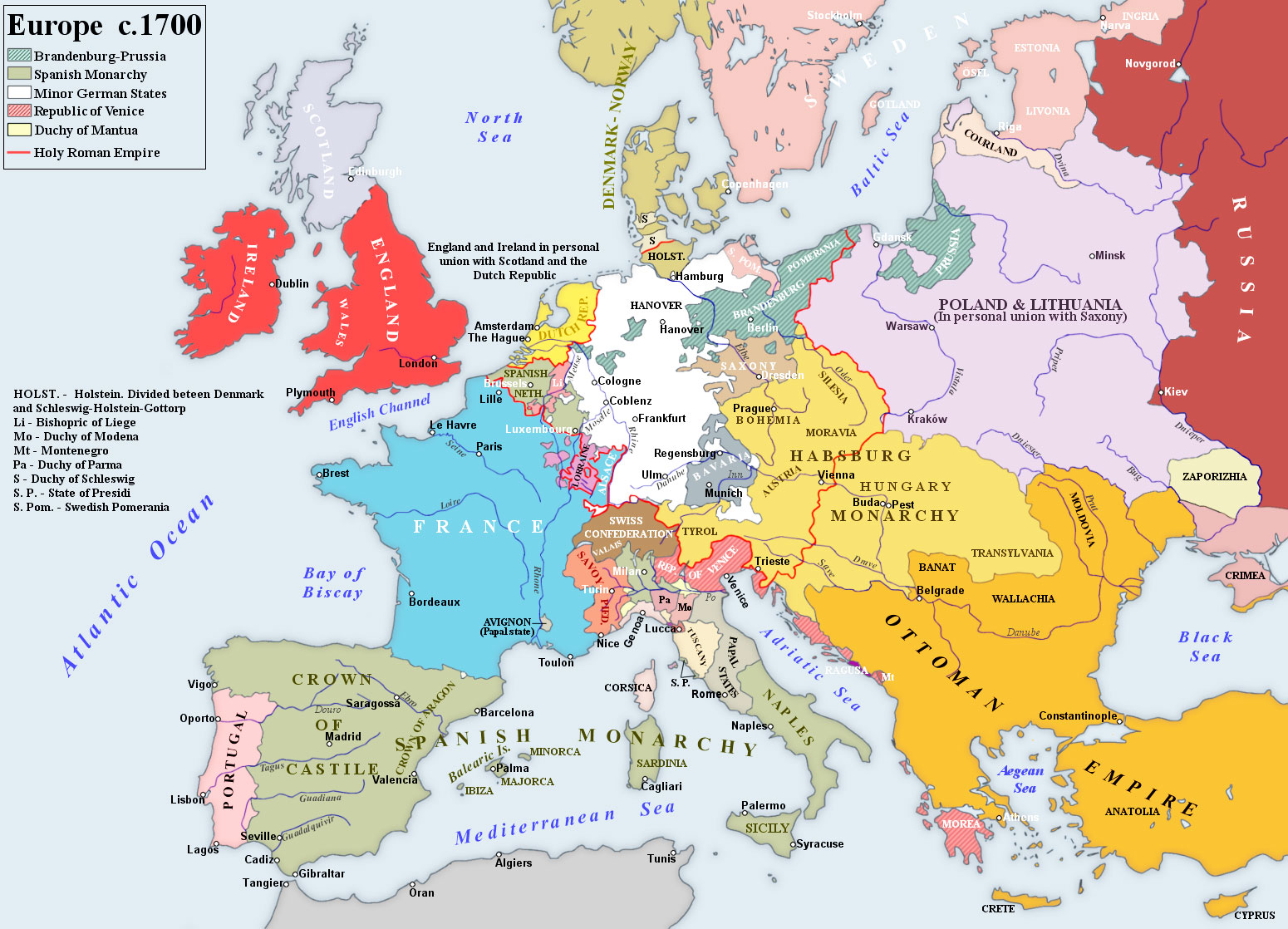
of Janus might have been closed. Peace reigned throughout the civilized world.
The treaty of Ryswick, concluded in 1697, had established harmony between
France, Great Britain, the German Empire, Holland, Italy, and Spain. Germany
had become pacified with Turkey by the treaty of Carlovitz;
and a truce for thirty years had been concluded between the Sublime Porte and
the Czar of Russia. In the west of Asia, Aurungzebe reigned without a rival in India, and Kang-he governed in peace the vast Tartar
regions. In military reputation, France was recognized as the leading power,
and Louis XIV was in the zenith of his glory. Great Britain, having secured her
civil liberties, had reappeared upon the battlefields of Europe, under her
constitutional king, William III, who was acknowledged to be the first general
of the age. As Stadtholder of Holland, he had exalted himself to a high
influence in Europe before he obtained the crown of Britain. But his British
soldiers had displayed their ancient prowess at Steinkirk,
Landau, and Namur,—names which will live for ever in the bloodless campaigns of
Uncle Toby and Corporal Trim. Russia may be said to have entered the family of
nations on this very first of January, when the Czar Peter I having just
returned from the workshops of Holland and England, established the European
calendar of time. Her envoys had already penetrated to the Western courts, and
opened negotiations with them; but till this period she had been considered more
Asiatic than European.
1. A British Fleet sent to the Baltic.
So strong was the feeling and expectation of peace,
that the British Parliament called upon their sovereign to reduce his standing
army at the beginning of this year to 7000 men, and the sea forces to 8000.
Nevertheless, in the month of May a fleet consisting of thirty sail, English
and Dutch, was placed under the command of Vice-Admiral Sir George Rooke, and despatched to the Baltic. A confederacy had been entered
into between the Northern powers to oppress and annihilate the young King of
Sweden, and Charles XII had appealed to the sovereigns who were bound by treaty
to assist him, alleging that without any just cause the czar and the King of
Poland had made war upon him.
2. War between Denmark and Sweden.
Without any public declaration of war, 40,000 Saxons,
under General Fleming, suddenly sat down before Riga, on March 12, and summoned
the Count Von Dahlberg, who commanded in the place for the King of Sweden.
Dahlberg replied that he was prepared to defend it. As soon as Charles XII
heard of this transaction, he appealed, as has been already stated, to the
protecting powers, and on the 13th of April he issued a proclamation to his
subjects calling, on them to stand to their allegiance to him. He next equipped
a fleet of forty-two sail, manned with 14,000 men, to unite with Sir George
Rooke’s force; and also despatched 26,000 or 30,000
men under General Ferson to the succour of Riga. The
Danes, at this time, kept the sea with a power much superior to the Swedes, and
at first they thought to endeavour to hinder the
junction of the confederate squadrons: but as it was their whole strength, they
dared not risk losing it, and accordingly withdrew it into the port of
Copenhagen. On the 20th of July, Sir George Rooke arrived before that capital,
and immediately bombarded the fleet under the castle. The young king witnessed
this, his first feat of arms, from the deck of the great Swedish ship, “The
Royal Charles,” said to have been the largest vessel of war that had till then
been built, and carrying 120 guns. But it did not suit the temperament of
Charles XII to be an idle spectator of war—burning to flesh his maiden sword,
he made a descent with some of the crew on the isle of Zealand, and, with
characteristic impatience, he is said to have jumped out of the shallop that
took him towards the shore, up to his middle in the water, and placing himself,
sword in hand, at the head of his men, would have marched forthwith on
Copenhagen. But Sir George showed himself, on this occasion, to be as good a
politician as he was a warrior. He displayed the greatest firmness in enforcing
the resolution of is sovereign to procure an equitable peace for Sweden; but be
would not permit the young and impetuous monarch to make use of the power he
had brought to his aid towards his own aggrandizement; and on the 18th of
August he presented a treaty, which he made both Danes and Swedes accept at Travendahl.
4. War between Sweden, Poland, and Russia.
From Copenhagen, therefore, the King of Sweden
hastened to Riga, but he found that the King of Poland had already raised the
siege. This sovereign had come in person, on the 4th of July, and sat down
before it, but, in deference to the King of England, he now drew off his forces
and marched them away. He was, however, no party to the treaty of Travendahl, but resolved to unite with the Czar Peter, who
now openly declared war against Sweden. In the month of October, this monarch
advanced to besiege Narva, with an army of 70,000 foot, 25,000 horse, and an
immense train of artillery. The young king placed himself at the head of his
whole army, consisting of but 16,000 foot and 4000 horse, which he transported
by water, in 200 vessels, and landed at Pernau.
Thence, on the 15th of November, he pushed forward to Revel. He instantly
placed himself at the head of his cavalry and some 4000 infantry, and marched
in search of his enemy. He soon came up with an advanced guard of about 5000
Russians, strongly posted amidst the rocks of a defile, supported by a corps of
20,000 men behind it. This advanced guard no sooner saw the Swedes than it
turned about and fled, carrying disorder into the main body.
Delighted at his first success, Charles determined to
attack the 24,000 Russians before him, with all their cannon, without waiting
for his troops to come up to him. Some of his veterans remonstrated with him on
the risk of such a proceeding, but he replied, with coolness and with greater
judgment than usually marked his character, “Surely I have two advantages over
the enemy; one, that my troops are superior, and the other, that the position
they occupy is too narrow for their numbers.
The king, after resting his army a short time,
prepared to give battle, but first ordered public prayers to be offered up by
the whole of the troops. He then formed them in review order, and thus
addressed them, “Behave yourselves like brave men, and be not daunted with the
great body of the enemy; be convinced that God, the protector of right, will
not fail to strengthen us, provided we do our duty and confide in Him. I desire
no more from you than what I will do myself. I will show you the example ; you
have only to follow it.” This short exhortation had all the effect the king
desired. The soldiers cried out together, “We are ready to live and die with
“you.”
5. The Battle of Narva.
It was near midday on the 36th of November when the
King of Sweden advanced upon the Russian intrenched camp with the troops and
guns that had been brought up. A furious snow-storm blew right in the enemy’s
face, which so blinded them, that they thought the Swedish artillery, which
only consisted of ten guns, admirably placed and well served, was more numerous
than it was. The czar had the advantages of the services of the Duke de Croi, a
Frenchman, Generals Allard, Weide, and other German officers of distinction,
by whose advice and judgment he had posted his troops; but he himself was at
the moment gone back to bring up the remainder of his army. In the mean time
the Russian intrenchments were breached, and the Swedes, headed by their
intrepid king, poured in through them. For an hour and a half the Muscovite
soldiers stood firm; but they then turned and fled. Charles, at the head of the
4000 or 5000 men he had with him, pursued the whole Russian host as far as the
bridge across the river. He was always in the van, one horse had been shot
under him, and he received a spent ball in the neck, which rested in the folds
of his cravat. The bridge broke under the flying fugitives, and thousands were
drowned. All order was at an end, and General Dolgoruki refused to receive orders from the Duke de Croi and the foreign generals. The
consequence was that almost all of them delivered up their swords. The young
conqueror of eighteen years of age received them with a courtesy and politeness
that would have become a sovereign of maturer years. He returned their swords
to the Duke de Croi and the superior officers, and ordered them money for their
immediate expenses. The inferior officers and soldiers, he, more generously
than wisely, set free to rejoin their companions, after depriving them of their
arms; so that they immediately rejoined the czar’s army. Night now approached;
but the king found that there was still a considerable body of men who
maintained their position on one flank of the camp. He immediately seized the
Russian artillery he had captured, and placed them in position to dislodge this
force at break of day; whilst in the meanwhile he wrapped himself in his cloak,
and laid down to sleep. But at two in the morning, General Vede, who commanded
this corps of the enemy, sent in to solicit his Majesty to accept his
submission; and whilst it was yet dark, these troops, many thousands in number,
defiled before the king, laying down their arms and their colours,
and passing across the river. If these might be called prisoners, they were
four times more numerous than the conquering army, whose whole loss in the
battle did not exceed 1200 men, whilst of the Russians those who were killed
and drowned were estimated at 6000 men. The consequences of this victory to the
King of Sweden were immense. He had advanced without any regard to supplies;
now magazines, vessels of transport full of provisions, and a large extent of
country from whence to draw further supplies, were obtained for his army,
together with an immense amount of arms and ammunition, whilst he had at once
obtained for himself the prestige and the reputation of a first-rate general.
The czar, hastening up with his reinforcements, learned midway the result of
the battle, but he felt it would be unwise with his inexperienced troops,
however numerous, to attempt to recover his ground against an army better
disciplined than his own, and flushed with victory. He was nevertheless
unshaken under this adversity. “ I knew very well,” said he, “that these Swedes
would beat me at first; but we shall in the end learn to conquer them.”
6. Death of Charles II, King of Spain. Louis XIV
seizes the Spanish Netherlands.
ON the third of November, 1700, died Charles the
Second, the last male of the austrian dynasty, which had governed Spain from the death of Ferdinand and
Isabella to the period at which these Memoirs commence.
The king had scarcely expired, before the ministers
and officers of state assembled, according to antient custom, to examine and
publish the royal testament. As this was a new era in the History of
Spain, and as general anxiety prevailed to know the new sovereign, the
palace was crowded with people of all ranks, and the antichamber filled with the foreign ministers
and principal courtiers, all eager to receive the
earliest intelligence. At length the folding doors being thrown open,
the duke of Abrantes appeared, and a general silence ensued to hear the
nomination. Near the door stood the two ministers of France and Austria, Blecourt and Harrach. Blecourt advanced with the confidence of a man who expected a declaration in his favour;
but the Spaniard, casting on him a look of indifference, advanced to
Harrach and embraced him with a fervour which announced the most
joyful tidings. Maliciously prolonging his compliment, and repeating
his embrace, he said, “Sir, it is with the greatest pleasure—Sir, it is
with the greatest satisfaction—for my whole life— I take my leave of the
most illustrious House of Austria.”* The embassador,
who during this strange address had already begun to express his own
satisfaction and promise the future favour of his sovereign, was
thunderstruck with the malicious unexpected insult; and it required all
his firmness to remain and hear the contents of the will, which
overthrew the hopes and baffled the plans of his imperial master.
Blecourt retired exultingly to announce the joyful news of the
nomination of a french prince, and the same day
dispatched an abstract of the will, with which he was instantly supplied
by the zealous care of Portocarrero.
This celebrated testament consisted of fifty-nine
articles. The first eleven related to matters of religion and internal
government; the twelfth to the succession of the issue of Charles should he
leave heirs. This served as an introductory clause to the thirteenth and
fourteenth articles, which contained the dispositions for the
transfer of the monarchy to a new sovereign.
The will declared Philip duke of Anjou, second son of
the dauphin, heir of the whole Spanish monarchy; in case of his death
without issue, or accession to the french crown,
entailed it on his brother the duke of Berry, on the same condition;
next on the archduke Charles, second son of the Emperor, with a similar
provision against its union with the austrian dominions; and finally on the duke of Savoy and his heirs. The
testament recommended the immediate successor to espouse one of the
archduchesses. Should the new king be a minor or absent,
the administration was vested in a junta or council of regency,
consisting, as was customary, of the queen as president, and the principal
members of the church and state; namely, the primate archbishop of
Toledo, cardinal Portocarrero; the inquisitor-general, Don Balthazar de
Mendoza; the presidents of Castile and Aragon, Don Manuel Arias, and the
duke of Montalto; and the representatives of the grandees and council
of state, the counts of Benevente and Frigiliana.
The object of the will was evidently threefold: to
prevent the dismemberment of the Spanish monarchy; to obviate the danger
of uniting the two crowns of France and Spain on the same head;
lastly, to preserve the natural order of succession. The choice of a french prince was supported on the principle, that the
renunciations of the two infantas, aunt and sister of the testator, were
merely intended to prevent the union of the two crowns of France and
Spain; and that danger being obviated by the dispositions of the will, the
natural right of succession necessarily took place.
By an article of the testament, and a codicil executed
on the 5th of October, a proper maintenance was assigned to the widow queen;
and the successor of the monarchy was enjoined to confide to her the
government Of the Netherlands or any part of the Italian provinces at her
choice; or, if she preferred remaining in Spain, to grant her the government
and jurisdiction of the place where she might establish her residence.
The junta of regency instantly assumed the functions
of government; and their first care was to announce to the king of France
the decease of their sovereign and the nomination of Philip duke of Anjou.
With this communication and a copy of the will, a messenger was dispatched to
France; and he was enjoined, if the testament was refused by the french court, to proceed to Vienna and offer the
succession to the archduke Charles, in conformity with the dispositions of
the deceased prince. Meanwhile the change of government was received in
Spain with all the national sedateness; and the people waited with
anxiety, though in tranquillity, the decision which was to give them a new
sovereign.
The copy of the will was accompanied with letters from
the junta, requesting Louis to acknowledge the new monarch, and send
him without delay to take possession of the throne. The king of
France had already time to form his resolution on this important occasion;
for he had been regularly acquainted with the progress of the whole
transaction, and the intrigues of his partizans; and recent messengers had
arrived from Blecourt at Madrid, and Harcourt on
the frontiers, announcing the contents and signature of the will.
The court was at Fontainebleau when the Spanish
messenger arrived with the communication of the junta. After the solemn
professions, and engagements of Louis with the maritime. powers, he deemed
it necessary to affect some little prudery, in order to justify
his. conduct in the face of Europe. He therefore declined receiving
the Spanish embassador who was to present the will,
till he had taken the advice of his council. This body was accordingly
assembled, and consisted of the dauphin, the chancellor Pontchartrain, the
duke of Beauvilliers, chief of the council of finance and governor of the duke
of Anjou, and the marquis of Torci, secretary of
foreign affairs, The question was agitated with the same seriousness,
as if it had been a matter of real deliberation. The solitary voice
of the duke of Beauvilliers was. alone heard in favour of the treaty of
partition; the chancellor with due legal formality contented1 himself
with a simple exposition of the case; Torci calmly urged the necessity of accepting the will; and his sentiment was
briefly but strongly supported by the dauphin, who after adverting to
his own rights, declared that his. highest ambition would be gratified by
being at once the son and father of a King.
Louis, after listening with attention and complacency
to these deliberations, affected to concur in the opinion of his son, and
announced his resolution to accept the will. He communicated his
determination to the Spanish embassador in
a private audience, and transmitted a speedy answer to the junta.
“The marquis of Castel Rios,f has transmitted to us the clauses of the testament, which relate to the
succession, and the wise dispositions for the government of the kingdom
till the arrival or majority of the successor.
“The sensible grief which we feel for the loss of a
prince, whom his excellent qualities, and the strict ties of blood,
rendered most dear to us, is infinitely increased by the proofs
which he gave us at his death, of his justice arid love for his
faithful subjects, and the desire he shewed to maintain after his decease
the general quiet of Europe and the happiness of his kingdoms. We
will on our part contribute to both, answering the confidence he always reposed
in us, and conforming ourself to his intentions expressed on the
will. All our care henceforth will be to raise, by an inviolable and
strict correspondence, the Spanish monarchy to the highest pitch of grandeur.
We accept in favour of our grandson the duke of Anjou, the will of the
deceased Catholic king; our only son the dauphin accepts it
also, yielding without any reluctance the just rights of the deceased
queen his mother, and our dear spouse, as well as those of the deceased
queen our most honoured lady and mother, which were indisputably
acknowledged by the opinion of the several ministers of state and justice,
consulted1 by the deceased king of Spain. Far from reserving to himself
any part of the monarchy, he sacrifices his own interest to the desire of
reestablishing the antient lustre of a crown, which the will of the late
Catholic king, and the voice of his people have unanimously given to
our grandson. We will cause the duke of Anjou immediately to depart,
that he may the sooner give his subjects the satisfaction of receiving
a king, whom they are persuaded God has called to their throne. His
first duty ought to be, to cause virtue, justice, and religion to reign
with him, and wholly to apply himself to promote the happiness of his
people, to raise and maintain the grandeur of so mighty a monarchy to choose always,
and reward those whom he shall find in a nation so valiant and wise,
capable of serving him in his councils and his armies, and
the different departments of the church and state. We will instruct
him further in what he owes to his subjects so inviolably devoted to their
king; and what to his own proper glory. We will enjoin him to
remember his birth, to preserve the love of his country, but above all, to
maintain for ever that peace and perfect good understanding so necessary to the
common happiness of our subjects and of his own, which has
always been the principal object of our wishes; and if the
misfortunes of past conjunctures have hindered us from making it appear, we are
persuaded this great event will so alter the state of things, that every
future day will produce new occasions to shew our esteem and particular good will,
to the whole Spanish nation
This communication was accompanied with a private
letter written by Louis himself, acknowledging the services of Portocarrero
with the strongest expressions of gratitude and regard, as the person
to whom his grandson principally owed his crown. He promised his
future protection and aid, and. concluded with assurances, that the young
sovereign should be guided by his. counsels.
The political farce on the acceptance of the will was
acted at Fontainebleau; but the more pompous part of the representation
was reserved for Versailles. The king summoned the dauphin; with his
children, the dukes of Burgundy, Anjou and. Berry, and the Spanish embassador, into his cabinet, and briefly addressed
the young duke of Anjou: “Sir; the king of Spain has made you a king.
The nobles demand you, the people desire you, and I give my consent. You
are going to reign over the greatest monarchy in the world, and over
a brave people who have been ever distinguished for their honour and
loyalty. I recommend you to love them, and gain their affection, by
the mildness of your: government”. Turning to the embassador,
he added “Sir, salute your king:” and the embassador,
kneeling down, expressed his homage in a long compliment.
The folding doors being then thrown open, Louis
advanced with that air of majesty which he knew how to assume, and addressed
the courtly crowd. “Sirs,” he said, “behold the king of Spain: his
birth and the will of the late monarch have called him to the throne.
The whole Spanish nation demand him; it is the decree of Heaven, and
I yield to it with pleasure.” Again directing his speech to the
young prince, he continued, “Be a good Spaniard, this is your first
duty. But remember that you were born a Frenchman to maintain the
union between the two crowns. You will thus render both nations
happy, and preserve the peace of Europe.”
The young prince immediately received the customary
honours of royalty, with the congratulations of his family and the court: and
the short interval before his departure was employed by Louis in
preparing him for the duties of his new station.
Repeated solicitations from the regency announced the
impatience of the nation to hail their new monarch, and expatiated on the
danger of giving time to the austrian adherents to
recover from their surprise and consternation; and Philip was publicly
proclaimed at Madrid as soon as the acceptance of the will was
notified. These representations induced Louis to hasten bis
departure.
On the fourth of January the new sovereign departed
from a court which he was never more to revisit. He had a long conference
with his grandfather, and afterwards attended the solemn celebration
of mass, with the whole royal family, amidst a vast concourse of
spectators. After this ceremony, the royal party quitted Paris in
the same carriage, with a cavalcade unusually numerous, and proceeded
through applauding multitudes to Sceaux, which was destined as
the place of separation. At taking their last leave, the force of
nature overbore all the dictates and forms of policy, and the parting was
long, affecting, and tender, accompanied with tears and expressions
of mutual sorrow.
At the moment of separation Louis presented the
princes of the royal house to Philip with the memorable address. “Behold,”
he said, “the princes of my blood and of yours. The two nations
should consider themselves but as one; they ought to have the same
interests; and therefore I hope that these princes will be as much
attached to you as to me. Henceforward there will be no Pyrenees.” Words which
announced to Europe the alarming effects to be expected from the union of
these two great monarchies in the same family.
After a short retirement to calm their emotion, Louis
returned to Versailles, and the dauphin repaired to Meudon.
Philip took the route to Spain, accompanied by his two brothers till
he reached his own frontier. Their progress was marked with all the
honours which a loyal nation could pay to the grandson of its sovereign,
and to a prince who added the lustre of a second crown to the
splendour of the House of Bourbon. The royal party descended the Garonne
in magnificent barges to Bourdeaux, where the constable of Castile,
deputed as extraordinary embassador from the new
government to Louis, presented his respects and homage to his
future sovereign. Prom hence they proceeded by Bayonne and St. Jean
de Luz, and took leave of each other in the Isle of Pheasants, that
memorable spot where the treaty was executed with such solemnity, which
was to exclude the House of Bourbon for ever from Spain, but
which now witnessed the breach of that solemn engagement.
Here all the french took
their departure, except the duke of Harcourt, the marquis de Louville, and the count d'Ayen;
and the young monarch, on the limits of his new kingdom,
was surrounded by a splendid suite of Spanish courtiers, who conveyed him
in a magnificent barge across the Bidassoa.
It is a singular proof of the nature of the government
and the situation and temper of the people, to observe, that amidst all
this splendour, the royal equipage was not only deficient
in magnificence, but even in convenience; and that the king received
only 1,000 pistoles for his journey, While 12,000 had been granted at
the same moment to the constable embassador. Curiosity,
respect, and affection, in some degree, compensated for this deficiency;
for in every part of his passage he was greeted by exulting and
admiring crowds, who were captivated by his youth and animated
countenance, which formed a pleasing contrast to the
premature decrepitude and doleful appearance of the deceased
sovereign.
During his journey he followed the injunction which he
had received from Louis, to take an opportunity of discarding the widow
queen. The pretext for her dismission was furnished by a quarrel
between her and the leading members of the junta. To her complaints Philip
returned a cold and formal answer. “ Some persons” he observed, “having
attempted by different methods to disturb the good intelligence which
I hope to maintain with your majesty, I deem it necessary for the
quiet of both that you should quit the court till I have investigated the
matter. I have given orders that you shall be treated with all due
respect; you shall receive the dowry assigned to you by the late king, and
you have my permission to choose any town of Spain for your residence”.
She lingered for some time, but the continual mortifications which she received
from Portocarrero drove her to Toledo before Philip reached the capital.
Philip arrived at Madrid on the 18th of February, but
as the preparations for his public assumption of the government were not
completed, he took up his temporary residence at the palace of Buen
Retiro. On the 21st of April he made a triumphal entry, with a
magnificence Calculated to flatter a chivalrous and high
spirited nation, and to display all the splendour of a crown esteemed
by its subjects the most powerful in the whole Christian world.
The eyes of Spain and of Europe were turned to the
young king, who was to form the commencement of a new dynasty, and whose accession
was a new sera in the political history of modem times. Philip had just entered
the seventeenth year of his age, and at a time when the ardour and
petulance of youth exert their full force, was of so sedate or so docile a
character, as to justify the remark of his governor the duke of
Beauvilliers, that his royal pupil had never given him a moment of
uneasiness or contradiction. With this pliant disposition, bred up in a bigotted and monotonous court, where every thing bore the stamp of submission, and bent before the nod of the great
monarch, Philip had learnt to regard the person and will of
his grandfather with a respect almost bordering on adoration. He had
imbibed also, a deep and awful sense of religion, and in his whole
conduct and deportment displayed a moral purity and scrupulous
decorum, which are rarely found in courts. A slight deformity of person
was compensated by his prepossessing countenance; but he was stiff in his
manners, and his good qualities were concealed by extreme timidity,
and ignorance of the world. The difficulties and dangers of his
situation were too mighty even for a prince of superior capacity and
mature? age; and therefore, as the defects pf his character were known, every
precaution was necessary to watch over and direct his conduct,
As the primary object of Louis was not a mere
disinterested regard for the elevation of his grandson, but a desire to exclude
a hostile family, and employ the power, resources, and territories of
Spain for the aggrandizement of his own kingdom, the means and persons who
were to direct the movements, and fashion the character of Philip,
were all adapted to the attainment of this end. The first instructions
given by the monarch to his pupil and grandson, amidst much trifling
and common place advice, contain the outlines of that system which time
and events were to mature and complete.
“Fail in none of your duties, especially towards God.
Preserve yourself in the same purity as you have been educated. Promote
the honour of God wherever you have power, seek his glory, and give
an example; this is one of, the greatest benefits which kings can confer..
“Declare always for virtue and against vice.
“Have no attachment to any person.
“Love your wife, live well with her, ask such a one of
God as will suit you. I do not think you should take an austrian.
“Love the Spaniards, and all the subjects attached to
your crown and person. Prefer not those who flatter you most, esteem those
who for your good hazard your displeasure; these are your true
friends.
“Cultivate the happiness of your subjects, and for
this cause enter into no war except compelled, and after having well considered
and weighed the motives of it in your council.
“Endeavour to restore your finances; watch over your
Indies and your fleets; remember commerce; live in a close union with
France; nothing being so advantageous for our two powers as an union
which nothing can resist.
“If you are compelled to make war, head your armies.
Endeavour to re-establish your troops everywhere, and commence with
those of Flanders.
“Never quit your business for your pleasure, but lay
down rules to yourself which will give you time for liberty and
recreation.
“There is none more innocent than the chace, and a taste for a country residence, provided
they lead you not into too great an expence.
“Give great attention to business when you are spoken
to; at first listen much without deciding.
“When you have acquired more knowledge, recollect that
it is your business to decide, but whatever may be your experience, listen
always to the advice and arguments of your council before you come to
a decision.
“Do everything that is possible to discern the persons
of most consideration, in order to employ them on proper occasions.
“Endeavour to employ Spaniards as viceroys and
governors.
“Treat all welt say nothing unpleasant to any, but
distinguish persons of quality and merit.
“Show your gratitude to the late king and those who
were inclined to choose you as his successor.
“Place great confidence in cardinal Portocarrero, and
testify to him your approbation of his past conduct.
“I think you ought to do something considerable for
the embassador who has been so fortunate as to demand
you, and to salute you first in quality of subject.
“Do not forget Bedmar, who is a man of merit, and
capable of serving you.
“Place an entire confidence on the duke of Harcourt,
he is a man of talents and probity, and will only advise you for your own
sake.
“Keep all the french in due
order.
“Treat your domestics well, but not with too much
familiarity, and still less with confidence; employ them while they are
prudent, dismiss them on the slightest fault, and never support them
against the Spaniards.
“Have no intercourse with the queen dowager more than
you can avoid; contrive that she may quit Madrid, but not retire from Spain. Whereever she may be, observe her conduct, and prevent
her from interfering in any business; suspect those who haye too much
intercourse with her.
“Love your relations, recollect their concern at
losing you; maintain an intimate connection with them both in important
and little matters ; ask of us what you want or desire to have,
which you do not find in Spain; we will do the same towards you.
“Never forget that you are a frenchman,
and that which may happen to you. When you have children to secure the
succession of Spain, go to Naples and Sicily, pass to Milan, and come
into Flanders. This will be an opportunity to see each other again.
Meanwhile visit Catalonia, Aragon, and other places; see what is to
be done for Ceuta.
“ Throw some money to the people when you are in
Spain, and particularly on entering Madrid.
“Do not appear to be struck with strange figures;
beware of ridiculing them; each country has its own manners; you will be
soon accustomed to what at first appears the most surprising.
“Avoid as much as possible conferring favours on those
who give money to obtain them. Give at proper times liberally, and receive
few presents, except trifles. If you cannot decline them, make more
considerable ones in return, after an interval of a few days.
“Have a casket to bold particular things, and keep the
keys yourself.
“I end with one of the most important precepts which I
can give you. Suffer not yourself to be governed; be master'; have neither
favourite nor prime minister. Listen, consult your council, but decide.
God, who has made you a king, will give you the necessary knowledge while
you are guided by good intentions”.
Philip literally obeyed these instructions. He placed
his full confidence in Portocarrero; he suffered him to assume the power
of forming the new ministry, of gratifying his personal or political
antipathies, and filling at his pleasure all offices and appointments of
state ; and from the commencement of his reign Philip was the king of
a party and the vassal of France, to whom he principally owed his crown.
1700—1701.
Meanwhile Louis had taken every imaginable precaution
to prevent opposition on the part of the other powers of Europe, and
to secure the acknowledgment of Philip in the Netherlands and in
Italy. He had found means to gain the prince of Vaudemont,
governor of the Milanese, though an austrian subject, and recommended by the king of England as a confidential general,
whose assistance might contribute to secure that duchy for the House
of Austria; he was equally successful with the duke of Popoli,
viceroy of Naples, who owed his appointment to a similar motive; and he was
assured of the fidelity of the elector of Bavaria, who exercised the
government of the Netherlands. Philip was accordingly proclaimed in the
exterior provinces with the same tranquillity as at Madrid.
Louis, however, was fully convinced that he could
never pacify the emperor and the maritime powers, nor quiet the alarms which
they justly conceived at the addition of the Spanish monarchy, to the
overgrown power of France. As he foresaw, therefore, that the possession
of the Spanish crown must ultimately depend on the decision of arms,
he had spared no pains to commence a contest with advantage, even
before the death of Charles; and he hoped by a prompt and vigorous
effort to bring it to a speedy and successful issue. He had gradually
collected a powerful army on the Spanish frontier; and the duke of
Harcourt, possessing the advantage of local knowledge and connections, was
intrusted with the command, with orders to seize the frontier places, Pampeluna, Fuentarabia,
and St. Sebastian; and force a way into the peninsula, should there be the
slightest doubt of a peaceable submission to Philip. To maintain the
internal tranquillity, and cut off all direct support of the disaffected,
Louis by threats and promises prevailed on the king of Portugal to
acknowledge the new sovereign, and conclude an alliance with the House of
Bourbon.
He at the same time secured an entrance into, Italy by
negotiating a marriage between Philip and a princess of Savoy, and by
promising the duke the supreme command of the army which was to act
in Italy. He likewise obtained permission to introduce a french garrison into Mantua, the citadel of Lombardy, and the key of the
principal military passage from Germany.
But it was against the maritime powers and the emperor
that he employed the best combined and profoundest precautions. As Holland
and the Netherlands formed the connecting link between England and
Austria, and as security on that vulnerable quarter of his empire
would enable him to pour his principal force into Germany and Italy, he
exerted all the resources of his policy to become master of the
Netherlands, which opened a way into Holland, and gave him a valuable
extent of coast on the channel. With this view he had secretly tampered
with the elector of Bavaria, and even before the death of the late
king had obtained his nomination to the government of the Netherlands, and
had stationed an army on the frontier ready to invade them at the first
signal.
It will be sufficient barely to mention that he was
assured of deriving the used advantages from the support of the electors and
princes of the Rhine; that he fomented the incurable jealousy of the german states against the emperor, and was secretly
favoured by many who hoped to profit by times of confusion, and
only waited for an opportunity to sell their services on the most
advantageous terms.
He did not however so for despise public opinion as to
suffer his glaring violation of the most solemn engagements to appear
without justification. He notified in form the accession of Philip to
the states of Europe; and in particular he addressed a private letter written
with his own hand to William, whom he had duped and betrayed to the
last moment, by declaring that he would abide by the treaty of
partition whatever might be the disposition of the king of Spain.
This artful and plausible apology contained the substance of the arguments
which he advanced on this memorable occasion. He justified, bis
acceptance of the will by declaring that the treaty of partition was not
calculated to answer the view with which it had been concluded, the
maintenance of public tranquillity. It had, he urged, been rejected by the
emperor, one of the principal parties, and was scarcely approved even
by those who were eager for its ratification. The english and dutch had expressed strong dissatisfaction with
its general tenour, and in particular with the union
of chap. Naples and Sicily to France, as highly detrimental to their
commerce. If he had rejected the will, the whole succession would have
instantly devolved on the archduke Charles, who was eager to accept it;
and the Spaniards were so unanimously determined to oppose the
dismemberment of their monarchy, that it would be necessary to extort
their acquiescence by force. Hence a war must have been
undertaken not only to wrest the crown from the archduke supported by
the whole Spanish nation, but to secure the share of the dauphin, and to
fulfil the other provisions of the treaty. The quota of ships to be
supplied by the maritime powers, would not suffice for this purpose; and it
was doubtful whether they would incur additional expence,
or furnish a more effectual support. The treaty of partition, he added,
was more advantageous for France than the acceptance of the will; and
therefore he hoped, and trusted that the same good understanding would
continue to subsist between him and the maritime powers, and that he
should not incur blame by adhering to the spirit, rather than the letter
of the treaty; because the acceptance of the will tended more to the
maintenance of the general peace, and obviated that danger to the balance of
power, which would have resulted from a partition.
A similar apology was at the same time addressed to
the dutch, accompanied by a letter to the french embassador the count de Briord, in which the same arguments are repeated, and
accompanied by suggestions calculated to raise disunion between the maritime
powers and Austria.
“You will speak in the same manner to the pensionary
as to the english ambassador. Shew him that, as
the emperor is not engaged, there can be no security for the execution of
the treaty. And truly this embarrassment would never have occurred,
if the king of England and the States General had strongly pressed the
emperor to sign, instead of flattering him with secret hopes that he
would not be forced to comply; if they had taken more active measures
towards the duke of Savoy; if they had acted with better faith
in causing the princes of the north and of the empire to enter into
the guaranty; finally, if they had settled in time the aids necessary for
the execution of the treaty.
“But we must not yet reproach them; it will suffice to
speak to the pensionary as I mark to you in this letter; and to follow the
sense of the memorial. You may even shew him this paper without
leaving a copy.
“You will inform the Spanish embassador at the Hague that I enjoin you to communicate the orders you have
received, to him. The zeal which he has always shewn for the service of
his sovereign, leaves me no reason to doubt that he will join with
you and give you all the necessary information for the good of the Spanish
monarchy. Assure him that I have at present nothing in view but to
maintain its perfect integrity in all its parts ; communicate to him also
the copy of my answer to the council of regency”
Such flimsy apologies were not however sufficient to
pacify the resentment of William, nor to dissipate the alarms of both the
maritime powers; lest the accession of Philip should furnish an
opportunity for the usurpation of the Spanish Netherlands by France. The
correspondence of William, with his friend the pensionary, displays his feeling
under the impression of the moment, and shews his motives for concluding
the treaties of partition, which were long considered as the reproach of
his policy.
The unexpected tenor of the Spanish testament, and the
foresight and promptitude of Louis, struck a temporary panic into the
principal courts of Europe. In England he found a violent and clamorous
faction ready to aid his views, reechoing his
fallacious arguments, drowning all consideration of honour or policy with the
cry of peace, and baffling all the attempts of William to rouse the
people to a sense of their danger.
In Holland the dread of impending ruin excited an
unanimous sentiment of indignation against France. Preparations were made
for hostilities; and subsidiary alliances concluded with Denmark, the
elector Palatine, and several of the german states. But Louis had too perfectly matured his schemes to give time
for this spirit to acquire strength and consistence. By the
connivance of the elector of Bavaria he introduced his army into the
Netherlands; be surprised all the frontier fortresses, and
captured 15,000 dutch troops by whom they were
garrisoned in virtue of the barrier treaty with Spain. With this
advantage, it was not difficult to negotiate with a rich and timid nation. The
fear of an immediate invasion, and an anxiety to liberate the captured
troops, extorted from the dutch government an
acknowledgment of Philip as sovereign of the whole Spanish
monarchy. The parliament and nation of England constrained William to
follow this example.
In the midst of this universal submission, the emperor
alone displayed a spirit worthy of a powerful and enlightened sovereign.
Leopold was confounded at the bequest of Charles, which he confidently expected
would prove in favour of the archduke Charles; but he expressed his
indignation with more vehemence than seemed congenial with his character; and
his resentment was rapidly communicated to his subjects,
who respected his dignified feeling, and shared in his disappointment.
He issued a bold and vehement remonstrance against the
usurpation of the Spanish monarchy by a french prince, and at once questioned the authenticity of the will itself, and
the right of the deceased monarch to make a disposition contrary to the
acknowledged claims of his family and the solemn obligation of treaties.
The imperial embassador, Harrach, after
presenting this protest, immediately withdrew from Madrid. The court of
Vienna made vigorous preparations to bring the dispute to the test of
arms. Levies took place in every part of the hereditary dominions,
and ministers were dispatched to rouse the maritime powers and the princes
of the empire. As Italy was considered the only theatre where Austria
could contend with France on equal terms, troops were collected in the
Trentin and the neighbouring districts; and emissaries sent to form
an imperial party in the Milanese, to excite an insurrection in Naples,
and to prepare the way for the military operations. Although these efforts
foiled in their immediate effect, yet the emperor confided in their
eventual success. He was encouraged also by the rising discontents in
Spain, and the secret suggestions of William and the dutch ; he hoped by a bold and fortunate effort to dissipate the
general alarm, and rouse the other powers of Europe to a sense of
their honour and interest.
Meanwhile the internal situation of Spain began to
attract the attention of the different powers who were likely to be
involved in the impending conflict. Portocarrero had
actively employed the interval since the accession of Philip to
strengthen his influence, and disgrace those whom he either feared or
disliked, under the pretext of partiality to the cause of
Austria. Besides the forced retreat of the widow queen, he had
induced Philip to confirm the exile of Oropesa, procured the disgrace of
the grand inquisitor, deprived the admiral of Castile of his office of
mayor domo mayor, iu favour of the duke of
Medina Sidonia, and repulsed all his overtures for an accommodation with
the new government. He transferred the different provinces to his
creatures or flatterers, and particularly that of Catalonia, from the prince of
Darmstadt to his nephew, the count of Palma. He urged Philip to exile many
of the grandees who were obnoxious to his power, and he did not disdain to
comprise in his list of proscriptions, the confessors of the late king,
and of the widow queen. Lastly, he extended his system of patronage over
every department, and placed his dependent ecclesiastics in situations for
which their acquirements and character were totally unfit. On this
subject Louville sarcastically observed to Torcy, “Remember you will have priests proposed for
the presidency of Castile. We have a priest governor of Mexico, and
one aged seventy, who conducts our commerce at Seville, with the
success which you see. As the presidencies of the councils become
vacant, priests will be proposed to fill them, and I do not despair
of seeing a similar nomination to the command of armies and fleets, when
we have them”
Although the accession of Philip had been unexpectedly
tranquil, a spirit of opposition soon manifested itself against the new-
government. While Portocarrero was giving the reins to his ambition
and vengeance, the french king was employed with
equal activity to consolidate arid extend his influence, by a change in
the general system of administration. Under the austrian sovereigns
the operations of the government had been conducted by the respective
councils boards of Castile, War, Finance, the Indies, Marine, Grace, and
Justice; and the chiefs of these boards formed a species of cabinet
council, called the Universal Despacho. This body however was not assembled in the presence of the king; but
the real organ of the sovereign will, and consequently the prime minister
of Spain, if we may use the term, was the principal secretary of the Despacho, whose office was to register the
result of its deliberations, submit it to the king, and announce the royal
pleasure. The person who now filled this office was Ubilla, who acted
so important a part in the arrangement of the late testament.
A native Spaniard, who possessed all the advantages
attached to this office, under a young and inexperienced sovereign, could
not fail of becoming the real spring of the government. To obviate
the danger, Portocarrero and the president of Castile were admitted into
the royal presence, when the secretary of the Despacho made
his reports, and soon afterwards it was proposed to extend the same
privilege to Harcourt, the french embassador.
Louis, either confiding in the attachment of the cardinal, or willing to shew
the appearance of disinterestedness, affected to decline the proposal; but
his prudery was overcome by the repeated instances of Portocarrero, and
the conviction, that without this expedient, no human contrivance could
prevent the government from becoming purely Spanish.* In the first
novelty of a new reign the whole court, and a considerable part of the
nation, vied in their adulation of the french monarch. Portocarrero and Arias hailed him as the regenerator of Spain ;
he was requested to repair to Madrid, and assume the administration in
person; and he was respectfully informed that the air of the country
would produce a salutary effect on his health, while, in the present
tranquil state of Europe, he might govern France by means
of messengers. The same language of servility was heard in all
quarters: the inhabitants of Burgos in particular, humbly requested that
he would* honour them with a visit in the spring, when their bulls
were in high spirit, that they might gratify him with the national solemnity
of a bull-feast-
Louis received this torrent of flattery with pleasantry,
observing that the Spaniards had constituted him prime minister to his
grandson. But notwithstanding his deep knowledge of human nature, and
perfect acquaintance with court homage, it produced the effect of
deceiving him, as well as his ministers, into the notion that he
could exercise the same absolute sway in Spain as in his own kingdom. On the
other hand, the sanguine expectations which the nation had formed of the
wisdom, perfection, and energy, of the new government, were too
extravagant to be realised; and it was the .just remark of the shrewd Louville, that even should an angel descend from
Heaven to take the reins, the public hopes must be disappointed in the
existing state of Spain, gangrened as it is from one extremity to the
other.
The police and internal government were sunk into the
most deplorable disorder. Even in the very capital itself, the neglect or
incapacity of past governments had given the reins to every species
of licentiousness. The palaces of the grandees, and even the churches,
were become the asylum of crimes; the slightest rise in the price of
provisions excited the deepest alarm; every street and square was filled
with armed vagabonds, discarded domestics, people without occupation
or means of subsistence; the establishments destined to maintain the respect
due to royalty were sunk into a mere empty form, and all the dignity
of the crown had not been sufficient to preserve the late monarch from
the most mortifying insults both to his person and authority.
Similar disorder reigned in the finances. The royal
revenues were absorbed by the servants of government, or the farmers and agents
on whom its necessities reduced it to depend for supplies; and at the
same time, the people, both in the capital and provinces, were loaded
with every species of monopoly and extortion. The vast revenues of
the new world were still worse administered; the viceroys and governors,
after defrauding the crown and oppressing the subject, were suffered
to return from their governments, and enjoy with impunity the fruit3 of
their peculation and venality.
The crown was thus not only robbed of its splendour,
but reduced to inconceivable penury. The same difficulties occurred in
raising ten pistoles as ten thousand; the salaries of the royal household
were unpaid; the pay of the troops was in constant arrears, and the royal
guards were often reduced to share with mendicants the charitable
donations of convents and hospitals.
Wretched as was the internal situation of Spain, the
naval and military establishments were equally deplorable.
The two treaties contracted with Portugal and Savoy,
which were intended to secure the throne and maintain tranquillity, were
the principal causes of her ruin, from the imprudent security which
they inspired. Hence both the frontiers and distant provinces were neglected.
No care had been employed to fortify the frontiers of Andalusia, Valencia,
and Catalonia, justly considered as the keys of the peninsula. As if
there had been po prospect of war, these provinces were without
garrison and magazines; the fortifications dilapidated, even the breaches
which Vendome had made in the former siege of Barcelona were not repaired,
and from Roses to Cadiz scarcely a single fort or castle was garrisoned or
mounted with artillery. The same negligence prevailed in the ports of
Galicia and Biscay; the magazines were without ammunition; the arsenals and
work-shops empty; the art of constructing ships was lost; the royal navy
consisted only of those armed vessels which were employed in the trade to
South America, and a few galloons; six gallies, decayed with age,
were anchored in the bay of Carthagena, and seven were kept in the ports
of the genoese territory. The distant provinces
were equally defenceless. In Naples were only six complete companies,
in Sicily 500 men, scarcely 300 in Sardinia and the Balearic Isles; and in
the Netherlands and Milan, the countries the best provided against an
attack, were no more than 8,000 troops in the former, and 6,000. in
the latter.
The militia appeared only on the muster roll, and were
inexperienced and undisciplined, and the peasantry were alone obliged to
provide themselves with muskets. The whole army did not exceed 20,000
men.
Thus totally ruined within, and unprovided lor war
without, it was evident that the preservation of the crown must solely depend
on the exertions of Louis, and the measures which were necessary to
attain this object, soon dissipated the fallacious hopes inspired by the
accession of a new dynasty.
To make a merit of zeal for the public service, and to
supply the deficiency in the revenue, many places and offices in the royal
household were suppressed by Portocarrero, and among the rest, the
number of gentlemen of the bed chamber was reduced from forty-two to six.
He likewise abolished various offices in the treasury, and
the different tribunals and councils. But these reforms were more specious
than real; for the whole saving did not amount to 200,000 crowns, while
it involved numerous families in embarrassment or ruin. The reform was
therefore too contracted to produce any essential utility, and too
general not to alienate numbers attached by interest to the government,
besides weakening the bond of union, which connected numerous branches
of the inferior nobility with the throne; and the biographer of Philip justly
observes; “from this period the nobles began to assume more independence,
and to be less under the control of the court”.
In this career of reform, the sweeping hand of
Portocarrero did not spare even the pensions which the piety of former
sovereigns had granted for the subsistence of poor widows, and the
maintenance of charitable institutions. To complete the series of these
obnoxious defalcations, the soldiers, far from being won over to the
new government by the usual graces, not only derived no benefit from the
change of sovereigns, but saw even the regular payment of their
scanty pittance suspended. Such impolitic parsimony damped the
sanguine hopes of a people who expected that the accession of a new dynasty
would be marked by a profusion of benefits, and who flattered
themselves that their country would resume all its pristine splendour
without sweeping away those abuses and incumbrances which had been
accumulating for ages.
The pride and dignity of the Spanish nation were
deeply wounded by an order which imparted to the peers of France the same
rank and honours as were enjoyed by the grandees of Castile; and it
required all the influence and even the threats of Philip to extort the
acquiescence of his high spirited nobles in this odious measure
The dissatisfaction of the natives was aggravated by
the petulance of ridicule, and by the eagerness of the french to domineer in the trivial concerns of customs, manners,
and fashions; by the reform of the royal kitchen, and the
introduction of french cookery ; the occasional
use of the french costume, and the abrogation of
many parts of the antient etiquette. The impression which these trifling
innovations made on a people bigotted to their
own usages, will appear from an incident which occurred during the
preparations for the marriage.
Philip ordered the marquis of Villafranca, to whose
department the direction of such matters belonged, to deliver to a french upholsterer the tapestry, hangings, and other
ornaments used on this occasion. The rigid Spaniard did not
suffer his devotion to France to outweigh his national prejudices. He
refused compliance, and to the remonstrances of the upholsterer, replied “we must
live in Spain, as they do in Spainand nothing
but a new and positive order from the king could induce him to obey.”
The change of sovereigns led to other mischiefs, which
all the vigilance of the french court was in vain
exerted to prevent. On the accession of a french prince, Madrid was crowded with swarms of frenchmen,
of the most despicable, and abandoned characters, who were eager
to gather the fruits of the promised land. Whole tribes of harlots,
swindlers, gamesters, pickpockets, and projectors, allured thither by
the lucre of gain, vilified by their infamous conduct their native
country, and gave new force to that odium which had hitherto
operated as an insuperable barrier between the two nations.
The seeds of rebellion were diffused, and the public
grievances aggravated by the fanaticism of the clergy. The priests abused
the sacred office of confession to excite discontent, the french were stigmatised as heretics, those who were
connected with them were accused of irreligion, and even the authority of the
pope was falsely employed to give new strength to the pretensions of
an austrian prince.
All these causes contributed to excite discontent in a
nation wedded to antient establishments, and proud of former magnificence. But
the general odium was still further aggravated by the appointment of
a frenchman to the management of the finances. As
Portocarrero was himself unequal to the task of new modelling
the revenue, Louis, at the instigation of the council, sent Orri, a
man of obscure birth, who in a subordinate branch of the finances in
France had acquired a superior knowledge of political economy. He had
first emerged into notice in a situation similar to that of our excisemen.
He afterwards became steward to the duchess of Portsmouth, and being
dismissed returned to his original situation in the excise. Possessing great acuteness
and activity, he found means to render himself useful to some of the
farmers general, was employed in several commissions of
great delicacy, which he fulfilled to. the satisfaction of his
superiors, and finally attracted the notice and obtained the patronage of
the minister Chamillart. His knowledge and talents
were duly appreciated, and it was hoped that his native obscurity
would shield him from the jealousy of Portocarrero and the princess
Orsini. He was therefore selected as a proper person to investigate the Spanish
finances, and form the plan for a new system of administration. But had
it been possible for any foreigner to become popular in so odious an
office, the requisite qualities were not found in Orri. Though servile
and officious to those on whom he depended, he was haughty and
imperious to others, of an irritable and impetuous temper, and ignorant of
the manners, prejudices, and feelings of the Spanish people.
The new minister proposed extensive reforms in nature
and perception of the revenue, and endeavoured to model it on that of France,
with a precipitancy and want of address or discretion ill calculated to
conciliate the unbending firmness of the Spanish character. This abrupt
attempt to lay the axe at once to the root of all abuses, gave great
offence to every class of the nation; and the clamour was heightened
by his plans for resuming the fiefs extorted by the nobles from the crown
in times of trouble and confusion. The nobles imperiously
demanded the convocation of the cortes of Castile, the
only legitimate assembly which could authorise these innovations, and
as an additional argument, they urged the necessity of exchanging the
customary pledges between the monarch and the people, by the
confirmation of the national privileges on one side, and the oath of
allegiance on the other. The demand was supported by the more independent
members of the cabinet; and loudly re-echoed by the people, who looked
with peculiar confidence and affection to this neglected assembly. A
proposal to convene a body, which had essentially curbed the royal
authority, embarrassed the king and his personal friends and adherents. It
was refeirer to Louis, but he prudently declined
interfering, and Philip, after long deliberation, endeavoured to evade it
by
1701.
I. WAR BETWEEN THE GRAND ALLIANCE AND FRANCE. — 2. WAR
IN ITALY BETWEEN THE IMPERIALISTS AND THE FRENCH.—3. WAR IN
SCANDINAVIA. 4. NAVAL WAR. 5. DEATH OF JAMES II., KING OF ENGLAND,
AND HIS MILITARY CHARACTER.
|
|
|
The Peace of Travendal was
a peace treaty concluded at the outset of the Great Northern
War on 18 August 1700 between the Swedish
Empire, Denmark–Norway and Holstein-Gottorp in Traventhal. Denmark had to return Holstein-Gottorp to
its duke, a Swedish ally, and to leave the anti-Swedish alliance. The Danes
only reentered the war after Sweden's major defeat in the Battle of
Poltava, 1709, having used the time to reform their army. The treaty was
guaranteed by France, the Holy Roman Empire, the United Provinces (Netherlands)
and Great Britain
In 1698 and 1699, Peter the
Great of Russia, Augustus II the
Strong of Saxony and Poland–Lithuania, as well
as Christian V and his successor Frederick IV of
Denmark-Norway agreed on a three-front assault on the Swedish Empire, where
minor Charles XII had ascended the throne in 1697. Holstein-Gottorp,
just south of Denmark, was tied to Sweden by the marriage of
duke Frederick IV to Hedvig Sophia, daughter of Charles XI
of Sweden, in 1698. Danish forces entered Holstein-Gottorp in March 1700
and besieged the fortress of Tönning, while
August the Strong was advancing through Swedish Livonia
In the meantime, Sweden had negotiated the
support of the Maritime Powers, the Netherlands and the United Kingdom, against
Danish assaults on Holstein-Gottorp. Such assaults violated the Altona
convention of 1689, of which the Maritime Powers were the guarantors. In
addition, the Maritime Powers prepared for the emerging War of the Spanish
Succession and therefore opposed an additional war in the Baltic Sea. Aided
by the Dutch and British navies, a Swedish fleet deployed a 10,000 strong army
near Copenhagen. Caught by surprise and unable to defend his capital,
Frederik IV of Denmark-Norway had to make peace.As soon as the end of the war was in sight, the Maritime Powers withdrew their
vessels and made it clear that they preferred a peace at once and had no
interest in Sweden crushing and annexing Denmark.
In Travendal,
Denmark-Norway left the Great Northern War by obliging herself to not
engage in future armed conflicts with Sweden. In paragraph XIII, the king
of Denmark and Norway in his own name and the name of his successors promises
to neither engage in hostilities with Sweden nor ally with or in any way aid
Sweden's enemies, and adhere to all earlier Dano-Swedish treaties. The duke
of Holstein-Gottorp's sovereignty was restored, and the treaty detailed the
conditions under which armies and fortresses were to be maintained in the area It
was further agreed that Holstein-Gottorp be financially compensated by
Denmark-Norway for the war costs, resulting in the subsequent payment of
260,000 Reichstalers
Paragraph XIV mentions France,
the Holy Roman Emperor, the dukes of the Holy Roman Empire, and the
guarantors of the Altona convention as guarantors of the treaty. The
guarantees of the United Provinces and the United Kingdom for the
treaty were reconfirmed in a convention signed by the aforementioned parties
after Queen Anne's succession in Great Britain, 1702.
By the time of Travendal, Augustus
II the Strong's campaign in Swedish Livonia had not produced
satisfactory results. Though Dünamünde was
captured and renamed "Augustusburg", he
failed to take Riga or gain the support of the local nobility.
Furthermore, Russia's forces had not yet entered the Great Northern War,
as they were bound by the Russo-Turkish War until the Peace of
Constantinople set them free in the summer. Thus, August's reaction
to Travendal was to enter negotiations with France
and Brandenburg-Prussia and ask them to mediate a truce with
Sweden. Charles XII of Sweden, however, rejected the offer, refusing to
enter negotiations as long as Saxon forces were in Livonia. Peter the
Great took a more indifferent stance, and marched his troops towards
Swedish Ingria as agreed on in the Treaty of Preobrazhenskoye.
As soon as Denmark-Norway was out of the
war, Charles XII speedily embarked his armies and headed from Denmark to his
Baltic dominions. Russian forces entered Ingria and laid siege
to Narva in October, while August the Strong was preparing winter
quarters in Livonia. On 30 November, Charles XII’s army relieved
Narva before turning south sweeping August the Strong's forces out of
Livonia, pursuing and decisively defeating them at Kliszow and Fraustadt during the following years, forcing August
to drop out of the war in the Treaty of Altranstädt in
1706. The tide turned only in 1709, when Charles XII's last remaining
adversary Peter the Great was able to crush his army at Poltava exile
and the Swedish king to Bender in the Ottoman Empire. Denmark-Norway
and Saxony then abandoned Travendal and Altranstädt and entered the war again.
Frederik IV of Denmark-Norway used the
peace period to reform the Danish army. Instead of relying on mercenaries, the
army was now raised from peasants distributed by Danish landowners. The
mercenary force was kept and fought on the Maritime Powers' side in
the War of the Spanish Succession against roi soleil Louis XIV of France. Frederik also implemented civil reforms
such as the abolishment of serfdom. When he re-entered the Great Northern
War, the mercenaries were still fighting France, but were returned to
participate in the war in 1713.
PEACE OF RYSWICK
The Peace of Ryswick,
or Rijswijk, was a series of treaties signed in the Dutch city
of Rijswijk between 20 September and 30 October 1697. They ended the
1688 to 1697 Nine Years’ War between France and
the Grand Alliance, which included the Dutch Republic and
the Holy Roman Empire.
One of a series of wars fought
by Louis XIV of France between 1666 and 1714, neither side was able
to make significant territorial gains. By 1695, the huge financial costs,
coupled with widespread famine and economic dislocation, meant both sides
needed peace. Negotiations were delayed by the question of who would inherit
the Spanish Empire from the childless and terminally ill Charles
II of Spain, the closest heirs being Louis and Emperor Leopold I.
Since Louis could not impose his preferred
solution, he refused to discuss the issue, while Leopold refused to sign
without its inclusion. He finally did so with great reluctance on 30 October
1697, but the Peace was generally viewed as a truce; Charles' death in 1700 led
to the War of the Spanish Succession.
In Europe and North America, the terms
essentially restored the position prevailing before the war, though Spain
recognized French control of the island of Tortuga and the western
portion of Hispaniola (Saint-Domingue). In Europe, France evacuated
several territories it had occupied since the 1679 Treaty of Nijmegen,
including Freiburg, Breisach and the Duchy of Lorraine;
conversely, it retained Strasbourg.
Background
Charles II (1665–1700); his
inheritance overshadowed negotiations. The Nine Years' War was
financially crippling for its participants, partly because armies increased in
size from an average of 25,000 in 1648 to over 100,000 by 1697. This was
unsustainable for pre-industrial economies; the war absorbed 80% of English
state revenue in the period, while the huge manpower commitments badly affected
the economy.
The 1690s also marked the coldest point of
the so-called Little Ice Age, a period of cold and wet weather affecting
Europe in the second half of the 17th century. Harvests failed throughout
Europe in 1695, 1696, 1698 and 1699; in Scotland and parts of Northern Europe,
an estimated 5–15% of the population starved to death.
Although fighting largely ended in Europe
after 1695, the subsidiary conflict known as King William's
War continued in the Americas. A French fleet arrived in
the Caribbean in early 1697, threatening the Spanish treasure
fleet, and English possessions in the West Indies. England occupied
the French colony of Acadia, while the French repulsed attacks
on Quebec, captured York Factory, and caused substantial damage to
the New England economy.
Talks were dominated by the primary issue
of European politics for the last 30 years: the Spanish inheritance. By 1696,
it was clear Charles II of Spain would die childless, and his
potential heirs included King Louis XIV of France and Emperor
Leopold I. The Spanish Empire remained a vast global confederation;
in addition to Spain, its territories included large parts of Italy,
the Spanish Netherlands, the Philippines, and much of
the Americas. Acquisition of these territories by either France
or Austria would change the European balance of power.
Recognising he was not strong enough to impose his
preferred solution to the Spanish question, Louis wanted to prevent its
discussion, by dividing the Grand Alliance and isolating Leopold. In
the 1696 Treaty of Turin he made a separate peace with the Duchy
of Savoy. Other concessions were the return of the Duchy of
Luxemburg to Spain; considerably larger than the modern state, it was
essential to Dutch security. Louis also agreed to recognise William
III as monarch of England and Scotland, rather than the exiled James
II.
Formal discussions between the delegations
were held in the Huister Nieuwburg at
Ryswick, mediated by Swedish diplomat and soldier Baron Lilliënrot. Many members of the Empire, such
as Baden and Bavaria, sent representatives, although they were
not party to the treaties. Talks proceeded slowly; Leopold habitually
avoided making decisions until absolutely necessary, and since the terms failed
to address the inheritance question, he would only agree to a ceasefire. One of
the Spanish negotiators, Bernardo de Quiros, ignored instructions
from Madrid to make peace at any price, and agreed to support this
demand. Although the British initially preferred to continue fighting, William
became anxious to finalise peace. William and Louis
appointed the Earl of Portland and Marshal Louis-François de Boufflers as their personal representatives; they met
privately outside Brussels in June 1697, and quickly finalised terms, with de Quiros being overruled.
The peace consisted of a number of separate
agreements: on 20 September 1697, France signed Treaties of
Peace with Spain and England, a Ceasefire with the Holy Roman
Empire, and on 21 September, a Treaty of Peace and Commerce with the
Dutch Republic. When Charles fell seriously ill, Leopold used it as an
excuse to delay signing; one frustrated negotiator claimed I”t would be a shorter way to knock (Charles) on the head, rather than all Europe
be kept in suspense.” The Spanish king recovered, while William threatened
to dissolve the Alliance if Leopold did not sign before 1 November; he finally
did so on 30 October.
The treaty essentially restored the map of
Western Europe to that agreed by the 1679 Treaty of Nijmegen; France
kept Strasbourg, the strategic key to Alsace, but returned other
territories occupied or captured since then, including Freiburg, Breisach, Philippsburg and the Duchy of Lorraine to
the Holy Roman Empire. French forces also
evacuated Catalonia, Luxembourg, Mons and Kortrijk in
the Spanish Netherlands. Louis recognised William as king, withdrew support from the Jacobites,
and abandoned claims to the Electorate of Cologne, and the Electoral
Palatinate.
In North America, positions returned to
those prevailing before the war, with France regaining Acadia, although
in reality low-level conflict persisted around the boundaries. Conversely, in
the Caribbean Spain recognized French control of the western portion
of Hispaniola and the island of Tortuga; France had in fact
established its colony of Saint-Domingue years earlier. Meanwhile,
the Dutch returned the colony of Pondichéry in
India to France.
Aftermath
The Needle of Rijswijk erected
during 1792–1794
All sides interpreted Ryswick to be a
truce, and expected conflict to resume when Charles died. The war demonstrated
that France could no longer impose its objectives without allies. Louis
therefore adopted a dual approach of a diplomatic offensive to seek support,
while keeping the French Army on a war footing. The increase in
Habsburg power following victory in the Great Turkish War with the
signing of the Treaty of Karlowitz in 1699
was offset by the growing independence of states like Bavaria, which looked
to Louis, rather than Leopold, for support.
The war diverted resources from both
the Dutch and French navies, and although the Dutch still
dominated the Far East trade, Ryswick marked a turning point in
England’s rise as a global maritime power. Previously focused on
the Levant, its mercantile interests began challenging Spanish and
Portuguese control of the Americas, where the French struggled to compete. The
huge debts accumulated by the Dutch weakened their economy,
while London replaced Amsterdam as the commercial centre of Europe. The Nine Years’ War, together with the
subsequent War of the Spanish Succession (1701-14), marked the end of
the Dutch Golden Age.
At the same time, the determination of
the Tory majority in Parliament to reduce costs meant that
by 1699, the English army had been reduced to less than 7,000 men. This
seriously undermined William’s ability to negotiate on equal terms with France,
and despite his intense mistrust, he co-operated with Louis in an attempt to
agree a diplomatic solution to the Spanish succession. The so-called Partition
Treaties of The Hague in 1698 and London in 1700 ultimately
failed to prevent the outbreak of war between the two kingdoms.
After the death of James II died in 1701, Louis XIV proclaimed Prince James, the former heir of James II, rightful king of England, despite the treaty.
|