JAPAN'S GENERAL HISTORY
LIBRARY

|
JAPAN'S GENERAL HISTORYLIBRARY |
|
A CONCISE HISTORY OF THE WAR BETWEEN JAPAN AND CHINA1984-1985.COMPILED BY JUKICHI INOUYE.
PREFACE. The object of this little book is to give a succinct account of the progress of the war between Japan and China up to the time of its compilation. No one can be more sensible than the compiler, of the defects of a work of this kind. In writing of a war still in progress, we cannot grasp the true proportion of its events, as we are liable to be dazzled by brilliant achievements and to attach to them a greater importance than to those which, though no less vital to the accomplishment of the object of the war, fail to attract public attention through absence of stirring victories. Such, for instance, are the operations in North Manchuria, for though the retention of positions like Haiching and Funghwangching will afterwards be found to have been as indispensable towards a successful termination of the war as the capture of Port Arthur or Wei-hai-wei, we are more fascinated by the brillancy of the Japanese victories at those fortresses than by the stubborn resistance offered unflinchingly to inclement climate and harassing armies. While the size of this work frees it from the perplexity which would arise in a more complete history from the very multitude of newspaper reports, this same compactness exposes it to the sin of omission as regards those events, the important consequences of which we do not at present suspect. While recognising this fatal want of historical perspective, the compiler was led to produce the present work with the sole object of briefly recounting the principal events of the war, a survey of which is complicated by the operations of the Japanese armies in divers directions. The present work, therefore, makes no claim beyond facilitating this survey. The compiler has also studiously avoided entering into argument or treading on disputed ground, and believes that his ;compilation is at least free from rhetorical flourishes and from padding. He has with an effort confined himself to a plain, unvarnished relation, where it is so easy to let enthusiasm run riot; and whether this be a merit or otherwise, only the general interest taken in the war will probably induce the perusal of this work. In conclusion, the compiler desires to acknowledge his indebtedness to the Tokyo and Yokohama newspapers, upon whose accounts he has freely drawn in the compilation of this little history. March 10th, 1895. The publication of the present work having been unavoidably delayed, the history has been brought down in the appendix to April the 10th.
Chapter I. Causes of the War. Chapter II. Diplomatic Negotiations. Chapter III. Phungdo; Asan; and Proclamations of war. Chapter IV. Battle of Phyongyang. Chapter V. Battle of Haiyang. Chapter VI. Invasion of Chinese Territory. Chapter VII Capture of Kinchow and Port Arthur. Chapter VIII. Operations in Manchuria. Chapter IX. Capture of Wei-hai-wei. APPENDIX |
 |
CHAPTER I. CAUSES OF THE WAR.
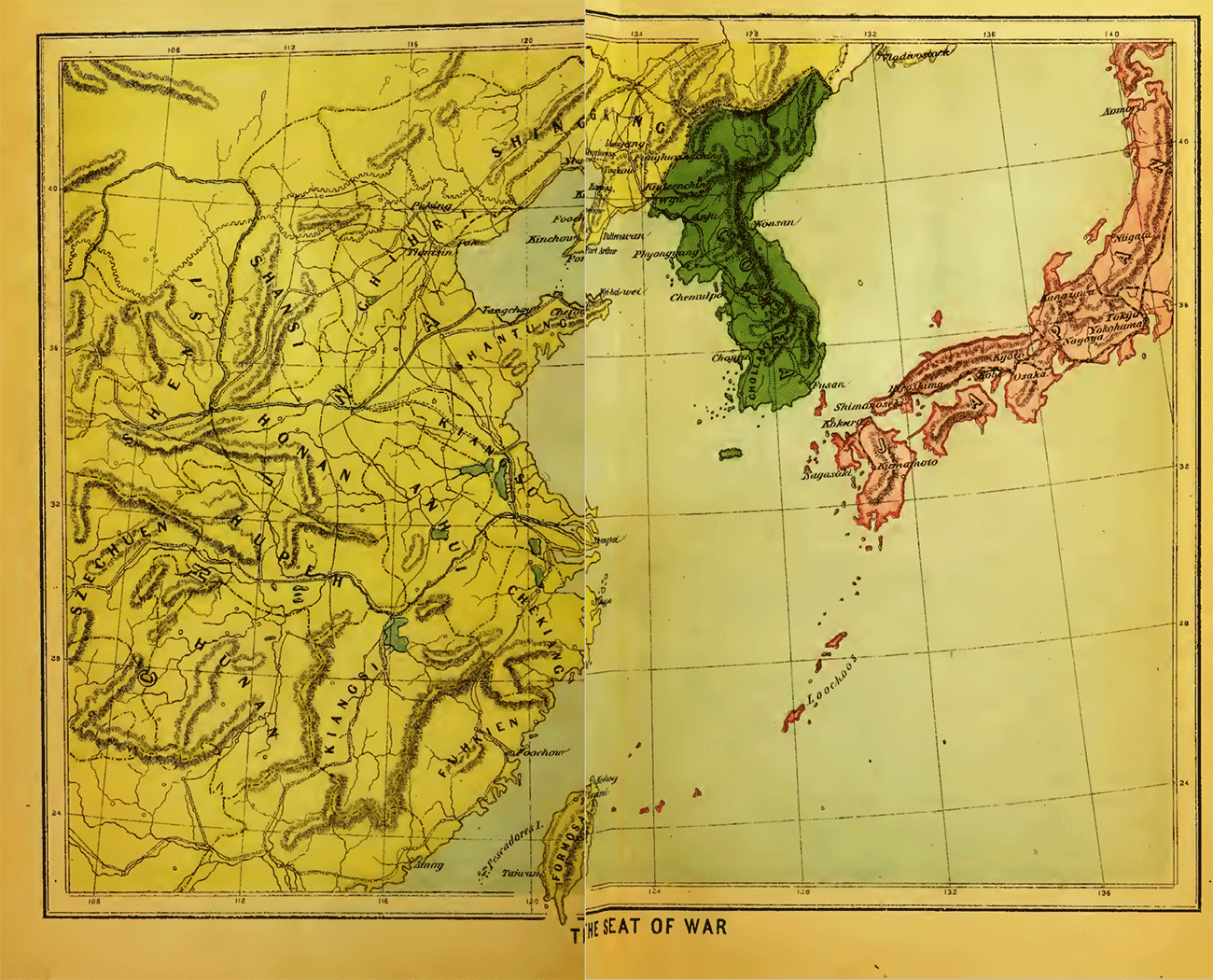
The Peninsula of Corea has always served as a buffer state between Japan and China. Leaving out of consideration the invasion of Corea by the Japanese Empress Jingo (AD 201- 269) more than fifteen centuries ago as the peninsula consisted then of three independent states, we know that the Taiko Hideyoshi’s conquest of the Land of Morning Calm in the last decade of the sixteenth century was only preliminary to the subjugation of the Middle Kingdom itself, a daring scheme which was abandoned only through the death of the Taiko. The succeeding dynasty of Tokugawa took a diametrically opposite course, and Japan passed from the policy of expansion which had been inaugurated by Hideyoshi, Date Masamune, Lord of Sendai, and others, to that of complete isolation, the Tokugawa Shoguns devoting all their energy to the perfection of that feudal system which only fell in 1868. Though, however, the Tokugawa family closed the country to foreign intercourse, they maintained friendly relations with the kingdom of Corea, which was consolidated by the founder of the present Li dynasty in the last decade of the fourteenth century. There were frequent interchanges of courtesies, and whenever a Shogun succeeded to his high office, an embassy was sent from Corea to congratulate him on his accession. The Corean Kings apparently thought that the Shogun was the true and only sovereign, and were unaware that in Kyoto there was the rightful Emperor whom the Shogun himsplf acknowledged as his liege lord. When in 1868 the Shogunate came to an end and the government of the country was restored to the lawful Emperor, envoys were despatched to Corea to announce that fact; but the Corean Government refused to receive the embassy. Further communications on the subject from the newly-constituted Imperial Government of Japan proved equally futile. Great indignation was aroused in Japan at Corea’s contumelious attitude towards her. The military class, chafing under the quiet which reigned throughout the country after the stirring war of the Restoration, were ready to seize upon any pretext for turning their idle arms abroad; and already the invasion of the Corean peninsula for its insult to Japan was mooted. But the peace party prevailed and the whole energy of the government was wisely devoted to the reorganisation of national affairs. The war spirit was, however, again aroused when, in the summer of 1873, that country offered gratuitous insult to Japan by an open declaration of its contempt for a nation which was casting off its national institutions fonthose of the Occident. In both official and private circles there was a universal cry for a military expedition to Corea. Soyejima (since created Count) was despatched to China to ascertain the relations subsisting between that Empire and the peninsula. The Chinese Government, fearing troublesome complications if it asserted its suzerainty over Corea, denied that the peninsula was its tributary state. Soyejima, on returning to Japan, became one of the leading spirits of the war party; and Saigo, taking up the cry, gave the weight of his great influence to the bellicose faction. The Japanese Government was split into two opponent camps; and the war party were about to carry the day when the Japanese Embassy which had been despatched to Europe and America to propose the revision of the treaties, returned to Japan, and cast in their lot with the peace party, whose calmer counsels finally prevailed. The leaders of the war party seceded from the Government. But the Government persevered in its peaceful work of administrative Reorganisation. Though the Japanese Government thus overlooked the insults offered by Corea on two occasions, it was not long before a third was inflicted. In August 1875, a Japanese man-of-war Unyo which had been surveying in Corean waters, anchored offthe Island of Kanghwa, at the mouth of the river flowing through Seoul, before proceeding to Newchwang, when it was fired upon from the forts on that island. The vessel replied to the attack and succeeded in burning down the castle of Yongchong on the same island. The matter was reported at once to the Government; and an embassy was sent to demand satisfaction. After much delay, the Corean Government apologised and, for the first time, concluded a treaty on the footing of an independent power, in February 1876. By this treaty, Corea opened in 1881 the ports of Inchon (or Chemulpo) and Wonsan to foreign trade, the port of Fusan having been long opened. Thus Japan was the first to introduce Corea to the world as an independent state. Meanwhile, Prince Heungson, the father of the reigning King of Corea, better known as the Tai-Wonkun, who had been acting as regent during the King’s minority from 1860 was driven out of power in 1875 by the Mins, the queen’s family, who thenceforth filled the highest offices of state. The Tai-Wonkun, tyrannical as he had been, had always done much to maintain the efficiency of the army and been indulgent to the soldiery, among whom he was consequently very popular. When the Mins came into power, these soldiers refused to obey them, and that family raised a new army drilled by a Japanese officer, to supplant the old refractory army. The latter were naturally indignant when they were given the cold shoulder; and they conspired for the restoration of the Tai-Wonkun to power. In July, 1882, they revolted and rushed into the palace where they surrounded the King and succeeded in effecting the Tai-Wonkun’s restoration. The queen whom they sought to murder as being the most important member of the Min family, had escaped from the palace and fled to Chhungju, in Chhung-chhong-do. The Japanese Minister at Seoul was compelled to fly for his life to Chemulpo, whence he was conveyed by a British man-of-war to Nagasaki. He soon returned to Corea to demand satisfaction for the attack on the Japanese Legation ; but the Tai-Wonkun hesitated to apologise for the outrage. The Minister left Seoul, and war was imminent between Japan and Corea. The Queen of Corea had in the meantime appealed to Li-Hung-chang for help, and before the Tai-Wonkun had been a month in power, an army was sent from China, the result of which was tfiat the Tai-Wonkuri was inveigled into a Chinese man-of-war and carried off to China, the Mins were restored to power, and a treaty was concluded with Japan, undertaking among other things, to pay an indemnity of 500,000 yen and consenting to Japan’s stationing troops at Seoul. All went well for two years; but in 1884, the reprisals China suffered at the hands of the French caused many Coreans to waver in their belief in China’s ability to protect their country. Though the Mins remained firm in their reliance on the Middle Kingdom, there arose two other parties in the Corean Government, one advocating an appeal to Russia for protection and the other turning to Japan for the same purpose. The last resolved to enforce their views by violent means. On the 4th December, when Hong-Yongsik, their leader, held a banquet to celebrate the opening of the Post Office at Seoul, of which he had been appointed chief, his accomplices waited outside to put an end to such of their enemies as had been invited to it. Failing in their object, Pak Yonghyo and Kim Okkiun, two of Hong’s principal accomplices, went at once to the palace and took possession of the King’s person; and early next morning, their chief enemies were summoned to the palace; but when they entered the palace gate they were assassinated. Having thus got rid of the chiefs of the pro-Chinese party, they appealed to the Japanese Minister to guard the King. The Minister went at once to the palace with two hundred Japanese soldiers. Meanwhile, the Chinese troops, numbering three thousand in all, also hurried to the palace under the command of Yuan Siekai, their chief. The King then placed himself under Chinese protection; and the Japanese Minister had to make the best of his way to Chemulpo. Many Japanese residents of Seoul were killed by the Chinese soldiery; and the Japanese Legation was burnt down. Pak Yonghyo and Kim Okkiun fled to Japan. On the Japanese Minister’s return to Japan, Count Inouye, Minister for Foreign Affairs, was despatched to Corea, where he extorted from the Corean Government a promise to rebuild the Japanese Legation at its own charge and to send an embassy to apologise for the attack on the Minister. But the outrages on the Japanese residents in Seoul had been mostly committed by the Chinese troops; and accordingly, Count Ito, Minister of the Household Department, was despatched with Lieut.-General Count Saigo, Minister of Agriculture and Commerce, to demand satisfaction from China. Negotiations were opened at Tientsin with Li-Hung-chang, and on the 18th April, 1885, the Treaty of Tientsin was concluded, by which both the Contracting Powers undertook to withdraw their troops from Corea, and not to send military instructors to that country. The third clause of the treaty provided that if in future there should be in Corea a disturbance or important affair, and it should be necessary for both Japan and China, or either one of them, to despatch troops, they should first mutually communicate on the matter, and on the subsidence of the affair, the troops should be at once withdrawn and not be permanently stationed.” This clause is of great importance as the difference between the two powers in the construction put upon it was the first link in the chain of events which led to the great war. By this treaty, both the powers clearly recognise Corea as an independent buffer state, over which China has no more rights of suzerainty than Japan. China, in other words, plainly surrenders the pretensions she had thitherto, and indeed since, implicitly put forth by her conduct, with regard to the peninsula. This fact is admitted even by her friends who deplore this treaty as a weak concession on her part. After Corea had formally apologised to Japan in 1885, the relations between the two countries were unruffled except by the prohibition in 1889, by the Governor of Hamgyondo, of the export of rice from that province. The pretext for that prohibition was the alleged failure of harvest in that province, though in reality the crops were above the average. The Japanese merchants who were put to great losses by the annulment of contracts for export through this prohibition brought claims for compensation against the Corean Government. The prohibition was repealed in April 1890, but the claims were only settled in 1892 by the Corean Government’s agreement to pay 110,000 yen. In spite of the Treaty of Tientsin, Chinese influence was paramount at the Corean Court through its Resident Yuan Siekai, who had commanded the Chinese troops during the attacks upon the Japanese in 1884. Early in 1894, an event took place, which, though not of direct political importance, served to refan the ill feeling in Japan against China. For nearly ten years Kim Okkiun and Pak Yonghyo, two of the leaders in the émeute of 1884, had found refuge in Japan, which had in 1885 refused the demand of the Corean Government for their extradition. The people of Japan were startled by the intelligence that Kim Okkiun had been murdered at Shanghai on the 28th March by his countryman Hong Chong-u. The Chinese Government assisted in the conveyance of Kim’s body to Corea, where it was beheaded and exposed in public places. It was moreover discovered soon after that another Corean had also plotted against Pak Yonghyo’s life. The man was apprehended, but was eventually released through insufficiency of evidence. He was however, deported to Corea; but by the time he arrived at Seoul, his patrons, the Mins, had lost their power. Not long after the murder of Kim Okkiun, there arose in various parts of Corea disturbances caused by the Tong-haks or the Eastern Learning party, incoherent groups of men without any definite object or principle notwithstanding the high-sounding name. They were little more than peasants’ riots, as the men appear to have taken arms only against the oppressive measures of their rulers. As local governors were mostly creatures of the Min family, the Tong-haks so far revolted against constituted authority in that the ultimate result of their rebellion, if successful, would be the overthrow of the Mins. In April the first rising took place at Kopho in Chollado, followed by another at Kimhai in Kyong-sang-do, where the rebels threw the governor and his officers into prison. There was a third atChhung-ju, in Chhung-chhong-do. In every engagement, the Tong-haks defeated the local troops, until the Government appointed a general, Hong Kehun by name, to suppress them. He surprised and routed a company at Keumsan; but the Tong-haks were roused to further action by this reverse and they were at the same time strengthened by large reinforcements. The general was unable to disperse them. He defeated them again at Ydsan, a hill on the boundary between Chollado and Chhung-chhong-do; but at Paiksan, a mountain between Chonju and Kopho, he fell into a trap and was repulsed with a heavy loss. After this, the Tong-haks were successful in every engagement until on the ist June, Chonju, the chief town of Chollado, fell into their hands. General Hong, finding that the insurgents were too strong for him, memorialised the Government to appeal to foreign aid. On the 26th May, Yuan Siekai, the Chinese Resident, seeing that the Corean troops were unable to cope with the rebellion, called upon Min Yongchun, the Chief Minister of State, and advised him to appeal to China for help, undertaking at the same time to suppress the rebellion in ten days with Chinese troops. Min agreed to this proposal as there appeared to him to be no other way of restoring place. This, however, was a private understanding between the two men. The Corean Government itself was averse to an appeal to foreign help as it knew that the arrival of Chinese troops would be sure to be immediately followed by that of Japanese soldiers ; and in spite of Hong’s memorial, a false report was posted outside the gates of Seoul to the effect that the Tong-haks had been completely suppressed. But no one believed this report, and as the Tong-haks threatened to march upon the capital, the inhabitants of the city were already preparing to hurry away with their household effects. There was, therefore, no real opposition to the proposed appeal to China; and on Yuan Siekai’s wiring to Li-Hung-chang Min Yongchun’s appeal, preparations were at once made for the despatch of three companies (1,500 men in all) from Wei-hai-wei. On the 6th June, Chinese men-of-war with these troops on board arrived off Asan where the debarkation commenced on the 8th. On the same day, Li-Hung-chang informed the Japanese Government through the Japanese Consul at Tientsin that “three companies of troops were at the request of the Corean Government being sent to Corea as reinforcements for the suppression of the civil war and with no other object; the troops would, on landing at Asan, proceed at once to Chonju ; and on the suppression of the Tong-haks, they would be immediately withdrawn in accordance with the Treaty of Tientsin, and would neither enter Seoul nor remain at Chonju.” We may here add, though anticipating the events, that the Tong-haks, on hearing of the arrival of Chinese and Japanese troops in their country, all fled home as if frightened at the serious consequences of their petty risings; and General Hong returned to Seoul in triumph on the 29th June, apparently implying that it was through his own generalship that the Tong-haks had vanished.
|
CHAPTER II. DIPLOMATIC NEGOTIATIONS.
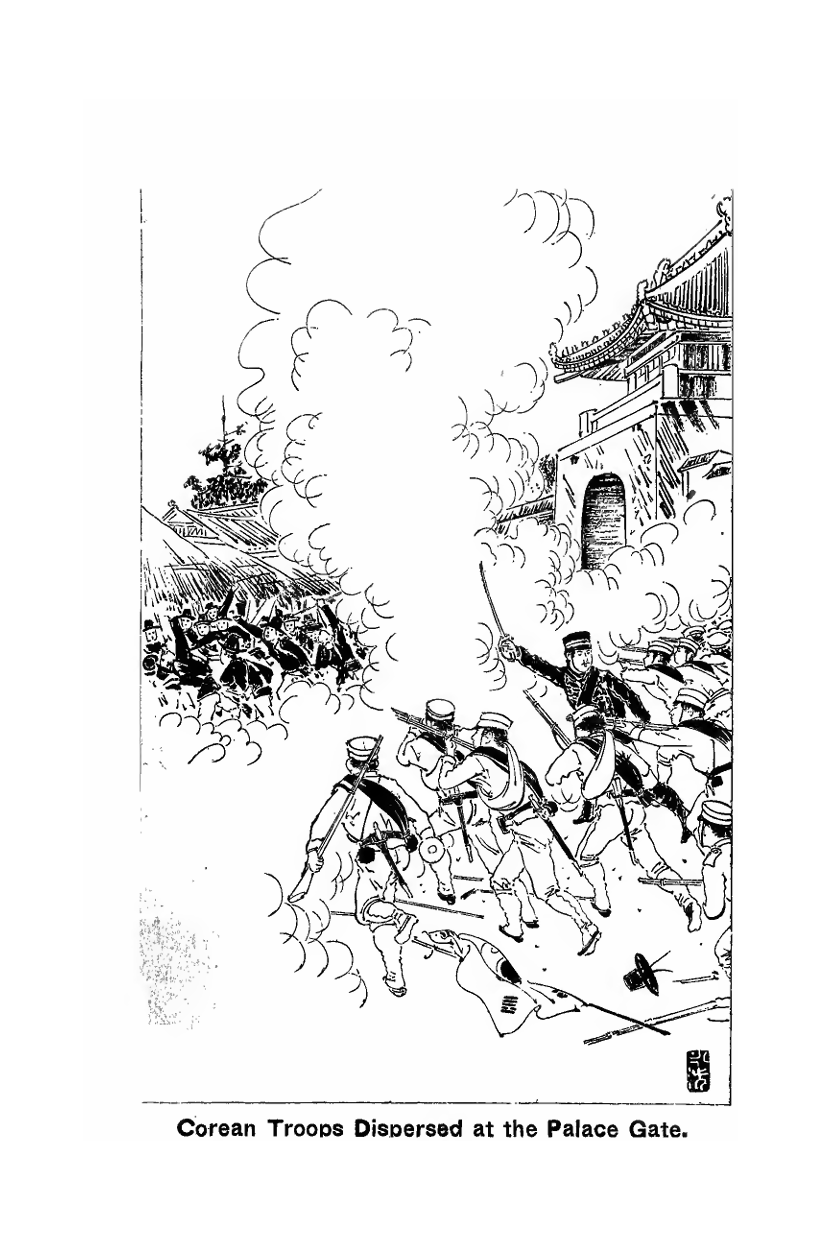
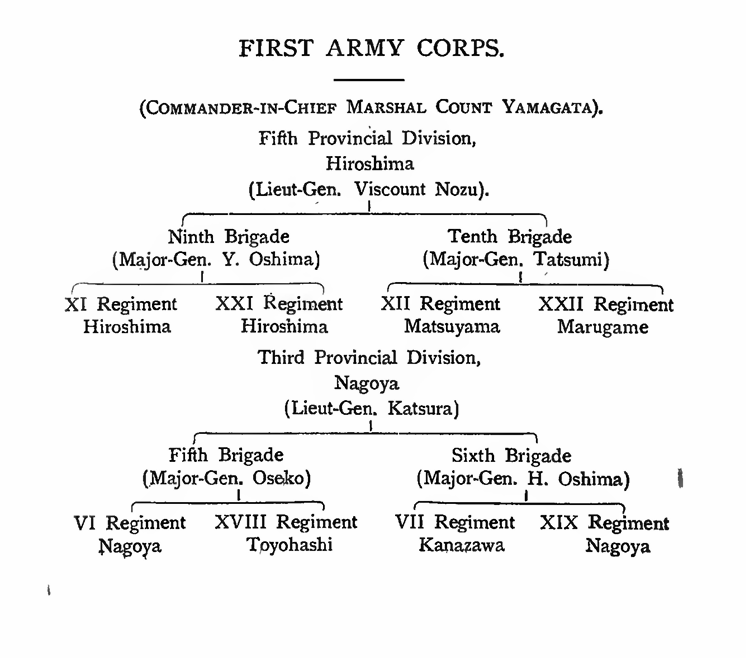
While China was thus sending her troops to Asan, in Corea, the Japanese Government did not remain idle. It watched with growing anxiety the triumphs of the Tong-haks as their threatened march upon the capital was a direct menace to the safety of the Japanese Legation and residents there. That anxiety was, however, intensified when it was found that China was bent upon taking advantage of the impotence of the Corean Government to reassert her claims upon the peninsula. Intelligence came of the Chinese preparations at Wei-hai-wei, and the Japanese Government resolved to despatch at once Mr. Otori, the Japanese Minister at Peking and Seoul, who was at the time in Japan on furlough, to the latter city. He was recalled on the 4th June from Oiso, a watering place in Sagami, to Tokyo, where he presented himself at the Foreign Office on the following morning. He was ordered to proceed at once to Corea. He went the same day to the naval port of Yokosuka where the despatch-boat Yayeyama had been got ready to carry him, and left the port in that war-vessel that evening. After-stopping a few hours at Kobe on the following evening, the vessel went direct to Chemulpo where it arrived at 3 p.m. on the 9th. The same afternoon Mr. Otori landed, and next morning, in spite of a heavy rain, he left for Seoul escorted by a corps of 400 marines. On hearing of Mr. Otori’s arrival at Chemulpo, Yuan Siekai, the Chinese Resident, had intended to go at once to Chemulpo to dissuade him from entering Seoul, but he delayed for a day, thinking that Mr. Otori would not come to the capital in the rain. The Corean Government, too, sent an official to intercept him at Chemulpo, but he came too late. Mr. Otori entered Seoul, while a detachment of the corps of marines was stationed outside the city. They were relieved on the 13th by the Infantry. As the Chinese were sending troops to Corea, the Japanese Government also resolved to despatch troops for the protection of the Legation and the Japanese residents in Corea, who numbered altogether nearly 10,000. On the 5th June, therefore, orders were given to Lieut.-General Viscount Nozu, Commander of the Fifth Provincial Division, with the headquarters at Hiroshima, to prepare for the despatch of troops to Corea, while similar orders for preparations were given to the admiralty port of Kure, near Hiroshima. The Divisional reserve was called out, and by the 10th, a Combined Brigade under Major-General Oshima, was awaiting final orders to leave the garrison. Meanwhile, ten of the best passenger ships of the great Japanese Steamship Company, Nippon Yusen Kaisha, were chartered by the Government and ordered to proceed at once to Kure, and by the 10th, they had arrived at that port, though they were when the orders were received, at different parts of the Japanese coast. The Wakanoura-maru, which reached Kure on the 8th, was on that night laden with stores and provisions and on the following morning, took troops on board, and left for Corea immediately after. She arrived at Chemulpo on the 12th, and the same day, a detachment left for Seoul where it relieved the marines, who returned to the Yayeyama. The remaining nine transports left Ujina, the port of Hiroshima, in quick succession, the last of them steaming out of port on the evening of the 11st. As soon as the Combined Brigade had left in these transports, the Japanese Government officially announced that “as, the internal disturbances in Corea having arisen and daily increasing in violence, the Corean Government was unable to suppress them, the Japanese Government had despatched troops for the protection of the Japanese Legation, Consulates, and people in that country; the Chinese Government having lately informed the Japanese Government of the despatch of troops to Corea, the Japanese Government also immediately informed the Chinese Government of the above-mentioned despatch of its troops.” There was a further despatch of troops on the 15th. Coolies were also sent. The Japanese army, on arriving in Corea, took immediate possession of Kuhyonsan, a hill of high strategic importance between Seoul and Chemulpo, and set guns on the summit. About 4,000 men were stationed at Chemulpo. Ten Japanese men-of-war, including the flagship Matsushima, the Yoshino, and the Chiyoda, were anchored in the harbour of Chumlpo. The negotiations of the Japanese Government in connection with the despatch of troops were carried on separately with the Chinese and Corean Governments. The progress of the former may be gathered from the official despatches which the Japanese Government communicated to the House of Peers at the extraordinary session of the Diet at Hiroshima in October last. On the 7th June, Wang Fungtsao, the Chinese Minister at Tokyo, informed the Japanese Foreign Office that he had received from Li Hung-chang a telegram stating that the Corean Government, being unable to suppress the Tonghak rebellion, had appealed to the suzerain state to aid in its suppression according to the precedents set by China in the disturbances of 1882 and 1884, and as it was the usage of China to protect its tributary states by despatching reinforcements, Li Hung-chang had, by the order of the Emperor of China, despatched General Yeh to Corea to restore order in the tributary state and to enable the merchants of other nationalities to trade in peace; and it was also added that the troops would be immediately withdrawn on the restoration of peace, in accordance with the clause 3 of the Tientsin Treaty. The Japanese Minister for Foreign Affairs, in acknowledging the receipt of this communication, took exception to the words protection and tributary state in the despatch, as the Japanese Government had never recognised Corea as China’s tributary state, and on the same day, the Japanese Charge cCAffaires, Mr. Komura,informed the Chinese Tsungli-yamen of his Government’s intention to.despatch troops to Corea as the necessity therefor had risen on account of the disturbances in the peninsula. Two days later, the Tsungli-yamen replied that China had sent troops to Corea at the request of the Corean Government as it was her usage to protect tributary states, and thought as a matter of course that as Japan wished to protect her Legation, Consulates, and residents, there would be no necessity for the despatch of a large force. It hoped that the Japanese troops, being despatched without any request to that effect on the part of the Corean Government, would not cause suspicion by being sent into the interior, and also expressed its anxiety on the possibility of a collision between the troops of the two countries through ignorance of each other’s language and the difference in their military usages. To this, the Japanese Chargé d'Affaires replied on the 12th to the effect that his Government again took exception to the term “ tributary state ” applied to Corea; Japan had sent troops to Corea in accordance with the treaty of Chemulpo in 1882, while the communication on the matter had been made to the Chinese Government in consequence of the Tientsin Treaty ; as to the strength of the force sent to Corea, the Japanese Government would be its own judge ; they would not be sent where their presence would not be required; and finally, there would be no fear of any hostile demonstration on the part of the Japanese troops who were under strict discipline, on meeting with the Chinese. On the day Mr. Komura made this communication to the Tsungli-yamen, the first Japanese detachment arrived at Chemulpo, and thus all discussion on the despatch of Japanese troops Was now too late. Next, on the 17th of the same month, the Japanese Minister for Foreign Affairs proposed to the Chinese Government through its Minister in Tokyo that Japan and China should act in concert and suppress the rebellion in Corea, and both appoint officials for jointly advising on the Corean finances, dismissal of officials from the central and local governments, and the maintenance by Corea of a sufficient army to preserve peace in the country. But the Tsungli-yamen replied five days later that as the Corean rebellion was already suppressed, there was no need to discuss the joint action of the two countries with regard to its suppression; as Corea should carry out her own reforms, China would not interfere in her internal affairs and still less should Japan, which had recognised the Corean independence from the very outset; and that the withdrawal of troops after the suppression of the rebellion required no deliberation as it had been stipulated by the Tientsin Treaty. As the Chinese Government thus showed its unwillingness to cooperate with the Japanese Government, the Japanese Minister for Foreign Affairs informed the Chinese Government on the same day that, much as the Japanese Government regretted the refusal of the Chinese Government to cooperate with it, not only its friendship for Corea, but its own interests in that peninsula forbade it to leave her in her present troubled state, and knowing the frequency with which these internal disturbances took place in that country, it refused to withdraw its troops until means were taken for ensuring the permanent peace of the country. The Japanese Government's refusal at the present juncture to withdraw its troops was not only in direct observance of the Tientsin Treaty but also for the purpose of preventing similar troubles in future. The last document published by the Japanese Government is dated the 14th July. In this the Japanese Chargé d'Affaires at Peking comments upon the Chinese Government’s rejection of all attempts at rapprochement, its sole demand being the withdrawal of Japanese troops from Corea; and added that as China merely continued the same cry and turned a deaf ear to all proposals of mutual understanding when the British Minister at Peking offered to mediate, it was clear that she was determined upon falling out with Japan, and therefore, the Japanese Government disclaimed all responsibility for whatever might ensue from the Chinese Government’s attitude. Though we are not told of the course of events from the 22nd June up to the 12th July, it is evident from the last despatch that the British Minister at Peking had attempted to mediate; indeed, Sir Edward Grey, the British Parliamentary Secretary for Foreign Affairs stated in reply to a question in the House of Commons that the British Government had in the interests of peace advised both Japan and China to come to a peaceful settlement. The Russian Minister at Tokyo also offered a similar advice to the Japanese Government. But all such attempts had failed, as the despatch of the 14th July shows. Meanwhile, in Corea itself, the indecision of her Government was intensifying the strained diplomatic relations between the three eastern governments. As the Chinese Government refused on the 22nd June to cooperate with the Japanese in Corean reforms, the latter resolved to carry them out single-handed. But before making any attempt of the.kind, it was necessary to obtain from the Corean Government an assurance of its own independence. Accordingly, on the 28th of the same month, Mr. Otori, the Japanese Minister at Seoul, asked the Corean Government whether Corea was an independent state. Though Japan had recognised Corea as independent state in the Treaty of Amity of 1876, China had lately referred to her in official despatches as a tributary state and it was to rebut this pretension of China that a declaration to the contrary was required of the Corean Government. The Corean Court was at once divided into three parties, the first asserting that Corea, having been introduced by Japan to the world as an independent state, certainly was and had always been such, and the second stating that it was plain from her past and present relations that Corea was China’s tributary state, while the third, feeling that either of the above assertions must offend one of the two nations, was anxious to reply vaguely that Corea was what Japan had recognised her to be in their treaty, without committing the Government by any positive assertion. But as they could not come to a decision, a telegram was sent to Tientsin to ask Li-Hung-chang’s advice in the matter. The telegraph communication, however, having been interrupted, it was not after the Government, on being pressed, replied that Corea was an independent state that Li-Hung-chang instructed the Government to avoid complications and gave it permission to act independently in diplomatic matters. Having been thus assured of the independence of Corea, Mr. Otori proposed to the Corean Government a scheme of . national reform; and after much hesitation, the King of Corea appointed a commission to discuss the matter with Mr. Otori. The Commission held consultations with him on the ioth July, and the days following. He had proposed changes in the personnel of the central and local governments, opening offices to talent; and the reorganisation of the national finances, of law and courts of justice, of the army and police, and of the educational system of the country. On the 16th, the Corean Government informed Mr. Otori that it accepted the main principles of these reforms; but when he requested a written official announcement to that effect, the Government again hesitated, and changing its mind once more, notified the Japanese Minister that though it was willing to carry out the proposed reforms, it could not do so until the Japanese troops were withdrawn from Corea, where their presence threatened, by the fear inspired in the natives, to create disturbances and might give other Powers an excuse for also landing their troops. This sudden change of attitude was due to the Chinese Resident Yuan Siekai’s threat to bring a large Chinese army into Corea and to Li-Hung-chang’s instructions to the Corean Court to reject any proposals brought by Mr. Otori as China would certainly make Japan withdraw her troops who, he added, were in great straits. The decisive moment had come. It was no longer possible for the armies of both her neighbours to remain at the same time in Corea. As long as the Chinese forces were stationed at Asan, any attempt at reform by. the Japanese Government would be futile; and as a final resource, Mr. Otori demanded on the 19th that the Corean Government, in order to prove its assertion of the independence of Corea, should compel China to withdraw her troops whose pretext for coming to Corea was the protection of a tributary state and that it should abrogate the existing treaty between Corea and China. He gave the Government three days to reply in; but thosedays passed without any communication from that Government. Mr. Otori resolved to proceed early on the morning of the 23rd to the palace and ask the king for a definite answer as it was useless to negotiate any longer with the Government. Early on that morning, Mr. Otori left the Japanese Legation under a strong Japanese guard. As the party approached the front gate of the palace, they were fired upon by the Corean troops stationed behind the palace walls. The Japanese replied and soon took possession of the barracks of the royal bodyguard on both sides of the gate. The north and east gates also fell into their hands. There were altogether two skirmishes, as the result of which 17 Corean troops were killed and 70 wounded, while a Japanese horseman was killed and two foot soldiers were wounded. Mr. Otori entered the palace and had an audience with the king who assured the minister of his anxiety to carry out reforms, the refusal of his Government having been forced upon it by the Mins and Yuan Siekai. Soon after Mr. Otori, came the Tai-Wonkun, the king’s father, who had been summoned thither. He advised the king to act according to the Japanese proposals. The Mins, on hearing of the defeat of the Corean troops at the palace, fled from the capital; and the king was deserted by them in his sorest need. On the 24th, he entrusted the Tai-wonkun with the conduct ot the Government and gave orders for the punishment of the Mins. And on the following day, he abrogated the treaty with China and requested Mr. Otori to take measures for the expulsion of the Chinese troops at Asan. On the same day Major-General Oshima, Commander of the Combined Brigade, left the Japanese encampment at Yongsan, near Seoul, at the head of his troops, for Asan.
CHAPTER III. PHUNG-DO; ASAN; AND PROCLAMATIONS OF WAR.
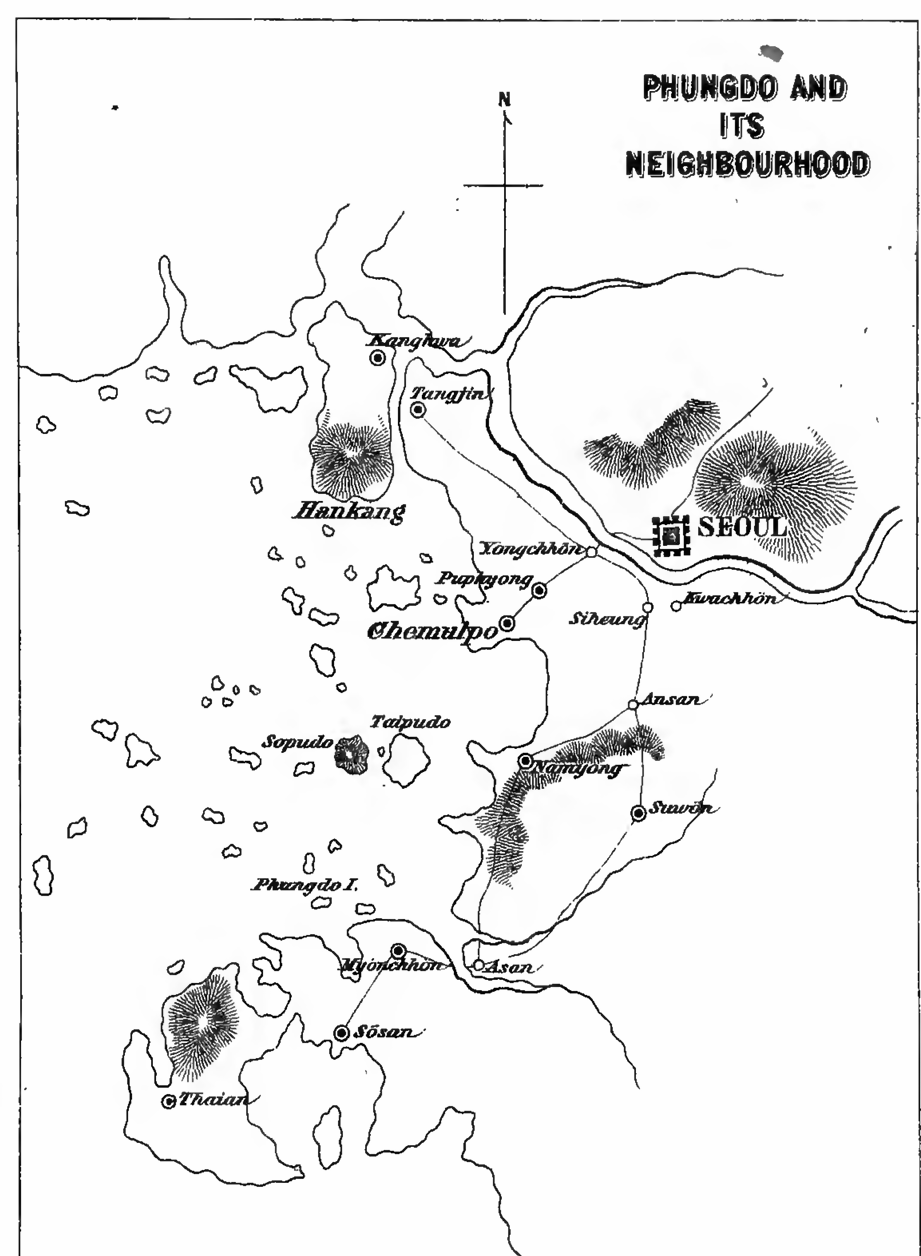
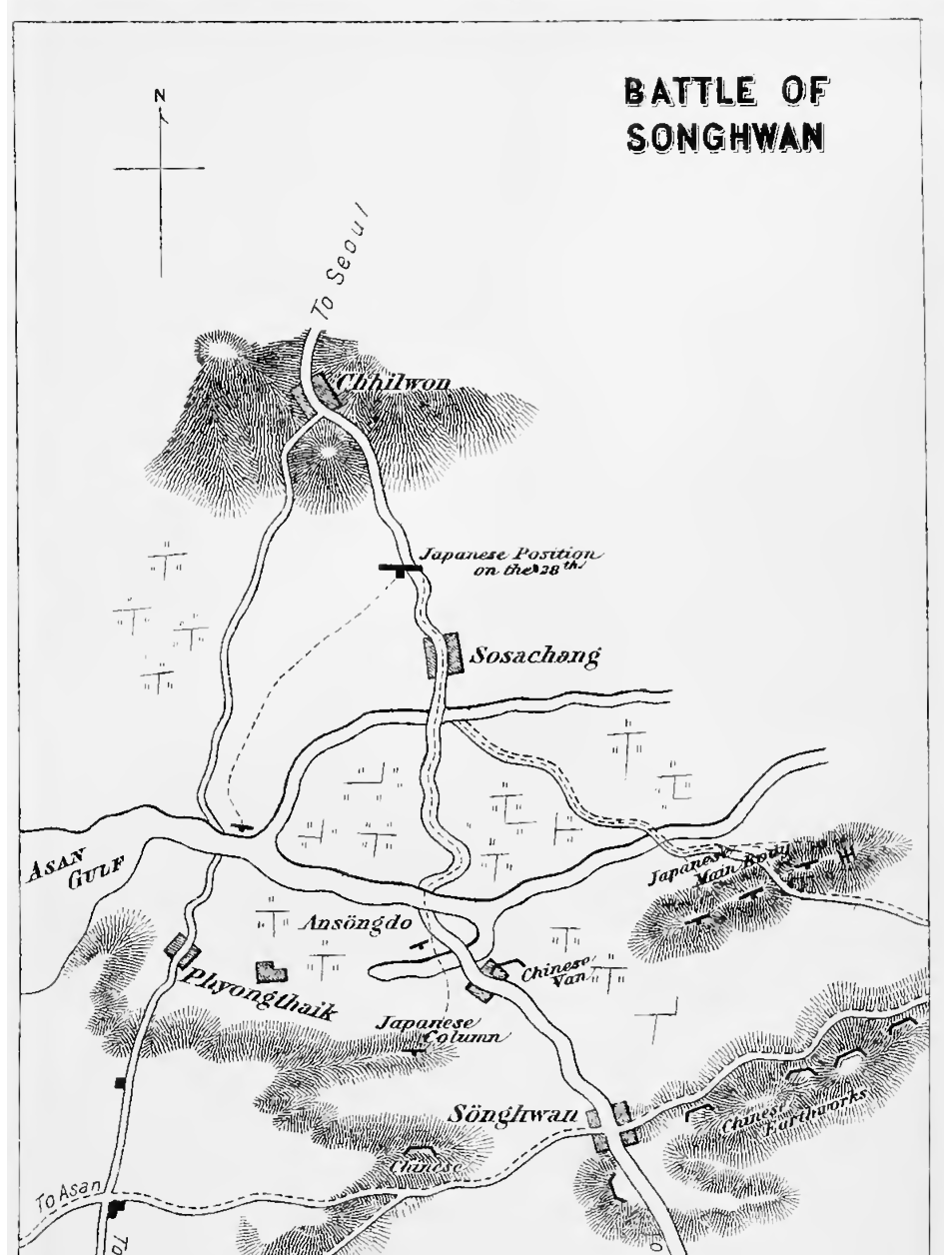
Before the Japanese troops left their encampment at Yong-san to march upon Asan, the men-of-war of Japan and China had an encounter in Corean waters, which practically opened the long-expected war though the proclamation of war was not made till a week later. About the 21 st July, China began to send more troops to Corea. Her intention was to despatch an army to Wiju, on the Corean frontier, and to reinforce those already at Asan; and the two armies were, by marching towards each other, to get the Japanese army near Seoul tactically between them. When the despatch of Chinese troops from Taku, Weihaiwei and Port Arthur was rumoured in Japan, the Japanese men-of-war Yoshino, Naniwa, and Akitsushima were sent from Sasebo on the 23rd to assertain the fact by cruising in the Corean waters. As they were on the 25th at about 7 a.m. between the islands of Phungdo and Shopaioul on their way to Chemulpo, they met two Chinese men-of-war, Kwang-yi and Tsi-yuen, which had left Asan to meet a Chinese transport. Though the Japanese regarded these vessels with anything but friendly feelings, still as active hostilities had not yet broken out, they saluted them, but the Chinese did not return the courtesy. As the sea was narrow, the Japanese men-of-war turned their course to the south-west to get into a more open sea, when they came very close to the Chinese. The latter fired upon them; and the Japanese were not slow to reply. After a sharp encounter of an hour and twenty minutes duration, the Tsi-yuen fled towards the gulf of Pechili, while the Kwang-yit in making for land, ran aground. Soon after, another Chinese warship was seen coming towards Asan with a transport flying the British flag under convoy. On the approach of the Akitsu-shima, the warship which turned out to be the Tsao-kiang, hoisted the white flag and surrendered. She was captured. Meanwhile, the Naniwa stopped the transport. On examination, she was found to be a British steamer, Kowshing, which had been chartered by the Chinese Government and was carrying over 1,100 Chinese troops and stores from Taku to Asan. The Naniwa ordered her to follow her to the Main Squadron, but Captain Galsworthy, commanding the vessel, replied that the Chinese on board prevented him and were for returning to Taku. The captain and the crew were threatened with death by the Chinese if they left the vessel. All attempts to take the ship were therefore useless as the Chinese refused to surrender; and the Naniwa therefore signalled to the captain that his crew should jump into the sea as soon as a red flag was hoisted on the warship. On seeing the red flag, therefore, the crew jumped into the sea, and were fired upon by the Chinese. They were all killed exeept the captain, the first officer, and the quartermaster who were picked up by the Naniwa's, boats. The Naniwa then sank the Kowshing with a shot which struck her engineroom. Only a few Chinese escaped by swimming to an island. Major von Hanneken, who was also on board, having been ordered by the Chinese Government to fortify Asan, also swam ashore. The Kwang-yi was found stranded by Japanese men-of-war on the 27th in a little bay to the south of Caroline Bay. Her crew had escaped in boats after exploding her powder-magazine. On the Kowshing were two Chinese Generals, fourteen field officers, and 1,100 men. The Tsao-Kiang's crew, numbering 82 in all, were brought over to Japan and are at present prisoners at Matsuyama. Captain Galsworthy and his first officer Tamplin were brought to Sasebo, but were soon released after their depositions had been taken, as also Muhlenstedt, a Danish telegraph engineer, who was on board the Tsao-Kiang. It may be here added that the Japanese Government has offered to make ample reparation for the loss of the Kowshing, which was flying the British flag, if on careful enquiry, the Japanese man-of-war should be found to have committed a breach of international law. On the 25th July, as we have said, the Japanese army left Yongsan, It consisted of the Twelfth and Twenty-first Regiments of Infantry, with the usual complement of other arms, that is, the Ninth Brigade, whose headquarters are at Hiroshima. As a corps was left to guard Yongsan and Seoul, the total strength of the army now on the march did not probably exceed 4,000. The progress of the army and the engagement at Songhwan has been described by the war correspondent of the Asahi in the following manner:— After the newspaper correspondents had received permission to accompany the army, they made instarft preparations and were ready to start, when at 10 a.m. on the 25th, they met Lieut.-Colonel Fukushima and Major Uyehara, who told them of the naval victory at Phung-do. The correspondents followed these officers to Yongsan. But when they arrived there, the army had already started though Major-General Oshima and his adjutant Major Nagaoka were still at the headquarters. The correspondents started at once, and after crossing the River Hangan at Tongjak they overtook the army. General Oshima and his staff came up soon after. At 6 p.m., the army arrived at Kwochhon, which is 7% miles from Seoul. Here the army was quartered for the night in open air. Next day, it arrived at Suwon, which is only about 10 miles from Kwochhon. On the 27th, it left Suwon at 4 a.m., and arrived at Chinwi at noon, a distance of 15 miles. At Suwon, though the Corean Government authorised the Japanese army to employ coolies and beasts of burden free of charge, the commander paid them all for their work, to the great joy of the Coreans. For the remainder of the day the troops were allowed to rest themselves on the grass, as there were no houses to accommodate them. The outposts were strictly guarded; and at 4 o’clock next morning (28th), the army began to move and soon arrived at Chhilwon, which is less than five miles distant. Here a small detachment was sent direct to Asan, while the main body marched about three miles more to Sosachang. Chinese tents were now seen in the distance, and among them their red and green flags could be descried by telescope, fluttering in the breeze. Their horsemen were also to be detected riding to and fro. The Chinese camp was situated on a hill at Songhwan, an important position on the Asan road, about 17 miles from Asan. In front of the hill are rice-paddies and marshes, crossed in the middle by a little stream which runs into Asan Bay, and a narrow path leads up to the hill. It was a position easy to defend and hard to attack. Corea is far hotter than Japan. The temperature since the 24th had been 96 or 97 degrees. The troops, having to cariy a heavy load, besides their rifles, through a wretched road, were extremely fatigued ; and from their arrival at 10 a.m., they were allowed to rest themselves, though the enemy’s camp was only 6,000 metres off. But as they had no tents, they had to sit under the burning sun on the grass, while General Oshima himself could only find two mattings to shade himself. There was no pure water and the troops had to slake their thirst with the muddy water of the paddies, which they found in their distress more refreshing than the iced water they would get in Tokyo. At 4 p.m. it rained and the temperature fell, which greatly exhilarated the troops. At 7 p.m., outposts were set. Before this, the adjutant, Major Nagaoka called the Asahi correspondent and asked the war correspondents through him to assist the ambulance corps, which was insufficient, in searching for the dead and wounded after the battle which would take place at dawn. The correspondents all swore to do everything in their power. At midnight, the army left, the two wings forming separate companies. As it has already been said, there was only one path to the hill, and there was a bridge over the stream, at Ansongdo which had to be crossed. The main body crossed the bridge at 2; but when the last detachment was on the point of Crossing at about 3, over 300 Chinese troops in ambush near the bank cut off the bridge and opened fire on the detachment at about 30 or 40 metres distance. As the attack was so sudden, and behind the detachment there was only the ambulance, the Japanese troops were at first confused, but Captain Matsuzaki at once ordered them to march forward, and the troops, encouraged by the order, rushed upon the Chinese with a shout and bore them down. In this skirmish, on the Japanese side, six men were killed by the enemy, 17 or 18 were drowned, and 15 or 16 wounded, though the fight had only lasted fifteen minutes. Captain Matsuzaki himself was killed by a shot as he rushed at the head of his troops.
The Chinese fled leaving behind 18 or 19 killed, among whom was an officer, and two prisoners. All was then quiet for two hours. At 6 o’clock, the Japanese left wing opened fire; but the Chinese did not respond until the Japanese had fired fourteen or fifteen rounds. Then began the fight in earnest. The two wings attacked the Chinese at the same time. The Japanese charged with a shout upon the enemy, and each charge effected a new lodgement. The Chinese began to retreat towards Asan. At 7.30, that is, after an hour and a half, the battle was overand quiet was restored. It appears that the Chinese General Nieh had at first come to defend this outpost at Songhwan with 1,000 troops; but hearing that the Japanese army had left Yongsan, over 1,500 more troops had been brought from Asan under General Yeh on the 27th and 28th. They had intended, in case of defeat, to retreat to Chonan, a garrisoned town, about 25 miles south-east of Songhwan; but the Japanese left wing attacked them from the east to drive them back to Asan. Though the Chinese ambuscade at the bridge was to be praised, their setting up their guns immediately round their tents showed their ignorance of tactics, for if their tents were set on fire by cannon, they would not only be unable to extinguish it, but they could have not remained within the line of their guns. At first the Chinese fought outside the earthworks, with the intention evidently of taking refuge there if they were beaten back. But the sudden charges of the Japanese gave them no time to run within the parapets. They fled, leaving their flags behind. On a high hill to the left of the main camp was a thick wood, within which the Chinese had their guns. As it commanded the Japanese army, which approached it without suspecting any camp within, a sudden volley of cannon and small-arms took the latter by surprise. This camp held out longest. Here too, however, several flags were found. Round the camp of the Chinese artillery, against which the Japanese right wing advanced, guns were set, with palisades round the earthworks. They were broken down by the Japanese; and four or five artillery officers and over ten men were killed. The Japanese officers speak in high terms of the skill of the Chinese artillery at this fight. General Oshima and Lieut.-Colonel Fukushima had a narrow escape. The Chinese loss may be computed at over 100 killed and 400 wounded, making a total of over 500. The Japanese loss in the second fight was a little over 20 wounded. Several Chinese were taken prisoners; the Chinese wounded begged for their lives with clasped hands. The Chinese General Nieh is a noted officer under Li-Hung-chang, and is well-known among Europeans for his successful suppression of the mounted brigands of Manchuria. The general cannot escape responsibility for the defeat at Songhwan. His behaviour on this occasion utterly belied his reputation and showed him to be a man of no great military attainments, for when the Japanese troops attacked his camp, he deserted it, threw away his uniform as it was an encumbrance to flight, and left behind the papers which, as a general, he should never have allowed to leave his side. On the road the Chinese had taken in their flight were found uniforms, hats, and boots. They had all entered farm houses and obtained there by force Corean dresses to disguise themselves in. Several uniforms, apparently officers’, were also found on the road, on which were also seen continuous drops of blood. The Japanese army pursued the Chinese. It was expected that the Chinese would make a desperate stand at. Asan and there was a general boding that the storming of Asan would be attended with a heavy loss ; but on arrival there, the army found to its astonishment that the trenches were deserted, with many hundreds of thousands of rounds of powder and 600 or 700 large bags of rice. The Chinese fled in confusion to Kongju, whence they took a circuitous route northward, and a majority of them under Generals Yeh and Nieh arrived at Phyongyang in the middle of August. Their total strength before the battle of Songhwan was about 3,ooo. The total Japanese loss at the battle was two officers and 32 sub-officers and men killed or drowped, and four officers and 50 sub-officers and men wounded, of whom five subsequently succumbed to their wounds. The Japanese army returned in triumph to Seoul on the 5th. As these engagements at Phungdo and Songhwan placed it beyond a doubt that hostilities had commenced, the declaration of war was hourly expected. And on the 1st August, proclamations of war were published both in Tokyo and Peking. The Japanese Proclamation ran as follows:— “We, by the grace of Heaven, Emperor of Japan, seated on a Throne occupied by the same dynasty from time immemorial, do hereby make proclamation to all Our loyal and brave subjects as follows :— “We hereby declare war against China, and we command each and all of Our competent authorities, in obedience to Our wish, and with a view to the attainment of the national aim, to carry on hostilities by sea and land against China, with all the means at their disposal, consistently with the Law of Nations. “During the past three decades of Our reign, Our constant aim has been to further the peaceful progress of the country in civilization; and being sensible of the evils inseparable from complications with foreign States, it has always been Our pleasure to instruct Our Ministers of State to labour for the promotion of friendly relations with Our Treaty Powers. We are gratified to know that the relations of Our Empire with those Powers have yearly increased in good-will and in friendship. Under the circumstances, We were unprepared for such a conspicuous want of amity and of good faith as has been manifested by China in her conduct towards this country in connection with the Corean affair. “Corea is an independent State. She was first introduced into the family of nations by the advice and under the guidance of Japan. It has, however, been China’s habit to designate Corea as her dependency, and both openly and secretly to interfere with her domestic affairs. At the time of the recent civil insurrection in Corea, China despatched troops thither, alleging that her purpose was to afford succour to her dependent State. We, in virtue of the Treaty concluded with Corea in 1882, and looking to possible emergencies, caused a military force to be sent to that country. “Wishing to procure for Corea freedom from the calamity of perpetual disturbance, and thereby to maintain the peace of the East in general, Japan invited China’s cooperation for the accomplishment of that object. But China, advancing various pretexts, declined Japan’s proposal. Thereupon, Japan advised Corea to reform her administration so that order and tranquillity might be preserved at home, and so that the country might be able to discharge the responsibilities and duties of an independent State abroad. Corea has already consented to undertake the task. But China has secretly and insidiously endeavoured to circumvent and to thwart Japan’s purpose. She has further procrastinated, and endeavoured to make warlike preparations on land and at sea. When those preparations were completed, She not only sent large reinforcements to Corea, with a view to the forcible attainment of her ambitious designs, but even carried her arbitrariness and insolence to the extent of opening fire upon Our ships in Corean waters. China’s plain object is to make it uncertain where the responsibility resides of preserving peace and order in Corea, and not to weaken the position of that State in the family of nations,—a position obtained for Corea through Japan’s efforts,—but also to obscure the significance of the treaties recognising and confirming that position. Such conduct on the part of China is not only a direct injury to the rights and interests of this Empire, but also a menace to the permanent peace and tranquillity of the Orient. Judging from her actions, it must be concluded that China, from the beginning, has been bent upon sacrificing peace to the attainment of her sinister object. In this situation, ardent as Our wish is to promote the prestige of the country abroad by strictly peaceful methods, We find it impossible to avoid a formal declaration of war against China. It is Our earnest wish that, by the loyalty and valour of Our faithful subjects, peace may soon be permanently restored and the Glory of the Empire be augmented and completed. Given this 1st day of the eighth month of the 27th year of Meiji. Imperial Sign-Manual Imperial Seal Counter-signed by all the Ministers of State. ” The Chinese Proclamation was couched in the following terms:— “Corea has been our tributary for the past two hundred odd years. She has given us tribute all this time, which is a matter known to the world. For the past dozen or so years Corea has been troubled by repeated insurrections, and we in sympathy with our small tributary have as repeatedly sent succour to her aid, eventually placing a Resident in (her capital to protect Corea’s interests. In the 4th moon (May) of this year another rebellion was begun in Corea, and the King repeatedly asked again for aid from us to put down the rebellion. We then ordered Li Hung-chang to send troops to Corea, and they having barely reached Asan the rebels immediately scattered. But the Wojen without any cause whatever, sent their troops to Corea, and entered Seoul, the capital of Corea, re-inforcing them constantly until they have exceeded ten thousand men. In the meantime the Japanese forced the Corean King to change his system of government, showing a disposition every way of bullying the Coreans. It was found a difficult matter to reason with the Wojen. Although we have been in the habit of assisting our tributaries we have never interfered with their internal government. Japan’s treaty with Corea was as one country with another; there is no law for sending large armies to bully a country in this way, and compel it to change its system of government. The various Powers are united in condemning the conduct of the Japanese, and can give no reasonable name to the army she now has in Corea. Nor has Japan been amenable to reason, nor would she listen to the exhortation to withdraw her troops and confer amicably upon what should be done in Corea. On the contrary, Japan has shown herself bellicose without regard to appearances, and has been increasing her forces there. Her conduct alarmed the people of Corea as well as our merchants there, and so we sent more troops over to protect them. Judge of our surprise then when, half-way to Corea, a number of the Wojen ships suddenly appeared and taking advantage of our unpreparedness opened fire upon our transports at a spot on the sea-coast near Asan, and damaged them, thus causing us to suffer from their treacherous conduct which could not be foretold by us. As Japan has violated the treaties and not observed international laws, and is now running rampant with her false and treacherous actions, commencing hostilities herself, and laying herself open to condemnation by the various Powers at large, we therefore desire to make it known to the world that we have always followed the paths of philanthropy, and perfect justice throughout the whole complications, while the Wojen on the other hand have broken all the laws of nations and treaties which it passes our patience to bear with. Hence we command Li Hung-chang to give strict orders to our various armies to hasten with all speed to root the Wojen out of their lairs. He is to send successive armies of valiant men to Corea in order to save the Coreans from the dust of bondage. We also command the Manchu Generals, Viceroys and Governors of the Maritime Provinces, as well as the Commanders-in-Chief of the various armies, to prepare for war and to make every effort to fire on the Wojen ships if they come into our ports, and utterly destroy them. We exhort our Generals to refrain from the least laxity in obeying our commands in order to avoid severe punishment at our hands. Let all know this Edict as if addressed to themselves individually. Respect this !” |
CHAPTER IV. BATTLE OF PHYONGYANG.
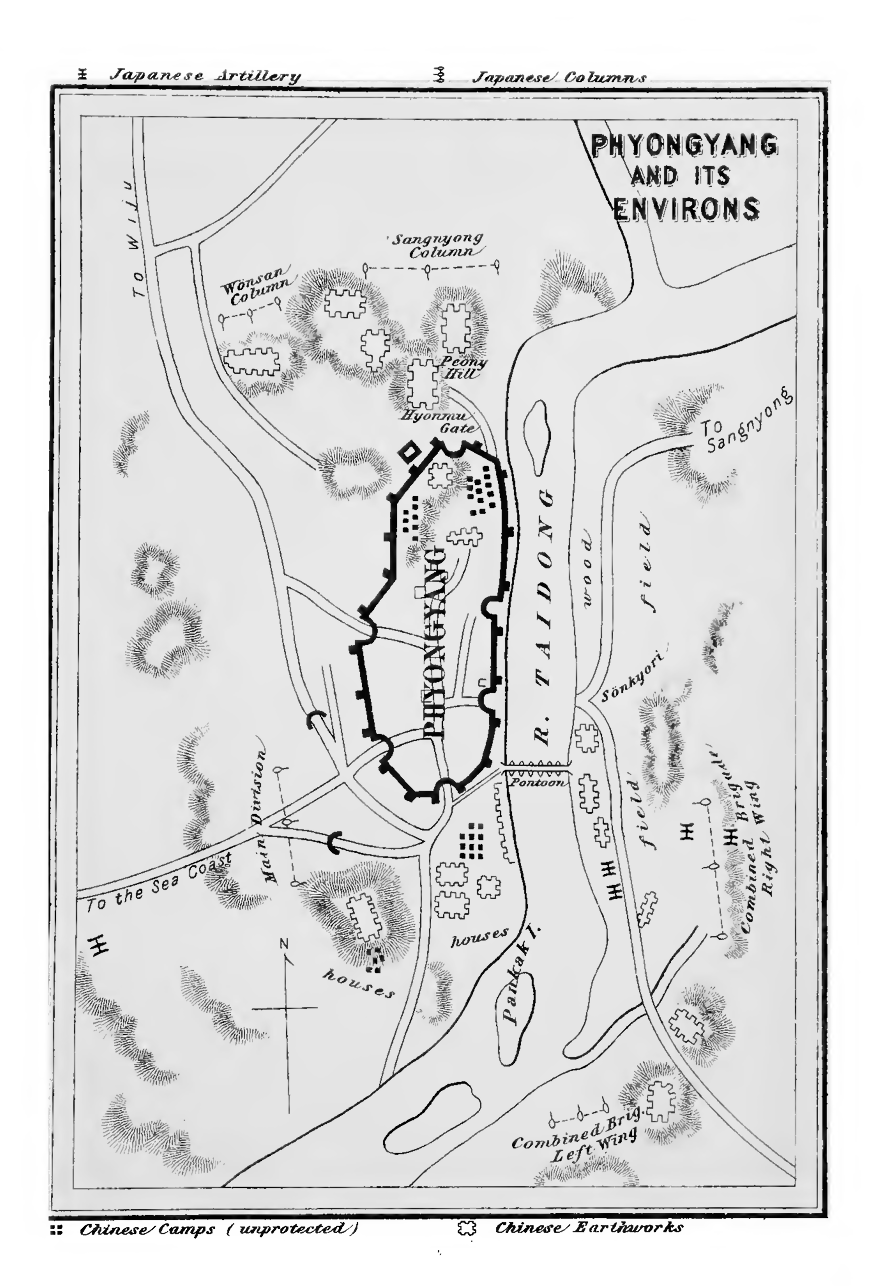
Major-General Oshima’s forces having routed the Chinese from Asan, it was next necessary to expel the Chinese who were advancing southward from Wiju, on the Corean frontier. These were making Phyongyang their stronghold. On the ioth August, a party of nine Japanese scouts had an encounter with the Chinese at Suchonchong, on the River Taidong, and they were all killed except one. On the 19th August, Lieut.-General Nozu, Commander of the Fifth Provincial Division, who went overland from Fusan, arrived at Seoul. On the same day, he heard that a battalion of the Twelfth Regiment, Infantry, and an Artillery company, which had landed at Wonsan had already arrived at Phochhong on their way to Seoul. They were ordered to change their direction to Sangnyong, where they joined a Infantry battalion of the Combined Brigade, and formed the Sangnyong Column. Major-General Oshima’s Combined Brigade which had left Seoul on the 8th and reached Soheung on the 19th, was on account of the incomplete line of communications compelled to return to Kaisong. The Brigade was ordered to march forward again on the 25th. Lieut.-General Nozu next received information that a Combined Brigade of the Third Provincial Division which would land at Wonsan by the 26th would be placed under his command. These troops he ordered to march upon Phyongyang via Yangdok and Songchhong. All the arrangements were completed for closing upon Phyong-yang where the entire Chinese forces in Corea were concentrated. The Japanese forces in Corea were disposed in the following manner: — 1. Oshima Combined Brigade under Major-General Oshima. Infantry, XI and XXI Regiments (less a battalion of the latter). Cavalry, I Company. Artillery, III Battalion. Engineers, I Company. Ambulance Corps and Field Hospital. 2. Sangnyong Column under Major-General Tatsumi. Infantry, XII Regiment I Battalion (less a company). XXI Regiment, II Battalion (less a company). Cavalry, III Company 1/2 sub-company. Artillery, I Company. 3. Wonsan Column under Colonel Sato. Infantry, XVIII Regiment. Cavalry, III Battalion (less a company). Artillery, III Regiment (less a battalion). Engineers III Battalion (less a company). Ambulance Corps. 4. Seoul Guard Corps under Lieut.-Colonel Yasumitsu. Infantry, XXII Regiment II Battalion (less a company). 5. Oseko Combined Brigade under Major-General Oseko. (To hold Wonsan). Infantry, VI Regiment. Cavalry, III Battalion I company. 6. Main Division. a. First Marching Column under Lieut.-Colonel Shibata. Infantry. XXII Regiment (less a battalion). Artillery, II Battalion. b. Second Marching Column under Lieut.-Colonel Tomoyasu. Infantry, XII Regiment (less a battalion). Cavalry, V Battalion, Staff and II Company (less a subcompany). Engineers, V Battalion (less a company). Ambulance Corps. There were a company of the XXI Regiment, Infantry, at Nakdong to guard the telegraphs, a company of the XXII Regiment at Chemulpo, a company of the XII Regiment and a small detachment of the XII Cavalry Company at Yongsan to guard the depots of supplies. The Oshima Brigade was to advance on the main road toward Phyongyang, and divert the enemy’s attention from the other columns which were closing upon the city. The Sangnyong Column was to make a sudden attack from Samdung upon the city ; and part of the Wonsan Column was to cooperate with it, while the remainder was to cut off the enemy’s retreat at Sun-an. The Main Division was to attack Phyongyang from the south and west roads. The general attack was to be made on the 15th September. On the 25th August, the advance-guard of the Oshima Brigade left Kaisong, followed by the main column under MajorGeneral Oshima on the 28th. On the following day, the latter arrived at Phyongsan, where it stayed until the 2nd, when Major-General Tachimi, Commander of the Tenth Brigade, and now in Command of the Sangnyong Column, arrived. They both went on that day to Namcheon, whence on the following day, the former advanced to Chongsu while the latter turned off to Singe. On the 4th, the Oshima Brigade reached Soheung, and on the same day the advance-guard reached Pongsan. A small Chinese detachment which had come as far as Pongsan immediately retreated to Hwangju. On the 5th, a regiment under Lieut.-Colonel Nishijima arrived at Pongsan, while the advanceguard, which was a battalion under Major Ichinohe, took possession of a pass half-way between Pongsan and Hwangju. On the 6th, the Ichinohe Battalion attacked Hwangju; and with the assistance of the Nishijima Regiment, soon succeeded in capturing the town. On the 7th, Major-General Oshima entered Hwangju. On the 10th, the Brigade reached Chunghwa, and on the 12th, advanced upon Phyongyang. The Brigade was divided into two wings, the right under Lieut.-Colonel Nishijima, and the left under Lieut.-Colonel Takeda, which took up their positions on the bank of the River Taidong. The Chinese frequently fired upon them, but without much result. There were a few skirmishes, but the Brigade remained quiet until the 15th. On the 14th, reports of guns were heard in various directions, from which it was ascertained that all the Columns had taken up their positions for the great battle. The Sangnyong Column left Singe on the 6th and arrived at Samdeung on the 9th, though it experienced great difficulty in crossing a river near the latter town from want of boats. On the 12th, the Column left Samdeung, but when it had proceeded eight miles, a report came that an advance-guard under Major Yamaguchi, which had been sent on the previous day, was being attacked by over 1,000 Chinese on the Taidong; but before the Main Column could come up, the enemy had already taken flight towards Phyongyang. The skirmish had taken place at Maik-chonchom where the Taidong crosses the Sangnyong-Phyong-yang road, and is about 10 miles higher up than the latter city. On the 13th, the Brigade reached Kukjuhyon, close to that stronghold. The Main Division arrived on the 10th, the First Column at Hwangju and the Second at Pongsan. On the 11st, the Main Division began to cross the Taidong at Sipiho, where it is over 1,000 yards wide and it was not until the 14th that the entire body reached the other side of the river. On that day, the Main Division reached Sachon about ten miles from Phyongyang while the advance-guard was only 2'1/2 miles off at Sindong. At night the former advanced at Sanchon, about four miles from the enemy’s stronghold. The Wonsan Column reached Yangdok, 45 miles from Wonsan, on the 2nd September, Songchhon on the 8th, and Yudong, about 20 miles from Phyongyang, on the list. On the 13th, it arrived at Sun-an, about 12 miles on the Chinese rear, whence, on the 14th, it advanced to Kampuk, which is only 2'1/2 miles from Phyongyang. Communications were opened with the Main Division. And all was now ready for the general attack on the morrow at 7.30 a.m. Meanwhile the Chinese were preparing for the defence of their stronghold. They had thrown up numerous earthworks, of which there were altogether 27 in and about the city. On the “Chinase bank of the liver they had built a great wall, over 2,000 metres long and four metres high, with a trench outside. They were composed of four separate armies, namely, GENERAL. ..........................................................STRENGTH. Shengtse ......................Troops under Wei Jookwei. 6,000 Etse............................. .......................Ma Yukwan. 2,000 Fung...................................................Tso Paokwei. 3.500 Moukden Shengtse.............................Nieh Kweilin. 1.500 These made up altogether 13,000, and if we add the Asan fugitives under General Yeh Chihchao,the total strength of the Chinese was probably about 15,000. It may be here added the strength of the Japanese army which surrounded Phyongyang was slightly in excess of the above, as may be seen from the following figures. Oshima Brigade .........between 3,600 and 3.700 Sangnyong Column ..................2,400........2,500 Wonsan Column........................4,700........4,800 Main Division............................5,400.........5,5oo ................................................16,100..........16,500 Or taking the mean, about.......16,300 On the 15th, Major-General Oshima’s Brigade was the first to open fire as its object was to draw out the enemy. On the 15th, the Wonsan and Sangnyong Columns and the Provincial Division were to attack suddenly from the rear, and leave the enemy a road to escape to the west coast, as that was preferable to starving them out in Phyongyang. Major Okuyama’s Column left the river below Pankak Island, and came to the south of Phyongyang to keep open the communication between the Division and the Brigade. By attacking the enemy on three sides, the Japanese gave them the alternatives of surrender or flight to the coast.
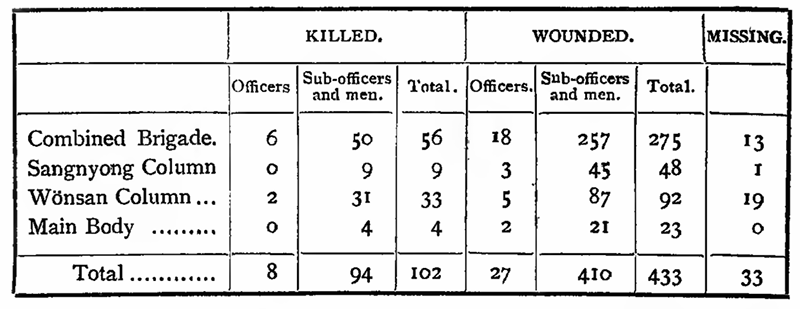
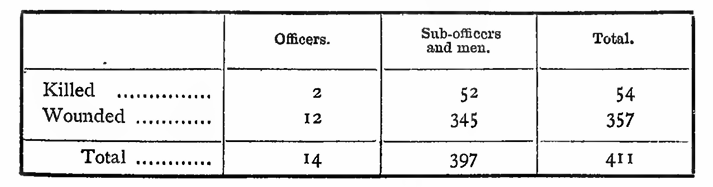
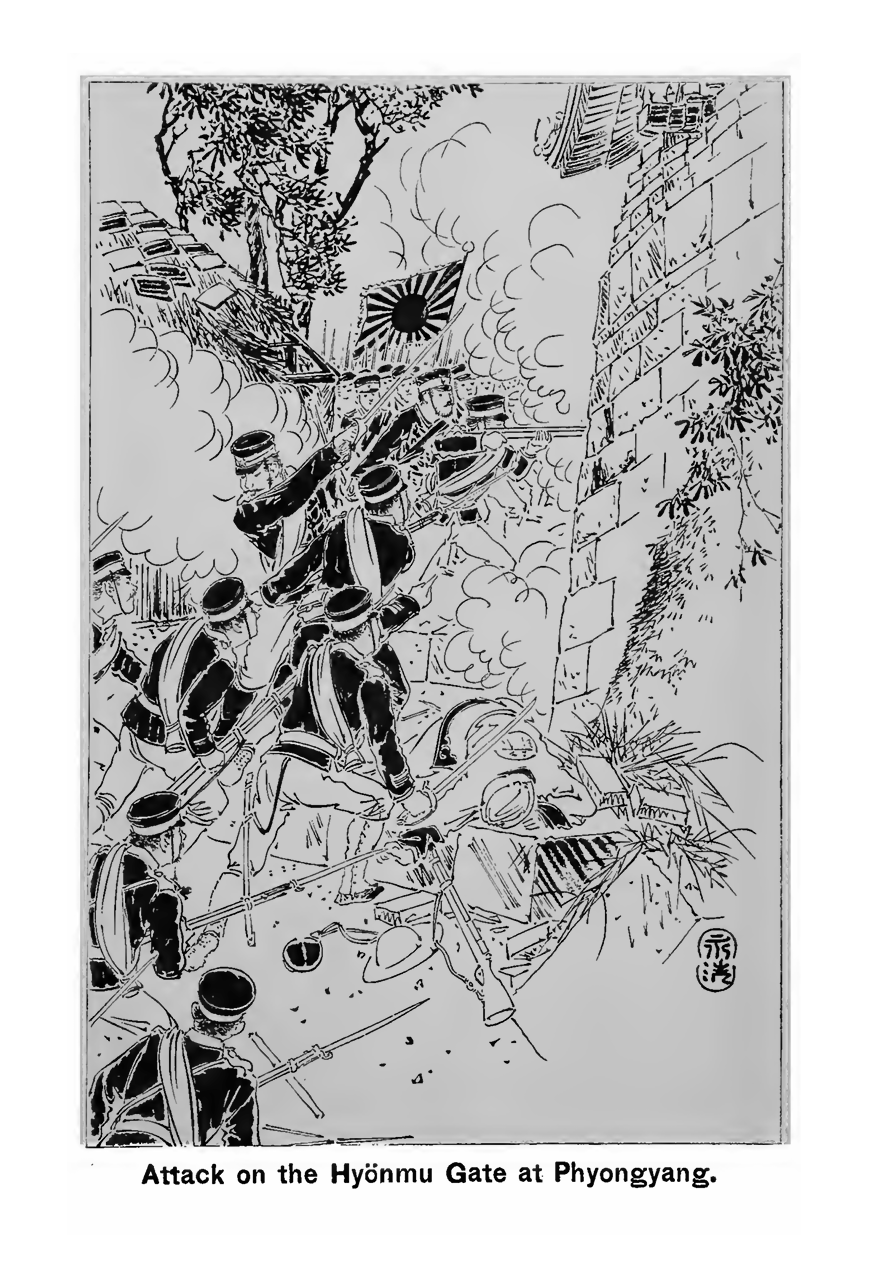
On the morning of the 15th, the Combined Brigade commenced fire on the bank of the river, and the Wonsan Column began also to fire upon the enemy from Mt. Kampak. Being thus attacked on both sides, the enemy did not know of the approach of the Sangnyong Column on the rear until it was within Soo metres. General Tatsumi, its commander, attacked the enemy’s third fort before Peony Hill; but the column was so hailed on its flank with volleys from thirteen-chambered .nagazine-rifles on the ist and 2nd forts that it was obliged to desist. The column was divided into two, one of which attacked the enemy’s right and the other the centre. Three companies were also led against the first fort, over which they climbed and bayoneted some fifty of the enemy. In this attack, the captains of the three companies were severely wounded; but the fort was captured at 7.30. One of the two sub-divisions of the column next carried the third fort at 8.0. The Wonsan Column, meanwhile, attacked the enemy’s left, and a battalion, suddenly descending upon the Wiju road, took by storm the left fort. Soon after, the second, fourth, and fifth forts before Peony Hill fell. The Wonsan and Sangnyong Columns next attacked Peony Hill from three sides with such effect that the enemy were utterly swept out of it. After the capture of this important position, Colonel Sato of the Wonsan Column attacked the Hyon-mu Gate of the city which fell after three assaults. The enemy’s cannon sounded less and less; and the Japanese columns, also being fatigued, rested at 2 p.m. At midnight of the 14th, the Main Division arrived at Sanchondong, and at daybreak saw the enemy waiting for its advance at their earthworks. The Japanese Artillery occupied a hill opposite to the earthworks at Oison and fired upon them, and the enemy replied with equal energy. An Infantry company then descended the hill and marched through a sesame field. About 100 horsemen of the enemy approached the company without its knowledge; but the Artillery, seeing the danger, fired upon them. The company then became aware of the horsemen’s approach, and fired upon them. A majority were killed, and seven or eight were taken prisoners, who confessed on examination that the men on the north side of the city were disheartened Attack on the Hyonmu Gate at Phyongyang. at the death of their General Tso-Paokwei, whose bodyguard and cavalry had already taken to flight. A little after, about 40 of the enemy’s cavalry were seen to flee by a stream behind Oison; these too were attacked, and only one escaped. Major Okuyama had by their time set fire to the enemy’s camp and entered the city. The Oison earthworks were also stormed at almost the same time, taken, and burnt down. The Combined Brigade was so successful in drawing out the enemy that the latter were taken by surprise when they were attacked in other quarters. The enemy’s forts, each 16 feet high, at Songkyori, were attacked; but they defended themselves with such energy under Generals Yeh and Ma that loss was heavy on both sides. The Japanese lost over 20 officers killed. The earthworks were taken after a severe fight. The forts were next attacked, but the enemy’s Mausers, with their thirteen chambers, were irresistible, the Japanese rifles being single. Two companies in the centre having exhausted their ammunition and lost their officers, showed a disposition to retreat, when the adjutant Major Nagaoka, rushed at their head and encouraged them. They soon regained their ground. General Oshima, who was standing about 70 metres behind the van also rushed forward some 40 metres and commanded the nth Reginent. The officers tried to persuade him to retire to a place of safety; but he refused, saying he would die under the standard. The troops were encouraged by their leaders’ example. And at last at 2.30, they gained possession of the forts, after fighting for nearly ten hours. The severity of this fight was due to the difficulty of getting a good position for the artillery, which was at the time 1,400 metres from the forts and was therefore comparatively ineffectual. At 4.30, the Chinese hoisted the white flag. General Tatsumi sent an aide-de-camp, and the enemy said that as it was raining heavily and night was coming on it would be difficult to examine their troops, and asked the Japanese to allow them time until the following morning to make preparations for capitulation. The request was granted; but that evening, the Chinese made preparations for flight. At 8.0, they left the city, some through the gates in companies, others jumping over the wall, and made for the coast and Wiju roads. They were attacked; but they made themselves into squares and defended themselves in their flight. Over 300 were founded dead next morning on the coast road and 200 on the Wiju. The Chinese attacked the Red Cross Society’s Field Hospital and committed outrages on the defenceless sick. The South-west Gate, facing the river, was captured at 7 p.m., the few Chinese guards being dispersed. The second gate was taken soon after, though the Chinese threw stones to prevent the advance of the Japanese. Early next morning, the whole army entered the city. The Chinese left behind about 2,000 dead, and their wounded are believed to have been at least double that number. Many bodies were found dead on the road. About 700 prisoners were taken, of whom 17 were Coreans. Of the Chinese, 25 died of their wounds and 47 were killed for attempting to escape. Altogether 37 guns and 1,160 rifles were captured with large quantities of ammunition and provisions. The Japanese losses were as follows :—
It may be here mentioned that on the 15th September, the Military Headquarters were removed from Tokyo to Hiroshima to be nearer the seat of war, the Emperor himself presiding over their councils as the Commander-in-chief of all the Japanese forces.
|
CHAPTER V. BATTLE OF HAIYANG.
The Japanese Navy had done little more than reconnoitre Chinese coasts, convoy Japanese transports to Corea, and jealously watch for the appearance of the Chinese fleet in Corean waters, ever since the engagement off Phungdo on the 25th July. For nearly two months little or nothing was heaifd of its whereabouts or movements. The very silence gave rise at one time to all sorts of sinister rumours and surmises. Only once, on the loth August, was it seen off Wei-hai-wei, when that naval port was fired at, and that too was a mere ruse on its part. The comparative strength, therefore, of the two navies was yet unknown, though in the matter of mere numerical strength the Chinese Squadron had a decided superiority. But the Japanese had the advantage with regard to its equipment. The mastery of the Corean sea was still disputed; and until the two navies could come to a decisive issue, the belligerent powers could only send their transports to Corea under a strict convoy and always keeping well to the shore. And this decisive issue it was that was brought to a head on the 17th September. The Japanese forces were slowly but surely closing upon the Chinese garrison at Phyongyang. The Chinese generals at Phyongyang, though jealous of one another, appear all to have relied upon numerical superiority for victory. None of them sent scouts to ascertain the movements of their enemy, whom, had they been alert, they could have seriously harassed by a well-concerted plan of successive attacks upon their interior lines. But the Chinese did nothing of the sort; and when they were not rejoicing at victories over Japanese reconnoitring parties, they called for the despatch of more troops, although, being a thousand or so inferior in strength to the attacking army, they could have easily held out against them in their well-fortified position. About the 14th September, therefore, Li-Hung-chang sent at their urgent request reinforcements of 4,000 men together with stores and provisions in five transports from Taku. These vessels which were met by six cruisers and four torpedo-boats in Pechili Gulf, made under their convoy for Tatungkow. At Talienwan, they were joined by eight other men-of-war including the battleships Ting-yuen and Chen-yuen. On the 16th, they reached Tatungkow, where the men and stores were landed. These troops, it may be added, were, on the fall of Phyongyang becoming known, sent to Kewlienching, whence they fled on the 24th October when that stronghold was attacked by the Japanese. The Chinese warships remained at anchor until the 17th, when a cloud of black smoke was seen in the south, and seeing the approach of the Japanese Squadron; Admiral Ting ordered his ships to prepare for battle. The Chinese weighed anchor and advanced towards the Japanese in a wedge formation, the two ironclads in the centre leading the fleet, the vessels of which were ranged on either side in the order of their size. The transports went up the Yalu River for safety. On the 14th September, the Japanese Squadrons convoyed thirty transports to Caroline Bay, where the Third Flying Squadron, consisting of six smaller vessels of the navy, was left to cover the landing of the troops. The rest of the fleet made for the Taidong River, which they reached on the following day, and here too four minor vessels were sent up the river to cover the army, if necessary, in crossing the river in the attack that had already commenced upon Phyongyang. On the 16th, the remaining warships, that is, the Main Squadron, the First Flying Squadron, the Gun-boat Akagi, and the Merchant-cruiser Saikyo, turned their course towards Haiyang Island, where they expected to meet the enemy’s fleet. The torpedo-flotilla which had accompanied them to the Taidong had gone up the river, and they did not wait for their return before starting for the opposite shore of the Yellow Sea. On the morning of the 17th, the two squadrons arrived at Haiyang; and as no Chinese warship was to be seen about the island, the squadrons made for Talu Island, off Takushan. At 11.40 a.m., the Chinese fleet came into sight and was advening towards them. The Akagi and the Saikyo, not being fighting ships, were ordered to get under cover of the squadrons. At noon, just before the battle was commenced, the Japanese flqet was 12 miles to the N.E. by N. of Talu Island. The Flying Squadron, consisting of the Yoshino, Takachiho, Naniwa, and Akitsushima, first advanced to attack the Chinese right, followed by the Main Squadron, which comprised the Matsushima, Itsukuskima, Hashidate, Chiyoda, Fuso, and Hiyei. The Chinese fleet consisted of the Ting-yuen and Chen-yuen in the centre, followed on either side and a little to the rear by the King-yuen and Chih-yuen, outside them the Lai-yuen and Chinq-yuen, then the Yang-wei and Tsi-yuen flanking them, and outermost of all the Chao-yung and Kwang-chia. The Kwang-ping and Ping-yuen remained outside the line. At 12.45, the Chinese opened fire at 6,000 metres, but the Flying Squadron did not reply until it was within 3,000 metres. The two vessels on the extreme right of the Chinese Squadron, which were the Chao-yung and Yang-wei were attacked by the squadron, being the nearest to it, and they were separated from the fleet. The Flying Squadron continued to attack them until it was 1,600 metres from them. The Chao-yung caught fire and sank. As the Main Squadron advanced at the rate of ten knots an hour, the Hiyei, which could not keep up that speed, was soon left behind, followed closely by the Fuso; and when the Chinese saw the Hiyei lagging behind, the Ting-yuen and Ping-yuen poured broadsides into her; but these two assailants were too close together and had to desist from firing for fear of hitting each other. The Hiyei, finding herself at such close quarters, boldly advanced between the Ting-yuen and King-yuen and passing through the Chinese line, rejoined the Main Squadron. Two torpedoes were discharged at her, but missed their mark; a shell, however, from the Ting-yuen's great gun struck her ward-room and worked a great havoc. At 1.55 she caught fire and was hors de combat, though the fire was subsequently extinguished. The gun-boat Akagi had also been left behind. The vessels of the Chinese left wing pressed upon her and though her starboard guns cleared the Lai-yuen's bridge of men, her own bridge suffered no less. Her captain, Commander Sakamoto, was killed as well as several of her gunners. Her mainmast was also struck down, and she was hotly pursued by the Lai-yuen and others, and she only escaped by causing a fire on the Lai-yuen's quarter-deck, whereupon the Lai-yuen and the rest slowed down to extinguish it. The Akagi's steam-pipe was damaged, but was afterwards repaired. The Saikyo, on seeing the Chih-yuen and Kwang-ping approach her, had got under cover of the Flying Squadron ; but when the latter went to the rescue of the Hiyei and Akagi, she was once more exposed; and four shells from the Ting-yuen's great gun struck the upper deck saloon, shattered the woodwork, and damaged the steering-gear. The Matsushima and the Ping-yuen next exchanged shots. The former’s wardroom was damaged and four men were killed, while the latter’s 26 c.m. gun was disabled. The Ping-yuen, Kwang-ping, and a torpedoboat next assailed the Saikyo; two torpedoes were discharged at her, but she managed to steer clear of them. She was after this out of action, as she had suffered severe though not vital injuries. A duel between the two hostile flagships resulted in the Chinese catching fire and the Japanese losing the use of three 12 c.m. guns, and the death or disablement of over 60 men, on the latter through a heap of ammunition catching fire. The latter’s 32 c.m. gun was temporarily damaged. Her hull also listed slightly. The Chinese flagship was ably covered during the fire by her sister ship Chen-yuen. By this time the Yang-wei and the Chih-yuen had been sunk. The Tsi-yuen had fled, followed by the Kwang-chia, which struck the Tsi-yuen and was stranded near Talienwan. The flying Squadron pursued the remaining ships. The Lai-yuen again caught fire but managed to return to Port Arthur, almost a wreck, while her sister-ship King-yuen was sunk by the Yoshino. As it was now close on sunset, the Flying Squadron was recalled. The Saikyo and Hiyei had returned to the base of operations. The Matsushima was sent back to Japan for repairs, while the Admiral’s flag was transferred to her sister-ship Hashidate. The remainder of the Japanese fleet followed the retreating Chinese at a distance as they feared a night attack by the torpedo-boats. As, however, they failed to find the Chinese next morning, though they had gone as far as the mouth of the Gulf of Pechili, they returned to the previous day’s scene of battle. The Yang-wei which was seen stranded was destroyed with a torpedo. The fleet then returned to its base of operations. On the Naniwa and Akitsushima reconnoitring the east coast of the Kinchow Peninsula on the 23rd, they saw the Kwang-chia near Talienwan, but as soon as they came into sight, the vessel’s crew fled after destroying her by explosion. Thus the Chinese lost five men-of-war, namely, the Chao-yang, Yang-wei, Chik-yuen, King-yuen, and Kwang-chia, while the Japanese lost none at all, the greatest damages having been suffered by the Matsushima, Akagi, Hiyei, and Saikyo, all of which were soon refitted for service. The Matsushima's torpedo-room was pierced and her Hotchkiss gun was damaged. The Hiyei's upper deck was also injured. The Akagi's top-mast was struck down and her commander was killed. The Naniwa had a shell explode near the water-line and another in her coal-bunker. The Matsushima was struck by a shell each in her torpedo-room, on the mast, and the engine-room. The Chiyoda's hull was penetrated just above the water-line, while a shell exploded against the Hashidate's 32 c.m. gun barbette. The Saikyo had four 30I c.m. and one 21 c.m. shells on her mainmast and piano-room, 2 15.0 c.m. shells on her quarterdeck, 4 ( 42 ) shells of 12 c.m. and over io of 6 c.m. and less in varian ports of the ship. On the Chinese side, the Ting-yuen had a fire on board which lasted two hours, her mainmast was struck down, and the 15 c.m. gun on her stern was the only one serviceable when the battle was half over. The Ching-yuen, Ping-yuen, Kwang-ping, and Tsi-yuen fled with little damages. The Chao-yung caught fire and sank. The Yang-wei also caught fire and stranded; she was afterwards destroyed by the Japanese. The Chih-yuen heeled on the starboard and also sank. The King-yuen was also on fire and afterwards, her boiler exploding, she also went down. The Lai-yuen was severely injured, but managed to reach Port Arthur. The Kwang-chia stranded on a reef near Talienwan, and was a week later destroyed by explosion. Two gunboats, the Chen-nan and Chen-chung, were with the Chinese fleet, but did not take part in the engagement. There were eight foreigners on the Chinese ships, two of whom were killed, and four wounded, including Major von Hanneken. The Chinese lost about 6oo men, according to a Shanghai account, though probably a greater number went down with the ships, and 252 wounded returned to Port Arthur. The Japanese lost 80 killed and 188 wounded; of the latter 29 afterwards succumbed to their wounds, making the total number of deaths from the fight 109. Of these, 13 officers were killed and 26 wounded. Two months after the battle, 61 of the wounded were in hospital, 34 having recovered and 63 did not enter hospital as their wounds were too slight. The greatest losses were suffered by the Matsushima with 35 killed and 76 wounded 22 of whom died later, followed by the Hiyei with 19 killed and 37 wounded, the Itsukushima with 13 killed and 18 wounded, and the Akagi with n killed and 17 wounded. The Chiyoda was the only vessel on which no casualities whatever occurred.
|
CHAPTER VI. INVASION OF CHINESE TERRITORY.
After the utter rout of the Chinese army at Phyongyaug, the Japanese army took up temporary quarters at that city, as its intention was next to drive the Chinese out of Corea. On the 17th September, a flying column was sent after the fugitive Chinese. Marshal Yamagata, who had been appointed Commander-in-Chief of this army, which is called the First Army Corps to distinguish from the others, arrived at Phyongyang on the 25 th September followed soon after by Lieut.-General Katsura, Commander of the Third Provincial division. The First Army Corps was now fully organised in the following manner.
With their complements of the Cavalry, Artillery, Engineers, and Commissariat. Commander of the Field Artillery.........Major-General Kuroda. Chief of the Staff of the Corps...............Major-General Ogawa. On the 24th, a column of the Tenth Brigade under General Tatsumi left Phyongyang for Wiju, on the Corean frontier. On that day Sun-an was reached. The distances on the main road to Wiju are as follows : —
The column reached Sukchhon on the 25th and Anju on the 27th, at the latter of which it remained until the 5th to complete the line of communications from Phyongyang. Outside Anju across the road to Wiju runs the River Chhong-chhon, where the Chinese had thrown up earthworks to oppose the advance of the Japanese army. But when the Engineers of the column constructed a pontoon across the river, the Chinese deserted these earthworks and made a hasty retreat. On crossing the river, the road divides into two, the main road to Wiju and the other to Kusong. The column reached Kasan on the same day. The Chinese had burnt the towns as they passed through them in their retreat; and Kasan was in ruins. On this day, the main body of the Fifth Provincial Division arrived at Sukchhon, while the report was received on that day from the advance cavalry which had reached the Yalu. From them it was ascertained that the Chinese had retreated across the river and had thrown up earthworks on its tight bank from Antung to a point opposite to Wiju. On the column’s arrival at Chonju on the 6th it was at first decided to make this town a depot of supplies as it is nearly half-way between Phyongyang and Wiju, but the project was abandoned as the entrance to Pogan, at the mouth of the River Chhong-chhon, was too shallow to admit of the approach of transports. Kwiyong, therefore, on the coast between Chholsan and Yongchhon, was made a depot instead. After reaching Sonchhon on the 7th and leaving it on the 9th, the column Game to Chhonggan, where the road to the left passes through Chholsan to Kwiyong; but the column marched on the main road, and arrived on the 10th at Sokotkwan, which was made the headquarters of the Brigade, as it was within an easy reach of the castle of Paingmasan, which commanded Wiju and the country across the Yalu. On the 17th, the Tenth Brigade took possession of Wiju. The Chinese were seen to make great preparations for defending the frontier, but General Tatsumi was obliged to wait till the arrival of the rest of the First Army as Marshal Yamagata had strictly forbidden desultory fighting. A column of the Third Division, which had left Sukchhon on the 4th, after passing through Anju, took the road to Kusong from the River Chhong-chhon, and advancing from Kusong to Wiju, was joined on the road by a detachment of the Tenth Brigade, which had been sent to reconnoitre up the River Yalu for the most suitable place for crossing it. Another column of the Third Brigade, under Colonel Sato, also took the road to Kusong and advanced to Sakin, near Chhongsdng. Marshal Yamagata and his Staff- arrived at Wiju on the 23rd. The Chinese at Phyongyang had been defeated in a single day though they had boasted that they could hold out for three years. They began to throw up earthworks at Anju on the River Chhong-chhon; but on the Japanese flying column coming up, they threw away their arms and provisions, and fled to Kasan. There too they failed to make a stand, and divesting themselves of their uniforms, they escaped to Wiju. But as Wiju is a small castle, they resolved to make their final stand at Kewlienching, on the Chinese bank of the Yalu. The Mingtse Troops from Taliehwan and the Lutai Trained Troops who had been brought to Tatungkow under the convoy of the Peiyang Squadron, refused to enter Corea when they heard of the Japanese victory at Phyongyang which they were to have reinforced, while their return to their garrisons was cut off by the defeat of the warships which had convoyed them. These, therefore, joined the Phyongyang fugitives at Kewlien-ching to prevent the Japanese invasion of China. The commander of the Chinese forces at Kewlienching was Sungkiang, who, having studied the military science in Europe, was reckoned a great general by his countrymen. His troops were more or less trained. Their strength was about 21,000. During the forty days that Sung-kiang had been at Kewlienching, he had strengthened the castle. He had fortified the bank from Sukuchin to Antung, while a strong wall was built in front of Kewlienching, with independent forts. From Kewlienching to Hooshan and Litseyuan, there were forty-three redoubts, three or four metres high, of sufficient thickness to resist ordinary shot and with deep trenches. On eminences behind them were built forts commanding the approaches. Kewlienching has ranges of mountains behind it while on the south-east flows the Yalu, and the Ngaeho on the north-east; and facing it across the Ngaeho stands Hooshan, an eminence of strategic importance. The Chinese had taken possession of this hill; and unless they were dislodged from this position, it would be disadvantageous to attempt to storm Kewlienching. But as Hooshan was well-fortified on front, Marshal Yamagata decided to attack it on the flank and rear. Accordingly, Colonel Sato, of the 18th Regiment, who was in command of two battalions of that regiment with a small company of Cavalry and Artillery, was ordered on the 23rd to cross the Yalu at Sukuchin, about 7'1/2miles up-stream from Wiju. On the 24th, at 11 a.m., Colonel Sato’s column forded the river at a point two miles up-stream from Sukuchin. Chinese troops were on the opposite bank at the mouth of the River Anping, where guns had been set, and began to fire upon the Japanese. But the latter still advanced, and when they were about 600 metres from the enemy, the Chinese fled from the guns. They consisted of 300 Chuntse Troops and 60 Amour horsemen. They left behind two guns, fourteen rifles, and over 400 tents besides articles of clothing, which all fell into Japanese hands. Colonel Sato successfully crossed the river with only one man wounded, while the Chinese lost 20 killed or wounded. The Yalu is one of the five great rivers of Corea. It is divided into three streams. Though it is not very deep, the weather being cold, it was difficult to wade across it, nor were there boats enough to carry the troops. The Staff Headquarters, therefore, ordered the Engineers corps to construct a military bridge. Little boats were immediately made from pine and these together with iron boats brought by the Third Division, were used for throwing a pontoon across the river to Hooshan. The work was commenced on the night of the 24th and completed by dawn. The Japanese army was then disposed as follows :— (1) . Lieut.-General Katsura was to cross the pontoon with a body of Infantry of the Third Division and attack the enemy in front at Hooshan. (2) . Major-General Oseko, forming the right wing with a body of Infantry of the same Division, was to cross the river and occupy a hill to the east of Hooshan. To these two bodies, companies of Artillery were attached. (3) . Major-General Tatsumi was to form the left wing with a body of infantry of the Fifth Division and a company of Artillery. (4) . Major Okuyama, forming the left column, was to hold Yailho lower down stream. (5) . Colonel Sato, forming the right column, had already crossed the river at Sukuchin and was stationed on the right bank. (6) . Major-General Kuroda was to occupy a hill to the east of Wiju with field guns and mortars
The right wing was to command the enemy’s earthworks from a high hill to the east of Hooshan and aid General Katsura’s front attack. The left wing was to go round the flank of Hooshan and by cutting off communication between Litseyuan and Kewlienching, also aid General Katsura. The right column was to take a circuitous road to Litseyuan, after storming which it was to join General Katsura. The left column was to intercept the enemy from Antung. General Kuroda’s Artillery was to cover the army on its advance upon Hooshan. These arrangements having been made, Major-General Oseko left Wiju at 4 a.m. on the 25th, and crossing the pontoon, took possession of the hill. Lieut.-General Katsura followed at 6 and advanced towards the enemy, who were astonished on seeing the Japanese on their side of the river, as they were ignorant of the construction of the bridge during the night; but they had been prepared for the attack and fired upon the Japanese. MajorGeneral Kuroda then poured his artillery-fire upon the enemy to cover Lieut.-General Katsura’s advancing army; but these Lutai troops fought stubbornly, being constantly reinforced from their camp behind Litseyuan. The battle raged furiously, the whole of the enemy’s earthworks being enveloped in smoke. Presently, a fusillade was suddenly opened from a position halfway up the hill to the east of Hooshan. It gradually approached the enemy. This was Major-General Oseko’s right wing, which now fired upon the enemy’s flank. Thus attacked from two sides, the Chinese could no longer hold out, and began to retreat at 7 a.m. On hearing how hard-pressed were the troops at Hooshan, over 3,000 horse and foot left Kewlienching to reinforce Hooshan. Major-General Tatsumi’s column, which had crossed the bridge at past seven, was advancing upon the left flank of Hooshan when it came upon these /reinforcements. The enemy fired upon the Japanese, who soon extended their line. After a severe fight, the enemy retreated to Litseyuan. Their position was, however, taken by storm; and as from that place, MajorGeneral Tatsumi joined in the attack on three sides, the enemy were routed. As their retreat to Kewlienching was intercepted by Major-General Tatsumi, they fled along a path to Funghwang. Major-General Tatsumi immediately pursued them and came to their encampment a mile and a half up the Ngaeho from Litseyuan. Here he captured 10 guns and over 400 tents ; and pitched his camp. On this day the Third Division was encamped near Litseyuan. The Staff Headquarters were stationed in Wiju ; but at past one, they crossed the river with the staff of the Fifth Division and removed to a hill near Hooshan, where plans were made for attacking Kewlienching. As Kewlienching was strongly fortified, it could not be stormed without a heavy loss. The Staff Headquarters, therefore, decided not to attack the castle in front. Lieut.-General Katsura was, therefore, to march with the Third Division from the Ngaeho higher up than Litseyuan, and taking the road to Tungtien-kow, attack the castle in rear. Lieut.-General Nozu was to lead the Fifth Division between the road from Litseyuan to Tungtien-kow, and the third stream, and attack the enemy’s left wing. The two Divisions were to commence their attack at 3 p.m. next day. During the night of the 25th, the enemy continually fired. On the morning, the Ninth Brigade approached Kewlienching and opened fire. There was no reply, and the whole castle was buried in silence. The Eleventh Regiment climbed up the walls and entered the castle. Not a Chinese was to be seen. The enemy, it was evident, had fled under cover of night. The Fifth Division sent its cavalry in pursuit, but without success. It was not the first time that the enemy had shown their skill in flight. At 10 a.m., General Yamagata entered Kewlienching. The old Custom-house was converted into the Staff Headquarters. Soon after, the Rising Sun was to be seen fluttering on the castle-top. The Japanese losses at Hooshan and Kewlienching were an officer and 32 sub-officers and men killed, and three officers and and 108 sub-officers and men wounded. The Chinese losses were very great. The Japanese army buried 495 Chinese dead, and many bodies were also seen floating down the Ngaeho. The booty consisted of 34 cannon with ammunition, several hundred rifles, over 400 tents, capable of holding 8,000 men, and large quantities of provisions. Meanwhile, Major Okuyama left Wiju on the afternoon of the 25th and arrived at 4 at Majonpo, which faces Antung across the river. His object was to attack Antung over the river so that no reinforcements could be sent thence to Kewlien-ching, when the general attack on the castle should take place on the following day. The Chinese, in reply, kept up during the night of the 25th a desultory fire; but when he resumed the attack on the 26th, there was no more response from Antung. He crossed the river, and found it had been deserted by the Chinese during the night. This town was subsequently made the headquarters of the Civil Administrative Office of the Chinese territory occupied by the First Army. Mr. Komura, late Chargé d'Affaires at Peking, was made Director of this office, but was later succeeded by Licut.-Colonel Fukushima. The garrison at Kewlienching had fled in two directions, one section making for Takushan, and the other for Funghwang-ching. The latter castle is one of some importance, being at the time garrisoned by some 7,000 men under Liu Shenghew, a younger brother of Liu Mingchuen. It is about 37 miles from Kewlienching. It was intended to make a general attack on this castle on the 3rd November, the birthday of the Emperor of Japan. But when Major-General Tatsumi’s Column had on the 29th advanced 25 miles from Kewlienching to Tangshan, on the Funghwang road, it was reported to him that evening that the Chinese had already set fire to the castle and deserted it. The column entered the castle on the following day. About 200 private houses had suffered from the fire. The Chinese officers had made for Moukden; but the men fled towards the coast, because they feared that if they followed their officers, they would be compelled to continue to take part in the hopeless war. The following quantities of provisions and money were obtained at the three castles taken from the enemy :— Kewlienching:—313 koku of cleaned rice and 75.5 of uncleaned rice, and 127.2 of other cereals, besides 2,270 mon of Chinese money. Antung :—2,000 koku of cleaned rice, 500 of uncleaned rice, 1,000 koku of other cereals, and 8,820 mon, of Chinese money. Funghwangching :—100 koku of cleaned' rice, 1,000 koku of wheat, 4,437 koku of other cereals, and 10,000 kwan of Chinese money. Major-General Oseko, Commander of the Fifth Brigade pursued the Chinese fugitives from Kewlienching along the Takushan road; they had hoped to reach Port Arthur. He took possession first of Tatungkow and entered Takushan on the 5th November. Here he heard that the Chinese fugitives, on discovering that the Japanese Second Army Corps had landed at Petsewo on the Takushan-Port Arthur road, changed their course northward at Takushan and made for Siuyen. This town is of strategic importance, as there are four roads leading from it, northward to Liaoyang, southward to Takushan, westward to Haiching and Kaiping and eastward to Funghwangching. Its possession was therefore necessary for forming a junction between the two Army Corps and for facilitating operations in West Shingking. The strength of the Chinese garrison at Siuyen, reinforced as it was by the Kewlienching fugitives, did not exceed 3,000; but it was considered necessary to capture it for strategic purposes. Accordingly, Major-General Oseko was ordered to march upon it from Takushan with his column which consisted of three battalions of Infantry, a company of Cavalry, and two companies of Artillery, while Major Mihara was also to make a simultaneous rear attack on the town with a battalion of General Tatsumi’s Column at Funghwangching. Major-General Oseko left Takushan on the 15th and on the morning of the 17th, as the Japanese approached Hunghea-putse, about 600 Chinese were seen on a mountain to the west of Pahea-putse. The Chinese began to fire upon the Japanese, but without any result. Reinforcements came from Siuyen until, at 2 p.m., the Chinese exceeded 2,000. They extended, as they advanced, with the apparent intention of outflanking their enemy; but they stopped short when they were from 600 to 1,000 metres off. The Japanese waited for them to come within a shorter range, but the Chinese, after remaining irresolute for some time, began to retreat; and as the sun was sinking, the Japanese resolved not to pursue them, but quietly entered Hunghea-putse. Early next morning, they advanced upon the Chinese who, however, fled. From reports of guns behind Siuyen, it was plain that Major Mihara was close upon that town. When Major-General Oseko reached Pahea-putse, the Chinese left Siuyen by the road leading westward. At 8.30 p.m., the Oseko Column took possession of Siuyen. Major Mihara had left Funghwangching on the 14th and reached Lingkow on the 16th. On hearing of the approach of the major’s battalion, the Chinese divided their forces into two bodies, the first to oppose Major-General Oseko, and the second to lie in wait for Major Mihara on a hill at Hwangtsintse, about 2'1/2 miles from Siuyen, where four companies of Infantry and one of Cavalry were stationed with two guns. As Major Mihara approached Hwangtsintse on the 17th, the Chinese began to fire upon the Japanese, with the object of intercepting their further advance. Lieut. Machida was sent to dislodge them with a sub-company of 42 picked troops. The sub-company clambered up the rocky side of the hill and reached the top unscathed by the enemy’s fire. They charged upon them. The Chinese fled from hill to hill, still pursued by the Japanese, until they made good their escape to Hinglungkow. The main body at Siuyen now began to retreat towards Tomuh. On the 18th, the Chinese were driven from Hinglungkow ; and as Major-General Oseko was also close upon Siuyen, they fled in disorder. Four guns were captured, and these were turned upon their former owners as they, fled. The Japanese only lost one man wounded in Major Mihara’s battalion. |
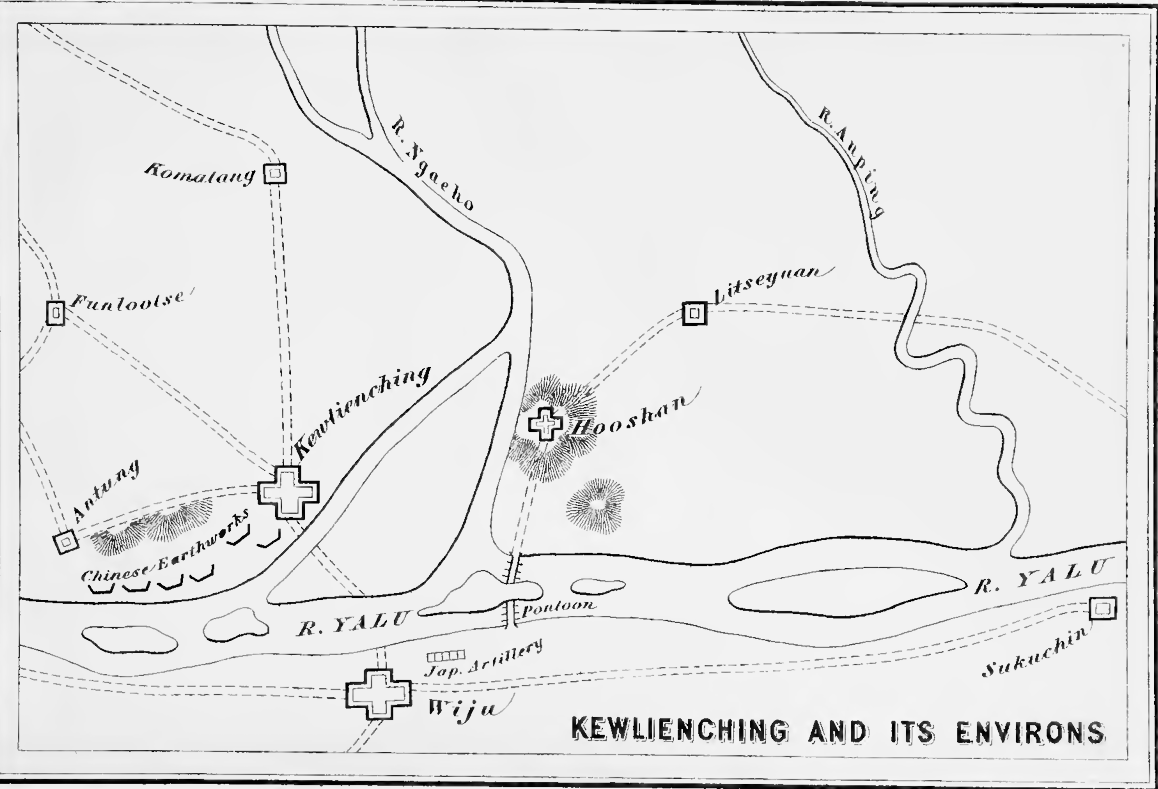
CHAPTER VII . CAPTURE OF KINCHOW AND PORT ARTHUR.
The Chinese had been utterly defeated at Phyongyang on the 15th September and finally driven out of Corea by the battle of Kewlienching on the 24th October; and the Japanese army next invaded Chinese territory. As the First Army Corps drove them from castle to castle in Manchuria, it was necessary to strike a decisive blow by the capture of the great Chinese fortress and naval station of Port Arthur. Such a victory would place the whole of Pechili Gulf in Japanese hands. And to this end, the Second Army Corps was organised and despatched to the Regent’s Sword. This Second Army was to be composed of the First Provincial Division and the Twelfth Brigade, wjkich belongs to the Sixth Provincial Division. The First Division, whose headquarters are at Tokyo, reached Hiroshima on the 27th September, Marshal Oyama having been appointed its Commander-in-chief on the preceding day. On the 15 th October, the transports were ready to take the army over to the Regent’s Sword. The Japanese Diet held at the time an extraordinary session at which a war budget of 150,000,000 yen was unanimously voted. The Sixth Brigade under Major-General Hasegawa had already left for Corea, whence it was afterwards re-transported to China. The army was constituted in the following manner:—
The first fleet of transports left Ujina, the port of Hiroshima, between the 16th and 18 th, followed by two more fleets, and arrived at Oeundong, at the mouth of the Taidong, in Corea. On the 24th, a fleet of over 50 transports left that place under convoy of men-of-war. Hwayuankow, a little village at the mouth of the River Hwayuan, was chosen for landing as though Petsewo, a town of some importance further west, would have been preferable in many respects, the beach was muddy and extended too far out for landing. Petsewo is about 60 miles from Kinchow. Marines from the Chiyoda first landed and, after taking possession of the shore, were followed by the army. The troops which had left Ujina by the 18th were all landed at Hwayuankow by the 28th. The landing of horses, however, occupied twelve days. On the 25th, the advance guard which had landed early that morning left Hwayuankow. The First Battalion of the First Regiment, Infantry, under Major Saito, arrived the next day at Petsewo, which was occupied, without any resistance. The First Division reached that town on the 29th and the Commander-in-chief on the 4th November. On the 2nd, Major Saito was sent with a battalion each of Infantry and Engineers towards Kinchow to make a reconnaissance. The First Division left Petsewo onthe 3rd and reached Hwangheateen, 25 miles from that town, on the 4th. Major Saito met on the same day a company of Chinese at Lluheateen, whence, after a sharp encounter, the Chinese fled? leaving behind provisions and ammunition. On the 5th, when the Division had gone some three miles from Hwangheateen, the Chinese began to fire upon the advance-guard from the batteries at Mt. Tahoshang, which was about. 6,000 metres from the army. Lieut.-General Yamaji then made a forced march over 25 miles through hilly road to Kanheatun with two regiments with the object of attacking the Chinese rear as he had found that the Foochow road was quite unguarded. Major-General Nogi was left with an I.ifantry regiment and an Artillery corps to attack the batteries at Tahoshang, while Colonel Kono, with another regiment, the 15 th, was to advance against the enemy’s left from the Petsewo road. Next day, the 6th, having been fixed for the attack on Kinchow, the regiments left their encampments at 4 a.m. Major Saito, of the 15 th Regiment, led his battalion around the right flank of the forts at Tahoshang to the rear. A company of that battalion clambering up a precipice, charged upon the first battery, of which, in spite of a stout resistance, it soon took possession. With the aid of a second company, the same company also occupied the second battery. The fugitive Chinese were pursued to Kinchow. Lieut.-General Yamaji had, in the meanwhile, advanced along the Foochow road, while Major-General Nogi and Colonel Kono also closed upon Kinchow. Simultaneously with the latter, the Second Regiment, one of the Main Division, opened fire upon the castle. For fifty minutes the Chinese replied with their Krupp guns, but after that, showed a disposition to retreat. As the castle walls were 30 feet high, the Engineers destroyed with gun-cotton the North gate which was the strongest of all; and through the breach the Japanese rushed in. The East gate was also broken open. The Chinese then opened the West gate and fled along the Port Arthur road, pursued by the Japanese as far as Sooheatup. The castle fell at 10 a.m. Major-General Nogi and Colonel Kono were then sent with their regiments against Talienwan. When they arrived at the forts early on the morning of the 7th, they found them deserted. All the forts, magazines, and the torpedoLstation fell into their hands. The total strength of the garrison at Kinchow was about 1,500 while there were at Talienwan over 5,000 who, however, took to their heels as soon as they heard of the capture of Kinchow by the Japanese on the 6th; the Chinese lost a small number in killed, and 100 wounded, while among the Japanese a lieutenant and a few privates were wounded at Kinchow. On the 7th, the Japanese fleet came to the Bay of Talienwan to assist the army; but when they arrived, the fortress had already beeen taken. Talienwan is a naval port next in importance to Port Arthur and Wei-hai-wei. There are three forts on Hoshang-tao, which juts out in the middle of the Bay. The central fort has 2 21-c.m. and 2 15-c.m. guns, while the east and west forts have 2 24-c.m. guns. The Laokewtow fort, lying to the west of Hoshang, has 2 24 c.m. and 2 21 c.m. guns; the Hwangshan, S. W. of Laokewtow, possesses 2 24-c.m. and 2 12-c.m. guns ; and the Seuheashan fort, N.E. of Hoshang, is furnished with 4 15-c.m. guns. The capture of Kinchow and Talienwan had been effected by the First Provincial Division alone. After these victories, the army took up its headquarters at Kinchow where a Civil Administrative Office was opened. On the 13th, Major-General Hasegawa arrived at Kinchow at the head of the 12th or Combined Brigade. On the i6tb, the Army encamped outside the city, and on the following day, commenced the march upon Port Arthur. The Army advanced in two columns. The right column consisted of the Independent Cavalry, the First Provincial Division Infantry (except two battalions of the 15th Regiment), the 12th (Combined) Brigade (except such as were included in the left column), and the Siege Artillery Train. The column marched from Kinchow via Sanshih-lipu and Shwangtai-kow. The left ( 58 ) column consisted of the 14th Infantry Regiment (except a battalion which remained at Liushootun), a sub-company each of Cavalry and Engineers, and half a Medical Corps. This column under the command of Lieut.-Colonel Masumitsu passed through Tsintseling to the north-east of Port Arthur. A battalion of Cavalry went as an independent body to reconnoitre the enemy. On the 18th, at 10 a.m., when it arrived at Seuheatun, it fell in with thousands of the enemy’s cavalry and infantry who came from the neighbourhood of the Shwytseying, and fought with them. The enemy increased in number. The Japanese cavalry, being surrounded by the enemy and seeing the hopelessness of fighting against such fearful odds, succeeded after a desperate struggle in cutting their way through towards Shwangtai-kow. An Infantry company of the Japanese advance-guard was about a mile in rear, and on seeing the Cavalry fighting desperately, charged upon the enemy though tlie company knew how greatly they were outnumbered, and assisted the Cavalry in making its retreat. The enemy, who were about 3,000 strong, now turned upon the Infantry and surrounded it. The Infantry fought desperately ; but when the Cavalry saw the Infantry hard-pressed by the enemy in the attempt to cover the Cavalry’s retreat, Captain Asakawa, at the head of 24 horsemen, rushed upon the enemy’s cavalry and freely used his sword. Seven of the enemy’s cavalry were killed, while many others fled with their arms cut off or their heads split. Captain Asakawa was wounded in the arm and shoulder, and Lieut. Nakaman, Infantry, was killed. Several were killed or wounded. Being overwhelmed, ’ the Japanese Infantry and Cavalry retreated to a high ground at Shwangtai-kow. A battalion of the advance-guard, hearing the reports of rifles, ran to their assistance and arrived on the south sides of Shwangtai-kow, just as the Cavalry and Infantry were being hard beset by the enemy. The battalion immediately extended and charged the enemy. About 2,000 metres to the south of the Japanese, 3,000 Chinese appeared on a hill with four mountain guns; but they were dislodged by the Japanese battalion. When the mountain guns of the main body of the advance-guard arrived on the spot, the enemy had begun to retreat. The Artillery, therefore, did not fire upon them; and the cavalry was sent in their pursuit. But as it was already close on sunset, the Japanese also retired. The Chinese had cut off the heads of the Japanese dead, struck off their hands, and drawing their bowels, had extracted their livers, presenting a most horrible sight. The Japanese officers and men, on seeing this, were seized with uncontrollable fury and swore to wreak summary vegeance on the inhuman foe. On the 20th, the army advanced to the vicinity of the object of its attack. As the attack was to be opened on the following morning, Marshal Oyama summoned the commanders and staff-officers to a hill lying to the north-west of Liheatun and gave orders with regard to the points of attack. As these and other officers were surveying the enemy’s forts from a distance, thousands of Chinese were seen coming towards them from the forts'and barracks. On careful inspection, their total strength was seen to be over 4,000. Lieut.-General Yamaji ordered the army to be ready for action and wait for the enemy’s arrival. The Chinese, ignorant of the Japanese preparations, advanced from three sides upon a hill to the south of Shihtsuytse, occupied by the Second Regiment, with the object of surrounding it. The Japanese had made every preparation. The artillery had been sent to the hill, and poured a terrific fusillade upon the enemy, who were unable to approach and had finally to retreat. As it was already sunset, the Japanese did not pursue them. The Japanese had only two wounded, while the Chinese losses were great. On the 21st, the Japanese army got the artillery in readiness soon after midnight, every soldier having taken off his knapsack. As soon as the moon rose, the columns made each for its point of attack. They were to be disposed as follows :—The First Provincial Division was in the first place to attack the forts on Etse-shan (Chair Mount), the Combined Brigade was to assault the forts on Urlung-shan (Two-dragons Mount), and the independent cavalry was to cover the right flank of the First Division. The Left Column was to intercept the enemy on the north of Port Arthur; and the Siege Artillery was to take up its position to the north of Shwytseying. As the preparations for attack had been made, the advance-guard, taking advantage of the light of the half-moon, went noiselessly up to the enemy’s forts. The fieldguns of the First Division were ranged on a field to the north-west of Shwytseying. They waited till dawn when they commenced the attack. As the locality was without roads and full of steep and stony slopes, great difficulty was experienced in getting the field guns in position. A company of Engineers and the Second Infantry Regiment were drafted to assist in drawing up the guns. MajorGeneral Nishi went westward with the Third Infantry Regiment, a battalion of the Second Regiment, half a Cavalry battalion, a Mountain Artillery battalion, and an Engineers company, and came upon the north-west of the Etse-shan forts. Lieut.-General Yamaji followed Major-General Nishi with the remaining troops. As soon as the day dawned, the field and siege guns opened fire, and woke up the enemy. The van of the Third Regiment under Major-General Nishi appeared suddenly on the west side of the west fort of Etse-shan; the mountain guns were also on the same side. There were over 40 siege and field guns attacking the three forts of Etse-shan ; but the enemy defended them with desperation. The coast guns also aided them. The ordnance made terrific noises. The Japanese guns told with deadly effect, and before long the Etse-shan forts fell. The Third Regiment stormed them and took possession of them. This was at a little past 8 a.m. MajorGeneral Nogi, at the head of the First Regiment, had a severe fight in preventing over 1,000 of the enemy’s cavalry and infantry from escaping to Fongheatun. After 30 minutes’ fight, the enemy were repulsed. At this time, the Japanese squadron which wjis off Port Arthur, went to the west coast and fired to cut off the enemy’s retreat. Thus being unable to fly northward, they concealed themselves in Laoteeshan, on the' extreme end of the Port Arthur peninsula. The Japanese Field Artillery then advanced upon the Sungshoo-shan forts. The guns were ranged at a proper distance, and commenced to' fire. But the enemy on these forts had already begun to prepare for flight when they saw the Etse-shan forts fall. When, therefore, the well-aimed shells of the Field Artillery fell upon them, they fled without waiting for the Infantry charge. At the same time, the Combined Brigade took possession of the Urlung and Keekwan forts. The Combined Bridge had no field guns, and could only use the mountain guns. At first the enemy showed no signs of retreat; but the First Division, flushed with the capture of the Etseshan forts, attacked them on the rear. Pressed on both sides, the Chinese could no longer hold out; and these forts fell at a little past noon. The landward defences having been completely captured by noon, the attack on the coast forts was commenced in the afternoon. Among these, the forts which had offered the greatest obstacles to the capture of Port Arthur were those on Hwangkin-shan (Golden Mount). These forts were the only ones on the coast whose range includecj not only the land forts, but even the positions where the Japanese field and mountain guns were placed. They contained guns of large calibre, free to move in any direction. It was, therefore, necessary to capture these forts before any others of the coast forts. To aid the Field Artillery, the Second Regiment was sent against the forts. Its march through the town was opposed by hundreds of the enemy, who, however, were soon disposed of. These forts were captured at about 5 p.m. As it was now after sunset, the attack on the forts to the west of Hwangkin-shan forts was suspended. In the night, however, the enemy fled. When on the morning of the 22nd, the Japanese advanced upon them, not a soldier was to be seen. Thus over 20 forts of Port Arthur were entirely occupied by the Japanese after a day’s attack. On the day of the attack on Port Arthur by the Japanese army, the Japanese men-of-war, Akagi, Chokai, Oshima, and Maya fired upon the forts at Laotsin-tsuy, on the eastern extremity of Port Arthur, which replied. The Japanese were not damaged; the firing continued for three hours. At I p.m. the Chiyoda, aided the army by firing upon the enemy from Kew-wan (Pigeon Bay). At 3, the forts on Mingtau-shan fired without effect upon the Japanese squadron. At 6, a little steamboat (30 or 40 h.p.) came out of the port; and on the Japanese pursuing it, it ran aground. The torpedo-mines in the harbour were removed on the 23rd, and the Japanese men-of-war entered Port Arthur on the night of the 24th. The Chinese men-of-war were all at Wei-hai-wei and did not show the least disposition to come out. When Kinchow was taken on the 6th, 2,000 Chinese troops who had already left Foochow to reinforce the castle, fell back on Foochow again. But seeing the Japanese garrison at Kinchow greatly weakened by the departure of the army for Port Arthur on the 17th, they resolved to attack the castle. On the 19th, Japanese mounted scouts saw the enemy marching with flying flags and pennons through Poolanteen (27 miles from Kinchow) on the road from Foochow. They came near Liangchiateen on the Petsewo road, and cut the Japanese telegraph line; but as the military supplies were sent from Petsewo to Talienwan by sea, and thence to Kinchow, no great inconvenience was felt. On the 20th, the enemy came to Sanshih-lipu ; a portion of the Japanese garrison was sent to Shihsanli-taitse to intercept their approach ; but as they did not come any closer, the Japanese returned to Kinchow. On the 21st, at 11 a.m., the enemy advanced and attacked Kinchow. Their strength was a regiment of infantry and 200 horsemen. As the Japanese had not enough forces for defence, telegraph operatives and coolies were armed with the rifles and guns captured at Kinchow. The Japanese men-of-war at Talienwan also sent about 200 marines. A company remained outside the castle, and the second was within. They fought stoutly with the enemy from noon till 3.15, when the enemy retreated. The Japanese losses were 57 of whom 9 were killed, while the Chinese lost 300. In this battle, the operatives and coolies fought bravely and did great service. On the following day, the fugitives from Port Arthur, many thousands in number, attacked Kinchow on their way to Foochow; but they were successfully repulsed. Major-General Nogi arrived with reinforcements at Kinchow on the 24th. On the 1st December, Marshal Oyama left Port Arthur for Kinchow, which was then made the headquarters of the second army. Port Arthur was given in charge to the Combined Squadrons. The Japanese had captured at Port Arthur 57 large-calibre guns on the coast defence forts and 163 small-calibre guns on the landard forts. The japanese losses were as follows:
Two of the officers wounded at Port Arthur died sub-quently, making the total number killed 31.The Chinese losses at Port Arthur and Kinchow have been put at 4,500. A few days after the capture of Port Arthur, Mr. Detring, Commissioner of the Chinese Customs at Tientsin, came over to Japan to make proposals of peace ; but as he was not armed with full powers for the purpose, the Japanese Government refused to treat with him, and he returned to China soon after. |
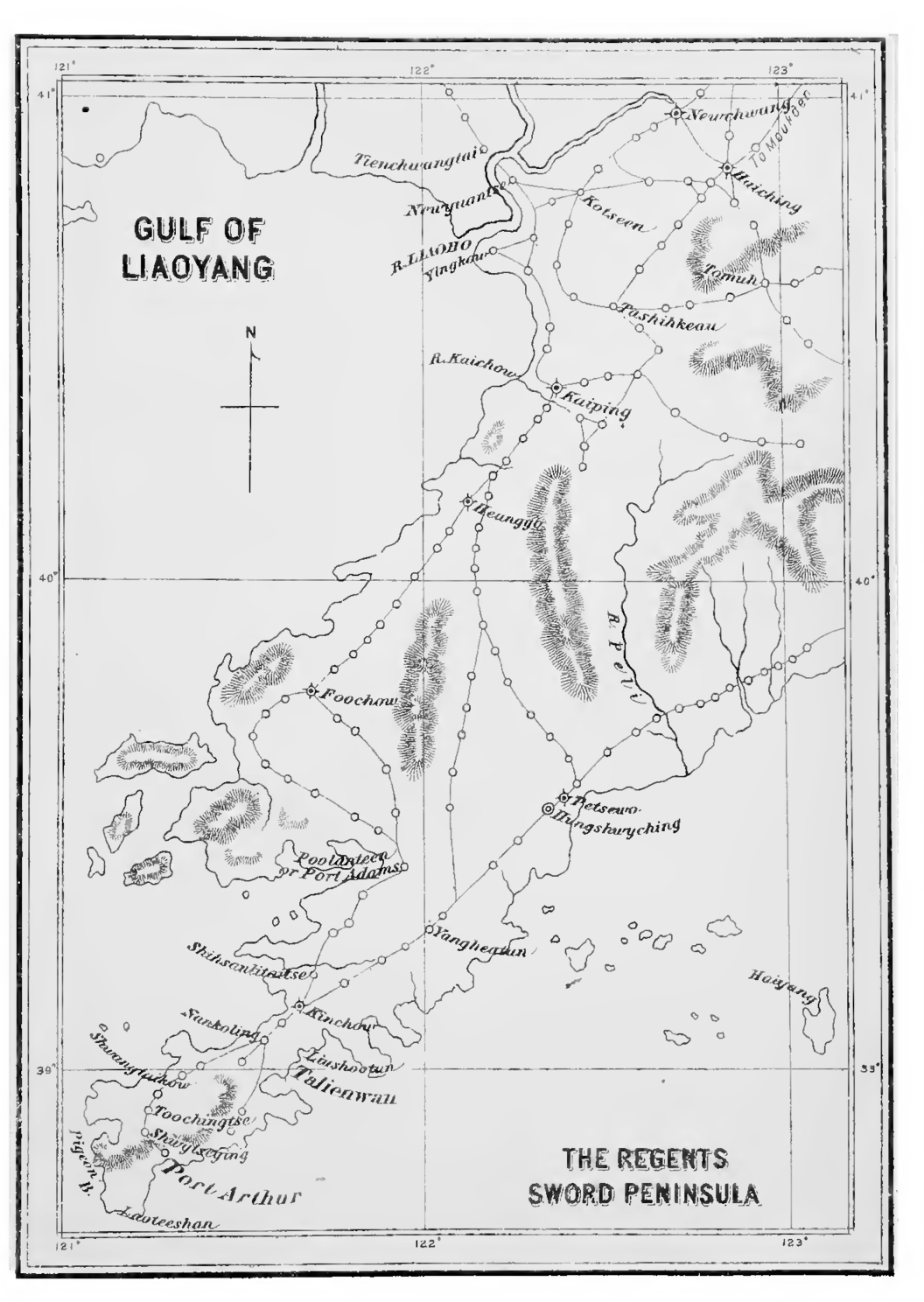
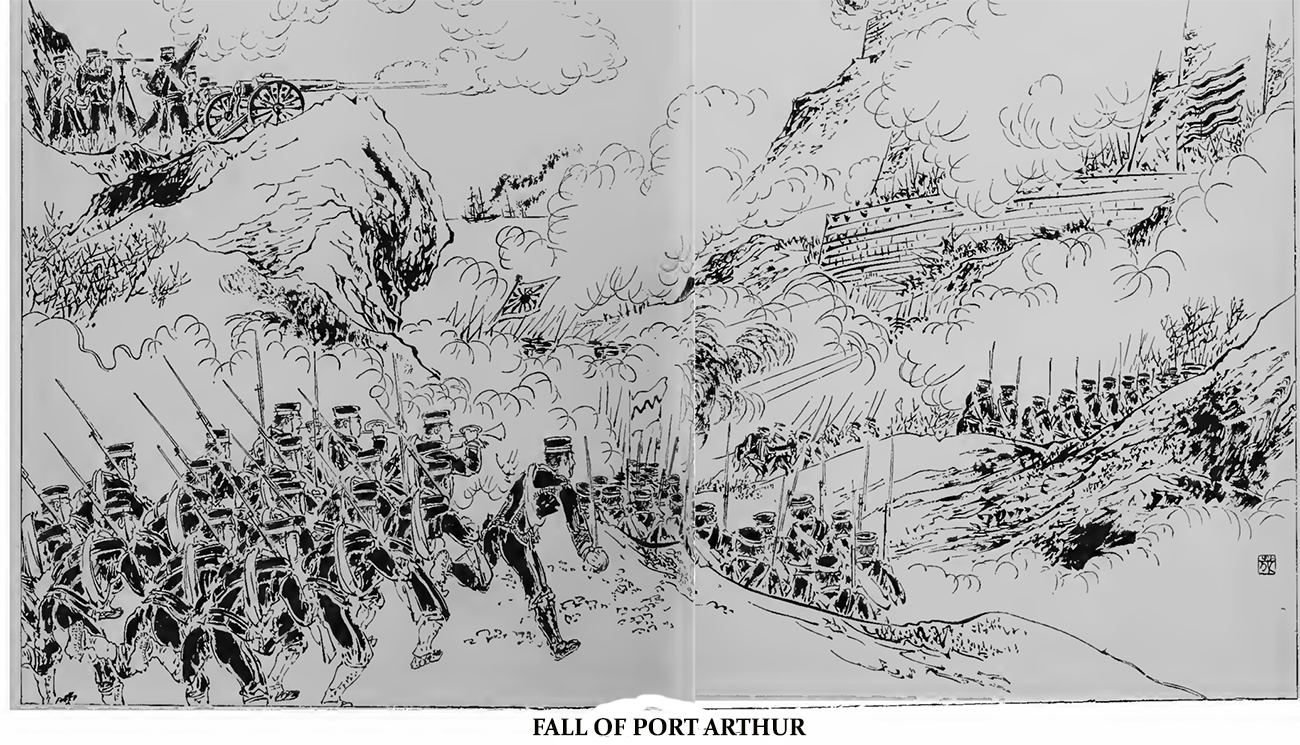
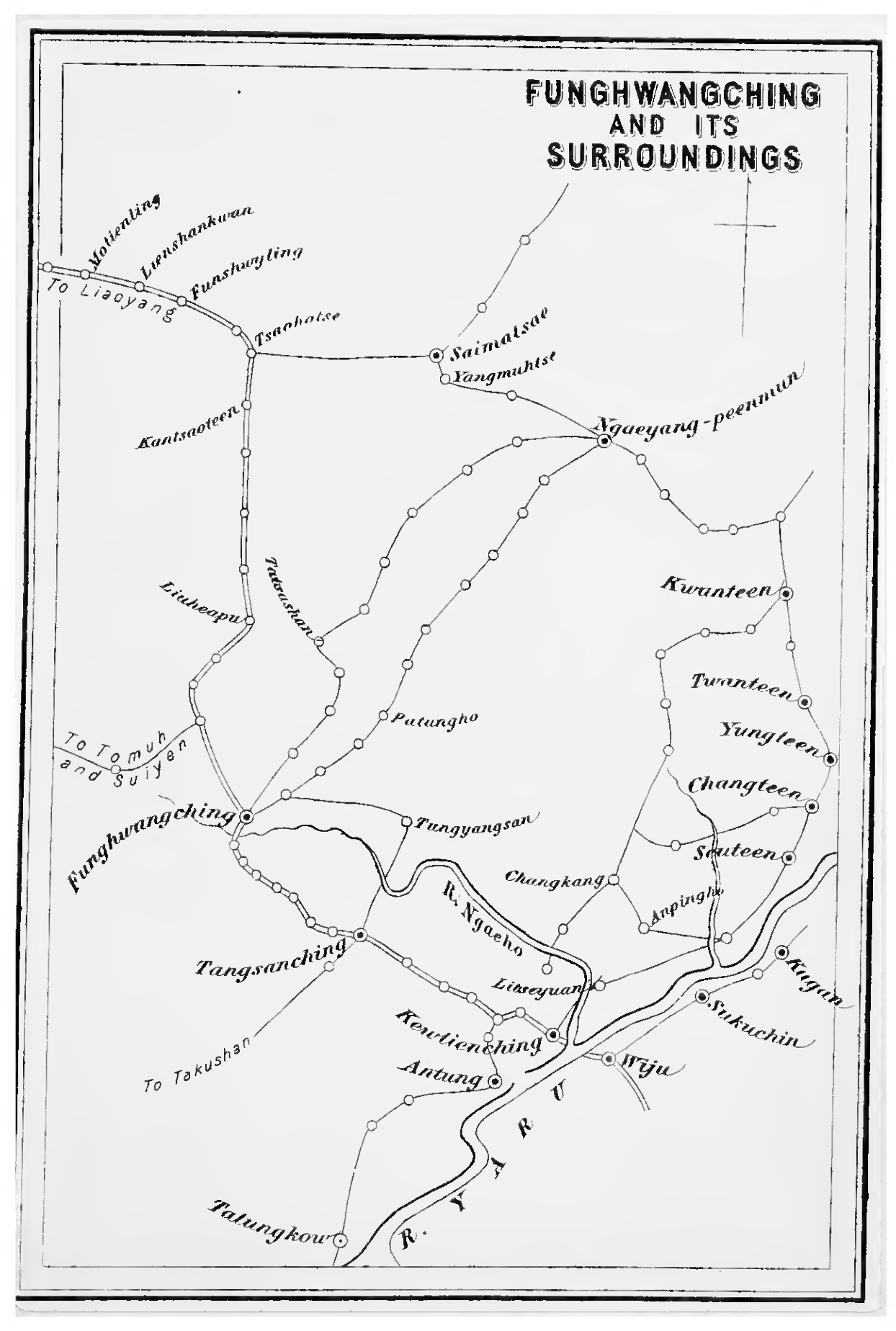
CHAPTER VIII . OPERATIONS IN MANCHURIA.
The First Army Corps’ operations in Manchuria were carried on in two different directions, the former being the movements of Major-General Tatsumi’s Column on the Moukden road, and the latter those of the Third Provincial Division in the Tomuh and Haiching district. These were supplemented by those of the Second Army Corps which advanced from Kinchow on the Kaiping road. Let us first follow the movements of the Tatsumi Column. There are two roads from Funghwangching to Moukden, one running northward to Tsaoho-kow whence it turns westward to Liaoyang, and the other running in a north-easterly direction to Ngaeyang-peenmun, whence it veers towards Liaoyang. Major General Tatsumi, who had made Funghwangching his headquarters on the 30th October, received a report that Chinese troops were to be seen about Lienshankwan in great strength. On the 10th November, he sent mounted scouts thither, followed by an Infantry battalion under Major Imada. The scouts met a Chinese detachment near Lienshankwan, and routing it, took possession of Lienshankwan. Major Imada entered the place soon after. The Chinese retreated to Motienling. Major-General Tatsumi also sent on the 9th November mounted scouts on the Kirin road, followed by a battalion under Captain Adachi, who reached on the 13th Ngaeyang-peenmun, 30 miles from Funghwangching. Before he could thence arrive at Saematsae he was beset by 1,800 Chinese, of whom 300 were horse. As he was outnumbered by nearly one to ten, he took his position on a hill and replied vigorously to their fire. After three hours’ fight, it became dark, and the captain began to retreat, as he had performed his proper duty of reconnoitring the enemy’s position. He had also sent a horseman beforehand with a report to Major-General Tatsumi; and the General immediately despatched Captain Hirai with a company, who succeeded in covering his retreat. Learning that Major Imada’s body might be too small to hold Lienshankwan, Major-General Tatsumi sent a battalion, under Lieut.-Colonel Tomioka, Commander of the 22nd Regiment. From Lienshankwan, Lieut.-Colonel Tomioka sent a company under Captain Kato to reconnoitre Saematsae; but atTsaohokow, the captain was confronted by 1,500 Chinese. He retreated to Tungyuenpu. On receiving the captain’s report, Lieut.-Colonel Tomioka left Lienshankwan as he might at any time be attacked On both sides, and arrived at Tsaohokow on the 25th. The Chinese were reinforced, and they now numbered 4,000 infantry, and 1,000 cavalry, with six guns. They were Kirin and Amour troops under General E-kuei-tang-o, of Amour District. They communicated with the Chinese who had retreated to Motienling ; and 1,000 each, of infantry and cavalry, with two guns, advanced past Lienshankwan to Fungshwyling. Their total forces were three times the Japanese. A battalion was pitted against the Amour troops, while the Motienling troops were kept at bay by two companies. Two captains and a lieutenant were wounded ; but they fought desperately. The Japanese made a brave stand against odds, but they lost over forty in wounded or killed. The engagement was brought to a close by a heavy snowfall. At night, the rifles were frozen, so that the Japanese were compelled to light fires to warm them. On the following day, the enemy had retreated out of range. Major-General Tatsumi sent a battalion again towards Ngaeyang. He received a report soon after that Colonel Nishi-jima of the nth Regiment, had routed the enemy at Kwanteen 011 the 23rd and was marching upon Saematsae. On the 26th, therefore, the Major-General left Funghwangching to combine with the Colonel in the attack upon Saematsae. On the 29th, he was close upon that town, when a horseman came to report that Lieut.-Colonel Tomioka was again hard-pressed about two miles from Tsaoho Castle ; and as, soon after, Colonel Nishijima reported the capture of Saematsae, lie turned eastward and reached Tsaoho Castle in the evening. A junction was formed with Lieut.-Colonel Tomioka. On the following day, a battalion was sent against the Chinese who had taken up a position near Tsuy-heafang. The Chinese, on being dislodged from one hill, immediately fled to the next and began firing as before. After three hours’ fighting, evening fell and the Japanese troops lit fires at Tsuyheafang. In the night, the enemy took to flight. The Japanese lost six men wounded, while the total Chinese loss is estimated at 200 killed or wounded. As the Chinese troops could not be seen for more than eight miles from Tsuyheafang, Major-General Tatsumi resolved to return to Funghwangching, which he reached on the 5 th December. As soon as Major-General Tatsumi had returned to his headquarters, the Chinese again advanced. They marched in two columns, one along the Kirin road and the other along the Liao-yang, with the object of closing upon Funghwangching. MajorGeneral Tatsumi, therefore, left the castle on the 9th December, and arrived that day at Seueliteen, 12'5 miles on the road to Mo-tienling. The General’s intention in taking this road was to hold the Chinese troops about Motienling in check so as to facilitate the march of the Third Provincial Division upon Haiching. On the 10th, he came to Fanheatai, 10 miles from Seueliteen, where he met the Amour General E at the head of 3,000 men. Fanheatai is in a valley from 1,200 to 2,000 metres wide, with mountains on both side, and a river flowing close by the village. The Chinese wings, consisting of about 600 men each, had taken up their positions on both mountains, while the centre was stationed between the river and village. They had two guns which they fired with smokeless powder. A Japanese battalion advanced along each mountain and fired upon the enemy’s wing on the other. After a few hours’ desultory fighting, a battalion under Major Imada extended into a double line, about 1,600 metres long, and bore down upon the enemy’s centre, which was utterly routed. The Chinese wings, being thus divided, fought half-heartedly for a short while and then took to flight, pursued for five miles by the Japanese. They left behind 110 dead, 107 guns, 16 prisoners, 4 horses, and 6 flags, while the Japanese lost 10 men killed, and 3 officers and 47 sub-officers and men wounded. On 11th, it was reported at Funghwangching that 3,000 Chinese under General E had advanced on the Saematsae road as far as Lungwan. Colonel Tomoyasu, who was in charge of the castle in the Major-General’s absence, sent two companies in that direction. After some skirmishes with the scouts, the Chinese, about 2,000 strong, arrived at the 13th on the bank of the Ngaeho, opposite the castle. During the night, they were surrounded by three Japanese battalions on three sides, and surprised at dawn. After a desperate fight, they fled in confusion along the Moukden road, the only one open, and were pursued as far as Changlingtse. Twelve Japanese soldiers were killed, and two officers, 7 sub-officers, and 53 men were wounded, while 139 Chinese bodies were found by the Japanese. A battalion was sent from Tangshan to Funghwangching and another battalion was sent to the former from Kewlienching on the 13th. On the 3rd December, the Third Provincial Division which had been stationed at Antung ever since the capture of that town, was ordered to march upon Haiching. On that day, the advanceguard left the town under Major-General H. Oshima, Commander of the Sixth Brigade, followed by the rest of the Division on the following day. On the 8th, the whole Division arrived at Siuyen. On the morning of the 10th,. the army began to march upon Tomuh. The right column under Major-General Oseko took the road which runs from Funghwangching to Tomuh, and the left column under Colonel Sato the road to Kaiping to guard the left flank of the main body, which went direct to Tomuh. On the morning of the nth, the main body, after crossing Seaoukushan, reached Urtao-hotse, when about 50 Chinese horsemen were seen 600 metres off, and on each of two hills not far off were 700 foot-soldiers. After a slight skirmish, in which Major Sakakiwara, a staff officer, was wounded by a random shot and afterwards died, the Chinese fled toward Yingshookow, a hill to the west of Urtao, and preparations were made for attacking that position on the morrow. But at dawn, it was found that they had retreated to Tomuh. The main body advanced toward Tomuh along the main road, while a battalion took the road from Yingshookow. Meanwhile, the Oseko column, whose progress had been unimpeded except at Panhea-putse, near Newsinshan, where a body of 500 Chinese was routed on the 1 ith, also approached Tomuh, so that the Chinese were attacked from three roads, and were soon put to flight. Tomuh was taken at 10 a.m. About 2,000 Chinese were opposed at Tomuh against the Yingshookow battalion, 2,000 against the Oseko column, and nearly 5,000 against the main body. The Oseko column and the battalion were joined to the main body, and after leaving a corps in charge of the town, the army left Tomuh immediately for Haiching. That night, the Division encamped at Yangheateen, about seven miles from Haishing, after a forced march of ten hours. At 9.40 on the morning of the 13th, the advance-guard arrived at Lohea-putse, two miles south of Haiching, when about 1,000 Chinese were seen on a hill called Keaumehshan, on the south-east of the castle, and nearly 600 on another hill to the west. There were also four guns on the former hill. As the Japanese approached, the Chinese descended from the hill and unlimbered their guns, while the Japanese fired upon them a battery of 12 mountain guns. A battalion under Colonel Awaii-bara also attacked them. Two companies made for the castle, but hundreds of Chinese defended the castle-gate. They were, however, routed by the Japanese charging upon them. The main body then entered the castle by the south gate, and the Oseko column by the east. The Chinese fled in confusion, about 5,000 making for Liaoyang and 3,000 for Newchwang. In the engagement at Tomuh, Major Sakakibara was the only officer wounded, and only six men of the Fifth Brigade were wounded, while at Haiching, four men of the Sixth Brigade were wounded. The Chinese losses are unknown, but are computed at 100 odd; and 24 horses, 2 old-fashioned guns, 200 rifles, 2 jingals, 14 flags, 18 spears, 21 bayonets, 6 swords, 7,200 cartridges, 66 bags of powder, 3 trumpets, 108 uniforms, and 3 saddles were captured. On the 13th, Lieut.-General Katsura wrote to a French missionary at Newchwang and to the late Honorary Consul for Japan at Yingkow, to assure them of the Japanese protection of the foreigners and Christians at those towns. A few days after the occupation of Haiching, Lieut.-General Katsura received a report that Sungkiang had left Kaiping with 20,000 men and was advancing upon Haiching. A reconnaissance company met small bodies of Chinese near Kaiheatun on the 18th, and after a sharp engagement, returned to Kaiching. On the morning of the 19th, Major-Generals Oseko and Oshima were sent with columns to intercept Sungkiang’s army. General Katsura expected that the Chinese would come to Liukungtun, but as it was found that they were not to be seen there, he believed they had retreated to Kaiheatun, and accordingly ordered Generals Oseko and Oshima to attack them there in front and on the left flank. General Oshima found Kaiheatun deserted and returned to Palihotse, whither General Katsura had advanced ; but a report came in the afternoon from General Oseko that a large body of the enemy had been found at Kangwasae. General Oshima went at once to his aid. When General Oseko reached Kaiheatun, the advance-guard had arrived at Heakeaho, whence it saw that there was a large Chinese column at Kangwasae, while there was another column at Makeuentse and a third at Hongshwy-paotse. A company of cavalry was also stationed between Kangwasae and Heakeaho. General Oseko came up, and preparations were made at Heakeaho. A battery of Mountain Artillery was called up and ranged on the west end of the village. Before attacking Kangwasae, it was first necessary to take possession of Makeuentse, 1,200 metres north east of Kangwasae, as the army would else be exposed to flank attack. Major Ishida, of the 18th Regiment, had therefore advanced with two companies, 200 metres towards Makeuentse, when his left wing was suddenly attacked from a wood close by. The companies then turned upon their assailants, and had put them to flight when the right flank was now attacked from Makeuentse. Major Imada then called a third company, and again tumedupon Makeuentse, covered all the time by the artillery at Heakeaho. The companies advanced; but they were without shelter of any kind and knee-deep in snow, and were therefore exposed to the enemy’s fire. When they were within 400 metres of the enemy, they came to a ditch, running slantwise to their course. The men jumped into it to cover themselves, but their formation was turned from a rank to a file, and exposed them to an enfilade fire. The officers did their best to restore the formation, during which the enemy’s fire told with deadly effect. It was resolved that they should charge upon them rather than fall one by one under their fire; and the charge was sounded. Before they reached them, the Chinese began to retreat and the Japanese carried the position by storm at 2 p.m. The artillery next turned its attention upon Kangwasae. At 4, General Oshima arrived at the battle field. The Chinese artillery was now ranged on the south end of the town, and told with great effect; and a Chinese company of infantry appeared to the left of the artillery in an exposed position, which was remarkable for the Chinese. They attacked the Japanese left, which was also, exposed to the fire of the artillery, and this cross fire worked a terrible havoc in that part. A Chinese ambush in a pinegrove was routed; and in spite of their disadvantageous position, the Japanese, by making charge after charge, at last captured Kangwasae. This battle was so far the dearest victory obtained by the Japanese. A battalion exposed to the enemy’s cross fire lost 160 killed or wounded out of the total 367, while in the 7th company, also in the same predicament, 13 out of 14 officers were disabled. The three companies which stormed Makeuentse lost 75, of whom only an officer was killed. The total Japanese loss was
The total number engaged in the battle was 4,537, so that the killed and wounded amounted to one-eleventh of the whole. The Chinese army actually numbered about 10,000, of whom perhaps 5,000 took part in the battle. About 200 were killed, and the wounded were probably 300. The Chinese fled towards Newchwang. Leaving a corps at Kangwasae, General Katsura returned to Haiching on the following day. A few days later, he was reinforced by Colonel Sato, of the 18th Regiment, who had left a battalion at Tomuh. For a month, Haiching enjoyed peace; but on the 17th January, 10,000 Chinese from the Liao-yang road, attacked Haiching from three roads, and were only routed after eight hours’ fighting. The Japanese lost a man killed, and 39 officers and men wounded. A third attack on Haiching was made on the 16th February from the same directions by 15,000 Chinese under General E and they were again repulsed, leaving over 100 dead behind. The Japanese lost 3 men killed, and an officer and 9 sub-officers and men wounded. On the following day, Tomuh was also attacked by 1,000 Chinese, the van of an army of 3,000, with 100 horsemen and 8 guns. Thirty of them were killed, while not a Japanese was killed or wounded. On the 1st December, Major-General. Nogi, Commander of the First Brigade, who had returned to "Kinchow from Port Arthur, sent Lieut.-Colonel Iki, with the First Regiment, Infantry, and a company each of Cavalry and Artillery, towards Foochow. At Poolanteen, it was discovered that there were at Foochow 6,000 or 7,600 Chinese consisting of the garrison proper, Port Arthur fugitives, and reinforcements from Heung-yo. But the Chinese retreated as the Japanese advanced, and Foochow was deserted by the Chinese troops when the latter entered it on the 6th. A few days later, the regiment returned to San-kwanmeau, near Poolanteen. Meanwhile General Tatsumi was fighting in the neighbourhood of Liaoyang, and General Katsura had captured Tomuh and Haiching, and it became necessary for the Second Army Corps to form a junction with the First. As the first step towards that end, the occupation of Kaiping was indispensable. Accordingly, orders were given to General Nogi to make preparations. The Second Army Corps had at the close of December three companies at Kinchow, a regiment each at Seauentao, Petsewo, and Poolanteen, and a Combined Brigade at Port Arthur. Though the plan for the attack of Kaiping was matured on the 21st, it was not until the 30th that the necessary preparations were completed as, the distance from Liushootun, the Second Army’s depot of supplies, to Kaiping being over 120 miles, great difficulties were experienced on account of the wretched road in opening a line of communication. On the 3rd January, the First Brigade started from Poolanteen. It consisted of an independent Cavalry nearly a battalion strong, the advance-guard of an Infantry battalion, the right column of two battalions, and the main body of three battalions, the three last also including smaller bodies of other arms. The right column under Colonel Iki took the direct road to Kaiping, while the main body under Major-General Nogi advanced along the Foochow road. On the 7th; the right column reached Heung-yo, followed on the ensuing day by the main body. On the 9th, the Brigade left Heung-yo, he main body by the main road and the right column by a side path; and in the evening, the former was at Yulinpu and the latter at Laoyanmeau, while their advance-guards were within 2,000 metres of the enemy. There were at Kaiping 4,000 or 5,000 Chinese under Generals Chang and Seu. They were encamped behind the banks of the River Kaiping, which flowed between the town and the Japanese army. Orders were given to Colonel Kono to attack the enemy’s right wing with two battalions and to Colonel Iki to bring his column against the Chinese left, while Major-General Nogi himself was to assail their centre. At 5.30 a.m. on the 10th, the Japanese got into position. About 1,400 metres to the east of Kaiping is a hill called Funghwang-shan, where the Chinese had ranged their guns and defended the position with 2,000 men. Colonel Iki sent against them a battalion, which charged upon them under the terrific volleys with which it was greeted, and successfully carried the position. The Chinese fled in confusion, hotly pursued, leaving behind over 100 dead. The Chinese in the centre, however, maintained their position and kept up a continuous fire as the Japanese charged upon them over the frozen river, frequently stumbling on the icc. But the Japanese succeeded in capturing the town at 9.40 a.m. The Chinese fled in the direction of Newchwang. In this battle, they showed great skill in shooting, and consequently the Japanese losses were great. In the 1st Regiment, two battalions of which stormed Funghwangshan, 53 were killed and 229 wounded, while in the 15th, 16 were killed or wounded, making the total killed and wounded, 305. In the afternoon, a battalion from Tomuh arrived at Kaiping and thus succeeded in forming a junction between the two Army Corps.
|
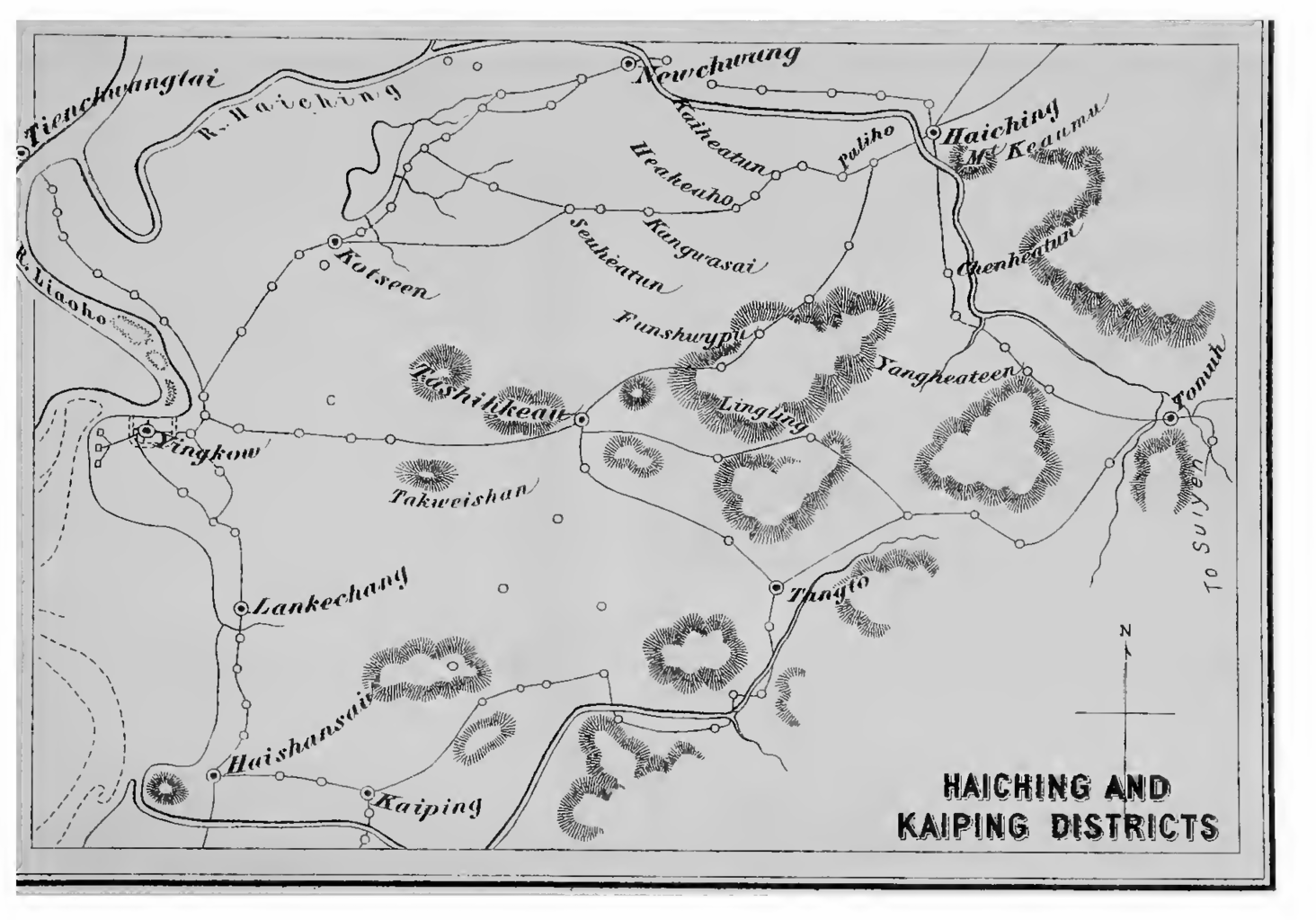
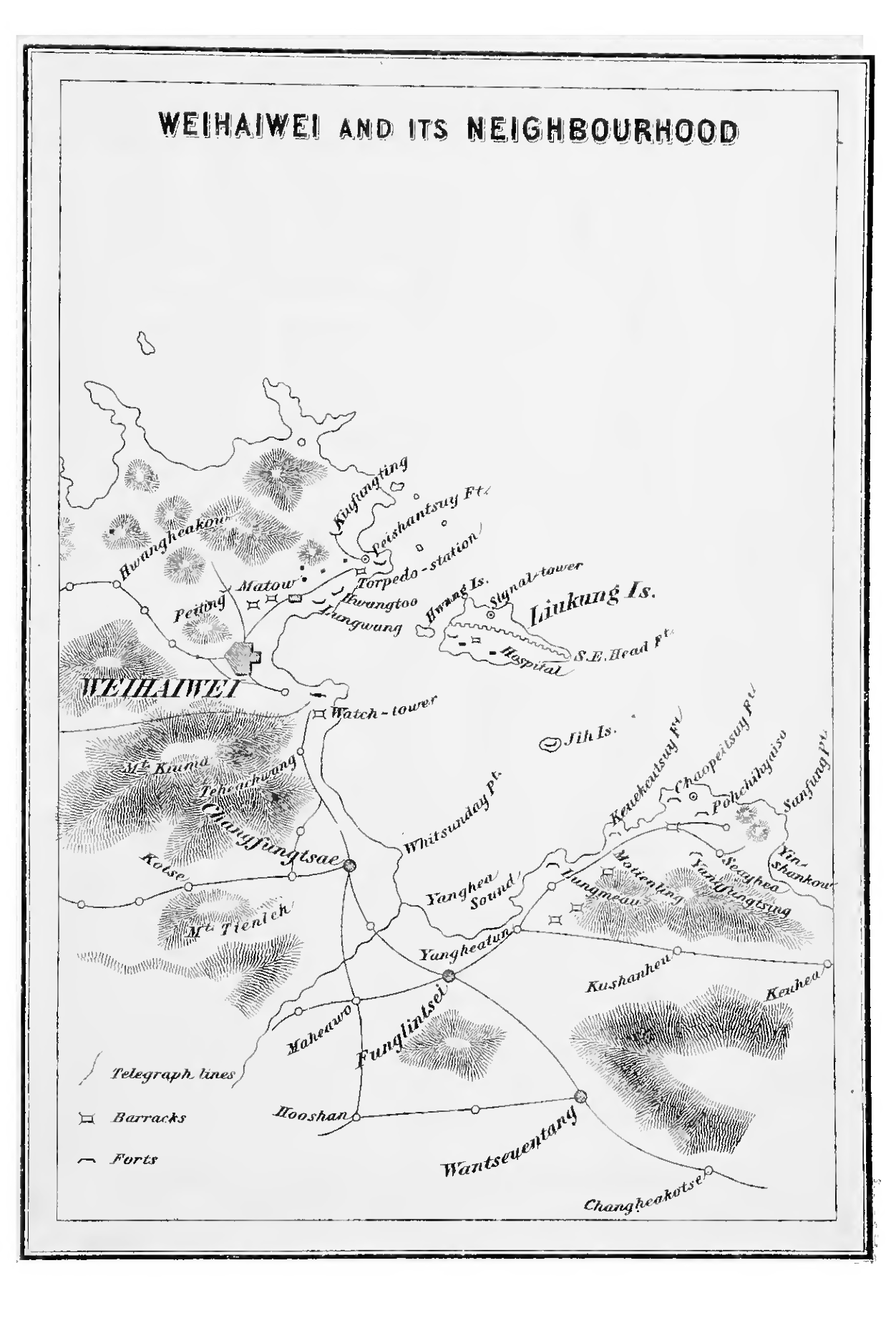
CHAPTER IX. CAPTURE OF WEI-HAI-WEI.
As China’s great fortress at Port Arthur had fallen on the 21 st November, it was next decided to attack Wei-hai-wei and destroy the remnant of the Peiyang Squadron, which had concealed themselves in that port, so that Japan could be the absolute mistress of Pecliili Gulf. On the 10th January, 1895, Jo transports left Ujina with the Second Provincial Division under the command of Lieut.-General Baron Sakuma, and the Eleventh Brigade (Sixth Division) under Lieut.-General Kuroki, and arrived on the 14th at Talienwan. On the 19th, a fleet of 19 transports departed from Talienwan, followed by another of 15 on the 20th and a third of 16 on the 21 st; and arrived at Yungching, the first fleet on the 20th, the second on the 21st, and the third on the 22nd. Marshal Oyama also reached the Bay of Yungching with the second fleet. The town of Yungching was occupied without any difficulty. The entire army was composed of
This corps was sent out as a portion of the Second Army Corps under Marshal Count Oyama. Preparations having been completed on the 25th, the army left Yungching, on the 26th, in two columns; the right (the Sixth Division) and the left (the Second Division), the former of which arrived by a northerly road from Yungching at Paouhea on the 29th, and the latter by a southerly road at a point to the southeast of Tseenting-tsesae, while the Staff Headquarters were at Menghea-chwangu. On the following day, an attack was to be made on the littoral forts, by the fleet and the Sixth Division, while the Second Division was to keep the enemy in check near Funglintsae. There had been skirmishes between the advance-guards and the Chinese, but nothing of a serious nature. The object of the Sixth Division was to take possession of the hills lying to the northeast of Kushanheu and thence to capture the coast forts. This was absolutely necessary for maintaining communication with the navy. The Division was divided into two wings, the left under Major-General Odera, consisting mainly of three Infantry battalions, and the right, under Major Watanabe, of a battalion, while Lieut.-General Kuroki held as reserve two battalions, with other arms. The Division left its quarters at 2 a.m., and the first object of attack was Motienling, the highest peak of a range of hills, on which a fort had been built. After a severe conflict, it was taken by assault, the Japanese charging up the hill on three sides. The Japanese Artillery corps at once entered the fort and began to fire the guns against other forts. The coast forts then turned their guns upon the captured fort and attacked it, with the assistance of several Chinese men-of-war. The Motienling fort was severely handled especially as the coast defence guns were far superior to its own. Meanwhile, a battalion of the left wing pursued the Chinese from Motienling and cut off their retreat. Even those in the coast forts showed a disposition to retreat before the Japanese took possession of all the roads. Taking advantage of this, the Japanese attacked and captured in succession the coast forts at Lung-meaoutsuy and Lukeutsuy, and the landward at Yangfungling. Now the only forts that were not taken in Pohchihyaisu were at Chaopeitsuy and Seayheasu, but their fall was only a question of time as they were entirely cut offby the Japanese. The Japanese began to attack them from the captured forts. The Seayheasu fort soon caught fire, and was destroyed; but the other still remained obstinate. Presently. 300 Chinese marines landed, and the garrison of the Chaopeitsuy fort set fire to the fort and joining these marines, tried to cut their way through the Japanese lines. They were almost all killed or driven into the sea. Thus the whole of the eastern forts of Wei-hai-wei fell into Japanese hands. The total strength of garrisons at these forts has been estimated at 2,600, of whom over 800 were killed or wounded. The Japanese lost about 115 in killed and wounded. Among these was Major-General Odera, Commander of the Eleventh Brigade, who was so severely wounded by a shell while in the Motienling fort that he died soon after. A newspaper correspondent was also killed. The whole of the next day was spent in making preparations for the attack on Wei-hai-wei itself on the morrow. The Sixth Division remained that day at Pohchihyaisu, and the Staff Headquarters at Wantseuentang, while the Second Division, which was principally charged with the task of attacking the naval port, was stationed at or near Funglintsae. The right column, in the meanwhile, had met on the 29th about 500 Chinese at Wantseuentang, which, however, it occupied with the loss of one killed and two wounded, The right wing, consisting of the Third Brigade, was led by Major-General Yamaguchi, while the left, consisting of the Fourth Brigade, was under Prince Fushimi. Early on the 30th, the advance guard of the left wing was attacked by the Chinese near Lwankochwang, and were hard-pressed as the latter were on a higher ground ; but the mountain artillery aided them so effectually that the enemy were put to flight. As Chinese troops were next seen fleeing from Yangheatun westward, the advance-guard advanced to attack them; hut they were so exposed to the fire of the men-of-war in the harbour that they were compelled to retire to Fungheawo. The Japanese lost two men killed and four wounded. The right wing took possession of the positions about Funglintsae. The Sixteenth Regiment was attacked by the Chinese who were fleeing to Wei-hai-wei from Pohchihyaisu. They had a sharp fight in which the Chinese men-of-war and torpedo-boats took part. The Chinese were, however, repulsed. Out of 2,000 who were flying towards Wei-hai-wei, 700 had attacked the regiment} and of these about 130 were killed. The Japanese losses were an officer wounded, and 38 sub-officers and men killed and 50 more wounded. After a day of preparation, the Second Division advanced on the 1st February to Lootaokow, about 12 miles south-west of Wei-hai-wei. On scouts reporting that there were 2,500 Chinese on the road to Wei-hai-wei, Prince Fushimi was sent with a regiment to attack them. In spite of a heavy snow-fall, the Chinese were completely routed, the Japanese losing 5 killed and 35 wounded. The Division slowly advanced, routing the Chinese concealed about the hills, and on the 2nd, the Fourth Brigade entered Wei-hai-wei without meeting with much resistance. Now only the island forts remained in the possession of the Chinese. Their capture as well as that of the Chinese men-of-war was the duty of the Japanese Navy, whose movements may be briefly summarised as follows:— After sending the first flying squadron to fire a few shots 011 the 19th at Tangchow to divert the attention of the Chinese at Wei-hai-wei, the Japanese fleet convoyed the transports to Yungching Bay, and though the troops had been entirely landed by the 24th, remained at the Bay until the 29th, when a report came that the army would attack Pohchihyaisu on the following day. 30th. The main squadron (the Matsushima, Chiyoda, Hashi-date, and Itsukushima), the first flying squadron (the Yoshino, Takar-chiho, Akitsushima, and Naniwa) and seven other vessels left the Bay for Wei-hai-wei at 2 a.m. The Fuse, Takao and Kongo had also gone thither overnight. The first flying squadron kept watch all day at the west entrance to Wei-hai-wei harbour, while the main squadron and the seven vessels were at the east entrance. Shots were exchanged with the forts at Liukung and Jih Islands, but without any result. 31st. The squadrons still kept watch ; and at 8 a.m., began to fire upon the islands, At 11.0, the sky became overcast and in the afternoon there was a heavy snow-storm, the temperature falling to 11 deg. Fahr. All, except the first flying squadron, returned to Yungching. 1st Feb. The storm continued unabated. 2nd. As the storm abated in the afternoon, the main squadron left for Wei-hai-wei. 3rd. The first and second (the Fuso, Hiyei, Kongo, and Takao) flying squadrons joined the main squadron. The second squadron, aided by the captured coast defence forts, had in the morning a sharp engagement with the east fort of Liukung Island and several Chinese men-of-war. The west fort was silent while the central fort discharged only 5 or 6 shells. There were no casualties among the Japanese, the only damage done being the cutting of the Takao's rigging. The third flying squadron (the Yamato, Musashi, and Katsuragi) also fired a few shots; but as the sky again became clouded, the squadron retired to Pohchih-yaisu. The firing was kept up however until night between the island forts and the captured littoral forts. 4th. The main and the first flying squadrons again kept about Liukung Island. Instructions for a night attack were given to the torpedo-boats. That night, the torpedo-boats Nos. 6 and 10 succeeded in cutting away 100 metres of the boom across the entrance to Wei-hai-wei, though they were fired at from the forts on the island. . 5th. At about 3 a.m., when the moon had gone down, the third torpedo flotilla, followed by the second, silently passed under the Pohchihyaisu forts and entered Wei-hai-wei harbour through the breach in the boom across the entrance. The torpedo-flotillas were composed as follows
The Chinese men-of-war lay before IJukung Island, while a gun-boat and a torpedo-boat kept guard. Their positions could just be seen. The torpedo-boat No. 22 was detected as she came close to the men-of-war, but she managed in the confusion caused by her presence to discharge two torpedoes. She was so severely attacked, however, that she made immediately for land; but she ran aground. One of her crew was killed, while several others were drowned. After a canvas-boat which had carried part of the crew ashore, had overturned and there was no other help, the rest in the torpedo-boat, including Lieut. Fukushima and five others remained in the hold while the boat was exposed to the enemy’s fire. They were rescued in the evening. The torpedo-boat No. 9, of the second flotilla, on taking her course to the north-west, came quite close to the Ting-yuen. She got among the Chinese torpedo-boats, which failed to recognise her until a light was thrown upon her from the men-of-war. She discharged a torpedo at 200 metres and another at about 50 metres, and as the latter took effect, she retreated at full speed; but the Chinese poured a heavy fusillade upon her, by which four men were killed and all her men in the engine-room were wounded. She could move no longer; but fortunately she met the torpedo-boat No. 19, which took over her crew, though the boat was abandoned. Nos 8 and 14 had stranded. The Ting-yueu had been hit and that day boats could be seen plying between Liukung and the man-of-war whose hull had foundered in shallow water. It was decided to make a second torpedo attack that night, though the Chinese were now on the alert. 6th. The first flotilla went into the harbour at 4 a.m. Three Chinese vessels were hit with torpedoes; and though the flotilla was fired at from the machine-guns, it returned absolutely undamaged. When day broke, the Lai-yuen, Wei-yuen, and a transport were seen to be half-sunk. The Japanese squadrons anchored at Yinshankow to prepare for the following day’s general attack. 7th. The main and the first flying squadrons commenced an attack on Liukung Island at 7.20 and the second, third (the Yamato, Musashi, Tenryu, Kaimon, and Katsuragi) and fourth (the Tsukushi, Atago, Maya, Oshima, and Chokai) flying squadrons also attacked Jih Island at the same time. After a severe engagement, one of the disappearing guns on Jih Island was disabled, and the magazine caught fire and exploded, so that the fort could no longer be seriously defended. Ten Chinese torpedo-boats, and two steam-launches came out of the harbour and were pursued by the first flying squadron. Eight of them ran aground as well as the launches, but the remaining two entered Chefoo, which, however, they left immediately after and also ran aground, They were brought by the Yoshino to Yinshankow. Most of the crews of these boats, on deserting them, were captured by the army. In the engagment of the morning, the Matsushima had three officers wounded, the Yoshino, two marines killed and four wounded, the Akitsushima, two wounded, the Fuso, one killed and six wounded, and the Tsukushi, three killed and five wounded. 8th. It was decided by the first flying squadron to destroy the boom at the entrance to Wei-hai-wei. Accordingly,. at 11 p.m., a tender and a boat were sent from each of the four men-of-war composing that squadron. The boom consisted of three steel hawsers, three inches diameter, to Which logs, five inches square and 12 feet long, were tied at regular intervals and kept in place by anchors. At first, the Chinese fired at the men when they heard the noise made by sundering the hawsers; but they desisted afterwards as they could not see the men. 9th. At 1 a.m., the men succeeded in cutting away 400 metres of the boom; and returned to the squadron at 2 a.m. It was decided to resume the work on the following night. The third flying squadron attacked the east fort of Liukung, while the first and second kept watch on the Chinese men-of-war. Two shells from the captured fort at Lukeutsuy struck the Ching-yuen, which sank thereupon. In the night, another portion of the boom was destroyed. 10th. The Itsukuskima kept watch all night, and was joined by the rest of the main squadron in the morning, while all the other vessels went to take in coal. 11th. The third flying squadron again attacked the fort on the south-east extremity of Liukung. On the Katsuragi, a gunner was killed and six others were wounded, while on the Tenryu, a lieutenant was killed, and an engineer and four marines were wounded. The Naniwa and Akitsushima then attacked the west fort to facilitate the destruction by a flotilla of the boom at the east entrance ; but the wind was too strong for the flotilla. 12th. A small gun-boat (the Chen-pi) flying a white flag came out of the harbour; and nine men were escorted in a boat to the Matsushima. The principal of them was Ching Peihkwang, Commander of the Kwang-ping. He told the officers who met him in the flagship that Admiral Ting being sick, he had been deputed to come in his stead and handed a letter from that Admiral, offering to surrender all the Chinese men-of-war at Wei-hai-wei, the Island of Liukung, and all the forts and stores there, if all the officers, men, and civilians on the island were allowed to leave it unmolested. The Admiral also proposed that the Commander of the British China squadron should guarantee the faithful performance of the conditions on his part. Admiral Ito, after consultation with his staff, accepted the offer of surrender and declined the guarantee as unnecessary, as he put perfect confidence in Admiral Ting’s military honour. He also invited the Admiral to reside until the conclusion of the war in Japan where he promised him every consideration and protection. Admiral Ito also sent him a present. Commander Ching returned to Liukung Island in the evening. 13th. At 8.25 a.m., Commander Ching came again, this time in the Chen-chung, with the Chinese flag at half-mast. Admiral Ting thanked Admiral Ito for his present, which, however, he was unable to accept, and requested him to wait till the 16th before taking possession of the island and ships as he feared that the troops would not be able before that time to make preparations for leaving the place. Commander Ching reported that after writing the above letter, Admiral Ting said he had now nothing more to desire as his request had been acceded to by Admiral Ito and calmly put an end to his own life. Liu Poochen, Commander of the Ting-yuen, and Chang Wanseuen, Commander of the forts on Liukung Island, also committed suicide. On Admiral Ito’s consenting to wait till the 16th, Commander Ching returned to Liukung, but came a second time, with the Taotai of the island. 14th. They came again to make further arrangements. 15th. The Chinese troops began to leave Liukung in vessels, which were allowed to proceed after examination; but as a high wind arose, all the Japanese men-of-war sought shelter, only the Takachiho remaining to keep watch. 16th. The weather becoming clear, the Naniwa and two torpedo-boats joined the Takachiho, and examined the vessels leaving Liukung Island as they passed out of the west entrance. Altogether nine vessels left with men, women, and children. 17th. The Japanese squadrons left Pohchihyaisu at 8.30 a.m., and entered the harbour of Wei-hai-wei from the west entrance. At 10.20, the Island of Liukung was taken possession of, and the Japanese flag was hoisted on the late Chinese warships, Chen-yuen, Ping-yuen, Tsi-yuen, and Kivang-ping, and gunboats Chen-nan, Chen-pe, Chen-si, Chen-tung, Chen-chung, and Chen-peen. The Chinese warship, Kivang-tsi, was disarmed and given to convey the remains of the late Admiral Ting to Chefoo. All the foreigners, 10 in number, who were on Liukung Island, except Howie, who had been previously seized and released on parole, were allowed to leave for Chefoo. All the captured men-of-war, except Chen-yuen, have since arrived in Japan. Thus fell the island of Liukung, after a brave resistance for a fortnight. While the Japanese attack on Wei-hai-wei and on Liukung Island was going on, two Chinese Plenipotentiaries, Chang In-hoon and Shao Yulien arrived at Hiroshima on the 31st January to treat for peace. On the 1st February, the Japanese Plenipotentiaries, Count Ito, Minister President of State and Viscount Mutsu, Minister for Foreign Affairs, exchanged credentials with the Chinese Plenipotentiaries, and on the 2nd, they refused to treat with them as the latter were not, according to their credentials, armed with full powers to negotiate for peace. On the 4th, the Chinese Plenipotentiaries left Ujina, and after a short stay at Nagasaki, finally departed for Shanghai.
APPENDIX. Lieut.-General Yamaji left Kinchow on the ioth February with the Second Brigade and arrived at Kaiping on the 19th. On the following day, Major-General Nogi removed to Tashih-keau. On the 21st, report was received at Kaiping from MajorGeneral Nogi that the Chinese were to be seen near Tapingshan. These, however, retired towards Yingkow. But it soon became known that there were still large forces lurking about Tapingshan, Tatsewo, East and West Shihlikow, and Laoyaimeaou, and it was decided to attack them on the 24th. The Japanese army, consisting of the First Brigade, advanced in divisions from various points upon Tapingshan. All the positions were taken without much difficulty, except West Shihlikow, where the Chinese offered desperate resistance from behind hastily-constructed earthworks. The Japanese, being in a disadvantageous position, were exposed to the enemy’s fire, while, being all day in deep snow, they suffered severely from the cold and not a few were frost-bitten. It was not until past five that the Chinese were effectually dislodged. In this battle, 182 were wounded and 41 killed on the Japanese side, while the Chinese left behind more than 120 dead bodies. On the 17th February, the Headquarters of the Fifth Division, commanded by Lieut.-General Oku, since the late Commander General Nozu had succeeded Marshal Yamagata as Commander-in chief of the First Army, left Kewlienching after nearly four months’ cantonment there, for Funghwangching. On the 23rd, the staff of the same Division arrived at Hwangheateen, where the road from Funghwangching divided into two, one running to Siuyen and the other to Haiching and the west, and met there the Ninth Brigade (less two battalions), two battalions of the XXII Regiment, Infantry, and battalions of other arms. After meeting with but slight resistance on the way, the Division arrived at Heashih-keautse on the 1st March. Meanwhile, the Third Division had left its winter quarters at Haiching, on the 28th February, at 3.30 a.m. On that day the Chinese were driven from their positions near Haiching, on the road to Liaoyang, the Japanese loss in the successive engagements being 95 killed or wounded, while the Chinese left 150 dead behind. The Division encamped that night at Tanghopu, one of the captured positions. On the following day it advanced to Kanszepu, the Chinese fleeing before it without once offering battle. On the 2nd, it took up its quarters at Nganshanchen, one of the principal towns between Haiching and Liaoyang, which had served as base of operations for the Chinese assailants upon Haiching, while on the same evening the Fifth Division reached Tangkangtse. On the. 3rcf, the Third Division advanced to Kangchwangtse, while the Fifth arrived at Tsuyheachwang, about 15 miles from Newchwang, which was to be attacked on the following day. On the 4th, the Fifth Division attacked the city in front and on the right flank, and the Third on the rear and in the left. Major-General Y. Oshima, of the Ninth Brigade, opened the attack on the city, while a battalion under Major Imada advanced on its right. The Chinese kept up a persistent fire from under cover, and the Japanese being exposed, the fight went on for more than two hours. Major Imada was killed. The first line of the Chinese improvised redoubts was carried by storm and the Chinese fled from house to house firing all the time. The Third Division also carried the earthworks on the left, and fought the enemy from house to house. Colonel Sato, Commander of the XVIII Regiment, was wounded. All night the Division kept strict watch ; and early next morning, they left for Yingkow, leaving behind a battalion to hold the city. The Japanese lost during the attack on Newchwang 41 killed and 173 wounded, while over 1,800 Chinese dead were found next morning and over 300 were taken prisoners. The Chinese garrison is said to have been 5,000 strong at the time of the attack. The Second Army had remained inactive since the battle of Tapingshan; but on the 4th March, it was reported that about 2,000 Chinese under Sungkiang had come to Laoyaymeaou. Preparations were at once made to attack them. On the following morning, however, the Chinese had left their positions, and the entire Chinese forces, it was further reported, had retired to Tienchwangtai, with only 2,000 at Yingkow. Major-General Nogi sent Colonel Iki to take possession of Laoyaymeaou. On this day, Lieut.-General Yamaji left Tashihkeau, and was on the following morning only five miles from Yingkow, while Major General Nogi also advanced upon that port. It had been intended that the port should be attacked on the 7th by the two Army Corps. But a sub-company sent by Colonel Iki to reconnoitre the neighbourhood succeeded without any difficulty in entering the east gate of Yingkow. It was followed by Colonel Iki’s regiment, which soon took possession of all the gates. Many Chinese troops were shot down as they fled over the ice on the River Liao to Tienchwangtai. On the morning of the 7th, the Japanese took possession of the coast-forts which were found deserted. The Chinese had laid many subterraneous mines, a few of which exploded and killed or wounded their enemies, but most of them were destroyed by the Japanese Engineers. As the First Division (Second Army) under Lieut.-General Yamaji had succeeded in capturing Yingkow without the cooperation of the First Army, the two armies next turned their attention upon Tienchwangtai. The Third Division formed the central body with the First and Fifth Divisions as left and right wings respectively. The Japanese opened fire with over 100 field guns across the River Liao at 8 a.m. on the 9th. The distance between them and the town was 3,000 metres. After two hours’ cannonade, the Chinese retreated towards Shwang-taitse, and the Japanese razed the castle of Tienchwangtai to the giound to prevent the Chinese.returning to it again. Over 1,000 houses and 300 boats were burnt down. The Chinese left 1,200 dead behind, while the Japanese lost 96 in killed and wounded. On the 15th March, a column under Colonel Hishijima left Sasebo for the south, and arrived on the 20th at the Island of Tsangtao, off the south-western coast of Formosa. On the morning of the 23rd, the column landed at Koching Point, on the south-east of Pescadore Inland, and after a slight skirmish took possession of the coast forts to the north-east of How Point, and also of Makung Castle. The Chinese then attacked Makung from the forts on Fisher Island ; but on the 25th, they fired their magazine and fled from the island. Thirteen officers and 560 troops surrendered at Yuanting. The whole of the Pescadores Group fell into Japanese hands. The Japanese lost an officer and 18 sub-officers and men wounded, and two killed, while the Chinese loss was 70 killed or wounded, and over 80 prisoners. The Viceroy Li Hung-chang, the Chinese Plenipotentiary, arrived at Shimonoseki on the 19th March and landed on the following day. He took up his quarters at Inshoji. After the exchange of full powers with the Japanese Plenipotentiaries, Count Ito and Viscount Mutsu, he proposed at the second meeting an armistice, whereupon the Japanese conditions for the armistice were formulated. At the third meeting on the 24th, Li Hung-chang withdrew his proposal as he considered the Japanese conditions too onerous. As he was returning from this meeting, he were shot at with a revolver by a fanatic named Koyama Rokunosuke, who wounded him on the left cheek. The man was immediately apprehended and afterwards sentenced to penal servitude for life. On the 30th, the Japanese Plenipotentiaries consented to an armistice for three weeks in North China. Li-Hung-chang recovered from his wound, and the negotiations were resumed on the 10th April, the Viceroy’s son, Viscount Li Ching-fang. having in the meantime been appointed Plenipotentiary to act in conjunction with his father.
|